


Seeing Michelangelo’s ceiling in the Sistine Chapel is one of Europe’s great travel moments, but timing your visit makes the difference between quietly admiring the frescoes and shuffling shoulder to shoulder in a packed crowd. With a little planning around seasons, days of the week and specific entry slots, you can dramatically improve your chances of a calmer visit and a better view.
Get the latest updates straight to your inbox!
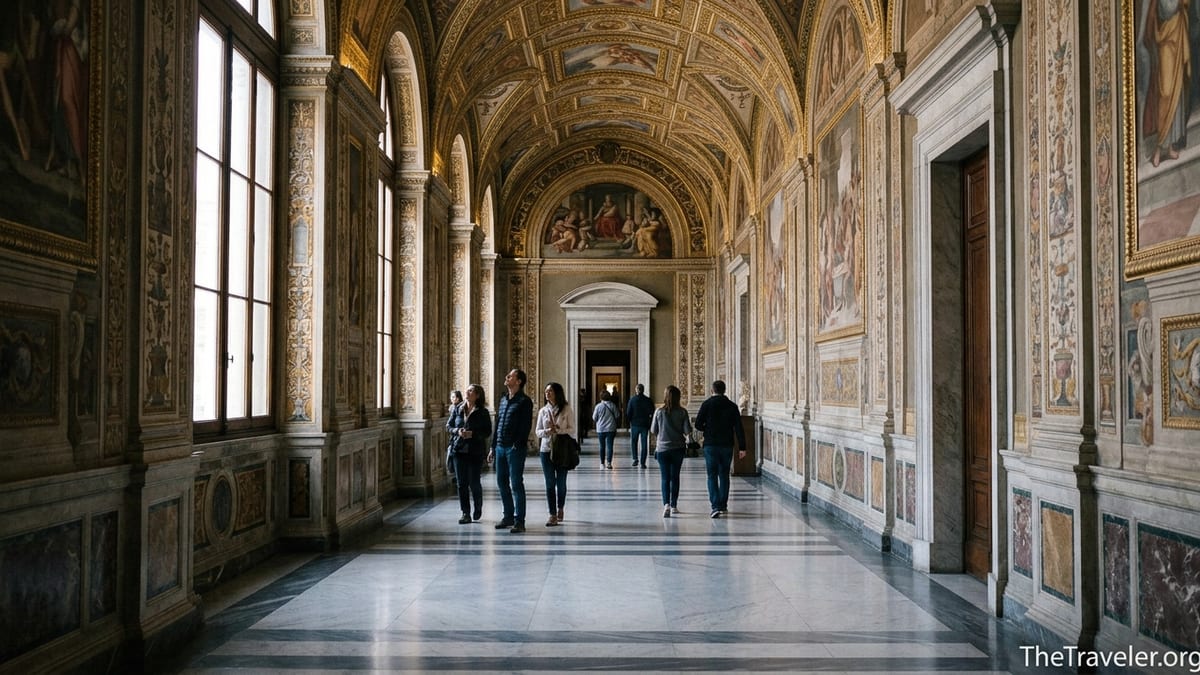
How the Sistine Chapel Works Within the Vatican Museums
The Sistine Chapel is not a separate attraction you can enter from the street. Every visitor reaches it by walking through a long one-way circuit of the Vatican Museums. This means your time inside the chapel is directly affected by when you start your museum visit, how fast you move and how many other people are on the same route.
From the main entrance near Viale Vaticano, even a brisk walker typically needs 20 to 30 minutes to cross the museums and reach the Sistine Chapel, passing through galleries such as the Gallery of Maps and the Raphael Rooms on the way. Many visitors stop for photos, audio-guide commentary or group explanations, so in busy hours you may need closer to 45 minutes before you even step into the chapel itself.
Because the Sistine Chapel comes near the end of the route, most people arrive already tired, and the room can feel even more oppressive when it is crowded. Guards ask visitors to remain mostly silent, photography is banned and you are expected to keep moving. At peak times this can mean being gently but firmly herded through, with little chance to pause and absorb the details of the Creation of Adam or the Last Judgment.
Understanding this basic flow helps you reverse‑engineer your timing. If you want to stand under the ceiling when it is at its quietest, you do not just choose a time to “see the chapel.” You work backward from the chapel to the museum entrance and pick a starting slot that gives you the best odds of smaller crowds when you actually reach the frescoes.
Opening Hours, Seasons and Crowd Patterns in 2026
In 2026, the Vatican Museums and Sistine Chapel are generally open Monday through Saturday, with standard hours that run from mid‑morning to early evening and extended hours on certain evenings. Exact opening and closing times can vary slightly by month and special events, but expect regular daytime entry to begin around 9:00 a.m. and last admission to be late afternoon, with closing time roughly two hours after the last entry. On some Fridays or Saturdays in the busier months, evening openings can stretch to around 10:30 p.m.
The museums close on most Sundays, apart from the last Sunday of each month when entry is free. These free Sundays are usually the most crowded days of the year, with long queues forming outside well before opening and gallery spaces quickly filling to maximum capacity. In practice, this makes the last Sunday of the month one of the worst times to aim for a peaceful Sistine Chapel experience, even though the lack of an admission fee is tempting.
Seasonally, crowd levels follow Rome’s broader tourism patterns. Late March through early November is high season, with peak intensity from about mid‑May to the end of September. During these months, overall visitor numbers are high, and popular mid‑morning slots can feel extremely crowded. By contrast, January and February, plus the second half of November and the first week of December, are typically quieter, with noticeably shorter security lines and thinner flows through the galleries. Many 2026 reports suggest that winter visitor numbers are running noticeably below the already moderate levels of 2025, which is good news for travelers who do not mind cool, occasionally rainy weather.
Specific religious holidays bring closures or heavy demand. Expect the museums to be shut on days such as New Year, Epiphany, Easter Sunday and Monday, May 1, June 29 and around mid‑August. The weeks surrounding Easter and around major Catholic celebrations can still be lively, but compared with the extraordinary crowds of the 2025 Jubilee year, 2026 is shaping up as a more comfortable time to visit overall, especially if you pick your day and time carefully.
Best Months and Days for Smaller Crowds
Month choice is the first big lever you can pull to improve your Sistine Chapel experience. If your dates are flexible, aim for the shoulder or low seasons. Late October and November (excluding the first days of All Saints and some long weekends) often combine bearable weather with noticeably thinner crowds. Visitors in these months frequently report being able to move freely in the galleries and finding space to stop under the Sistine ceiling without feeling jostled.
Winter offers the best odds of breathing room. January and February can bring chilly mornings and the risk of rain, but the trade‑off is real. Independent travelers in recent years have described walking straight through security shortly after opening and reaching the chapel to find it busy but not jammed, with room to look upwards without bumping elbows. If you are willing to wear a warm coat and keep an umbrella handy, this is one of the most rewarding times of year for art lovers.
Within any month, weekday choice is crucial. Tuesdays and Thursdays are often recommended as the sweet spot for the Vatican Museums. Mondays can feel especially busy because the museums are closed on most Sundays, so both weekend short‑break visitors and Monday cruise‑ship groups tend to pile in as soon as the doors reopen. Wednesdays create a different challenge: the weekly papal audience in St. Peter’s Square draws tens of thousands of pilgrims, and once the audience ends late morning, many of them head straight for the museums, swelling the lines and mid‑day time slots.
Friday and Saturday see a growing weekend surge, especially from spring through autumn. While Friday evening openings can offer a more relaxed atmosphere later at night, Friday daytime and most of Saturday remain among the busiest periods. If your schedule allows, prioritize a Tuesday or Thursday visit in the lower‑to‑mid seasons, or a winter Monday outside any major holiday period.
Exactly When to Go: Morning, Afternoon and Evening Compared
Once you have chosen your month and day, the next decision is what time of day to book your ticket. The shape of a typical day in the Vatican Museums is fairly consistent. When the doors first open in the morning, crowd levels start modestly, then build quickly through mid‑morning as tour buses and group visits arrive, often peaking between about 10:30 a.m. and 1:30 p.m. After lunch, numbers remain high through mid‑afternoon, then gradually thin out as closing time approaches.
If you book the earliest regular entry of the day, typically around 9:00 a.m., and walk with purpose, you may be standing under the Sistine Chapel ceiling by roughly 9:30 a.m. or a little later. At this stage, the room is rarely empty, but it is still filling rather than overflowing. Guards can allow a more natural flow, and you may find that you can step back, tilt your head and spend a few minutes tracing individual scenes of the Genesis cycle before the density of people reaches its peak.
Late afternoon is the second promising window. If last admission on your chosen day is around 4:30 or 5:00 p.m., booking that final or near‑final slot can work well, especially outside high summer. Many organized tours have already passed through earlier in the day, and families with young children tend to avoid later visits. Travelers who tried a 5:30 p.m. entry in recent years often describe a noticeably calmer museum by early evening, with the Sistine Chapel still busy but far less claustrophobic than at midday.
On evenings when the museums stay open late, such as summer Fridays, the last couple of hours before closing can feel almost intimate, particularly in shoulder season. The trade‑off is that you will have less natural light filtering into some rooms and may feel rushed if you linger too long before reaching the chapel. For most visitors who want to balance energy, light and crowd levels, the two most reliable strategies in 2026 are an early morning regular entry or a final afternoon entry on a traditionally quieter weekday.
Early Access and Guided Tours: Are They Worth It for the Chapel?
In addition to regular timed tickets, a range of tour companies offer early access packages that promise entry to the Vatican Museums before the general public. Typical early access tours in 2026 advertise starting times around 7:30 a.m., roughly 90 minutes before the standard 9:00 a.m. admission. In practice, this often means you are queuing at a special entrance with your guide a little after 7:00 a.m., moving through security quickly, and then walking a largely empty museum route directly toward the chapel.
For travelers focused primarily on seeing the Sistine Chapel with fewer people, these early access tours can deliver on their promise, although at a cost. Prices commonly start in the region of 110 to 130 euros per adult for small‑group experiences that include the museums and chapel, sometimes along with St. Peter’s Basilica. That is a significant premium over a standard ticket, but participants frequently describe arriving in the chapel around 8:00 a.m. to find only a small number of other early groups, allowing them to sit on the benches along the walls and gaze up in relative quiet before the main doors open.
However, not all products labeled as “early entry” are created equal. Some breakfast‑plus‑museum packages, for example, invite you into a Vatican cafeteria before regular opening, but do not grant actual early access to the galleries themselves. In these cases you may finish your coffee before being funneled back to the general admission line, losing the very advantage you paid for. Always read the fine print and check recent traveler reviews to see whether the tour truly enters the museum complex significantly before regular opening and whether it moves promptly toward the chapel.
Guided tours during regular opening hours can also improve your experience, even without early entry. A well‑run small group or private tour at 9:00 a.m. on a Tuesday in November, for example, might cost around 60 to 90 euros per person including skip‑the‑line tickets, but you gain a dedicated guide who manages timing, keeps you away from bottlenecks where possible and ensures you reach the Sistine Chapel at an optimal moment. For many visitors, the extra context around Michelangelo’s work and the chance to ask questions just before entering the chapel adds as much value as the time savings.
Viewing Tips Inside the Sistine Chapel
Regardless of when you arrive, a few practical habits can significantly improve your time inside the Sistine Chapel. The room is large but not enormous, and people naturally cluster in the center, craning their necks straight up. If you enter during a busy time, resist the urge to stop immediately. Instead, move slowly along one wall toward a corner, where you will often find a pocket of space with a clearer vertical view and a better angle on both the ceiling and the Last Judgment above the altar.
Guards will remind visitors frequently that photography and video are forbidden. This rule is enforced more strictly here than in many other parts of the museums. Trying to sneak a picture not only risks a public reprimand, it also distracts from the experience you came for. Accept that you will have no photos of the ceiling itself and focus on mental images instead. If you want to study details later, high‑quality reproductions can be found in art books back in central Rome or at home.
Because talking is kept to a minimum, preparation outside the chapel pays dividends. Before you enter, take ten minutes with a guidebook, audio guide or a short briefing from your tour leader to identify key scenes. Knowing roughly where to look for the Creation of Adam, the Separation of Light from Darkness, or the ancestral figures of Christ helps you organize what you see once inside. You will have more meaningful minutes of silence if you are not trying to decode the entire ceiling on the fly.
Finally, dress and comfort matter more than many visitors expect. The Vatican maintains a modest dress code: shoulders and knees should be covered, and hats removed. Security staff at the museum entrance enforce this more actively in warm weather. Inside the chapel itself, air conditioning helps, but the press of bodies still raises the temperature at busy times. Light layers, comfortable shoes and a bottle of water for the galleries (sipped outside the holiest spaces) will keep you more focused on art than on discomfort.
Sample Itineraries for a Better View
To see how all these pieces fit together, consider a first‑time visitor arriving in Rome in mid‑November. They book a skip‑the‑line Vatican Museums ticket for 9:00 a.m. on a Tuesday. By 8:45 a.m. they are in the security line, which moves quickly. Once inside at 9:05 a.m., they follow signs toward the Sistine Chapel, pausing only briefly in the Gallery of Maps. Around 9:35 a.m. they step into the chapel, where perhaps a few hundred people are spread out under the ceiling but there is still room to move. They spend 20 minutes circling the space, then exit back into the museum circuit to revisit earlier rooms now that the pressure to “see the chapel” has eased.
A couple visiting in early June with fewer scheduling options might choose a different tactic. Knowing that midday will be extremely busy, they book the last regular entry of the day, around 4:30 p.m., again on a Tuesday or Thursday. They arrive at the entrance half an hour ahead of time, move steadily through the galleries without lingering too long, and reach the chapel close to 5:15 p.m. While still far from empty, the room holds fewer large tour groups by this stage, and they find space near a side wall, standing back against the benches for a calmer upward view.
For a traveler with a higher budget and a deep interest in Renaissance art, an early access small‑group tour in February offers a premium option. They pay around 120 euros per adult for a 7:30 a.m. meeting time, and by 7:45 a.m. are already moving through almost empty corridors, listening as the guide points out major works but always keeping an eye on the clock. Just after 8:00 a.m., they enter the Sistine Chapel with only a handful of other groups present. Many visitors in this scenario describe being able to sit quietly for ten or fifteen minutes, an experience that feels dramatically different from a rushed mid‑day visit in July.
These itineraries illustrate the same principle: you do not need a perfect moment or a private viewing to enjoy a better look at the Sistine Chapel. You need an awareness of how crowds ebb and flow, a realistic sense of your own pace, and the discipline to book and stick to a time that aligns those factors in your favor.
The Takeaway
No visit to the Sistine Chapel will ever be completely empty. The Vatican Museums are among the most visited cultural sites in the world, and Michelangelo’s frescoes draw steady crowds in every season. Yet by choosing the right month, the right weekday and the right entry time, you can shift your experience from hurried and cramped to remarkably contemplative.
For most travelers in 2026, the sweet spots are clear: plan for winter or late autumn if you can, favor Tuesdays or Thursdays, avoid free Sundays, and target either the first regular entry of the morning or the final slot of the afternoon. Decide in advance whether early access tours feel worth the extra cost for you, and scrutinize the details to make sure they deliver true early entry if that is what you are paying for.
Above all, remember that the Sistine Chapel is more than an item to tick off a list. It is a work of faith and imagination that rewards every extra minute you can give it. Arriving at a calmer time is not a luxury; it is a way of honoring the art you have traveled so far to see.
FAQ
Q1. What is the single best time of day to visit the Sistine Chapel for fewer crowds?
The most reliable option is the first regular entry of the day, usually around 9:00 a.m., on a quieter weekday like Tuesday or Thursday, walking directly toward the chapel so you arrive before mid‑morning tour groups fill the space.
Q2. Which months are generally the least crowded at the Vatican Museums?
January and February are typically the quietest, followed by much of November and the first week of December, when overall visitor numbers drop and lines are shorter than in spring and summer.
Q3. Are early access Vatican tours really worth the higher price?
They can be, especially if your main goal is to see the Sistine Chapel with significantly fewer people. True early access tours that enter around 7:30 a.m. often reach the chapel before general opening, but they cost noticeably more than standard tickets.
Q4. Is it a good idea to visit on the last Sunday of the month when entry is free?
For crowd avoidance, no. The last Sunday free entry day is usually one of the busiest times, with long lines, packed galleries and a very full Sistine Chapel, even though you save on the ticket price.
Q5. How much time should I allow to reach the Sistine Chapel from the museum entrance?
At a steady pace with minimal stops, expect 20 to 30 minutes. During busy periods, stopping for explanations or getting stuck behind large groups can stretch this closer to 45 minutes.
Q6. Are evening visits less crowded than daytime visits?
Often they are, especially the last couple of hours on late‑opening evenings in shoulder season. However, evening availability can be limited to certain days, and you will have less time if you linger before reaching the chapel.
Q7. Does the papal audience on Wednesdays affect Sistine Chapel crowds?
Yes. After the Wednesday morning audience in St. Peter’s Square, many participants head straight to the museums, causing a mid‑day surge. If you want a quieter visit, avoid late Wednesday morning and early afternoon.
Q8. Can I stay inside the Sistine Chapel as long as I want?
There is no strict time limit announced, but guards manage the flow and may encourage people to move along when it is busy. In quieter periods you can usually remain for 15 to 20 minutes without feeling rushed.
Q9. Do I need a guide to enjoy the Sistine Chapel properly?
You do not need a guide, but having context helps. A guided tour, an audio guide or reading a short briefing beforehand can make your limited time inside much more meaningful, especially when talking is restricted.
Q10. What should I wear to avoid problems at the Vatican entrance?
Follow the modest dress code: cover shoulders and knees, avoid very short shorts or skirts, and remove hats indoors. Light layers and comfortable shoes will keep you relaxed as you move through the long museum route.