


Ala Archa National Park is the easiest taste of the Kyrgyz Tian Shan mountains from Bishkek, yet the practicalities have changed fast in the last two years. New bus routes, a ban on petrol cars driving into the gorge and rising entry fees mean that many older online instructions will now leave you stranded far from the main trailheads. This guide uses information verified in 2025 and 2026 to explain, in concrete detail, how to visit Ala Archa on your own without an organized tour, from central Bishkek all the way to the start of the hikes.
Get the latest updates straight to your inbox!
From Bishkek to the Park: Your Transport Options in 2026
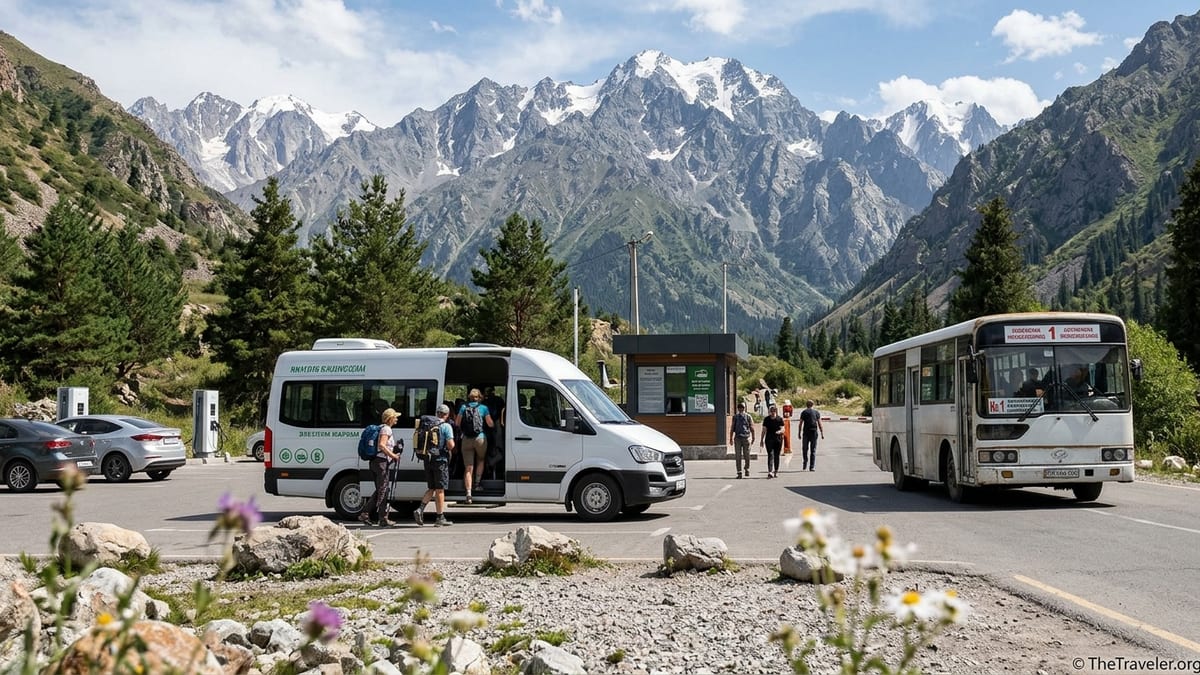
The simplest way to reach Ala Archa independently in 2026 is public Bus No. 1, which runs from central Bishkek directly to the national park entrance. According to Bishkek city transport information and recent local guides, the route starts near Old Square, close to Ala‑Too Square and the Supreme Court, and heads south along Baitik Baatyr Street all the way to the park checkpoint. Reports from late 2025 and 2026 describe departures roughly every 20 to 30 minutes from about 08:00 until early evening, with a journey time of 40 to 60 minutes depending on traffic.
Several Kyrgyz transport and hiking resources agree that by mid‑2026 city buses in Bishkek, including Bus No. 1, moved to cashless payment. Travelers in summer 2026 reported paying 40 to 50 som for a single ride, using a contactless bank card, QR payment through local apps, or a Tulpar transport card bought on board from the driver. In practice, foreigners without a local app have paid with an international Visa or Mastercard by tapping at the validator. You should still carry small cash notes in case procedures change, but be prepared that some drivers may refuse cash and insist on card or QR only.
Bus No. 1 drops you at the main gate of Ala Archa National Park, where you pass the checkpoint, pay your entry fee on foot and walk or ride onward into the gorge. This is a major shift from older advice that suggested minibuses toward Kashka‑Suu village and then hitchhiking: those marshrutkas still serve the valley road but do not bring you to the controlled entrance of the national park, and even less to the main trailheads higher up.
If you prefer more flexibility, Yandex Go and other app taxis remain widely used in Bishkek. Recent traveler reports in 2026 describe one‑way fares of roughly 800 to 1,200 som from central Bishkek to the Ala Archa checkpoint, depending on demand and exact pickup point. A private driver arranged through a guesthouse or agency will cost more but can be booked for a fixed round trip and waiting time, which matters if you intend to start or finish your hike outside the hours of the public bus and internal shuttle.
Park Entrance vs Trailheads: Shuttles and the End of Petrol Cars
Since 2025 Ala Archa has tightened vehicle rules. Kyrgyz media and the park’s own information confirm that private petrol and diesel cars are no longer allowed beyond the main checkpoint. Drivers must leave their vehicles in a large parking area near the gate. Only electric vehicles can proceed up the main gorge road toward the former “Alplager” area, where most classic hikes begin. This means that even if you come by taxi or with a local friend’s car, you will be dropped at the same entrance plaza as Bus No. 1 passengers.
To compensate, the park administration has introduced a fleet of internal electric shuttles that run from the checkpoint area up the tarmac road to key points in the valley, including the trailheads near the Alplager complex. Recent park briefings and guide articles in 2026 mention around 80 small electric vehicles operating inside the park, described as free for visitors who have already paid the entrance fee. The shuttles are used both as point‑to‑point taxis and as a loop service up the valley, though exact intervals are not always publicly posted and can vary with season and demand.
This distinction between reaching the gate and reaching the trailheads is critical for planning. The walking distance from the entrance checkpoint to the main Alplager area is roughly 11 to 12 kilometers on a steadily rising asphalt road. Without the internal shuttle, this adds at least 2.5 to 3 hours of uphill walking before you even start the waterfall or glacier trails. That is why older instructions that say “take a marshrutka toward Kashka‑Suu, then hitch a lift up the valley” are now unreliable; most private cars can no longer proceed, so you may find yourself on a road where few vehicles are allowed and those that are are working on a controlled schedule for registered visitors.
If you arrive early in the morning, before the first shuttle, or wish to descend late after the last run, you must be prepared either to walk this road in the dark or to adjust your hiking plan. Local hiking clubs in autumn 2026 recommend that day visitors plan their trailhead departure so that they can return to Alplager with at least one or two internal shuttle runs still operating, then catch the public Bus No. 1 or prearranged taxi back to Bishkek.
Entry Fees, Opening Arrangements and Park Regulations
In June 2026 Kyrgyz news outlets reported an updated price list for Ala Archa National Park. The adult pedestrian entry fee was set at approximately 250 som per person, with a reduced rate for children aged 7 to 14 and free admission for younger children. Fees for bringing a private electric car into the gorge increased to around 880 som per vehicle, separate from the per‑person entrance charges. These figures are subject to occasional revision, but multiple sources quoting the park administration in summer 2026 confirm them as the current baseline.
Payment at the checkpoint is now strongly oriented toward cashless methods. At the gate you will see payment terminals where visitors scan a QR code, tap a bank card or use local mobile‑banking apps. Reports from travelers in 2025 and 2026 indicate that it is still usually possible to pay in cash at a separate cashier window if the terminals fail or for visitors without cards, but this option is not always emphasized. To avoid delays, bring at least one working payment card plus some cash in Kyrgyz som as a backup.
The gorge road and main hiking area of Ala Archa are generally open year‑round, but facilities and transport can change with the season. In winter, snowfall occasionally closes the upper road temporarily, and the internal shuttle fleet may operate on a reduced schedule. During shoulder seasons in April and November, footpaths at higher altitude can be icy or under patchy snow even when Bishkek feels mild. Because official online updates are irregular, independent hikers in 2026 have been advised by both guide services and local bloggers to call the park office or message its social media account a day or two before visiting to confirm opening hours, shuttle times and road conditions for their specific dates.
Standard national park regulations apply throughout the gorge: open fires are restricted to designated picnic and barbecue areas, camping is allowed only in specific zones or with permission, and visitors are expected to carry out their rubbish. Rangers and park staff patrol the main road and popular trails, particularly around weekends when Bishkek families come for picnics. Fines for littering or wild camping near the river are real, so it is worth observing where locals set up their grills and where they do not before choosing your spot.
Understanding the Main Trails: Distances, Difficulty and Time
Most independent visitors focus on three categories of walks from the Alplager area: short riverside strolls, the Ak‑Sai Waterfall hike and longer alpine routes toward the Ak‑Sai Glacier and Ratsek Hut. Recent hiking descriptions from 2025 and 2026 broadly agree on the figures, although exact distances and ascent can vary a little between GPS tracks. All assume that you have already reached the Alplager trailhead, either by internal shuttle or by walking up from the gate.
The easiest option is a riverside walk along the Ala Archa River from the Alplager car park and picnic area. Paths on both banks allow you to wander for 1 to 3 kilometers with less than 100 meters of elevation gain, passing picnic tables, boulders and open meadows. Families from Bishkek often bring small children here on weekends, grilling shashlik and playing by the water. Allow 1.5 to 2 hours for a very relaxed out‑and‑back riverside walk plus photo and picnic stops.
The Ak‑Sai Waterfall trail is the classic intermediate day hike. Most recent GPS tracks describe it as roughly 7 to 9 kilometers return from the Alplager, with 600 to 800 meters of elevation gain. The path first climbs through light forest and scrub, then crosses rocky slopes and a small river by a footbridge or stepping stones, before reaching the base of the waterfall at around 2,700 meters altitude. A fit hiker with limited stops might complete the round trip in 4 to 5 hours, but a more realistic estimate for most visitors, including breaks and photo time, is 5 to 6 hours.
Beyond the waterfall, the Ak‑Sai Glacier and Ratsek Hut route becomes a strenuous alpine hike. From Alplager to Ratsek Hut, recent mountaineering club notes describe a total distance of about 10 to 12 kilometers return, with 1,000 to 1,200 meters of elevation gain, much of it on broken rock and sometimes lingering snow. Continuing to the glacier itself or to surrounding summits adds more ascent and exposure, and often involves early season snowfields, loose scree and indistinct paths. Local alpinists warn that although strong hikers can cover Ratsek as a very long day from Bishkek, treating it as a casual walk is unsafe; fatigue, afternoon weather and the need to descend before dark make an overnight stay in or near the hut a more prudent choice for most.
Seasonal Conditions, Safety and What to Carry
Ala Archa’s main hiking area lies between roughly 2,100 meters at Alplager and over 3,000 meters on the higher trails. This altitude difference matters. In March or April you can leave central Bishkek in light clothing and arrive at the trailhead to find snow patches on the ground and ice on wooden bridges. Even in June and early July, snowfields can linger above the waterfall and on the slope toward Ratsek Hut, especially in shaded gullies. In contrast, July and August bring warm alpine days but also frequent afternoon thunderstorms, with sudden temperature drops and hail at higher elevations.
Because of this, local hiking groups in 2026 consistently recommend carrying at least one extra warm layer, a windproof or waterproof shell, gloves and a hat, even for the waterfall hike in summer. Footwear should be sturdy with good grip; sneakers may suffice on a dry day to the waterfall, but they are inadequate once you encounter wet rock, mud or early snow. Trekking poles can significantly ease both the long ascent and the steep descent on loose gravel.
Trail marking in Ala Archa is mixed. The first segment of the Ak‑Sai Waterfall path is generally obvious, with some painted waymarks on rocks and well‑trodden soil. As you approach the waterfall and especially beyond it, paths braid and fade among boulders, particularly early in the season when snow covers the main line. Experienced hikers therefore rely on offline maps on their phones, using apps such as Maps.me or Organic Maps, with the relevant tiles downloaded in Bishkek beforehand. Mobile reception drops quickly once you leave the main road, and you cannot depend on a data connection for navigation.
Water comes from streams and the main river, but flow varies and there are no treated taps on the upper trails. Hikers commonly fill bottles at the Alplager area and again from side streams higher up, using filters or purification tablets. A reasonable baseline is to carry at least 1.5 to 2 liters per person for the waterfall hike in warm weather and more for the Ratsek route. Wildlife encounters are usually limited to marmots, birds and occasional livestock, but this is still a mountain environment; give any larger animals space and do not leave food scraps that can attract them to popular resting spots.
Getting Around Without Tours: Public Transport, Taxis and Drivers Compared
For many independent travelers, the most practical combination is Bus No. 1 for the city‑to‑park segment plus the free internal electric shuttle from the gate to the Alplager trailheads. On a typical Saturday in 2026, a solo hiker staying near Ala‑Too Square might tap into Bus No. 1 at around 08:00, arrive at the gate before 09:00, pay the 250 som entry fee, and then board an internal shuttle within 15 to 30 minutes for the 15 to 20 minute ride up the valley. This keeps direct transport costs extremely low and avoids negotiating with drivers.
Yandex Go taxis are most useful when your schedule does not match the bus. For example, a couple wanting to watch sunrise from the gorge in May could order a taxi at 05:00, pay perhaps 1,000 som for the car, and reach the gate well before the buses and shuttles begin operating. They would still rely on walking or hitching an early‑morning lift inside the park, but their city transfer would be secure. On the return, they might ride the internal shuttle down in late afternoon, then share another Yandex with other hikers waiting at the gate if the last bus feels crowded.
Private drivers arranged through Bishkek guesthouses or travel agencies are the most expensive option but offer the most control. Typical daily quotes in 2026 for a return trip with waiting time at the park range from about 3,000 to 4,500 som per vehicle, depending on vehicle size and season. For a group of four hikers wanting two different pick‑up times at the gate, or a family with small children and lots of gear, this can be worthwhile. The driver usually drops everyone at the checkpoint, waits in the car park, and is reachable via phone or by preagreed meeting time, bypassing the need to worry about the last bus back to Bishkek.
Whichever option you choose, think ahead about the lack of reliable mobile reception in the gorge. Experienced hikers in 2026 advise agreeing your exact return time, price and meeting point with any taxi or private driver while you are still in Bishkek or at least before leaving the main road area near the park entrance. In concrete terms, that can mean showing the driver the time on your phone and making them repeat “six o’clock, main gate” in Russian, Kyrgyz or English before you start walking.
Sample One‑, Two‑ and Three‑Day Itineraries
A realistic one‑day independent excursion for a fit but casual hiker might look like this: catch Bus No. 1 from central Bishkek around 08:00, arrive at the gate by 09:00, and ride the internal shuttle to Alplager. Begin the Ak‑Sai Waterfall hike by 10:00, aiming to reach the falls around 13:00 for a long lunch break with views of the glacier cirque. Start descending no later than 14:30, back at Alplager by 17:00 to catch a shuttle down and a bus back to Bishkek, arriving in the city between 18:30 and 19:30. This leaves a margin for slower walking, photo stops and minor delays, without pushing into dusk.
For a two‑day itinerary, you could devote the first day to a more relaxed combination of riverside walking, photography and short exploratory paths above the valley floor, then stay overnight in one of the lodges or guesthouses close to the Alplager area or back in Bishkek. On the second day, return to the gorge and tackle the Ak‑Sai Waterfall with plenty of time, perhaps starting earlier in the morning to avoid crowds and afternoon storms. This rhythm suits many families and less acclimatized travelers who prefer not to combine long walks with long transport days.
An optional third day is best reserved for experienced hikers who want to approach Ratsek Hut or the lower Ak‑Sai Glacier. A serious yet still nontechnical plan would be to stay overnight in Ala Archa accommodations near Alplager, then leave at first light around 05:00 or 06:00 with headlamps, aiming to reach Ratsek by late morning and descend well before afternoon weather builds. Given the 1,000 meters of ascent and the potential for snow or rockfall, you should not attempt this as your first hike in Kyrgyzstan or as a spontaneous extension of a waterfall trip; come prepared with good boots, layers, a helmet if you venture onto steeper ground, and knowledge of your own limits.
In all cases, a safe return time matters. Independent hikers in 2026 commonly treat 17:00 at Alplager and 18:00 at the park gate as soft cut‑offs for summer, giving enough buffer to use the last shuttles and buses. In October or March, when daylight is shorter and temperatures drop rapidly, moving those target times 1 to 2 hours earlier is sensible.
Where to Stay: Bishkek, Kashka‑Suu and Near the Park
Most independent visitors base themselves in central Bishkek and visit Ala Archa as a day trip. This has clear advantages. Guesthouses and hostels in the city center near Ala‑Too Square, such as small family‑run inns and mid‑range hotels, typically offer 24‑hour reception, heating, reliable hot water and easy access to cafes, supermarkets and bus stops. From such locations you can walk to the Bus No. 1 stop at Old Square in under 10 to 15 minutes, ride to the park, and return in the evening for dinner at one of Bishkek’s many restaurants.
There are also small hotels and guesthouses in the villages along the Ala Archa road, including around Kashka‑Suu. These can provide a quieter base closer to the mountains, sometimes with views up the valley. However, relying on them makes transport trickier. The older marshrutka routes to Kashka‑Suu and neighboring villages no longer continue into the park itself, and they use different numbers and boarding points than Bus No. 1. If you step out of your guesthouse expecting to flag a direct minibus to the trailhead, you may instead end up at the highway, still several kilometers from the checkpoint and a long way from Alplager.
Inside or immediately adjacent to the park, a small number of accommodations near the Alplager area and the park base offer rooms and sometimes simple meals. Recent price lists on Kyrgyz‑language booking pages show double rooms with breakfast in this zone starting from several thousand som per night, rising with comfort level. These places often rely on their own vehicle access arrangements and can assist with park logistics, but they may have more limited heating outside the main season and fewer food options than the city. You should not expect a supermarket next door; instead, bring snacks and, if staying overnight, confirm in advance whether dinner and breakfast are provided on site.
Budgets, Accessibility and Common Mistakes to Avoid
For a solo budget traveler in 2026, a straightforward day trip from Bishkek using public transport might cost roughly as follows: 80 to 100 som for two Bus No. 1 rides, 250 som for park entry, and 300 to 600 som for simple food bought in Bishkek and carried along, such as pastries, fruit and bottled water. That puts the direct out‑of‑pocket cost for the day in the region of 630 to 950 som, not counting gear rental or accommodation in Bishkek. A mid‑range dinner back in the city might add another 500 to 800 som.
For a couple sharing a Yandex Go or private taxi, the picture changes. If a round‑trip Yandex Go ride to the gate and back costs around 2,000 som total, that is 1,000 som per person. Adding two adult entry fees of 250 som each plus snacks and water might bring the essential costs for the day to around 1,700 to 2,200 som per person. An overnight stay in a mid‑range Bishkek hotel could add 3,000 to 5,000 som for a double room, while a room near Alplager is likely to be at least 5,000 to 6,000 som including breakfast, based on 2026 price sheets.
Ala Archa’s trails are not universally accessible. The path surfaces beyond the picnic areas are steep, rocky and often uneven, which makes them unsuitable for standard wheelchairs and difficult for travelers with limited mobility. The internal electric shuttles improve access along the main road, but disembarking points are still on rough ground. People with knee problems or poor balance sometimes choose to enjoy the scenery from the road and picnic sites rather than attempting the waterfall route. Families with small children often bring robust strollers only for the flatter riverside sections, then carry infants in baby carriers on the steeper paths.
Common mistakes independent visitors make include trusting outdated transport advice, underestimating how long it takes to move from the gate to the trailhead, and assuming that mobile data will work everywhere. For example, arriving by marshrutka at a village short of the park gate because an old blog suggested it, then discovering that private petrol cars are banned from the gorge, can leave you several hours’ walk from the hikes you intended. Likewise, starting the waterfall hike at 14:00 in September might mean descending in the dark if you move slowly or if the weather turns. Carrying a headlamp, warm layer, rain protection, offline maps and extra snacks greatly reduces the risks of these scenarios.
Who Should Consider a Driver or Guide, and Final Recommendations
Independent access to Ala Archa has never been easier for confident travelers, but a hired driver or local guide can still offer real value in specific situations. Budget backpackers who are comfortable with city buses and basic Russian or Kyrgyz phrases will typically do best on Bus No. 1 plus the internal shuttle, keeping costs to a minimum and enjoying the flexibility to turn back whenever they choose. For them, spending several thousand som on a private driver offers little extra benefit.
Families and casual hikers, on the other hand, may find that a prebooked driver or small tour adds enough convenience to be worth the price. Being picked up at the hotel, dropped at the gate, helped through the payment process and met again at a prearranged time can significantly lower stress, especially when traveling with children, grandparents or people unused to navigating foreign public transport systems. A local guide walking with you to the waterfall can also set a sane pace, manage timing for the return, and quietly ensure that everyone has packed sufficient layers, water and snacks.
Experienced trekkers with ambitions toward Ratsek Hut or more technical climbs in the Ak‑Sai valley should seriously consider at least local guiding or joining a small group, particularly if they are unfamiliar with Central Asian mountain conditions. Guides bring current knowledge of snow conditions, rockfall zones, river levels and recent weather patterns, and they can coordinate early transport so that you reach high ground in the morning and descend safely. Compared with the total cost of flights, gear and time invested in a Kyrgyzstan trip, the incremental price of a guide for one demanding day is modest insurance against getting caught out in a storm or losing the path on a snow‑covered moraine.
For all visitor types, the foundation of a safe and rewarding independent visit to Ala Archa is the same: verify your transport options and park entry conditions close to your travel date, distinguish clearly between reaching the gate and reaching the main trailheads, pick hikes that genuinely match your fitness and experience, and carry the simple essentials of mountain travel. With those pieces in place, a day or two in Ala Archa’s granite gorge becomes one of the most accessible high‑mountain experiences anywhere so close to a national capital.