


Pompeii is one of Europe’s most powerful travel experiences: 170 acres of streets, villas, frescoes, and plaster casts of victims frozen in time. It is also hot, crowded, and physically demanding. With a bit of smart planning, you can keep the magic and lose most of the stress. This guide focuses on practical, real-world strategies to experience Pompeii deeply without feeling overwhelmed.
Get the latest updates straight to your inbox!
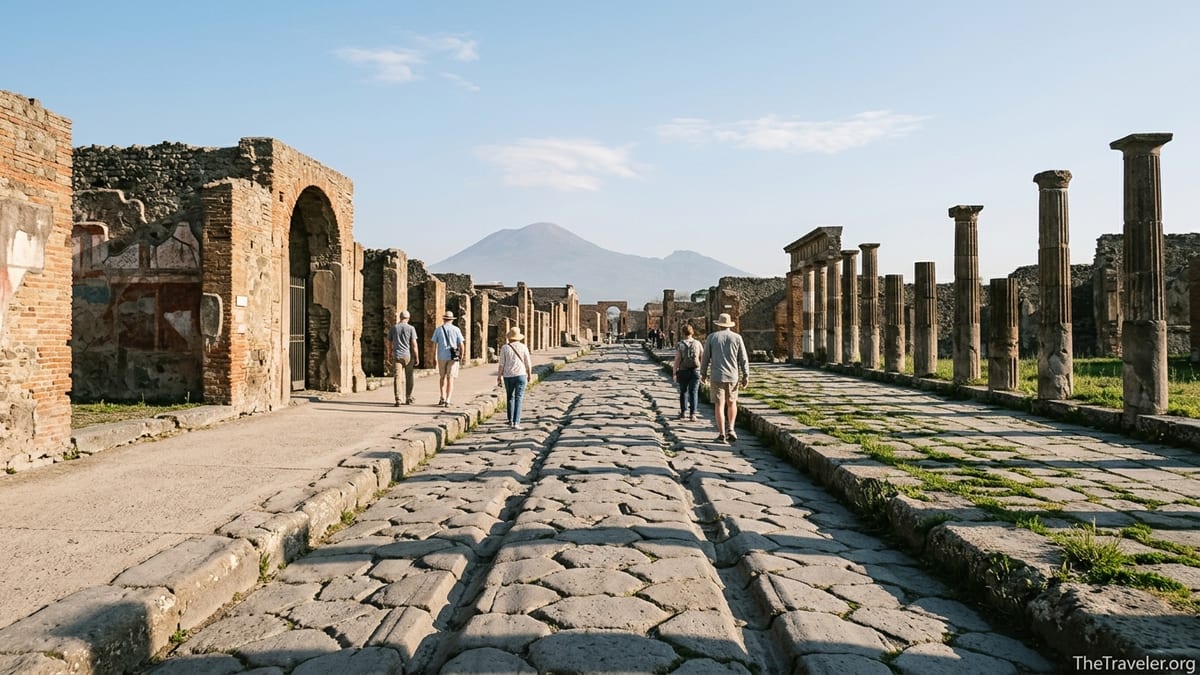
Choose the Right Day and Time So Pompeii Feels Human-Sized
The single biggest factor in how overwhelming Pompeii feels is when you go. The archaeological park now works with a daily visitor cap and timed entry, which means late arrivals in peak season often face heavier crowds and fewer open houses. In July and August, midday temperatures on site can reach the high 30s Celsius, while visitor numbers push toward the 20,000 daily ceiling. By contrast, arriving right at opening in April, May, September, or October can feel almost calm, with cool air and empty side streets.
As of 2026, official opening hours are generally 9:00 to 19:00 in the longer days from roughly April to October, and 9:00 to 17:00 from November through March, with last entry about 90 minutes before closing. That gives you a realistic visiting window of four to six hours, which is plenty if you are strategic. Early entry at 9:00 lets you see headline sights like the Forum and the House of the Vettii before the big bus tours arrive around 10:30. Late afternoon from about 16:00 can also be much quieter than late morning, especially once day-trippers peel off back to Naples and the Amalfi Coast.
Try to avoid weekends if you can, especially the first Sunday of the month when entry to many Italian state sites, including Pompeii, is free. On those days, long lines form outside Porta Marina before opening, and some travelers report waiting over an hour just to enter. If your trip is locked to that Sunday, plan for a shorter, more selective visit and consider booking an official guided tour through the park so at least the logistics are handled for you, even if the site is crowded.
Finally, keep an eye on Italian public holidays such as April 25 and June 2. A Tuesday in mid-May will feel vastly different from a Saturday over a long holiday weekend. When you build your itinerary for the Bay of Naples, slot Pompeii on a midweek day and keep the most flexible plans for the busier dates.
Buy the Right Ticket and Skip Unnecessary Queues
Ticket confusion is one of the main stress points for visitors. As of spring 2026, official tickets are sold through the Pompeii Archaeological Park and its authorized partner platform, typically Vivaticket. Standard adult prices sit around 18 euros for the basic “Pompeii Express” ticket and about 25 euros for “Pompeii Plus,” which adds access to certain suburban villas and nearby sites. There is also a combined Pompeii and Herculaneum ticket for a small premium, useful if you will visit both within 48 hours.
You will also see dozens of unofficial-looking sites selling “skip-the-line” access for 34 euros and up. These are legal resellers, but you are paying for service fees and sometimes bundled extras like a digital audio guide. If your priority is avoiding overwhelm rather than saving every euro, it can still be worth it: a timed-entry voucher and clear meeting point instructions remove the anxiety of working out Italian booking systems or discovering that your chosen slot has sold out. Just remember that the cheapest, most flexible option remains the official ticket, especially if you are comfortable buying online a few weeks in advance.
If you plan to explore several Campania highlights such as the Naples Archaeological Museum, Herculaneum, and Paestum, look into the Campania Artecard. The 3-day regional version typically includes free entry to your first couple of sites and discounts afterward, and Pompeii is often one of the included options. A traveler staying four nights in Naples might, for example, use the card for Pompeii on day one, the museum in Naples on day two, and Herculaneum and a Vesuvian villa on day three, saving money and time at ticket windows.
Whatever ticket you choose, book an early-morning or mid-afternoon slot in high season rather than late morning. Imagine a July day: you arrive at Porta Marina at 8:45 with a 9:00 timed entry already on your phone, walk straight past a growing line for on-the-day tickets, and by 9:20 you are standing in the almost-empty Forum. The same day, someone showing up at 11:30 without a reservation may find the next available entry is 13:00, by which time the site is at its hottest and most crowded.
Plan a Realistic Route Instead of Trying to “Do It All”
Pompeii covers such a large area that trying to see everything is the fastest route to burnout. Most guides suggest you need four to six hours for a satisfying visit, but even in six hours you will only scratch the surface. Treat Pompeii like a city neighborhood rather than a single “attraction,” and decide in advance what kind of stories you most want to follow: political power, domestic life, entertainment, religion, or the disaster itself.
A balanced half-day route for first-timers focuses on one main entrance, a core loop, and a handful of side forays. Enter at Porta Marina and start on the Forum, where you get your first full view of Vesuvius and the key civic buildings: the Capitolium, the Basilica, and the markets. From there you might head along Via dell’Abbondanza to peek into the Stabian Baths, then up toward the House of the Faun and the House of the Vettii, two of the most impressive residences open in recent years after long restorations. Finally, drift toward the theater district and the Lupanar before looping back via quieter backstreets and fountains.
Build in decision points to keep your day flexible. For example, tell yourself: if by the time you reach the House of the Vettii it is already too crowded inside, skip the next popular house on your list and detour to a less-known insula instead. Some travelers find that the most memorable moments are not the big-ticket rooms but a half-collapsed bakery, a small bar counter with dolia (storage jars), or a simple garden with a shrine. Allow your route to breathe; that is how you keep the experience human rather than a checklist.
Consider breaking your time into two focused halves if you have a full day. Spend 9:00 to 12:00 exploring the western half around the Forum and theater district, then leave the site entirely for lunch and a rest in modern Pompei. Return after 15:30 for a second, shorter session toward the amphitheater and Villa of the Mysteries, when the afternoon light is soft and temperatures have dropped. You will end up walking just as much, but the psychological fresh start after lunch makes the ruins feel less exhausting.
Use Guides, Maps, and Audio Intentionally
Pompeii is dense with detail. Without some kind of narrative help, many visitors report that after an hour everything starts to blur into “more ruins.” The key to avoiding mental overload is to choose one type of interpretive help and stick with it, rather than juggling a printed guidebook, a phone app, and random plaque reading all at once.
Hiring a licensed guide at the gate or booking a small-group tour in advance works well if you like stories and conversation. Expect to pay somewhere in the 15 to 25 euro range per person for a two-hour small-group tour, or more for a private guide. In practice that means a guide might take you through the Forum, a bath complex, a snack bar, and one or two elite houses, weaving these into a coherent picture of daily life. Afterward, you are free to wander on your own, but crucially you are no longer staring at every stone trying to decode it.
If you prefer independence, the official audio guide rented on-site is usually cheaper than most third-party phone apps and comes with simple, numbered stops that match the site map. Downloading a reputable offline audio tour to your smartphone before you travel can also work well, as long as you remember to pack headphones and a battery pack. Some travelers successfully combine a basic printed plan (often handed out at the entrance) with just a few preselected audio stops like the amphitheater, the House of the Faun, and the bakery; they ignore all other prompts, which keeps information volume manageable.
Whatever you choose, avoid “information FOMO.” You do not need to read every plaque or listen to every audio track. Consciously skip some stops. For example, if your audio tour includes 40 points and you have four hours, decide in advance to do 15 of them at most. This self-imposed limit prevents you from sprinting from number to number and lets you slow down where a place genuinely moves you.
Manage Heat, Terrain, and Sensory Overload
What physically overwhelms most people at Pompeii is not just distance, but the combination of sun, uneven stone streets, and very limited shade. In summer, temperatures on the exposed streets can be several degrees hotter than in shaded Naples. There are a few modern shade structures and trees in garden areas, but you should plan as if you will spend most of your time in direct sun.
Wear closed walking shoes with good grip rather than sandals or flimsy trainers. The basalt paving stones are polished smooth in places and can be slippery, especially if you step on the raised stepping stones that allowed ancient pedestrians to cross when the streets were full of water and waste. Many visitors underestimate how tiring these surfaces can be; four hours on Pompeii’s streets feels more like six hours on flat city pavement. If you have any knee or ankle issues, bring a lightweight walking pole and be careful on steep curb drops.
Water is easy to find, but only if you carry a refillable bottle. Numerous ancient fountains around the site still run with potable water, and filling up at them saves money and keeps your bag lighter. In July, it is normal for a couple to get through three to four liters of water between them over a four-hour visit. Sun protection is essential: a brimmed hat, sunglasses, and high-SPF sunscreen will make the difference between a pleasant afternoon and heat exhaustion later. Consider a light scarf or UV shirt to cover your shoulders during the worst of the midday sun.
Finally, be proactive about sensory breaks. The combination of crowds, heat, and dense historical content can feel claustrophobic even in the open air. Mark a few “quiet zones” on your map in advance, such as the area behind the Large Theatre, some of the outlying residential insulae, or the garden at the House of the Cryptoporticus when open. When you feel yourself glazing over, detour there for five or ten minutes of calm. Many travelers find that just sitting in a doorway and looking at the ruts carved by ancient cart wheels can reset their focus and energy.
Balance Pompeii With the Rest of Your Bay of Naples Itinerary
One subtle way to avoid being overwhelmed by Pompeii is to avoid stacking it next to other intense experiences on the same day. A common itinerary mistake is to book a half-day tour of Vesuvius in the morning and a self-guided Pompeii visit in the afternoon, or vice versa. On paper it fits; in reality, the combination of crater hiking, bus transfers, and then several hours in the ruins leaves most people wiped out. If you want to do both on the same day, consider a door-to-door group tour that includes transport, so at least you are not stressing about the Circumvesuviana train and local buses on top of everything else.
From Naples, the train ride to Pompeii Scavi station on the Circumvesuviana line takes around 35 minutes, and from Sorrento about 30 minutes. Trains can be crowded and standing-room-only at peak times. To make the commute calmer, avoid the 9:00-to-10:00 outbound crush when possible, and aim for an earlier departure with time for a coffee near the entrance before your timed entry. On the way back, many people leave between 14:00 and 16:00, so catching a later train after an early dinner in modern Pompei can mean a much more relaxed ride.
Think about pairing Pompeii with something contrasting and restorative. A traveler based in Naples for three days might schedule: day one in the city’s historic center and the Archaeological Museum, day two at Pompeii with a quiet evening on the seafront, and day three taking a slower excursion to Procida or a boat ride along the Amalfi Coast. Another option is to visit the more compact site of Herculaneum on one day and Pompeii on another, using Herculaneum’s shaded streets and better-preserved upper stories as a gentler introduction before tackling Pompeii’s sprawl.
If you are traveling with children or anyone sensitive to long, intense museum-style days, build in a firm “cut-off time” for leaving Pompeii, even if you feel tempted to squeeze in one more house. Knowing that you will stop by, say, 15:30 regardless of what you have seen helps everyone pace themselves and prevents the final hour from turning into a forced march.
The Takeaway
Pompeii does not have to be an ordeal. With a realistic plan, thoughtful timing, and a willingness to see less in order to feel more, you can experience the site as an evocative ancient city rather than a crowded theme park. Choose a midweek day in spring or autumn if you can, book an early or late-afternoon timed entry, and decide in advance which areas matter most to you.
Use a guide or a selective audio tour to give structure, but release yourself from the obligation to cover everything. Dress for heat and rough stone, carry water and sun protection, and schedule real breaks away from the densest crowds. Finally, fit Pompeii into a broader Bay of Naples itinerary that lets the experience breathe instead of crushing it between other all-day activities.
Handled this way, Pompeii becomes less about battling queues and fatigue and more about small, vivid moments: the grooves of cart wheels, a painted garden on a dining room wall, or the sudden, quiet sight of Vesuvius rising beyond an empty street. Those are the memories that will stay with you long after you leave the ruins behind.
FAQ
Q1. How many hours do I really need at Pompeii to avoid feeling rushed?
Most travelers find that four to five hours inside the site is ideal. It allows you to see key highlights like the Forum, a couple of bath complexes, one or two major houses, and the amphitheater without turning the visit into an endurance test.
Q2. Is it better to visit Pompeii from Naples or from Sorrento?
Both work well. From Naples, the train ride is a bit shorter and you have access to the Archaeological Museum before or after your visit. From Sorrento, the journey is calmer and pairs nicely with a more relaxed coastal stay. Choose based on where you are already staying rather than trying to move hotels just for Pompeii.
Q3. Are guided tours worth it, or should I explore Pompeii on my own?
A short guided tour at the beginning of your visit is often the least overwhelming option. A two-hour small-group tour gives you context and orientation, after which you can wander independently with a map. If you dislike groups, an audio guide or pre-downloaded app is a solid alternative.
Q4. What should I wear and bring to stay comfortable at Pompeii?
Wear breathable clothing, a brimmed hat, sunglasses, and sturdy closed shoes suitable for cobblestones. Bring a refillable water bottle to use at fountains, sunscreen, a light snack, and a small battery pack if you rely on your phone for maps or audio.
Q5. Can I visit Pompeii with young children or older relatives without it being too much?
Yes, but plan carefully. Aim for cooler hours, keep your route short, build in frequent rest stops, and do not be afraid to leave earlier than planned. Consider a stroller with large wheels for younger children and a walking stick or foldable seat for older travelers.
Q6. Is there food and shade inside Pompeii, or should I leave for lunch?
There is at least one cafeteria-style option and some vending areas inside the site, but seating and shade can be limited at peak times. Many visitors prefer to leave the park for a proper lunch in modern Pompei, then decide whether to re-enter later depending on their energy levels and ticket conditions.
Q7. How can I avoid the biggest crowds at popular houses and the Lupanar?
Head for top sights like the House of the Vettii, the House of the Faun, and the Lupanar immediately after opening or later in the afternoon. If you arrive to find a long queue, skip it and come back during a quieter window instead of standing in the sun for 20 minutes.
Q8. Is the first Sunday of the month, when entry is free, a good day to go?
It is only a good idea if your budget is very tight and you are prepared for serious crowds and longer waits at the entrance. For most visitors who want a calmer experience, paying for a regular timed ticket on a different day is a better choice.
Q9. Do I need to book Pompeii tickets weeks in advance?
In high season it is wise to book as soon as your travel dates are fixed, especially if you want the first entry slot of the day. In quieter months you can often find availability a few days out, but last-minute morning slots may still sell out on sunny weekends or holidays.
Q10. What is the best way to combine Pompeii with Herculaneum or Vesuvius without overdoing it?
If you want to see all three, spread them over at least two days. One good pattern is Pompeii on its own day and Herculaneum paired with Vesuvius on another, often through an organized excursion that handles transport. This keeps each day full but manageable.