


Few places on earth allow travelers to step so directly into the world of ancient Rome as Pompeii. Frozen in time by the eruption of Mount Vesuvius in 79 CE, this once-bustling port town near modern Naples is not just a collection of ruins but an entire cityscape preserved in ash. Archaeologists are still uncovering homes, frescoes and even meals abandoned mid-preparation, while millions of visitors each year follow Roman paving stones past bakeries, bathhouses and theatres that feel startlingly familiar. More than two millennia later, Pompeii remains one of the world’s most extraordinary archaeological sites because it captures ordinary life at the exact moment history changed forever.
Get the latest updates straight to your inbox!
A City Stopped in Time by Disaster
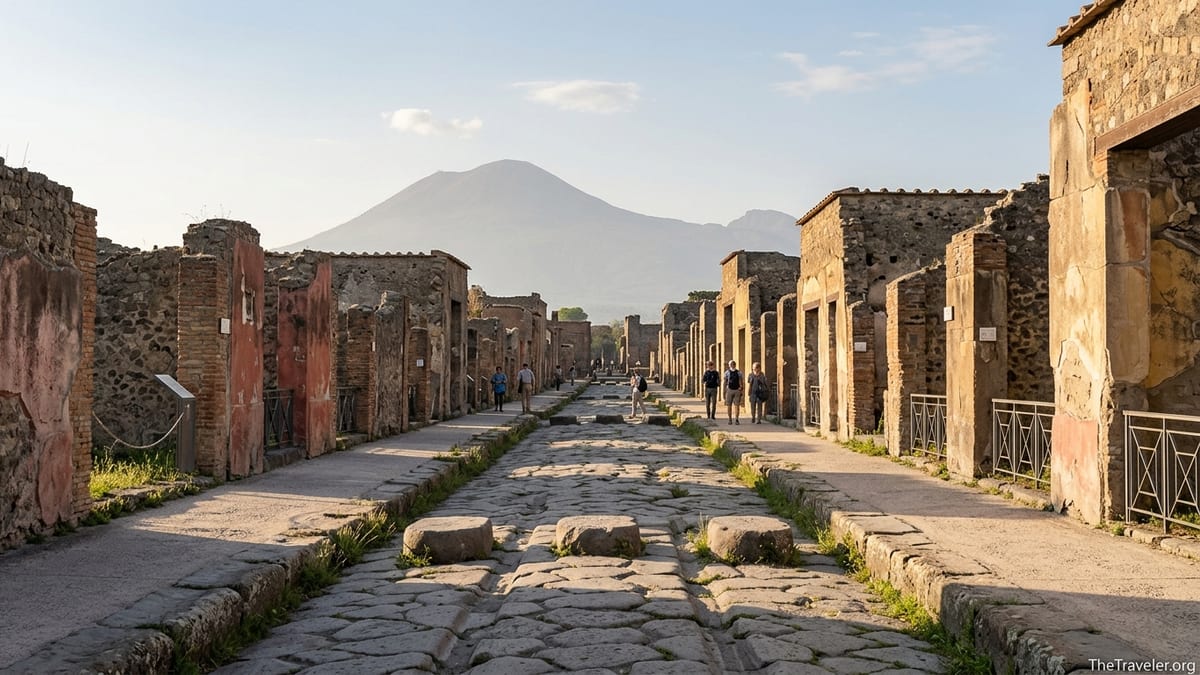
The eruption of Mount Vesuvius in 79 CE buried Pompeii under several meters of volcanic ash and pumice, sealing streets, houses and even household objects as if someone had simply switched history off. Unlike many ancient sites that gradually crumbled, Pompeii was abruptly entombed. When excavations began in earnest in the 18th century, archaeologists found walls still standing, upper floors partially preserved and even graffiti scrawled across shop fronts. Today, when visitors walk along the Via dell’Abbondanza, the main east–west street, they are following the same basalt paving stones Roman carts once rumbled across, complete with deep ruts worn into the rock.
Pumice and ash preserved details that would normally have vanished long ago: carbonized wooden doors, staircases, bedsteads and even the remains of food. In one property nicknamed the House of the Baker, archaeologists found millstones, ovens and loaves of bread still in their baking trays, turned to charcoal but clearly recognizable as round Roman loaves. Travelers who visit the site today can see replica bread in the Antiquarium museum, displayed next to carbonized nuts, figs and amphorae, helping to connect the silent ruins outside with the people who once rushed to finish their daily chores before disaster struck.
The speed of the eruption also preserved the final moments of individual lives. Using the famous plaster cast technique developed in the 19th century, excavators poured liquid plaster into hollow cavities left in the ash when human bodies decayed. The resulting casts capture people at the moment they died, curled into corners or huddled together. Modern visitors often encounter these in glass cases near the Forum or in the Antiquarium. The emotional impact of looking directly at a person who died nearly 2,000 years ago is a powerful reminder that Pompeii is not just a monumental site but a vast graveyard of individual stories.
A Rare, Almost Complete Roman City
What sets Pompeii apart from many other classical sites is its sheer completeness. Instead of one temple or a single theatre, travelers walk through an entire mid-sized Roman city: streets, neighborhoods, mansions, modest apartments, workshops, taverns and public baths. The site covers around 66 hectares, of which roughly two-thirds are currently excavated. For visitors arriving on regional trains from Naples or Sorrento and entering through Porta Marina, the first glimpse of the Forum framed against Vesuvius immediately conveys that this was a real urban hub, not a remote ruin.
The everyday functions of the city are remarkably legible. On a typical visit, a traveler might start at the Forum, where the remains of the basilica, temples and public buildings line a broad square that once hosted markets and political speeches. From there, a short walk leads to the massive Amphitheatre, one of the oldest surviving Roman amphitheatres, where spectators once watched gladiatorial games. Nearby, at the Large Palaestra, you can imagine young men training or swimming in the central pool. The Triangular Forum and adjoining theatre complex show how Pompeiians combined entertainment, religion and social life in adjoining spaces, much as modern cities cluster cultural venues together.
Residential quarters give an equally vivid impression of how people lived at different levels of wealth. Grand houses like the House of the Faun, with its famous mosaic depicting Alexander the Great in battle, stand only a few streets away from single-room shops and taverns. Travelers walking these blocks will notice marble counters with holes cut out for large jars, once used to store wine and hot food. These are the remains of thermopolia, ancient snack bars where Pompeiians grabbed quick meals, often in spaces no bigger than a present-day coffee bar in central Naples. Moving between these buildings in a single afternoon, visitors gain a sense of a complete social ecosystem frozen in stone and plaster.
Living Archaeology: New Discoveries in the 21st Century
Despite its fame, Pompeii is far from a finished excavation. In the last decade, new digs have transformed our understanding of the city and kept it constantly in the news. In 2023 and 2024, archaeologists working on stabilization projects along the unexcavated edges uncovered vivid mythological frescoes in what appears to have been an elegant dining room, with scenes of Helen of Troy and other legendary figures set against dark backgrounds. These discoveries, widely reported by international media, reminded travelers that whole sections of the city remain buried and that stepping into Pompeii today still means witnessing active archaeological work.
New finds are not limited to art. Recent excavations in Regio V and other districts have revealed everything from a remarkably well-preserved “fast food” counter with painted scenes of ducks and a dog, to the skeletons of people who died while trying to escape. In 2023 and 2024, reports surfaced of additional skeletons discovered in modest rooms along previously known streets, including a woman still wearing jewelry and holding a key, detail that suggests she was trying to protect valuables as volcanic debris fell. For travelers, stumbling upon a roped-off trench where archaeologists in hard hats are brushing away ash layers can be as memorable as seeing a finished fresco. It underlines that Pompeii is a work in progress rather than a static open-air museum.
The Archaeological Park of Pompeii has also embraced modern technology. Drones, laser scanning and digital mapping now document structures in three dimensions, helping researchers understand how different quarters evolved before the eruption. The park publishes many of its findings through a digital journal, while temporary exhibitions in the Antiquarium rotate new discoveries so that frequent visitors always have something fresh to see. For someone returning after a few years, entire blocks may look different, with new rooms open and fresh wall paintings revealed, making each visit a snapshot of an ongoing scientific project.
A Window Into Everyday Roman Life
Pompeii’s greatest strength is its focus on the ordinary rather than the spectacular. While there are grand villas and imposing public buildings, much of the site’s appeal lies in the small details of daily existence. Travelers can still read election slogans painted on house walls, where candidates were endorsed by friends, tavern keepers or neighborhood groups. In some cases, graffiti complains about poor wine, advertises gladiatorial games or records romantic spats. Walking along quieter side streets and pausing to decipher these messages brings ancient voices uncomfortably close.
Inside homes, details of domestic life remain frozen. In the House of the Vettii, reopened to the public after a major restoration, visitors see brilliantly colored wall paintings of mythological scenes alongside daily-life decorations such as cupids engaged in trades. The layout of the house, with its central atrium, reception rooms and peristyle garden, feels surprisingly modern. Light falling through the central opening still reflects off the shallow indoor pool, almost as it did when wealthy merchants received guests here. In smaller houses, simple wall paintings, storage jars and compact kitchens suggest a more modest but still comfortable lifestyle.
The city also preserves evidence of labor that supported these households. Bakeries with worn millstones show where enslaved or hired workers once turned grain into flour. Fullers’ workshops, which acted as ancient dry cleaners, contain large basins once filled with chemicals and even urine, used to treat cloth. For a modern visitor browsing boutique laundries and bakeries in nearby Naples or Sorrento, it is striking to see how tasks such as cleaning garments or making bread have changed in technology but not in basic function. Pompeii makes it unusually easy to draw parallels between a Roman workday and a 21st-century one.
World-class Preservation and Visitor Experience
In recent years, significant investment has gone into stabilizing and presenting Pompeii. The Great Pompeii Project, funded in part by the European Union, focused on shoring up excavation fronts, repairing vulnerable walls and improving drainage. Many structures that were once closed for safety reasons have been carefully restored and reopened. As a result, visitors in 2026 encounter a site that is both more accessible and better protected than it was a decade ago, with clear signage, safer walkways and new viewing platforms over fragile mosaics and gardens.
For travelers, practical improvements are as important as archaeological ones. Standard entry tickets to Pompeii cost in the range of the high teens in euros for adults, with reductions for young visitors and free access on the first Sunday of many months, subject to crowd-management policies. Official visitor information notes that the site typically opens around 9 am, closing between late afternoon and early evening depending on the season, and a thorough visit to the main highlights takes around four to six hours. Many travelers plan day trips from Naples or Sorrento using the local Circumvesuviana train, stepping off at Pompei Scavi station just a short walk from the Porta Marina entrance.
A growing focus on accessibility has also changed how people experience the ruins. An accessible route, sometimes referred to as “Pompeii for All,” uses ramps, leveled paths and raised walkways to connect key highlights, enabling visitors with limited mobility to see major sections of the city that would once have been blocked by high curbs and uneven stones. In addition, digital audio guides rented at the entrance, and official apps for smartphones, help orient independent travelers who prefer to avoid large group tours. On busy days, such as spring weekends, guides with licensed badges can be seen leading small groups into side streets to escape the crowds, highlighting quieter houses or recently restored baths that casual visitors might otherwise miss.
Archaeology, Ethics and Overtourism
Pompiei’s popularity is both a blessing and a challenge. In recent years, annual visitor numbers have reached several million, making it one of Italy’s most visited cultural attractions. On high-season mornings in April, May, June and September, long lines can form at the main entrances as tour buses arrive from Rome, Naples and cruise ports along the Bay of Naples. To protect the site, authorities limit the number of daily admissions and encourage advance ticketing, while some of the most delicate houses open on rotating schedules. Travelers who arrive at opening time or in the late afternoon often enjoy a noticeably quieter experience.
Managing this flow of people is not just a matter of convenience but of conservation ethics. Ancient floor mosaics can be damaged by constant foot traffic, frescoed walls can fade when exposed to large crowds, and narrow doorways can become dangerous bottlenecks. As a result, visitors now encounter ropes, plexiglass barriers and no-entry signs in particularly fragile spaces. While some travelers find these restrictions frustrating, they are a key reason why so many wall paintings and architectural details still survive. Responsible guides often remind clients not to sit on ancient walls, not to touch frescoes for photographs and not to pick up loose stones as souvenirs.
Ethical questions also extend to how human remains are displayed. The plaster casts of Vesuvius’s victims are among Pompeii’s most powerful sights, but there is a growing discussion among scholars and curators about how to avoid turning them into morbid attractions. Recent exhibitions have tended to present the casts with contextual information about Roman daily life, health and diet, backed by scientific studies such as CT scans of the bodies. Visitors are increasingly encouraged to view them with a sense of respect rather than ghoulish fascination, recognizing that these were people whose final moments were anything but picturesque.
Planning a Meaningful Visit Today
For modern travelers, part of what makes Pompeii extraordinary is how accessible it is, both logistically and intellectually. A visitor staying in central Naples might purchase a regional train ticket for only a few euros and be standing at the site entrance in under an hour. From Sorrento or smaller coastal towns, frequent trains and organized day tours make it straightforward to combine Pompeii with nearby Herculaneum or even a hike on Vesuvius. Many tour operators offer packages that include timed entry tickets, transport and a two-hour guided tour, useful for first-time visitors who want context without having to plan every detail independently.
Once inside the gates, however, the most rewarding experiences often come from slowing down. Instead of racing between every famous house, travelers who choose a single neighborhood and spend time there gain a deeper sense of place. For example, you might focus a morning on the area around the Forum and the nearby bath complexes, pausing to study the heating systems and water channels that brought hot and cold water to different rooms. In the afternoon, you could drift toward the more residential Regio VI or Regio VII, exploring lesser-known houses where you may find yourself briefly alone with a mosaic floor or a faded wall painting.
Practical preparation enhances appreciation. Wearing sturdy shoes is crucial, as original Roman paving stones are uneven and can be slippery in bad weather. Bringing water, a hat and sunscreen is essential during summer, when temperatures regularly climb and shade can be limited on the exposed streets. Many travelers choose to carry a printed map from the entrance information point, marking buildings they particularly want to see, such as the Brothel with its small frescoed cubicles or the Villa of the Mysteries with its iconic red-painted ritual scenes located a longer walk beyond the city walls. By combining simple preparation with a flexible schedule, visitors can balance the desire to see highlights with the chance to experience quieter corners of the site.
The Takeaway
Pompeii occupies a unique place in world archaeology because it captures an entire Roman city at the instant its story ended, preserving everything from grand temples to humble kitchens in extraordinary detail. Ongoing excavations and new discoveries, from mythological frescoes to previously unknown skeletons, mean that the site is constantly evolving, offering fresh insights even for return visitors. Investments in conservation and visitor infrastructure have turned Pompeii into a model for how large, fragile archaeological landscapes can be opened to the public while still being protected.
For travelers, walking Pompeii’s streets is more than a checklist of ruins. It is an encounter with lives that feel close enough to touch: merchants tallying accounts in peristyle gardens, bakers hauling loaves from the oven, children splashing in public fountains. The city’s preserved graffiti, snack bars and apartments collapse the distance between antiquity and the present, making the past feel disconcertingly familiar. Whether you visit as part of a day trip from Naples or as the centerpiece of a longer journey through Campania, Pompeii offers something few destinations can match: the chance to inhabit, for a few hours, the living fabric of an ancient world that ended in a single terrible day.
FAQ
Q1. How long do I need to visit Pompeii properly? Most travelers find that four to six hours is enough to see the main highlights, though a full day lets you explore quieter neighborhoods and revisit favorite spots at a slower pace.
Q2. What is the best time of year to visit Pompeii? The most comfortable periods are spring and autumn, roughly April to early June and late September to October, when temperatures are milder and crowds are thinner than in peak summer.
Q3. How much does it cost to enter Pompeii? Standard adult tickets are typically priced in the high teens in euros, with reduced rates for eligible young visitors and occasional free-entry days such as some first Sundays of the month, subject to official policies.
Q4. Can I visit Pompeii as a day trip from Rome or Naples? Yes. From Naples, regional trains reach Pompei Scavi station in under an hour, while many tour operators offer full-day trips from Rome that include transport, entry tickets and guided visits.
Q5. Is Pompeii suitable for children? Many families find Pompeii fascinating for children, especially with a guided tour or audio guide that explains daily life, though parents should be prepared for a lot of walking, uneven surfaces and limited shade.
Q6. Are there facilities such as food, water and restrooms inside the site? Yes. There are restrooms at several points within the archaeological park and a few cafes or kiosks near main entrances, though many visitors still bring their own water and light snacks to avoid lines during busy hours.
Q7. How accessible is Pompeii for visitors with limited mobility? An accessible route with ramps and leveled paths connects many major sights, but some streets and buildings remain difficult due to original high curbs and uneven stones, so visitors with mobility needs should plan carefully and allow extra time.
Q8. Do I need a guide to appreciate Pompeii? While it is possible to explore independently using maps and audio guides, many visitors find a licensed guide valuable for understanding what they are seeing and for navigating efficiently to key houses, baths and theatres.
Q9. Can I also visit Herculaneum or Mount Vesuvius on the same day? Combining Pompeii with either Herculaneum or a short hike on Vesuvius is feasible on a long summer day, but you may feel rushed, so travelers who prefer a deeper experience often dedicate a full day to Pompeii alone.
Q10. Is it safe to visit Pompeii today given its proximity to Vesuvius? Yes. The volcano is closely monitored by Italian authorities, and in the event of unusual activity, civil protection agencies have established alert systems and evacuation plans for the region, including tourist sites.