


Pompeii is one of those places that lives in your imagination long before you ever see it. The problem is that many travelers arrive at the gates of this buried Roman city unprepared for how large, hot and logistically quirky it really is. Between confusing ticket options, strict bag rules and the relentless Campanian sun, it is remarkably easy to turn a dream visit into an exhausting slog. Here are the most common mistakes people make when visiting Pompeii today, and how to avoid them with a bit of smart planning.
Get the latest updates straight to your inbox!
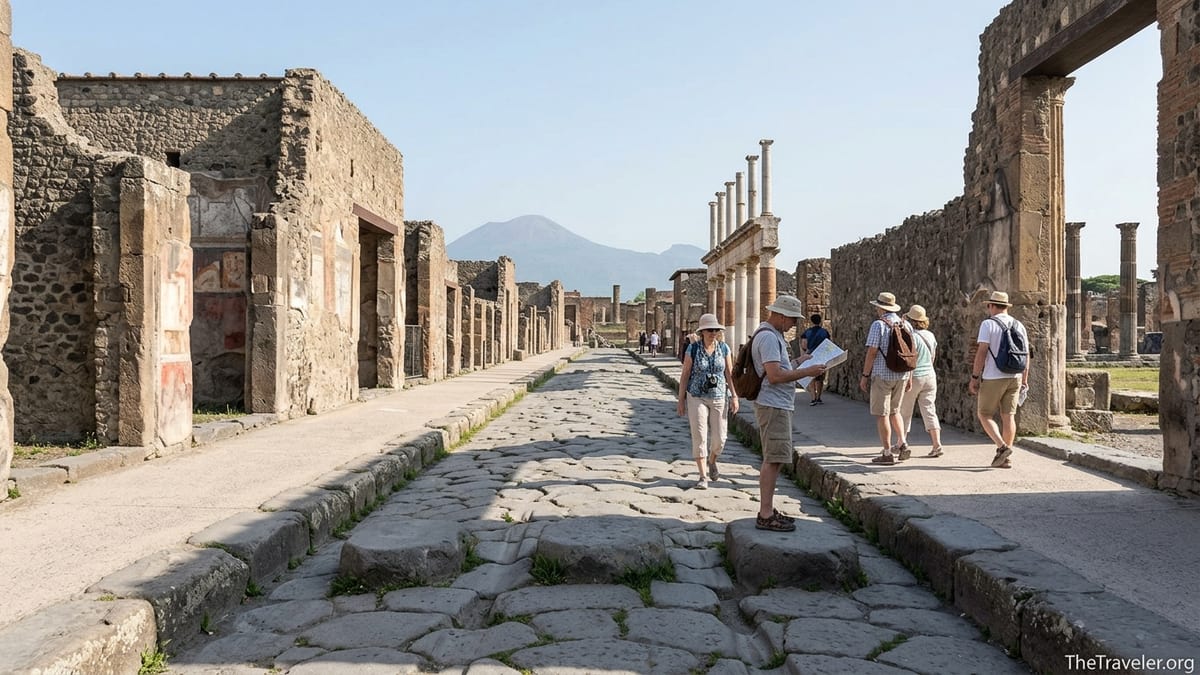
Underestimating How Big and Draining Pompeii Really Is
On paper, Pompeii looks like a simple half‑day stop between Naples and Sorrento. In reality, the archaeological park spreads over more than 60 hectares of excavated streets, houses and public buildings. Many first‑time visitors picture a compact cluster of ruins, similar in scale to a single forum or amphitheater. Instead, they step through the Porta Marina or Piazza Anfiteatro entrance, see a whole Roman city stretching to the horizon, and realize that "popping in for two hours" will barely scratch the surface.
A common mistake is cramming Pompeii into a rushed itinerary, such as a cruise passenger trying to squeeze in Vesuvius or the Amalfi Coast on the same short day. Visitors often report walking 10 to 12 kilometers over uneven basalt blocks and gravel paths without quite meaning to. By mid‑afternoon, families who arrived from Rome on the early Frecciarossa train via Naples are slumped in whatever slice of shade they can find, abandoning plans to see famous houses like the Villa of the Mysteries simply because they are too far away.
Another practical oversight is not building in enough breaks. There are shaded rest areas and a few on‑site cafés, but large sections of Pompeii are fully exposed. People who start at noon in July or August, especially those coming directly off the Circumvesuviana train from Napoli Garibaldi, often find themselves wilted within an hour. The basalt paving stones radiate heat, and many alleys feel hotter than the forecast temperature suggests. The better strategy is to treat Pompeii like an all‑day hike in a stone city: arrive near opening time, plan a long lunch break, then continue when the worst heat has passed.
Arriving Unprepared for Heat, Sun and Terrain
One of the biggest real‑world mistakes is showing up dressed for a city stroll rather than for a full day on rough archaeological terrain. Social media is full of photos of visitors in flimsy sandals or white sneakers that are blackened by volcanic dust by noon. The site has curbs that can reach ankle height, potholes where ancient stones have settled, and sloping side streets that become slippery gravel in the heat. Twisted ankles are not uncommon, particularly among people trying to hop from stone to stone for that perfect photo of the stepping stones in Via dell’Abbondanza.
Footwear and sun protection matter more here than in most urban attractions. Sturdy walking shoes or breathable trainers with good grip will make the difference between casually exploring the House of the Faun at the far end of town and deciding it is "too far." Many travelers also underestimate the intensity of the sun. In summer, temperatures inside the site can feel several degrees hotter than nearby Naples or Sorrento. It is common to see visitors buying emergency hats from vendors outside the Porta Marina Superiore entrance or improvising with scarves because they arrived without any head covering or sunscreen.
Water planning is another point where unprepared visitors struggle. Pompeii does have numerous free drinking fountains fed by the modern water system, marked on the official park map and in the MyPompeii app. Yet people still queue in the central café paying several euros for bottled water because they did not bring a refillable bottle. In peak season, the line for cold drinks can be long, cutting into precious exploration time. A simple stainless‑steel bottle filled at your hotel in Naples or Sorrento, and refilled at the fountains beside the Forum or near the amphitheater, keeps you hydrated and saves money.
Getting Caught Out by Tickets, Entrances and “Skip the Line” Hype
Ticket confusion is one of the most common and frustrating mistakes. Pompeii now sells nominative electronic tickets through the official channels, and also various passes that combine sites like Herculaneum, Oplontis and Boscoreale. Many travelers, overwhelmed by different platforms and product names, end up buying more expensive third‑party packages that simply bundle a standard entry ticket with an audio guide. Others purchase a three‑day pass thinking they can reenter Pompeii multiple times, only to discover the ticket allows one visit per site, not unlimited entry.
The term "skip the line" is especially misleading. On busy days outside Porta Marina, you will see salespeople in branded jackets promoting express access, fast‑track tours or "official" guides. In practice, if you already hold a dated electronic ticket on your phone, you often join a separate fast‑moving line anyway, so paying extra for a "skip the line" voucher can be redundant. Seasoned visitors report that during shoulder months like May and October, simply arriving by 9 am means almost no wait at the turnstiles, even without a premium product.
Entrance choice also matters more than most people realize. Many independent travelers automatically aim for Porta Marina because it sits near Pompeii Scavi‑Villa dei Misteri station on the Circumvesuviana line from Naples and Sorrento. That entrance tends to be the busiest, packed with tour coaches and large groups. The Piazza Anfiteatro gate, closer to the modern town and often used by school groups, can be significantly calmer, especially early in the day. Visitors who do not check which entrance suits their route may waste time in long queues at Porta Marina when a taxi to the other gate would have been faster and only a few euros more when shared.
A related mistake is not pairing tickets with a plan. Some visitors buy the cheapest basic entry and assume they will figure things out inside. Without at least a basic map or audio guide, they often spend the first hour wandering among anonymous walls, then realize hours later that they missed key sites like the Lupanar, the Stabian Baths or the Large Theatre. Others pay for a group tour that starts much later than their afternoon arrival, leaving them idle outside the gates. Matching your ticket type to your schedule, and booking any official tour that you genuinely want before your visit date, will reduce both stress and wasted time.
Bringing the Wrong Bag and Ignoring Park Rules
Packing for Pompeii is not as simple as throwing everything into a large daypack. The archaeological park enforces a bag size limit, typically around 30 x 30 x 15 centimeters, and large backpacks or suitcases are refused at the turnstiles. Many travelers coming straight from Naples Centrale with luggage, planning to continue on to Sorrento after their visit, discover too late that they cannot enter with their rolling suitcase. They are then forced to backtrack to the luggage storage across the road or to nearby private lockers, adding unexpected cost and precious lost time.
Security staff also apply specific rules about food, tripods and unauthorized audio devices. Small snacks and sandwiches are generally tolerated, especially if eaten in designated rest areas, but full picnics spread on ancient walls or in courtyards can attract stern warnings. Visitors have been asked to stop eating on the steps of the Temple of Apollo or beside delicate frescoes, not as rudeness but because crumbs, plastic and spilled drinks damage fragile surfaces and attract pests. Similarly, large camera tripods and drones are restricted, and flying a drone without prior written authorization from the park can bring fines.
Another easily overlooked rule involves audio guides. Pompeii allows official audio devices and approved digital guides, but commercial loudspeaker systems that distort the quiet of the site are discouraged. Some informal guides still use portable amplifiers that drown out the ambient sounds of footsteps on stone and birds over the forum. Joining one of these loud, fast‑moving groups may seem convenient at the entrance but can quickly feel intrusive. Independent travelers who rely on a good offline map and a reputable audio app on their phone can move at their own pace, mute commentary to soak in a view, and avoid clashing with other groups in narrow streets.
Small but important etiquette points also catch visitors off guard. Climbing behind ropes into restricted houses or leaning on frescoed walls for photos is prohibited, and staff do intervene. Parents sometimes let children run on low walls or jump across ancient fountains like playground equipment, only to be stopped by wardens. These rules may feel strict in the moment but exist to keep the site open to millions of visitors each year without accelerated damage.
Choosing the Wrong Time of Day or Year
Pompeii is open most days of the year, with longer hours in the summer season and reduced afternoon entry in winter. Yet many visitors only consider their own calendar, not how conditions inside the ruins change month by month. In July and August, midday heat combined with peak visitor numbers can turn the main streets into a slow‑moving, overheated stream. Queues for the most famous sites, such as the House of the Vettii or the Villa of the Mysteries, may stretch out into full sun. People who only realize this after booking a midday timed entry from their cruise ship often wish they had shifted their schedule by a few hours.
By contrast, those who plan an early arrival experience a different Pompeii. On many days between April and October, the park opens around 9 am (earlier on some weekends), and the first hour can feel uncrowded compared to late morning. The light at this time of day is also gentler, casting long shadows down Via dell’Abbondanza and making details like cart ruts and stepping stones more visible. Travelers who catch an early Circumvesuviana train from Napoli Porta Nolana or Napoli Garibaldi, arriving close to opening, often report leaving by early afternoon satisfied and less exhausted.
Seasonal timing matters too. Shoulder seasons such as late April, May, September and early October balance pleasant temperatures with reasonable crowds. Winter has shorter days and a chill wind that can whistle through exposed streets, but rewards visitors with quieter ruins and the possibility of lingering in houses without the pressure of a line behind them. Heavy rain, however, can cause temporary closures of certain areas for safety. Checking the official park announcements the night before your visit, especially in the cooler months, helps avoid disappointment if a favorite house or path is closed for restoration or weather.
Finally, some visitors forget that the first Sunday of many months offers free entry as part of a national cultural initiative. While this can be an appealing way to save money, it also means significantly higher local turnout. If your travel dates are flexible and you value space over savings, choosing a regular weekday instead of a free Sunday is usually the more comfortable option.
Neglecting Maps, Routes and Context
Walking into Pompeii without a plan is like opening a 700‑page novel to a random sentence and hoping to understand the whole story. The site is a grid of streets, but the most interesting locations are scattered and not always obvious. Many people follow the first visible group or simply wander straight up from Porta Marina to the Forum, then circle nearby and declare themselves done. Later, on the train back to Naples, they scroll through guidebooks and realize they missed the amphitheater, the brothel, the best preserved thermopolia or the quiet backstreets around the House of the Tragic Poet.
The park itself provides a free paper map at the entrances, and updated digital maps appear in the MyPompeii app and on large signboards near major crossroads. However, a surprising number of visitors tuck the map into a bag and never unfold it. A smarter approach is to sketch a simple loop before you enter: for example, from Porta Marina through the Forum and basilica, along Via dell’Abbondanza to the Stabian Baths, across to the theatres, then looping to the amphitheater and back via the quieter residential streets. Travelers who mark three or four "must see" locations on their map find it much easier to improvise the rest of their day.
Context also transforms ruins from anonymous walls into vivid spaces. Without even a basic understanding of Roman daily life, many structures blur into one another. A bakery with millstones looks like a house with odd pillars. A bar counter with dolia jars built into the masonry may seem like a random bench. Spending even half an hour the night before with a reputable guidebook, documentary or archaeological website helps. So does reading the interpretation panels outside major buildings inside the site, which are regularly updated in multiple languages. Travelers who do this often describe vivid mental images of bakers working in the shadow of Vesuvius or families eating in dim triclinia as ash began to fall.
Finally, visitors sometimes underestimate how easy it is to get turned around, especially when side streets are temporarily closed for restoration. Street signs in Latin are atmospheric but not always intuitive, and not every alley shown on older maps remains open. Taking a photo of the large orientation map near the entrance, and checking in with it periodically, can save you from backtracking long distances in the afternoon heat.
Expecting Pompeii to Be a Quick Photo Stop
Modern travel culture encourages people to collect destinations like stamps: step off the train, snap a picture in front of the Forum with Vesuvius in the background, post it, move on. Approaching Pompeii this way is one of the most limiting mistakes you can make. The city rewards slow attention: reading graffiti scratched into plaster, noticing the raised sidewalks that kept feet dry during rain, or observing how ruts in the road reveal centuries of cart traffic. These details do not fit into a 45‑minute whirlwind visit.
Many day trippers from Rome try to combine Pompeii and the Amalfi Coast in a single day tour. While these packages are convenient, they often allocate only two hours inside the ruins once driving time and lunch stops are subtracted. Guides then rush groups along a standard loop from the Forum to a handful of houses, past the baths and the Lupanar, leaving no time to linger in quieter neighborhoods. Participants report leaving with nice photos but a shallow sense of the place. By contrast, travelers who dedicate at least four to six hours inside the site describe moments of unexpected stillness, like standing alone in a garden behind the House of the Vettii or watching clouds gather over Vesuvius from the city walls.
Another consequence of the "photo stop" mindset is crowding at the same viewpoints. Dozens of people cluster at the Forum, the main theatre and the brothel at the same times of day, while entire backstreets remain nearly empty. With a bit of flexibility, you can reverse this pattern. Visit the busy highlights early or late, then spend the rest of your time in the less photographed zones: the large palestra, the necropolis gates, or the suburban villas on the edges of the site. Not only will your photos feel more personal, but you are also less likely to jostle shoulders in confined spaces or have your experience shaped by the pace of groups around you.
Finally, remember that Pompeii is not a theme park built for Instagram but the frozen remains of real tragedy. Loud music, shouting across streets, or climbing onto fountains for selfies erode the contemplative atmosphere. Visitors who treat the site as a rare chance to walk through a lost city, rather than a backdrop, tend to leave with both better memories and greater respect for what they have seen.
FAQ
Q1. How long do I really need to visit Pompeii properly?
Most travelers should plan at least four to six hours inside the site. This allows time for the Forum, major houses, theatres, baths and a few quieter backstreets without rushing.
Q2. Is it worth taking a guided tour, or can I visit Pompeii on my own?
Both options work. A good licensed guide or archaeologist‑led tour can bring the ruins to life, while independent visitors with a detailed map and audio guide enjoy more flexibility and quiet.
Q3. What should I wear for a summer visit to Pompeii?
Light, breathable clothing, a wide‑brimmed hat, sunglasses and sturdy walking shoes are essential. Avoid flimsy sandals and pack high‑SPF sunscreen, even on slightly cloudy days.
Q4. Can I bring food and a backpack into Pompeii?
You can bring a small backpack within the park’s size limits, plus snacks and water. Large bags, suitcases and full picnics are not allowed and may be refused at the entrance.
Q5. Which entrance is best for most visitors?
Porta Marina is closest to the Circumvesuviana station and popular with tour groups. Piazza Anfiteatro is often quieter. Choose based on where you are arriving from and crowd levels.
Q6. Do I really need to buy Pompeii tickets in advance?
Buying dated tickets in advance usually saves time and avoids confusion at the ticket office, especially in high season. Same‑day purchase is possible, but queues can be longer.
Q7. Is Pompeii suitable for children and older travelers?
Yes, but plan carefully. The terrain is uneven and the sun strong, so schedule rest breaks, use shaded areas and avoid the hottest hours. Strollers for very young children can be difficult on cobbles.
Q8. Are there places to buy water or use toilets inside Pompeii?
Yes. The park has several restroom facilities and small cafés, plus free drinking water fountains. Carry a refillable bottle so you can top up at fountains throughout the day.
Q9. Can I visit Pompeii and Herculaneum in the same day?
It is possible but tiring. Many visitors prefer to devote most of a day to Pompeii and another half‑day to Herculaneum to avoid turning both sites into rushed box‑ticking exercises.
Q10. Is it safe to take the Circumvesuviana train from Naples to Pompeii?
The Circumvesuviana is widely used by locals and tourists. It is generally safe if you keep an eye on your belongings, avoid displaying valuables and board less crowded trains when possible.