


Two Roman cities, one catastrophic morning in 79 AD. Yet for modern travelers, Pompeii and Herculaneum offer strikingly different experiences. One is vast, exposed and world famous. The other is compact, eerily intimate and often quieter. If you only have time for one on your trip to Naples, deciding where to spend those precious hours can shape how deeply the story of Vesuvius stays with you long after you fly home.
Get the latest updates straight to your inbox!
First Impressions: Scale Versus Intimacy
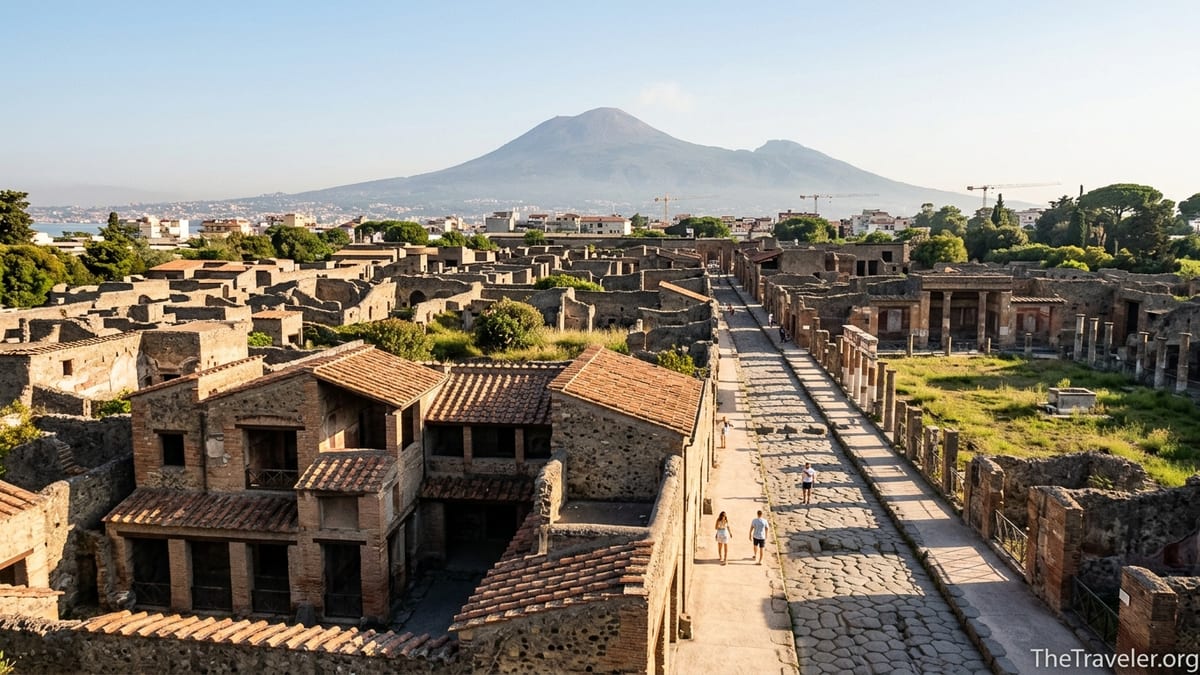
Most travelers feel the impact of Pompeii the moment they step through Porta Marina and see an entire Roman city stretching to the horizon. Streets run in straight lines, the outline of the forum is unmistakable, Mount Vesuvius looms at the far end and it takes only a few seconds to realize that you will not see it all in one visit. On a typical day from April to October, visitors stream along the basalt paving stones past bakeries, taverns and townhouses, and the sheer scale delivers a powerful sense of a lost world abruptly frozen in time.
Herculaneum, by contrast, feels like stepping into a tightly framed scene. From the entrance, you stand on a modern terrace looking down at a bowl of ruins surrounded by the present-day town of Ercolano. The excavated area is smaller and more contained, with two or three main streets and a compact grid that most travelers can cover in two to three hours without rushing. Instead of the shock of vastness, the first impact here is intimacy. You can see entire houses at a glance, from tiled courtyards to upper floors, and it feels less like a ruin and more like a neighborhood waiting for its owners to return.
That difference in first impression often shapes which site leaves a deeper mark. Travelers who are moved by grand scale, open vistas and the drama of a city-wide catastrophe tend to come away talking about Pompeii for years. Those who respond more to detail, atmosphere and the feeling of walking through lived-in spaces often find that Herculaneum haunts them more quietly but more persistently.
Practically, this also affects how you plan your day. Pompeii is frequently a half- or full-day commitment, especially if you arrive by Circumvesuviana train from Naples or Sorrento and join a guided tour. Many visitors walk 10,000 to 15,000 steps without realizing it. Herculaneum, only about 20 minutes from Naples by the same train line, can be seen in a focused morning or afternoon, leaving time for a leisurely seafood lunch along the Ercolano waterfront or a late-day climb up Vesuvius.
Preservation and Detail: Where the Past Feels Closest
Both cities were destroyed by the same eruption, but in different ways. Pompeii was buried mainly by falling ash and pumice, which collapsed roofs and left many interiors exposed. Herculaneum was engulfed later by fast-moving pyroclastic surges that carbonized wood, sealed upper stories and flooded the town under a deeper layer of volcanic material. The result is a stark difference in preservation, and this is where Herculaneum often surprises even seasoned travelers.
In Pompeii, everyday life is visible in broad strokes. You can walk past the remains of a bakery with millstones still in place, stand in the amphitheater where crowds watched gladiator games, or trace the ruts left by carts in the stone streets. Frescoes and mosaics do exist, but many of the finest examples were removed long ago to the National Archaeological Museum in Naples. What remains on site is impressive but sometimes fragmented, especially if you arrive expecting fully decorated interiors on every corner.
In Herculaneum, the preservation of detail can be astonishing. Travelers regularly comment on intact wooden beams, carbonized furniture, shelving still clinging to walls and even sliding doors and staircases that survive in recognizable form. In houses like the House of the Wooden Partition, you can peer into rooms where the charred remains of doors hang in their original frames. Mosaics and frescoes retain vivid color, from deep cobalt blues to rich cinnabar reds, giving a startling sense of how bright Roman domestic spaces once were. In some spots, carbonized roofs still project out over upper-floor balconies, and the city feels three dimensional in a way that Pompeii rarely can.
If your biggest hope is to see indoor spaces that feel almost intact, Herculaneum usually leaves the stronger impression. Guides often point out specific details that stay with people for years: a carbonized cradle in a bedroom, a delicate frescoed border above a doorway, or neat stacks of amphorae in a wine shop. These details, on a much smaller urban canvas, lend themselves to reflection and close observation, and many visitors leave feeling they have glimpsed the texture of real Roman domestic life more vividly than anywhere else.
Emotional Impact: Confronting the Human Story
Pompeii is where many travelers first confront the human scale of the disaster through the famous plaster casts of victims. These casts, made by archaeologists who filled voids left in the ash by decomposed bodies, are deeply affecting. You may see a figure curled in a fetal position, a child sheltering close to an adult, or a dog still straining at its chain. The casts are displayed in several areas that change over time, and for many visitors, this is the moment when the site shifts from fascinating ruin to human tragedy. Standing in front of these figures, with Vesuvius visible in the distance, creates a powerful emotional connection.
Herculaneum delivers its emotional blow in a different way, often more sudden and concentrated. Down near what was once the shoreline, arched chambers known as the boat sheds were excavated in the 1980s. Inside, archaeologists found the skeletons of hundreds of people who had gathered at the water’s edge hoping for rescue. Today, visitors can stand at the railings of these vaults and look directly at the remains: adults, children, and even jewelry and personal items still lying near the bones. It is as raw and immediate a reminder of mortality as you are likely to find in any archaeological site.
For some travelers, this encounter in Herculaneum is almost overwhelming. The ruins above feel calm and orderly, but here, at the edge of the ancient sea, the panic and suddenness of the eruption become brutally clear. By comparison, Pompeii’s human story is spread out across the city, from plaster casts in different locations to graffiti scratched on walls. The effect is cumulative rather than concentrated. You leave Pompeii with a broad sense of loss across a whole city. You leave Herculaneum with the image of one desperate group of people trapped in a single place.
Which has the greater emotional impact is ultimately personal. Families with younger children sometimes find the skeletons at Herculaneum more challenging, while older teens and adults often say that this specific, visceral encounter made the past feel uncomfortably real. In Pompeii, the casts strike a difficult balance between distance and immediacy. They are clearly remains, yet softened by the plaster medium. For many travelers, this makes Pompeii a powerful but slightly easier place emotionally, while Herculaneum delivers a sharper, quieter shock.
Visitor Experience: Crowds, Heat, and Logistics
When you look beyond the archaeology, the simple question of how it feels to visit each site can strongly influence which one leaves a bigger mark. Pompeii, as one of Italy’s headline attractions, sees heavy visitor numbers for much of the year. On a bright Saturday in June, long queues can form outside the Porta Marina entrance by mid-morning, and tour groups cluster around famous spots such as the forum, the Villa of the Mysteries, and the Lupanar. The site is largely exposed, with limited shade on the main streets, and in July and August, the combination of heat radiating off the stones and midday sun can be intense.
Herculaneum is usually calmer. Even in peak season, you are more likely to find yourself sharing entire streets with just a handful of other visitors, especially if you arrive when the gates open. Many houses are covered or partially roofed, offering shade and cooler air, and the smaller footprint means fewer long walks under the sun. Travelers who have mobility concerns or who are sensitive to heat often report that Herculaneum felt manageable and enjoyable, while Pompeii left them exhausted by mid-afternoon.
Logistics from Naples are straightforward for both. The Circumvesuviana commuter line from Napoli Garibaldi station serves Ercolano Scavi station for Herculaneum in roughly 15 to 20 minutes and Pompei Scavi Villa dei Misteri station in about 30 to 40 minutes, with tickets typically costing under 3 euros each way in 2026 on the regular trains. From Sorrento, the same line runs in the opposite direction, making both sites easy day trips from resorts along the Sorrento coast. For a more comfortable ride in summer, some travelers opt for the seasonal Campania Express, a tourist-focused train with reserved seats and air conditioning that also stops at both archaeological parks at a higher fare.
If you prefer not to navigate local trains at all, guided day tours bundle transport with admission and a licensed archaeologist guide. In 2026, full-day small-group tours from Naples that include Pompeii, Herculaneum, and sometimes Vesuvius typically range from roughly 90 to 130 euros per person, depending on inclusions. These can feel expensive, but for visitors short on time or nervous about logistics, they remove a layer of stress and ensure you see key highlights efficiently. Whether that convenience outweighs the freedom of exploring on your own is another factor that shapes how relaxed or rushed your day feels, which in turn colors the memory you take home.
Who Each Site Suits Best
Different kinds of travelers respond differently to Pompeii and Herculaneum, and understanding this can help you predict which site is more likely to leave a lasting impression. If you are drawn to epic history, sweeping views, and monumental public spaces, Pompeii is hard to beat. Walking into the large forum with Vesuvius as a backdrop, standing at the top of the amphitheater, or tracing the outlines of grand villas offers a sense of Roman urban life on a civic scale that few other sites in the world can match.
Herculaneum, though smaller, is ideal for travelers who love detail and narrative. Families with children often appreciate that the site is compact and easy to navigate, reducing fatigue and keeping attention focused. History enthusiasts interested in domestic architecture, interior decoration and daily routines often say that the preserved timber, vivid frescoes and compact houses at Herculaneum told them more about how people actually lived. Visitors who dislike crowds or who travel in the shoulder season, such as March or November, often find Herculaneum pleasantly quiet even when Pompeii feels busy.
Time is another key factor. If you only have one afternoon available and are staying in Naples, Herculaneum is usually the more realistic and rewarding choice. You can leave Napoli Garibaldi after breakfast, be walking the Roman streets by mid-morning, and be back in the city in time for aperitivo near Piazza Bellini. If you have an entire day and energy to spare, Pompeii offers room for exploration and surprise. Many travelers who spend six hours there still leave with entire districts untouched, already planning a return visit.
Budget also plays a role. Entry prices to both sites are broadly comparable and can change over time, but when combined with transport and optional guiding, a full Pompeii day can add up. For example, a private 2-hour guided tour of Pompeii booked through a local operator in 2026 often runs from around 140 to 200 euros per group, while a similar private tour at Herculaneum can be slightly less due to the shorter walking distances and narrower set of highlights. Independent travelers on a tight budget may choose to visit Herculaneum without a guide and rely on the official map and occasional information panels, which are easier to follow in a smaller site.
Trying to See Both in One Day
Many travelers staying in Naples or Sorrento are tempted to tackle both Pompeii and Herculaneum in a single day. On paper it is entirely feasible. The Circumvesuviana train connects Pompei Scavi and Ercolano Scavi stations directly, and the ride between the two is roughly 20 minutes. With an early start, you can spend the morning in Herculaneum, have a quick lunch near the station, and devote the afternoon to key areas of Pompeii before looping back to your base in the early evening.
The question is not whether it is possible, but whether it is wise for you. A dual-park day often totals more than 15,000 steps on uneven surfaces, much of it in the sun during the hottest months. Visitors who have done this frequently report that either the second site blurs into fatigue or they end up rushing through highlights without time for reflection. If you are deeply interested in Roman history or architecture and have limited days in the Naples area, this tradeoff might be acceptable. For a first-time visitor who wants to savor the atmosphere, it can be too much.
A compromise that many people find satisfying is to pair one archaeological park with a different kind of experience. For example, you might spend a long morning in Pompeii, then hire a shuttle or join a small-group transfer to the Vesuvius crater in the afternoon, walking the path along the rim with views back toward the Bay of Naples. Alternatively, you could visit Herculaneum in the morning and then continue down the Circumvesuviana line to Sorrento for a relaxed afternoon along the marina before returning to Naples by sunset.
If you do decide to see both in one day, planning helps preserve your energy and attention. Buying entry tickets in advance where possible, arriving at opening time, and prioritizing just a handful of must-see locations in each site can keep the experience focused. Comfortable walking shoes with good grip, a refillable water bottle, and a broad-brimmed hat are not just accessories here; they often determine whether you end the day exhilarated or exhausted.
The Takeaway
So which ancient Roman site leaves a bigger impact: Pompeii or Herculaneum? The truthful, if unsatisfying, answer is that it depends on what moves you most. Pompeii offers the drama of a full city laid bare, monumental public spaces and iconic views that have inspired writers, filmmakers and travelers for centuries. It is a place of grand gestures and broad perspectives, where the scale of loss and the power of nature feel almost operatic.
Herculaneum, in contrast, is about intimacy and detail. Here the colors on the walls are brighter, the wood in the doorframes still clings to life, and the human story is concentrated in a few small, devastating spaces. It is a place where you notice the pattern of a mosaic under your feet, the angle of a carbonized staircase or the curve of a seashell embedded in ancient plaster, and those tiny observations linger long after you leave.
If your trip allows, seeing both offers the fullest understanding of what happened around Vesuvius in 79 AD. If you must choose, consider your own temperament, your tolerance for crowds and heat, and how much time you have. For scale, spectacle and iconic imagery, choose Pompeii. For preservation, atmosphere and a more personal confrontation with the past, choose Herculaneum. Either way, you are unlikely to forget the day you spend walking streets that fell silent nearly two thousand years ago.
FAQ
Q1. Can I visit Pompeii and Herculaneum in one day?
Yes, it is physically possible to visit both in one day using the Circumvesuviana train between the two sites, but it will be a long and tiring day with a lot of walking. Many travelers report that they end up rushing the second site, so consider your fitness level and interest in archaeology before planning a dual-park itinerary.
Q2. Which site is better if I have mobility issues?
Herculaneum is generally easier for visitors with limited mobility because it is smaller, more compact and has more shaded, level areas. Pompeii’s vast size, uneven basalt streets and long distances between highlights can be challenging. In both sites, some areas have stepped access, so checking current accessibility information and considering a private guide who can tailor routes is advisable.
Q3. Is Pompeii more crowded than Herculaneum?
Yes, Pompeii usually receives significantly more visitors and can feel crowded, especially between late morning and mid-afternoon in peak season. Herculaneum tends to be quieter, with fewer large tour groups and more opportunities to explore rooms and streets in relative peace, particularly if you arrive early or visit outside July and August.
Q4. Which site is better for children and families?
Many families prefer Herculaneum because it is smaller, easier to navigate and has more shade, which helps children stay engaged. The well-preserved houses and colorful frescoes can capture young imaginations. However, older children and teenagers who have studied Roman history may be especially excited by the scale and famous landmarks of Pompeii. Your choice may depend on your children’s ages, stamina and interest in history.
Q5. Do I need a guided tour for Pompeii or Herculaneum?
A guide is not strictly necessary, but it can greatly enhance your visit, especially in Pompeii where the site is large and complex. A licensed guide or archaeologist can explain what you are seeing and lead you efficiently between key locations. In Herculaneum, the smaller footprint makes it easier to self-guide using maps and information panels, though many visitors still enjoy the context a guide provides. Audio guides are another option if you prefer flexible timing.
Q6. How much time should I plan for each site?
For Pompeii, plan at least four to six hours if you want to see the major highlights at a comfortable pace, more if you are very interested in archaeology. For Herculaneum, two to three hours is usually enough for a thorough visit, with extra time if you like to linger over specific houses or take plenty of photographs. Travel time from Naples or Sorrento should be added on top of these estimates.
Q7. Which site has better preserved frescoes and interiors?
Herculaneum typically offers better preserved frescoes, mosaics and interior details on site. The deeper burial and different eruption dynamics helped protect wood, upper stories and wall paintings to a remarkable degree. Pompeii certainly has impressive decoration too, but many of its finest pieces are now displayed in the archaeological museum in Naples, while Herculaneum still showcases exceptionally vivid domestic interiors in situ.
Q8. Is it safe to take the Circumvesuviana train to both sites?
For most travelers, the Circumvesuviana is a practical and commonly used option to reach both Pompeii and Herculaneum. Like any busy commuter line, it can be crowded and a bit worn, especially at rush hours, and petty theft can occur, so it is wise to keep valuables secure and stay aware of your surroundings. Travelers who want more comfort or guaranteed seating sometimes choose the seasonal Campania Express or join an organized tour that includes private transport.
Q9. Which site is better if I am most interested in the human story of the eruption?
Both sites tell the human story in powerful ways, but in different styles. Pompeii’s plaster casts, scattered graffiti and the scale of the abandoned city convey the tragedy across an entire urban landscape. Herculaneum’s boat sheds, where groups of skeletons were found near the ancient shoreline, offer a more concentrated and emotionally intense glimpse of people caught in a single desperate moment. If you want a focused, visceral encounter, Herculaneum may feel more immediate.
Q10. If I can only choose one, which should I pick?
If you dream of walking a vast Roman city with grand public buildings and iconic views of Vesuvius, choose Pompeii. If you value better preserved interiors, a more intimate atmosphere and an easier visit with fewer crowds, choose Herculaneum. Your personal interests, available time, tolerance for heat and crowds, and where you are staying in the Bay of Naples area should guide your final decision.