


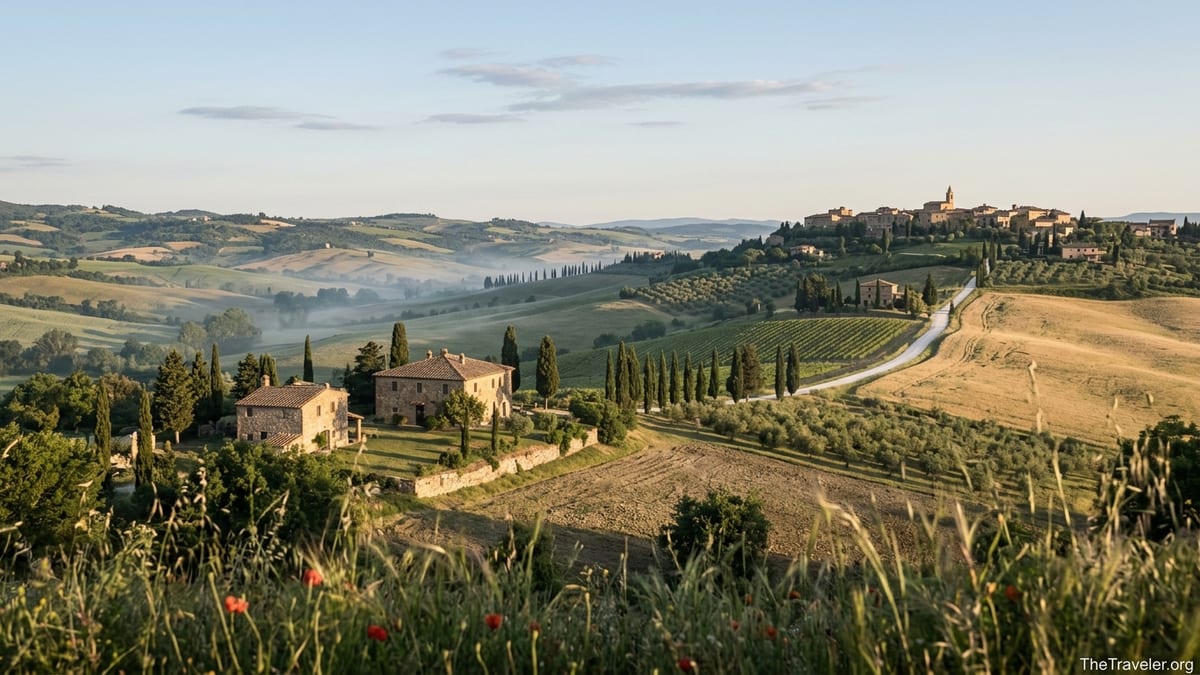
Ask ten travelers to picture the Italian countryside and most will describe the same scene: rolling hills, slender cypress trees, stone farmhouses and a glass of red wine in hand. That mental postcard is "Tuscany" in the global imagination, yet it actually blends two related but distinct experiences: the broader Tuscan landscapes that stretch from Chianti to the Crete Senesi, and the compact, UNESCO-listed Val d’Orcia south of Siena. Choosing between them can shape your entire trip, from the roads you drive to the wines you discover and the photographs you bring home.
Get the latest updates straight to your inbox!
Understanding Tuscany vs Val d’Orcia
First, it helps to untangle the terms. Tuscany is a large central Italian region that runs from the Apennine mountains to the Tyrrhenian Sea and includes everything from Renaissance Florence to the marble quarries of Carrara. When travelers talk about "the Tuscan countryside," they usually mean the wine-producing hills between Florence and Siena, such as Chianti Classico, plus nearby areas like San Gimignano, the Crete Senesi and the gentle Val di Chiana. These landscapes are varied: one day you may be winding through heavily wooded hills and vineyards near Greve in Chianti, the next across soft clay ridges south of Siena.
Val d’Orcia, by contrast, is a specific valley in southern Tuscany, roughly a 40-minute drive south of Siena, centered on small hill towns such as Pienza, Montalcino, San Quirico d’Orcia, Castiglione d’Orcia and Radicofani. The valley follows the Orcia river and was designated a UNESCO World Heritage cultural landscape in 2004 for its harmonious blend of agriculture, Renaissance-era land planning and natural beauty. In practical travel terms, it is a compact pocket where many of the “most Tuscan” views in coffee-table books and film stills are packed into a relatively small area.
If you stay in the Tuscan hills north of Siena, perhaps in a farmhouse near Castellina in Chianti, your days might be spent hopping between family-run wineries, medieval hamlets and viewpoints over forested ridges. Base yourself in Pienza or San Quirico d’Orcia instead, and you are in a landscape where almost every curve in the road reveals ploughed fields, lone stone farmhouses and ruler-straight rows of cypress trees marching along gravel lanes. Both are undeniably Tuscan; Val d’Orcia is simply the distilled, UNESCO-certified version.
Landscape: Soft Chaos vs Composed Perfection
The wider Tuscan countryside feels organic and sometimes a little chaotic. Around Chianti Classico, between towns like Greve, Radda and Gaiole, oak woods cloak many hillsides, vines cling to steep slopes and small castles sit above patchwork fields. North of Siena, toward San Gimignano and Volterra, the terrain rises and falls more sharply, with deep valleys cutting through the hills. South-east of Siena, the Crete Senesi introduces a lunar element: bleached clay hills, eroded gullies and lonely farms perched on rounded knolls. Driving the SP438 near Asciano, you may pull over just to stare at the sculpted folds of clay glowing silver in evening light.
Val d’Orcia, on the other hand, often feels as if someone composed it for a painting and then never touched it again. Between Pienza and San Quirico d’Orcia, long, gentle slopes are planted with wheat, vineyards and olive groves, interrupted by rows of cypress trees that seem placed with deliberate artistry. Around Montalcino, endless Brunello vineyards stripe the hillsides, but the spaces between still feel open and airy. Classic viewpoints, such as the farmhouse below Pienza made famous by films like "Gladiator," line quiet gravel roads where photographers set up tripods at sunrise to catch mist filling the valley.
If you like landscapes that surprise you at every bend, with sudden ravines, thick woods and hidden hamlets, the broader Tuscan hills may leave a stronger impression. A shoulder-season drive from Siena through the Chianti backroads can bring rapidly shifting panoramas in the space of a single afternoon. If, instead, your dream is a single, serene visual mood repeated in subtle variations for days, Val d’Orcia often wins. Travelers commonly describe it as stepping into the pages of a Renaissance painting, especially when golden wheat fields ripple below a dark green cypress-lined ridge.
Towns and Villages: Lively Hills vs Quiet Icons
In the wider Tuscan countryside, many visitors base themselves in or near towns like Siena, San Gimignano or Montepulciano. Siena offers a full medieval city experience, complete with its shell-shaped main square and striped cathedral, yet within 15 to 20 minutes’ drive you can be on small country roads flanked by vineyards. San Gimignano, north of Siena, is famous for its towers and has a distinctly touristy bustle during the day, but step outside town and you quickly find small estates producing Vernaccia white wine and agriturismi surrounded by olive groves.
Val d’Orcia’s main settlements are smaller and feel more like polished hilltop villages than full-fledged towns. Pienza, reimagined in the 15th century as an "ideal" Renaissance city, has a perfectly proportioned central square, tidy lanes and sweeping terraces looking out over the valley. You can walk the entire historic center in under an hour, stopping at shops selling pecorino cheese and small wine bars pouring local Orcia DOC reds. Montalcino is larger and more vertical, dominated by its fortress and dozens of cellars pouring Brunello di Montalcino; the views from the ramparts stretch over the patchwork of vineyards and grain fields that helped secure the valley’s UNESCO status.
Life moves at a slower pace in Val d’Orcia’s villages, particularly in the evenings outside high summer. After day-trippers depart, streets in Pienza or San Quirico d’Orcia can feel almost village-like, with residents chatting on benches and the only real noise coming from restaurant terraces. If you crave nightlife and a choice of bars, a base in Siena or a larger Tuscan town may be more satisfying. If your dream is to step out of your guesthouse and hear church bells rather than traffic, Val d’Orcia is likely to linger longer in your memory.
Food, Wine and Everyday Costs
Across the Tuscan countryside, food culture is grounded in simple, regional cooking: thick pici pasta with meat ragù, grilled meats, bean soups and local cheeses. Around Chianti and central Tuscany, you will find plenty of trattorie serving classic dishes alongside Chianti Classico and other regional reds. A casual dinner in a non-touristy village, for example in Castellina in Chianti or Castelnuovo Berardenga, might cost the equivalent of a modest city meal: a shared appetizer, two pastas, house wine and dessert usually end up at a reasonable price point compared with major Italian cities, though menus near top attractions can climb quickly.
Val d’Orcia fine-tunes this experience around its own specialties. Pienza is one of Italy’s best-known centers for pecorino, and entire streets are scented with ageing sheep’s cheese. Many small shops offer informal tastings where you try young, semi-aged and fully-aged pecorino, often paired with local honey or fig jam. Montalcino revolves around Brunello, one of Italy’s most prestigious reds. Tastings at wineries range from simple, standing-room samples included in a cellar visit to more elaborate, seated flights in modern tasting rooms with vineyard views. Per-glass prices in wine bars can be higher here than in broader Tuscany because of the wine’s reputation, but many establishments balance that with affordable options by the glass from younger or simpler cuvées.
Overall, both the broader Tuscan countryside and Val d’Orcia sit in the mid to upper range of rural Italy for prices, especially in peak season. Farmhouse stays near Chianti might offer slightly better value in late spring or early autumn, simply because there are more of them and competition is strong. In particularly sought-after corners of Val d’Orcia, such as properties within a short drive of Pienza with direct valley views, room rates can climb, especially in June, September and during local festivals. That said, budget-conscious travelers can still find smaller family-run guesthouses in villages like San Quirico d’Orcia or Castiglione d’Orcia that feel far removed from mass tourism.
Activities and How You Will Spend Your Days
In the wider Tuscan countryside, days often revolve around winery visits, hill town explorations and perhaps a side trip to a major city. From a base in Chianti, it is realistic to spend one day tracing the Chiantigiana road between Greve and Radda, another in medieval Siena, and a third dropping down into the Crete Senesi for a scenic drive. Many estates offer structured tastings and vineyard walks, and some agriturismi organize pasta-making classes or olive harvest experiences in autumn. The variety of terrain means cyclists can choose between challenging climbs and more moderate loops, while walkers will find numerous marked trails through woods and vineyards.
Val d’Orcia encourages a slower, more contemplative rhythm. Driving the loop Pienza – San Quirico d’Orcia – Montalcino – Bagno Vignoni – Pienza in one day is possible, but many travelers find themselves stopping so often for photographs and short walks that they end up splitting it over two. Bagno Vignoni, with its historic thermal pool set in the middle of the tiny village, offers a direct link to the valley’s spa traditions; nearby modern spa complexes allow visitors to soak in warm mineral waters while looking out over fields and cypress groves. Short walks from Pienza lead to panoramic overlooks or down into the valley floor, and there are longer trails for those who want to hike between villages, though these require more planning and often a return taxi.
For photographers, Val d’Orcia can feel like a concentrated workshop in light and composition. Sunrise mists, cypress-lined driveways and isolated farmhouses are all within a short drive of each other, which is why many photography tours now base themselves near Pienza or San Quirico. By comparison, photography in the broader Tuscan countryside may involve longer drives between viewpoints but offers greater variety: vineyards clinging to steeper hills, fortified castles, dense forests and, further afield, even glimpses of the sea.
Seasonality, Crowds and Practical Logistics
Both the Tuscan countryside and Val d’Orcia are at their most visually striking in late spring and early autumn. In April and May, fields flush green and wildflowers dot the verges; in late September and early October, grape harvests and low, golden light lend extra texture to the hills. High summer can be hot and busy across the region, with popular towns like San Gimignano and Pienza seeing steady daytime crowds, particularly when cruise ship excursions and coach tours are active.
Access is similar in both cases. Most travelers arrive via Florence, Pisa or Rome, then continue by rental car. Reaching Chianti or the countryside near Siena usually involves a shorter drive from Florence, which can make these areas appealing for shorter trips or nervous drivers. Val d’Orcia requires another hour or so on the road beyond Siena. Public transport options exist but are limited for countryside exploration: buses connect major towns, yet many of the classic landscape viewpoints and rural accommodations lie along small country roads with no service. As a result, a car or a private driver is the simplest way to fully experience either area.
Crowd patterns differ slightly. The broader Tuscan hills around San Gimignano, Chianti and Siena absorb large numbers of day-trippers from Florence and cruise ports, so certain spots are busy in the middle of the day but quiet at night once buses depart. Val d’Orcia, while increasingly popular, can feel calmer overall because it is less convenient for quick day trips and has fewer large-group tour stops. During shoulder seasons, especially on weekdays, you may find yourself almost alone on some of the smaller roads between Pienza, Monticchiello and Radicofani, even while other parts of Tuscany are bustling.
Which Leaves the Bigger Impression?
Choosing between the wider Tuscan countryside and Val d’Orcia ultimately comes down to what kind of memories you want to bring home. If your ideal trip mixes countryside with a major art city, winery visits with museum days, and you value having a variety of towns and landscapes within short driving distances, then staying in Chianti or near Siena may leave a deeper imprint. Many travelers remember evenings spent in a farmhouse courtyard north of Siena, with distant lights from hill towns on the horizon and the possibility of a spontaneous day trip to Florence or San Gimignano the next morning.
If, however, the image that drew you to Italy is that of soft, rolling fields wrapping around perfectly placed farmhouses under a wide sky, Val d’Orcia tends to resonate more strongly and more specifically. It is not just beautiful; it is coherent. The same design language of cypresses, grain fields, vineyards and stone villages repeats along the valley, which is exactly what UNESCO recognized when it declared the area a cultural landscape of outstanding universal value. Travelers often report that even short stays there feel unusually restful, as if the landscape itself has been tuned to a gentle, calming frequency.
For many visitors, the ideal solution is not to choose but to sequence: a few nights in or near Siena or Chianti for variety and access to major sights, followed by two or three nights based in Pienza, Montalcino or San Quirico d’Orcia to soak in Val d’Orcia’s concentrated charm. Even a single night in the valley, waking up to morning mist lifting off the fields, can be enough to fix it in your mind as the definitive Italian countryside.
The Takeaway
When asked which leaves a bigger impression, Tuscan landscapes in general or the Val d’Orcia in particular, the honest answer is that both linger, but in different ways. The broader Tuscan countryside captivates through range: wooded hills near Chianti, clay ridges in the Crete Senesi, lively towns, castles and a constant interplay between culture and nature. It is the place to feel you have sampled many faces of rural central Italy in a single trip.
Val d’Orcia, by contrast, imprints itself through focus. Within a relatively small valley, it gathers many of the elements that people associate with “Tuscany” and arranges them in a way that feels almost effortlessly harmonious. The result is an experience that can feel more like stepping into a curated work of art than simply visiting a rural district. For travelers who are most motivated by scenery, photographs and quiet hill-village life, that concentrated beauty often tips the scales.
If your time is short and your priority is diversity of experiences, base yourself in the wider Tuscan hills and treat Val d’Orcia as a day-long or overnight side trip. If, instead, you are willing to drive a little farther for a stay where every window and roadside pullout frames a potential postcard, then Val d’Orcia is likely to be the countryside that stays with you long after you have left Italy behind.
FAQ
Q1. Is Val d’Orcia part of Tuscany or a separate region?
Val d’Orcia is part of Tuscany, specifically a valley in the province of Siena, known for its UNESCO-listed cultural landscape and small hilltop towns.
Q2. If I have only one full day, should I spend it in Chianti or Val d’Orcia?
With just one day, Chianti is easier to reach from Florence, but if your top priority is scenery and iconic views, a long day in Val d’Orcia can be more memorable.
Q3. Do I need a car to enjoy Val d’Orcia and the Tuscan countryside?
A car or private driver makes a huge difference, since many viewpoints, agriturismi and wineries lie on rural roads with little or no public transport.
Q4. Which area is better for wine lovers?
Both are excellent. Chianti and central Tuscany offer many wineries close together, while Val d’Orcia focuses on iconic reds such as Brunello di Montalcino and local Orcia DOC wines.
Q5. Are prices higher in Val d’Orcia than elsewhere in Tuscany?
Prices are broadly similar, but especially scenic accommodations and wine-focused venues in Val d’Orcia can command a premium in peak seasons compared with less-famous hills.
Q6. What time of year offers the best landscapes?
Late April to May and late September to early October usually provide the most photogenic conditions, with green fields or harvest colors and softer temperatures.
Q7. Can I visit Val d’Orcia as a day trip from Florence?
It is possible with an early start and a long day, often via an organized tour or private driver, but an overnight stay gives you sunrise, sunset and quieter moments.
Q8. Is Val d’Orcia suitable for families with children?
Yes, especially for families who enjoy nature, easy walks and relaxed village life, though you will rely on a car and most activities are low-key rather than theme-park style.
Q9. How many nights should I spend in Val d’Orcia?
Two to three nights is a good minimum, allowing time for Pienza, Montalcino, San Quirico d’Orcia and scenic drives without feeling rushed.
Q10. Is it better to stay in a town or an agriturismo?
Staying in a town offers restaurants and evening strolls on your doorstep, while an agriturismo in the countryside gives you sunrise views, quiet and a closer connection to the landscape.