


More news on this day
Ukraine’s growing campaign of long range drone strikes inside Russia is beginning to affect the country’s vast domestic air network, raising new safety questions for travelers and route planners even as the Kremlin insists that skies remain secure.
Get the latest news straight to your inbox!
Drone Warfare Reaches Russia’s Transport Hubs
What began as a largely military focused drone campaign is now intersecting with Russia’s civilian transport system. Publicly available timelines of the conflict show that since early 2024, Ukrainian forces have stepped up long range drone attacks on targets hundreds of kilometers from the border, including oil refineries, power plants and airfields that sit close to major population centers and transport corridors.
Analysts note that a significant share of Russia’s refining capacity and critical energy infrastructure lies within range of Ukrainian drones. While these strikes are aimed at the logistics of Russia’s war effort, the geography is such that air routes and civilian airports sometimes fall inside temporarily restricted airspace. Russian aviation authorities have repeatedly introduced short term flight limits in affected regions after large drone raids, a pattern that has become more frequent as the long range campaign has expanded.
Travel industry observers say this evolution matters because Russia relies heavily on domestic air travel to connect distant regions. When airspace is briefly closed or rerouted around an unfolding attack or intercept operation, even without physical damage to runways or terminals, schedules can be thrown off for hours and aircraft repositioning becomes more complicated.
Temporary Airport Closures and Rerouted Flights
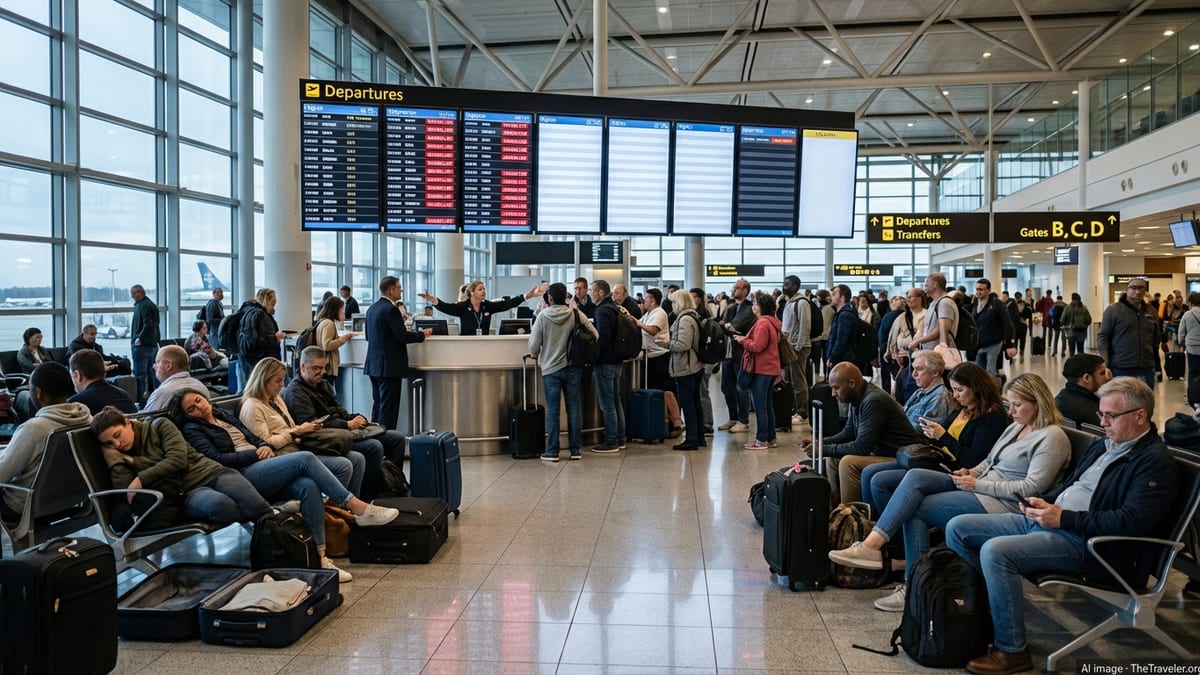
Reports from Russian regional media and international newswires in 2024 and 2025 describe a consistent response when drones approach major urban areas: airports pause arrivals and departures while air defenses attempt to intercept incoming aircraft. In several cases around Moscow, Kaluga and other cities, flights were held in holding patterns or diverted to alternate airports while terminals remained open to passengers on the ground.
One widely reported incident in August 2024 involved the regional airport serving Saratov, a Volga city that also hosts a major military air base. After a Ukrainian drone attack damaged homes in the area, civil flights were temporarily curtailed and only resumed once the airspace was cleared. Similar short suspensions have been documented near Moscow, where drones targeting oil infrastructure and other facilities have prompted air traffic controllers to route civilian jets around active engagement zones.
Aviation analysts emphasize that these interruptions typically last from a few hours to part of a day and rarely result in long term closures. Runways and navigation infrastructure are usually unharmed, meaning passenger operations can resume once debris is cleared and risk assessments are updated. For travelers, the practical impact is more likely to be delays, diversions and missed connections rather than outright cancellation of all services to a region.
How Much of Russian Airspace Is at Risk
Quantifying the potential disruption begins with understanding range. Studies by energy and security researchers indicate that Ukrainian drones have struck targets more than 1,000 kilometers from the front line, reaching as far as refineries and industrial facilities in central Russia. Industry assessments suggest that well over half of Russia’s refining capacity lies within reach of these systems, and many of those plants sit near major cities that are also aviation hubs.
This does not mean, however, that Ukraine can or will systematically shut down Russian civil aviation. Most drone strikes so far have been concentrated on specific refineries, depots and military airfields rather than navigation beacons or passenger terminals. Russia also maintains layered air defense systems around key cities, making it difficult for individual drones to freely overfly major airports without interception.
Current evidence points to a pattern of localized, time limited disruption instead of a nationwide halt. When a large wave of drones is reported, flight tracking data and local coverage often show temporary no fly zones in several regions at once, accompanied by ground stops at a handful of airports. Once the wave passes and debris is cleared, restrictions are lifted and airlines attempt to restore normal schedules, even if aircraft and crews are out of position for several rotations.
Implications for Travelers and Airlines
For passengers inside Russia, the main practical risk is operational unpredictability rather than direct physical harm from strikes. Airlines flying domestic routes must increasingly factor in the possibility of last minute airspace closures or diversions as drones approach high traffic corridors. Travel bloggers and independent aviation trackers have highlighted instances in which aircraft inbound to major hubs were suddenly redirected hundreds of kilometers away, forcing lengthy overland journeys for stranded passengers.
From a planning perspective, this environment complicates route optimization and crew scheduling. Carriers already dealing with sanctions, spare part shortages and restricted access to Western insurance now face another layer of uncertainty. Industry observers say some airlines are building additional slack into rosters and turnaround times on routes that have proven vulnerable to drone activity, particularly in southern and western Russia.
Internationally, most Western carriers stopped flying to Russia soon after the full scale invasion in 2022, and Russia’s skies are closed to many foreign airlines under reciprocal sanctions. That limits the global spillover of current disruptions. The main exposure is for Russian airlines and regional carriers that continue to operate a dense domestic network, along with passengers transiting via third countries that still maintain air links to Russian cities.
Could Ukraine Escalate Pressure on Russian Civil Aviation
Looking ahead, the central question for travel is how far Ukraine’s drone strategy will extend. Security analysts argue that Ukraine has strong incentives to keep focusing on military targets and energy infrastructure that directly support Russia’s war effort. Hitting civilian aviation infrastructure would entail higher legal and political risks and could erode international support, even if such facilities are dual use.
That said, the boundary between military and civilian systems is often blurred. Several Russian air bases that have been struck share runways or airspace with civil facilities, and energy installations targeted by drones supply fuel used by both the military and airlines. As long as such complexes remain in Ukraine’s sights, episodes of knock on disruption for nearby airports and flight paths are likely to continue.
Experts following the conflict suggest that the most plausible scenario is a gradual increase in frequency and geographic spread of short term interruptions rather than a decisive closure of Russia’s skies to civilian traffic. Unless Ukraine were to mount a sustained campaign directly against airports and navigation systems, Russian carriers are expected to keep flying, albeit with growing buffers in schedules and a higher baseline of risk for sudden diversions and delays.
Sources for further reading:
Associated Press coverage of Ukrainian drone attacks affecting Russian airports and refineries
ACAPS and other analytical reports on Ukrainian long range drone strikes
Critical Threats daily updates on strikes against Russian airfields and infrastructure
Oxford Institute for Energy Studies paper on drone risks to Russian refineries and logistics