


The first surprise at Herculaneum is how small it looks from above. Standing on the modern rim of Ercolano, peering down into the excavated bowl of streets and houses, I expected a ruined postcard of Rome-in-miniature. Instead, what emerged over the next few hours was something far more disruptive: a three-dimensional, domestic Rome where people cooked, gossiped, climbed stairs, flushed toilets, and argued over wine prices. Walking through Herculaneum did not just teach me about one buried town near Naples; it rewired the way I understood the entire Roman world.
Get the latest updates straight to your inbox!
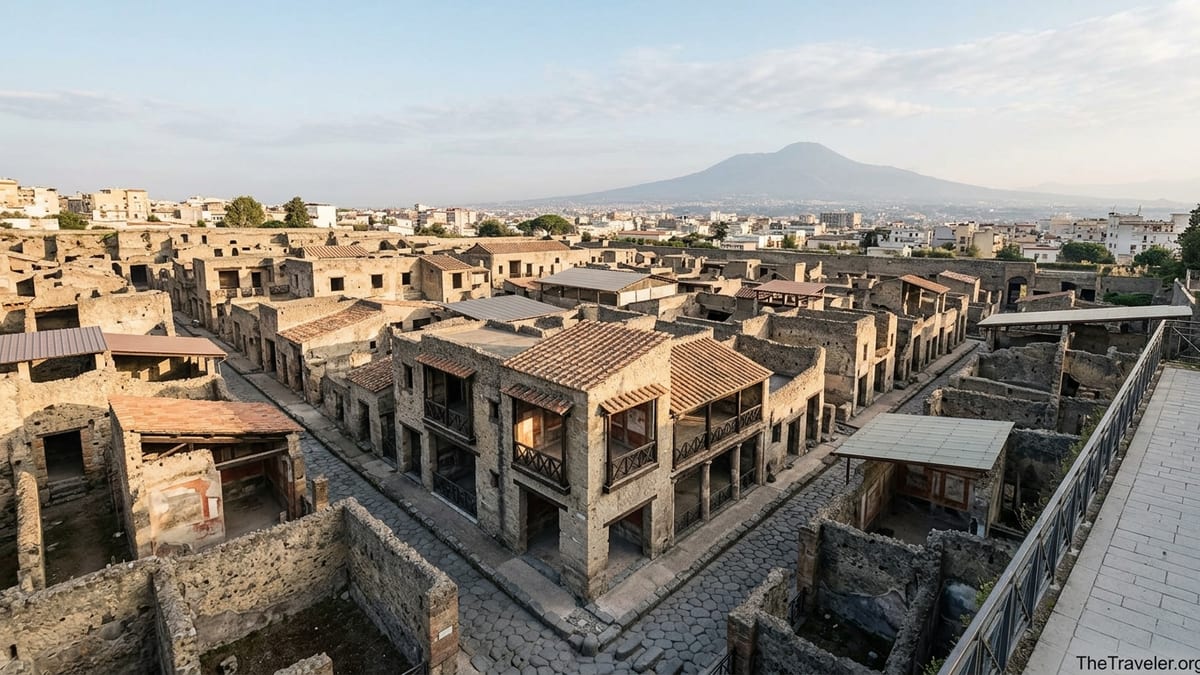
Descending From Modern Ercolano Into a Buried Roman Town
The transition into Herculaneum is unusually physical. You arrive in modern Ercolano on a busy Campanian street, where scooters weave between parked Fiats and bakeries sell cornetti and espresso for about 1.50 to 2 euros. From there, you walk downhill toward a sudden cut in the earth. Only when you reach the railing do you grasp that present-day Ercolano sits roughly 15 to 20 meters above the ancient town, built on the volcanic material that buried it in 79 AD. Looking down, Herculaneum appears like a stage set: a compact rectangle of streets and multi-story houses, framed by high retaining walls and the hum of contemporary life above.
Access is through a sloping concrete ramp and tunnel that carries you under that modern layer and out onto what was once the Roman shoreline. Today the sea is several hundred meters away, but as you emerge at the level of the ancient beach, the air cools and the traffic noise muffles. On summer mornings, the first visitors step onto the ancient breakwater in the soft light just after opening, often around 8:30 or 9:00 a.m., with the ticket gate behind them and Mount Vesuvius looming ahead. Tickets to the Archaeological Park of Herculaneum are currently around 16 euros for adults, with free entry for visitors under 18, making it a manageable half-day investment for most travelers.
What struck me even before entering the streets was the depth of the burial. At Pompeii, you walk straight through walls that rise from a relatively flat landscape. In Herculaneum, you constantly feel the weight of the eruption above you. The pyroclastic flows that engulfed the town created a compact, rock-like cap that sealed the site. That vertical dimension, the sense of a town entombed in a solid cylinder of earth, began to reshape my sense of Roman cities not as fragile outlines on a map but as volumes carved out of time.
Standing at the edge of the former beach, with modern apartment blocks perched high on the rim and the dark, hollowed archways of the ancient boat houses at your back, you start to realize that Herculaneum is not just about what survived. It is also about how thin the line was between our world and theirs. Shops, homes, and latrines lie preserved directly underneath 21st-century balconies festooned with laundry. The continuity feels almost unsettling.
Meeting the Dead at the Ancient Shoreline
The most emotionally jarring moment in Herculaneum often comes at the start. As you turn toward the series of stone vaults that once housed boats and storage along the waterfront, you find row after row of human skeletons. Around 300 people died here, huddled in the boat sheds and on the beach, waiting for a rescue that never came. Their bones lie in situ, some curled in fetal positions, others stretched toward the open water, a few still bearing the marks of jewelry or belts. It is one thing to know that Vesuvius killed thousands; it is another to stand in front of these specific families, caught in the instant when they realized the sea would not save them.
For many visitors, including me, this is where Herculaneum ceases to be an abstract site and becomes a neighborhood. Archaeologists once assumed most residents escaped, because the early excavations in the 18th century uncovered few human remains in the houses. It took modern work along the shoreline in the late 20th century to reveal the truth: the town’s story ended not in orderly evacuation but in sudden, searing catastrophe. Here, the eruption’s heat was so intense that it instantly killed those sheltering in the boat sheds, yet the same conditions carbonized wood, food, and textiles instead of burning them to ash. That paradox of destruction and preservation runs through every street you will walk later.
The shoreline also corrects another persistent myth about Roman cities: that they were static backdrops for grand political dramas. The boat sheds, which once housed fishing vessels and cargo, remind you that Herculaneum was a working port town, plugged into the economy of the Bay of Naples. Today, if you visit the markets in Naples’ Spanish Quarter and see stalls piled with anchovies, sardines, and octopus, you are not far from what the residents of Herculaneum were eating. Excavations of the town’s main sewer, the Cardo V drain, have revealed remains of dozens of fish species and everyday foods such as figs, olives, and cereals, confirming that this was a bustling, ordinary community of shopkeepers, artisans, and sailors, not a museum of marble elites.
Leaving the skeletons behind and climbing the ramp into town, I carried that image of people pressed into the vaults with me. It changed how I read every doorway. A bakery was not just a fine example of a Roman oven; it was the place someone left in a hurry that morning. A latrine was not a curious feature but a daily necessity suddenly abandoned. Instead of picturing anonymous “Romans,” I began to imagine specific households caught mid-week, mid-task, mid-stew.
Stepping Into Multi-Story Roman Homes
Herculaneum is often called the “vertical” complement to Pompeii, and you understand why the moment you look up. Here, unlike in most of Pompeii, upper stories still stand. Wooden balconies cling to facades, staircases twist to second floors, and charred beams support plaster ceilings. In some houses, lattice-work shutters in carbonized wood remain in place. The effect is startling: you are not looking at ground plans, you are walking into intact volumes of space. Rooms stack above one another, just as they do in any modern Italian town.
It is in these houses that Herculaneum rewires your sense of Roman domestic life. In the House of the Relief of Telephus, for example, you can still trace the logic of a wealthy home: an entrance leading to an atrium with an open roof and central pool, side rooms for receiving guests, and a peristyle garden behind. Yet even here, what lingers are not the grand gestures but the details. Door frames are made of carbonized wood, their grain still visible. Cupboards have been left half-open, their interiors darkened by time. In one corner, a staircase rises to an upper floor that once held private bedrooms. You suddenly realize that much of Roman family life was literally upstairs, beyond the reach of most archaeological plans.
A more modest but equally revealing stop is the House of the Wooden Partition. In its main room, a folding wooden screen, carbonized but still standing, divides the space. You can slide your eyes along its panels and imagine someone opening and closing it to create privacy, or to separate business from family life. In modern Ercolano, apartment dwellers still improvise with sliding doors and curtains to turn one room into two. That continuity of improvisation, more than any marble statue, made the Roman house feel familiar.
Walking through these homes also corrected my mental image of Roman interiors as cool, stone boxes. The surviving wooden furniture, ceiling beams, and internal shutters hint at spaces that could be dim, warm, and cozy. In some rooms, traces of woven baskets and wooden chests have been found. On hot afternoons, when the Campanian sun beats down on Herculaneum’s streets, stepping into these shadowed interiors feels like entering a lived-in apartment, the air still and thick with memory.
Shops, Sewers, and the Smell of Everyday Life
Most travelers arrive in Herculaneum expecting temples and frescoes. Many leave talking about the drains. One of the most important discoveries here lies not in a glamorous villa but beneath the streets: a long sewer running under the Insula Orientalis. Excavations of its compacted waste have produced sacks of organic material, including food scraps, seeds, and human excrement. Behind the unromantic detail is a simple revelation: these pipes captured a cross-section of what ordinary people ate and discarded. The picture that emerges is of a surprisingly varied diet, with affordable fish, fruit, vegetables, grains, and the occasional luxury, far beyond the stereotypical bread-and-olive cliché.
When you stand above those streets today, the sewer is invisible, but the infrastructure is not. Look down at the paving stones and you will see raised pedestrian crossings, angled to let carts pass between them while keeping feet dry when water and waste flowed down the roadway. Step into one of the public fountains, still recognizable by their stone basins and carved spouts, and it is easy to picture someone filling an amphora while a neighbor dumps washing water into the gutter. That mix of order and mess, of ingenious engineering and everyday grime, is the Rome that Herculaneum made real for me.
The shops themselves are some of the best preserved in the Roman world. On the main cardo, a thermopolium, or snack bar, still has its L-shaped counter embedded with round terracotta jars that once held prepared foods. The plastered walls behind it carry traces of painted menus and decorative motifs. Archaeologists have found similar bars all over Pompeii, but Herculaneum’s examples, nestled under surviving upper stories, feel like real street-level businesses. Imagine walking past one on a humid August evening in 78 AD, the smell of spiced beans and wine drifting out, prices painted on the wall much as small trattorie in Naples still chalk up their lunch specials today.
Elsewhere, a wine shop features dolia, large storage jars set into the floor, and evidence of shelving above. In one workshop, carbonized wooden racks may once have displayed goods. These modest spaces, roughly the size of small modern storefronts, underline that Roman urban life was stitched together by hundreds of tiny enterprises. Rather than see Rome purely as an empire of emperors and legions, Herculaneum insists you look closer at bakers, innkeepers, and shopkeepers whose livelihoods depended on foot traffic and neighborhood gossip.
Color, Texture, and the Shock of Intact Interiors
Herculaneum is an explosion of color in a way that many visitors do not anticipate. Because it was sealed by dense volcanic material rather than loose ash, its wall paintings and mosaics often preserve a vividness that can feel almost contemporary. In the House of Neptune and Amphitrite, a small dining room is wrapped in deep blue and green glass-paste mosaic, with a central panel showing the sea-god couple framed by intricate borders. Stand there on a bright day and the light from the doorway glints off the tesserae as if someone had cleaned them yesterday.
In many houses, pigments of red, yellow, black, and white expand across walls in geometric panels, framed by delicate imaginary architectures. A narrow corridor might be painted a rich crimson, while a reception room glows with yellow panels and tiny mythological scenes. At floor level, mosaics of black and white tesserae create patterns of waves, vines, or hunting scenes. You find yourself walking carefully, not because the site is fragile, but because the rooms feel complete enough that you worry about tracking dirt across their thresholds.
These interiors forced me to rethink the popular image of ancient Rome as a world of weathered marble. In Herculaneum, houses were not neutral shells; they were curated environments where color and image signaled taste, status, and mood. A modest dwelling might still invest in a single decorated room, just as many Neapolitan apartments today splurge on patterned tiles in the kitchen or a feature wall in the living room. When you compare these spaces to the more stripped walls often seen at other ruins, you realize how much of Roman visual culture we normally miss.
Color also softens the distance between then and now. In some rooms, the painted plaster has flaked away in patches, revealing underlying layers, much like an old palazzo where generations of repainting and repair show through. The conservation shelters that now protect key buildings, built of steel and modern materials, can seem jarring at first, but they are part of the same long story of maintenance and adaptation that once kept these homes habitable. Instead of seeing pure antiquity, you see a palimpsest: ancient paint, 20th-century excavations, 21st-century conservation, and the footsteps of today’s visitors all layered together.
Herculaneum, Pompeii, and Rethinking the Roman City
Most travelers visiting Herculaneum will also see Pompeii, often on separate days from a base in Naples or Sorrento. The comparison is instructive. Pompeii spreads across about 66 hectares, of which roughly two-thirds are excavated, a sprawling grid where you can walk for hours without crossing your own path. Herculaneum, by contrast, is compact, with the main accessible area small enough to cover in two to three hours at a gentle pace. Where Pompeii feels like a metropolis in ruins, Herculaneum reads more as a walkable neighborhood.
This difference in scale changed how I thought about Roman urbanism. Pompeii’s wide forum, grand public baths, and amphitheater foreground civic life and spectacle. Herculaneum focuses your attention on domestic and commercial life. Instead of tracking from temple to basilica, you find yourself ducking into bakeries, peering into bedrooms, and tracing staircases. The verticality and preservation of organic material, from furniture to food, unpack the invisible layers of city life: where people slept, how they stored grain, where they relieved themselves.
It also reframed the relationship between elites and non-elites. In guidebooks, Rome’s story is often told through emperors and senators, villas and marble. Herculaneum shows that a good part of Roman history happened at street level, in houses that combine shopfronts below with cramped accommodation above, not unlike the mixed-use buildings you see along today’s Corso Resina in Ercolano. Archaeological studies of the town’s sewer, for instance, highlight the diet of artisans and shopkeepers rather than the banquets of the wealthy. That bottom-up perspective changes how you picture “Roman society” as a whole.
The practicalities of visiting underline these contrasts. At Pompeii, you may spend around 18 to 26 euros depending on ticket type, then an entire day under the sun, often among large tour groups, tracing big circuits from the Forum to the Villa of the Mysteries. At Herculaneum, the 16 euro ticket buys you a calmer, more concentrated experience, where even in high season you can often find yourself alone in a side street for a few minutes. Many travelers now choose to pair a morning at Herculaneum with an afternoon at the Naples National Archaeological Museum, where statues, bronzes, and frescoes from both towns are displayed, completing the picture of a Roman world that is equal parts glamorous and ordinary.
Walking Herculaneum Today: A Practical, Human-Scale Experience
Logistically, Herculaneum is one of the easiest major archaeological sites in Italy to visit, and this ease reinforces its sense of being a living neighborhood rather than a fenced-off relic. From Naples, frequent Circumvesuviana trains to Sorrento stop at Ercolano Scavi station in around 20 minutes. From there, it is a straightforward 10 to 15 minute downhill walk past cafes, souvenir stands, and small hotels to the park entrance. Coffee near the station typically costs 1.50 euros at the counter, and a simple pizza margherita in a local pizzeria at lunchtime runs around 6 to 8 euros, making it an affordable day trip even for budget travelers.
Inside the park, the route is intuitive. After the ticket check, you cross a modern bridge that offers an excellent overview of the site, then descend to the ancient shoreline and loop through the grid of streets. Audio guides and guided tours are available at the entrance, with small-group tours in English often priced in the range of 30 to 45 euros per person. For many travelers, especially those who have already read a bit about the eruption, a simple printed map from the ticket office and the site’s bilingual information panels are enough to navigate.
The compactness has real advantages if you are traveling with children, older relatives, or anyone who might find the scale of Pompeii overwhelming. Instead of negotiating long, uneven distances under harsh sun, you are never more than a short walk from the exit, restrooms, or shaded areas. Many of the main streets are relatively level, though some side alleys and house interiors involve steps. Comfortable walking shoes with good grip are essential; the basalt paving stones can be slippery when wet, and some thresholds are higher than a standard stair in a modern building.
Time your visit for early morning or late afternoon to avoid the worst heat and crowds. On free-entry days, which Italian authorities occasionally schedule for residents, the site can be much busier, particularly in summer, so if you are planning a once-in-a-lifetime trip, paying the regular ticket price often buys you a calmer atmosphere. Bring a refillable water bottle; fountains near the entrance and in the park are usually available, though it is wise to confirm on arrival, as maintenance schedules can temporarily close some facilities.
The Takeaway
Before I walked through Herculaneum, my mental picture of ancient Rome was dominated by big monuments: the Colosseum, imperial forums, triumphal arches. Cities were lines on a map and ruins were outlines in stone. Herculaneum replaced that flat diagram with something thicker and more intimate. It showed me multi-story homes where carbonized beams still span ceilings, streets where waste and water ran in carefully engineered channels, and shops where counters and jars stand ready for customers who will never return.
Most importantly, Herculaneum shifted the scale at which I imagined Roman life. Instead of seeing “Romans” as a homogeneous, toga-clad crowd, I started to picture bakers waking before dawn, fishmongers hauling in nets from the bay, children running up and down internal staircases, and families gathering beneath painted walls in rooms still glowing red and yellow. The boat sheds at the shoreline, with their clusters of skeletons, anchored that vision in a single terrifying morning in 79 AD. But the rest of the town insisted on something else: the continuity of ordinary life that shaped those final hours.
If you are planning a trip to southern Italy, set aside a few hours for Herculaneum, ideally in addition to Pompeii rather than instead of it. Come not just for the frescoes or the famous mosaics, but to experience how a compact, vertical, deeply human town can transform your sense of an entire civilization. Walking those streets, you realize that ancient Rome was not mainly a story of emperors and armies. It was, above all, a mosaic of neighborhoods like this one, where history unfolded one conversation, one purchase, and one shared meal at a time.
FAQ
Q1. How long do I need to visit Herculaneum properly?
Most travelers find that 2 to 3 hours is enough to walk the main streets, visit several houses, and spend time at the ancient shoreline and boat sheds without rushing.
Q2. Is Herculaneum suitable for children and older visitors?
Yes, its compact size and relatively short walking distances make it more manageable than Pompeii, though cobblestones, steps, and uneven surfaces still require good footwear and some mobility.
Q3. How much does it cost to visit Herculaneum?
Standard adult tickets are currently around 16 euros, with free entry for visitors under 18; check locally for possible discounts or occasional free-entry days.
Q4. Can I visit Herculaneum and Pompeii on the same day?
It is possible but often exhausting. Most visitors get more from each site by dedicating a separate half or full day to each rather than combining them.
Q5. What are the must-see spots inside Herculaneum?
Highlights include the ancient boat sheds at the shoreline, the House of the Relief of Telephus, the House of the Wooden Partition, the House of Neptune and Amphitrite, and the thermopolium snack bars.
Q6. How do I get to Herculaneum from Naples?
Frequent Circumvesuviana trains toward Sorrento stop at Ercolano Scavi station; from there it is a 10 to 15 minute downhill walk to the archaeological park entrance.
Q7. Do I need a guided tour, or can I visit independently?
You can easily visit on your own using the site map and information panels. Guided tours and audio guides add helpful context, especially if you want a deeper understanding of daily life and recent discoveries.
Q8. When is the best time of day to visit Herculaneum?
Early morning and late afternoon generally offer cooler temperatures, softer light for photography, and smaller crowds than the peak midday hours.
Q9. What should I wear and bring for a visit?
Wear sturdy walking shoes, light clothing suitable for the season, a hat, and sunscreen. Bring a refillable water bottle and consider a small snack, as options inside the park are limited.
Q10. How is Herculaneum different from Pompeii?
Herculaneum is smaller, more vertical, and better preserved in terms of upper stories, wood, and interiors, giving a more intimate view of everyday life, while Pompeii offers a broader picture of a large Roman city with major public buildings.