


Standing on a Naples train platform, scanning the departures board for the Circumvesuviana line, many travelers face the same dilemma: should you spend your precious time at world-famous Pompeii, or slip one stop earlier and explore the more compact ruins of Herculaneum instead? With limited days in Italy and crowded itineraries, choosing wrong can mean either frustration or a major case of FOMO. The good news is that both sites are extraordinary. The better news is that one of them is likely a much better fit for your style, schedule, and stamina.
Get the latest updates straight to your inbox!
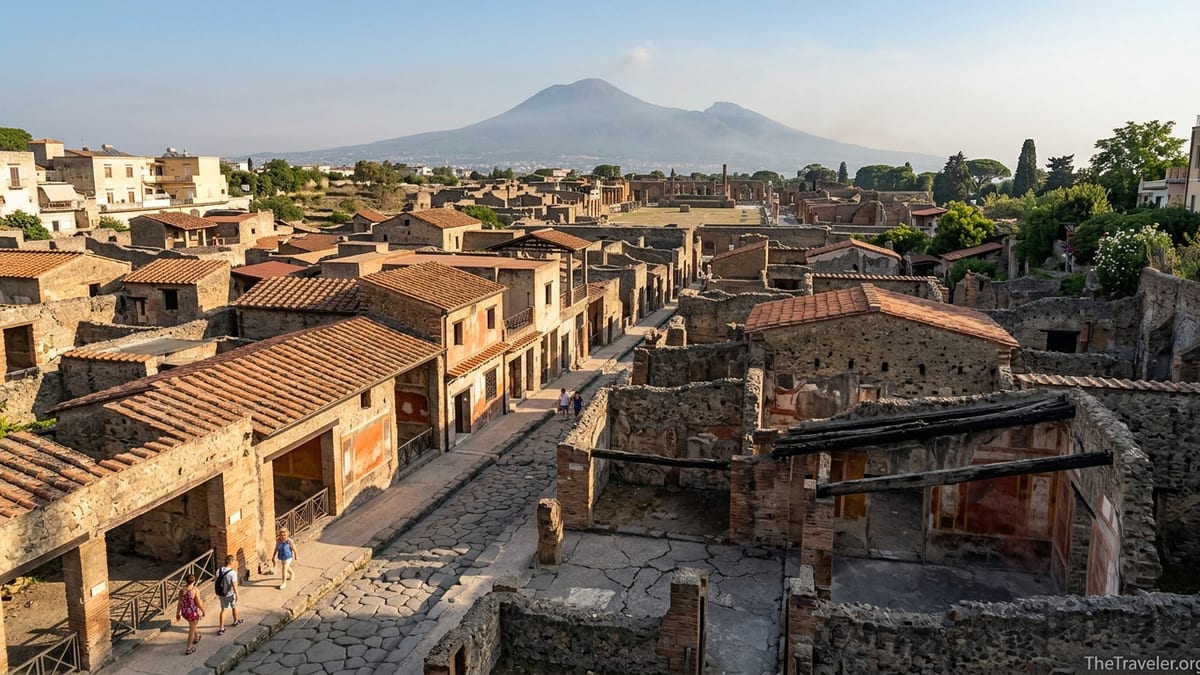
Big Picture: How Pompeii and Herculaneum Actually Feel
Pompeii and Herculaneum were both destroyed in the AD 79 eruption of Mount Vesuvius, yet the experience of walking through them today could not be more different. Pompeii is a vast, partially ruined city, mostly buried under ash and pumice. Herculaneum was entombed in a thick, fast-moving slurry of volcanic material, which carbonized timber and sealed upper floors, balconies, and even doors and furniture in remarkable detail. Strolling Pompeii feels like wandering through a ghost metropolis. Herculaneum feels like cutting through a still-intact neighborhood that was abruptly abandoned.
For many first-time visitors, Pompeii delivers that cinematic “I’m really in ancient Rome” punch. You enter through Porta Marina, tread deeply rutted streets paved with basalt blocks, and within minutes are walking past the forum, bathhouses, bakeries with stone mills, and the famous brothel frescos. Herculaneum, reached via a ramp that descends into a bowl below the modern town of Ercolano, feels surprisingly intimate: multistory houses crowd close together, wooden shelving and doors survive in situ, and vivid murals and mosaics seem to glow from the shadowy interiors.
Because Herculaneum is smaller and better preserved, it is often described as more “emotional.” You look into what are clearly real homes, with carbonized wooden cribs, storage chests, and even tufts of charred cloth. At Pompeii, the emotional impact comes from scale rather than intimacy. You might stand at a street corner where you can see multiple city blocks in all directions and still not have reached the edge of the site.
Whichever you choose, you are not comparing “good” versus “bad” but two different flavors of world-class archaeology. The decision is less about which one is worth visiting and more about which one is worth visiting first, given your time, energy, and interests.
Practicalities: Location, Transport and Time Needed
From central Naples, both sites sit on the same eastbound Circumvesuviana railway that runs toward Sorrento. Trains on the Napoli–Sorrento line generally take about 15 to 20 minutes to Ercolano Scavi station for Herculaneum and around 35 to 40 minutes to Pompei Scavi–Villa dei Misteri station for Pompeii. Outside of strikes or temporary disruptions, trains run roughly every 20 to 30 minutes at busy times, with more gaps in the middle of the day and on Sundays.
The walk from Ercolano Scavi station to Herculaneum is straightforward and short. You exit the station, head straight down Via IV Novembre, and in around 8 to 10 minutes you are at the ticket office. For Pompeii, the Pompei Scavi–Villa dei Misteri stop leaves you practically at the Porta Marina entrance, with only a couple of minutes’ walk. In both cases, budget an hour door-to-door from central Naples to be safe, especially if you need to buy train tickets at the station or navigate crowds.
Time on site is where the real contrast lies. Most travelers find Herculaneum comfortably “done” in about 2 hours. A detailed visit with an official guide or high-quality audio guide may stretch to 3 hours, but the scale remains manageable even for visitors with mobility issues or young children. Pompeii, by comparison, can easily fill an entire day. A focused visit that hits the forum, amphitheater, a few houses, the Stabian Baths, and the Lupanar still takes at least 3 hours at a brisk pace. Many travelers report 5 to 6 hours on site without seeing everything.
If your itinerary allows only a half day from Naples, Herculaneum is often the more relaxed choice. If you have a full day and stamina for long walks on uneven stone, Pompeii justifies the extra time. From the Amalfi Coast (Sorrento, Positano, Amalfi), Pompeii is usually more convenient, as it sits closer to Sorrento on the same line, but doing both in one very long day is possible for fit travelers in dry weather.
Tickets, Opening Hours, and Crowds
Both sites are part of the same UNESCO World Heritage listing and fall under Italy’s Ministry of Culture, but tickets and crowd patterns differ. As of mid-2026, standard single-day tickets for Pompeii are more expensive than Herculaneum and must be prebooked on the official seller (currently TicketOne via the Pompeii Archaeological Park) for a specific date and, in many cases, a timed entry slot to control daily visitor numbers. At busy times between roughly April and October, standard adult tickets for Pompeii typically sit in the low-to-mid 20 euro range. Combination passes that include suburban villas and nearby sites cost more. Herculaneum’s base ticket is usually a bit cheaper, often in the mid-teens, with reduced fares for EU youth and other eligible visitors.
In terms of opening hours, both sites usually operate from 9:00 a.m., with longer hours in the warmer months and earlier closing in winter. In 2026, Pompeii’s typical schedule runs until the early evening from April through October, then closes mid-to-late afternoon in winter, with last entry 90 minutes before closing. Herculaneum follows a similar pattern, opening daily except for major holidays such as 1 January and 25 December. Exact hours and any special closures can change for conservation work or events, so travelers should always confirm closer to their travel date.
The crowd experience is where the two diverge most. Pompeii remains one of Italy’s most visited attractions, with peak-season days drawing many thousands of visitors. On a July morning, bus tours from Rome and Florence start arriving by 9:30 a.m., queues form at ticket checks, and popular houses or the forum can feel very busy by late morning. Herculaneum, although not empty, usually sees a fraction of that footfall. Even in high season, many visitors report stepping into relatively quiet side streets or standing alone in upper rooms, something that rarely happens in central Pompeii during the day.
If you cannot tolerate dense crowds or are visiting in July and August with kids or older relatives, Herculaneum can feel like a gift: shorter lines, more shade, and space to linger over a mosaic without being rushed along by large groups. On the other hand, if you are visiting in shoulder season such as late October or early March, Pompeii’s crowds thin out considerably, and early morning or late afternoon visits can be surprisingly peaceful while still giving you the drama of a much larger site.
What You Actually See: Preservation and Atmosphere
Herculaneum’s great strength is preservation. Because it was buried under deeper, denser material, entire upper stories of houses, wooden beams, doors, and furniture survived in a carbonized state. In certain insulae you can still see intricate wooden latticework, staircases, and shelves. Wall paintings retain startlingly bright reds, blues, and yellows, and delicate mosaics on floors and fountains look like they were finished decades rather than millennia ago. You can peer into an ancient tavern, its wooden counter still in place, or into a storeroom where amphorae sit in their original racks.
Peppered through the site are intensely moving spots, such as the vaulted boat sheds where dozens of skeletons were discovered, believed to be residents who fled to the shoreline during the eruption. While plaster casts like those at Pompeii are less prominent, the raw archaeological evidence of those final moments is difficult to forget. Overall, Herculaneum feels like an archaeological jewel box, small but packed with texture, color, and detail.
Pompeii, by contrast, is less about intact interiors and more about urban scale. Many houses lost their upper floors, and timber rarely survives, so you walk through roofless spaces where sky pours in. What you gain is the sense of being in a complete Roman city: long straight decumanus roads, traffic ruts from carts, stepping stones to cross flooded streets, and water fountains on corners. The forum with its colonnades, the grand amphitheater, and the large public baths convey Roman civic life in a way Herculaneum cannot, simply because Herculaneum is so much smaller.
Pompeii also offers some standout individual sights: the Villa of the Mysteries with its enigmatic red frescoes on the outskirts of town; the theaters; the gladiator barracks; and, of course, the casts of victims caught mid-flight or in prayer. These casts are not only visually striking; they also shape many visitors’ lasting memories of the site. If what you are after is the “classic” Pompeii imagery you have seen in documentaries, you are more likely to find it at Pompeii than Herculaneum.
Comfort, Accessibility, and Travel Styles
In practical comfort terms, Herculaneum is generally gentler. The area you can visit is compact, and many paths are relatively level compared to Pompeii’s long, uneven basalt streets. There are still steps, slopes, and cobbles, and it is not fully accessible for anyone with significant mobility issues, but visitors who struggle with long walks or heat often cope better here. Shade is more plentiful too, thanks to narrower streets and more complete roofs. This matters in mid-summer, when temperatures in the Bay of Naples region often climb well above 30 degrees Celsius and stone surfaces radiate heat well into the afternoon.
Pompeii can be physically demanding. Even a three-hour visit can rack up several kilometers of walking on hard, irregular surfaces. It is common to see travelers in flip-flops or fashion sneakers regretting their choice halfway through the day. If you choose Pompeii, bring sturdy shoes with grip, a hat, sunscreen, and plenty of water. There are snack bars and water fountains on site, but in peak heat you may find yourself planning your route based on where little patches of shade are. Families with strollers frequently report difficulty navigating the high kerbs and stepping stones.
Your travel style should also guide your choice. Independent travelers who love to wander backstreets, take photographs, and read interpretive panels at their own pace often appreciate Herculaneum’s lower-key vibe. It is easy to find a moment of quiet contemplation in front of a frescoed wall, and photography is more relaxed when you are not jockeying for position with tour groups. Travelers who thrive on big, dramatic “bucket list” experiences, or who have studied Roman history and want to see a full city plan, may feel shortchanged if they skip Pompeii entirely.
Guided tours are available for both sites, often departing from Naples or Sorrento. A typical small-group half-day Pompeii tour might include return transport, a two-hour guided walk, and some free time, while combined full-day tours stop at Pompeii in the morning and Herculaneum or Mount Vesuvius in the afternoon. For Herculaneum, hiring a local guide at the gate is usually easy on the day, especially outside of the very busiest weeks, and the smaller size of the site lends itself to rich, in-depth storytelling in just a couple of hours.
Which Is Better for Different Types of Travelers?
If you are a first-time visitor to Italy with a strong interest in history but only one day for ruins, Pompeii still edges ahead. Its name recognition, vast cityscape, and iconic sights give you a deeper sense of Roman urban life. Many travelers flying back home would regret having been so close and not seeing it. In that case, you can make the experience more manageable by prioritizing: focus on one or two neighborhoods, the forum, one set of baths, the amphitheater, and one or two famous houses, rather than trying to “do everything.”
For travelers with limited mobility, young children, or a serious aversion to crowds, Herculaneum may be the smarter primary choice. A family staying in Naples with a jet-lagged five-year-old, for example, will usually have a better day walking the short distance from Ercolano Scavi station, spending two unrushed hours inside the site, then retreating for gelato in the modern town rather than dragging everyone through a full day at Pompeii in the heat. The quality of the remains is high enough that no one in the family will feel they have seen a “second-tier” site.
Art and archaeology enthusiasts who can spare at least a day and a half in the region should strongly consider visiting both, ideally on different days. One practical pattern is to devote a full day to Pompeii from Naples or Sorrento, then visit Herculaneum on your transfer day between Naples and the Amalfi Coast, stopping for two hours on the way. Another is to pair Herculaneum with the National Archaeological Museum in Naples, where many of the finest mosaics and artifacts from both sites are housed. Seeing the villas in situ and then the delicate pieces in climate-controlled galleries is a powerful combination for anyone who cares about material culture.
If your time is so constrained that you can only spare three or four hours round-trip from Naples, Herculaneum is almost always the better bet. You will spend less time queuing, walking long distances, and navigating crowds, and more time actually looking at well-preserved Roman homes. On a squeezed itinerary where every hour counts, that trade-off often feels worth it.
The Takeaway
So is Herculaneum worth visiting, or is it better to visit Pompeii instead? In reality, the answer depends less on which site is objectively “better” and more on what you want your day near Vesuvius to feel like. If your dream is to roam a ruined Roman city, stand in a vast forum with Vesuvius looming behind broken columns, and tick off an undeniable world icon, Pompeii should be your first stop. It asks more of you in time and energy but delivers big-scale drama in return.
If, on the other hand, you value detail over scale, dislike crowds, or have only a half day to spare, Herculaneum absolutely is worth visiting, and not as a consolation prize. Its compact footprint, beautifully preserved houses, carbonized wood, and vivid frescoes offer a vision of Roman daily life that is arguably more intimate and emotionally resonant than anything you will see at Pompeii. Many travelers who have seen both come away saying that, if they had to choose only one to revisit, they would pick Herculaneum for the quality of the experience.
In an ideal world, you would see both sites and the museum in Naples. But travel is full of trade-offs. With a clear sense of your priorities, a realistic look at your schedule, and an understanding of what each site does best, you can choose the ruins that will leave you inspired rather than exhausted. Whether you step off the train at Pompei Scavi–Villa dei Misteri or Ercolano Scavi, the essential thing is the same: you are about to walk the streets of a vanished world, still echoing with the lives that once filled them.
FAQ
Q1. Is it realistic to visit both Pompeii and Herculaneum in one day?
It is physically possible to visit both in one long day from Naples or Sorrento, but it is usually rushed. Most travelers who attempt this report spending about three to four hours at Pompeii in the morning, then two hours at Herculaneum in the afternoon, often in considerable heat. If you have only one full day, a better strategy can be to choose Pompeii alone, see it properly with a guide, and leave Herculaneum for a future trip.
Q2. Which site is better if I am traveling with small children?
Herculaneum is generally easier with young kids because it is smaller, has more shade, and involves less walking on uneven streets. You can explore a good portion of the site in 90 minutes to two hours, which matches many children’s attention spans. Pompeii can still work with kids who love history, but expect more fatigue and plan for frequent breaks, snacks, and shade.
Q3. How far in advance should I buy tickets for Pompeii and Herculaneum?
For Pompeii, especially between April and October or on weekends, it is wise to book timed-entry tickets as soon as they are released, often four to six weeks before your travel date. They can sell out for popular time slots. Herculaneum usually has more day-of availability at the ticket office, but in peak summer it is still sensible to purchase in advance if your schedule is tight or you want to combine your visit with a guided tour.
Q4. Are guided tours worth it, or can I visit on my own?
Both sites can be visited independently with a guidebook or audio guide, but a knowledgeable licensed guide can bring the ruins to life with stories and context you might otherwise miss. At Pompeii, a three-hour small-group or private tour is often the difference between wandering aimlessly and following a thoughtful route through key houses, streets, and public buildings. At Herculaneum, a two-hour guided visit can highlight details of preservation, daily life, and the eruption that are easy to overlook on your own.
Q5. Which ruins are better for photography?
For sweeping street scenes and dramatic views with Mount Vesuvius in the background, Pompeii is superior because of its size and open vistas. Photographers can capture long perspectives down basalt streets, wide shots of the forum, and the amphitheater’s curves. Herculaneum is better for close-up details: rich wall colors, mosaics, wooden beams, and intimate interiors. If you enjoy architectural and documentary-style photography, you will likely appreciate both, but you will shoot very different images at each site.
Q6. How should I dress for a visit to Pompeii or Herculaneum?
Wear sturdy, closed-toe shoes with good grip, as both sites involve walking on uneven stone and occasional steps. In warm months, light breathable clothing, a hat, and sunglasses are essential, along with sunscreen and a refillable water bottle. Even in shoulder seasons, sudden sunshine on exposed stone can be intense. In cooler months, bring layers and a waterproof jacket, since wind and rain can sweep across the open areas.
Q7. Is one site safer or more comfortable for travelers with mobility issues?
Neither site is fully accessible in the way a modern museum might be, but Herculaneum tends to be kinder to visitors with mild mobility limitations because of its smaller size and shorter walking distances. Pompeii has introduced some accessible routes and ramps, yet the overall area is large and the ancient paving is unforgiving. Travelers who use canes, have knee problems, or tire easily will usually find Herculaneum more manageable, especially if paired with plenty of breaks.
Q8. Can I combine a visit to the ruins with a trip to Mount Vesuvius?
Yes, many organized day tours from Naples and Sorrento combine Pompeii with an afternoon hike on Mount Vesuvius, often including transport up to the trailhead near the crater. Doing Pompeii plus Herculaneum plus Vesuvius in one day, however, is too ambitious for most people. If you want to add Vesuvius, it generally pairs better with Pompeii, while Herculaneum fits naturally with a quieter day or with a visit to the Archaeological Museum in Naples.
Q9. If I have already visited Pompeii once, is Herculaneum still worth my time?
Absolutely. Many travelers who have seen Pompeii on a previous trip say Herculaneum feels surprisingly fresh and different. Its scale, preservation of wood and upper floors, and intimate residential streets offer a new angle on Roman life rather than a repeat of what you have already experienced. For repeat visitors to the Bay of Naples, Herculaneum is often the perfect way to deepen, rather than duplicate, your understanding of the AD 79 eruption and its impact.
Q10. I am staying in Rome. Is a day trip to either site worthwhile, or is it too rushed?
A day trip from Rome to Pompeii or Herculaneum is long but very common. High-speed trains between Rome and Naples take around 70 minutes, and from there you connect to the Circumvesuviana train. If you catch an early departure from Rome and a late return, you can manage roughly five hours on site at Pompeii or combine a shorter visit to Herculaneum with time in Naples. It will be a packed day, but for many travelers, seeing at least one of the ruins is worth the effort.