


Smaller, quieter and astonishingly well preserved, Herculaneum is often described as Pompeii’s more intimate sister. For first-time visitors to southern Italy, this compact archaeological site in the modern town of Ercolano offers a vivid snapshot of Roman life, from multistory homes to carbonised wood and colorful frescoes. This guide walks you through everything you need to know to plan a smooth and rewarding first visit, based on current local information and what travelers are actually experiencing on the ground today.
Get the latest updates straight to your inbox!
Why Herculaneum Belongs On Your Italy Itinerary
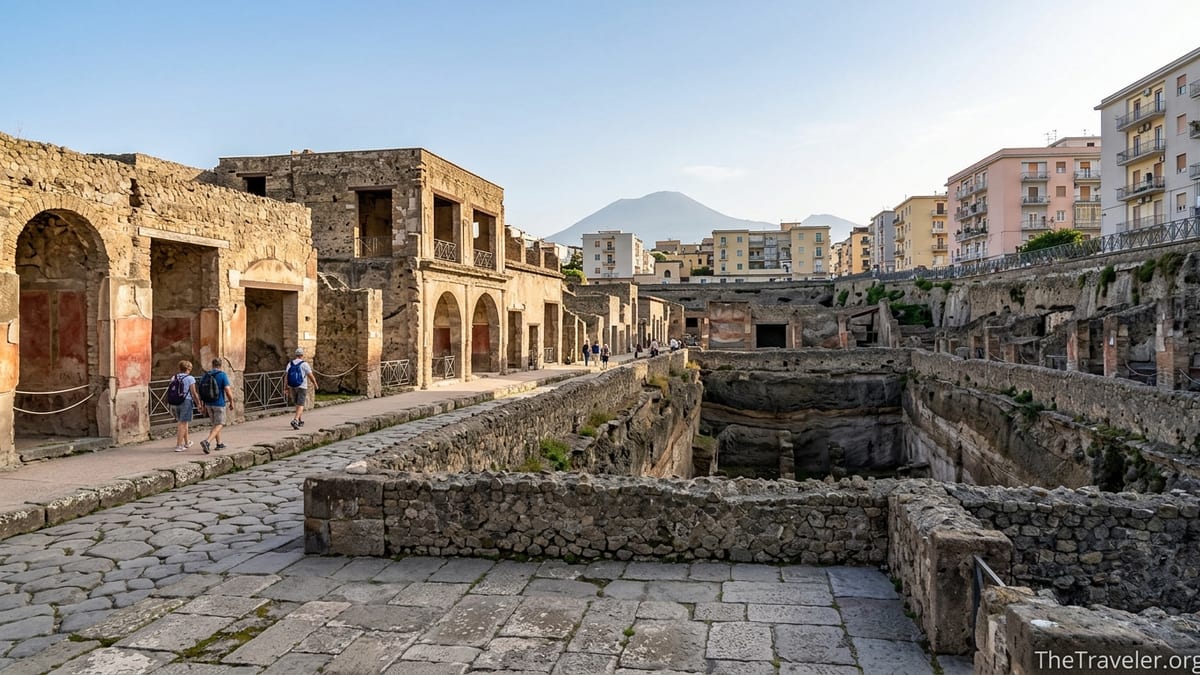
Herculaneum was a prosperous Roman seaside town buried by the eruption of Mount Vesuvius in 79 CE. Unlike Pompeii, which was mostly covered in ash and pumice, Herculaneum was engulfed in superheated pyroclastic flows that carbonised organic materials. As a result, today you can see details that rarely survive at other ancient sites: wooden beams, doors, furniture fragments and even parts of upper stories. Walking past these preserved balconies and shopfronts feels surprisingly close to stepping into a real Roman neighborhood.
For a first-time visitor, the biggest advantage of Herculaneum is its size. The excavated area is compact enough to see thoroughly in 2 to 3 hours without the long, hot walks that make Pompeii so tiring. Many travelers who have visited both say that Herculaneum offers a more concentrated, less overwhelming experience, especially if you enjoy architecture and domestic life more than vast ruined streets.
Herculaneum is also typically less crowded than Pompeii. While tour buses do arrive, visitor numbers are lower and the narrow streets can feel almost peaceful in the first hour after opening or toward late afternoon. This makes it easier to pause in front of a mosaic or fresco without being hurried along. First-timers often find that starting with Herculaneum builds their confidence to tackle larger sites later in their trip.
Finally, the site is well linked with Naples and the Amalfi and Sorrento coasts, so it works easily as a half-day trip. Many visitors pair a morning at Herculaneum with an afternoon bus trip up to Vesuvius, or visit on their way between Naples and Sorrento using the local train network.
Tickets, Opening Hours and Passes
Herculaneum is part of the Archaeological Park of Herculaneum, which publishes up-to-date information on tickets and hours. As of mid-2026, standard adult tickets typically cost in the low to mid teens in euros. There are reduced prices for young EU visitors and periodic free-entry days set by the Italian Ministry of Culture, especially on the first Sunday of some months, though these can be very busy.
The site usually opens daily in the morning, with last entry set roughly 90 minutes before closing time. Closing times change seasonally, with longer hours in summer and shorter hours in winter. Before you fix a schedule, check the latest times on the official park channels or at your hotel reception; small adjustments to opening hours are common, particularly around public holidays or heat alerts.
If you are planning to visit several sites around the Bay of Naples, such as Pompeii, Oplontis and the Archaeological Museum in Naples, it can be worth looking at regional passes that include Herculaneum. For example, recent versions of the Campania Artecard have offered free entry to your first sites plus half-price entry afterward over several days, along with local public transport in the Naples area. Travelers have used this to cover Naples to Ercolano Scavi on the Circumvesuviana train and combine both Herculaneum and Pompeii in one pass period.
Many visitors now prebook timed entry tickets or guided tours through tour operators and resellers. While same-day tickets are often available at the gate outside peak holiday weekends, prebooking a morning entry slot can help you avoid queues, especially in May, June and September when cruise arrivals spike. For a first visit, consider a small-group or private tour that starts inside the site: prices typically range from about 25 to 60 euros per person depending on group size and whether tickets and transport are included.
How To Get To Herculaneum
The easiest way to reach Herculaneum from Naples is by local train. From Napoli Centrale station, you follow signs down to the platforms used by EAV local services. Here you can board a train that stops at Ercolano Scavi, the station for Herculaneum. Regional guides and recent traveler reports indicate that the journey takes around 15 to 20 minutes, and a single ticket usually costs only a few euros. From Ercolano Scavi, it is a short downhill walk of roughly 600 to 700 meters along a straight main road toward the sea to the archaeological park entrance.
There are two main train options. The traditional Circumvesuviana commuter trains are cheap and frequent but can be crowded at rush hour and in summer. A tourist-focused service, often referred to as the Campania Express, runs fewer times per day but offers reserved seats, luggage space and air conditioning for a higher ticket price. Both use the same rail corridor between Naples and Sorrento, but not every train stops at Ercolano Scavi, so always check the screens on the platform and the stopping pattern before boarding.
If you are staying in Sorrento or along the Sorrento Peninsula, you can also take these same trains in the opposite direction toward Naples. The ride from Sorrento to Ercolano Scavi generally takes about 50 to 60 minutes. Some visitors break up a transfer day between Naples and the Amalfi Coast with a few hours at Herculaneum, leaving luggage at their accommodation or a left-luggage facility in Naples before heading to the ruins.
Driving is possible but generally not recommended for first-time visitors unfamiliar with Italian city traffic. The modern town of Ercolano is busy and parking near the site can be scarce or relatively expensive, especially in high season. If you do arrive by car, small private lots and garages near the entrance typically charge an hourly or flat day rate. An alternative is to join an organized excursion from Naples, Sorrento or Salerno, which usually includes return transport in a minibus or coach and a guided visit inside the ruins.
Planning Your Visit: Timing, Routes and What To See
For most first-time visitors, 2 to 3 hours inside Herculaneum is enough to explore at a comfortable pace, with time for photos and a short break. The best times of day are usually right at opening or in the last two hours before closing, when group tours thin out and the sun is lower. Midday, especially in July and August, can be very hot, and shade inside the site is limited despite some modern walkways and shelters.
Once you enter, you descend a ramp that overlooks the buried shoreline and the arched boat chambers where many skeletons were found. From here you can look back at the modern town built above the ancient ruins, a vivid reminder of how deep the eruption debris is. Many visitors start by walking the main decumanus, the east-west avenue, then branching into side streets to explore individual houses and shops, before finishing near the ancient baths and forum area.
Highlights for first-timers include the House of the Deer, with its terrace that once looked directly out to the sea, and the House of the Mosaic Atrium, where a striking black and white geometric floor greets you as you step inside. At the House of the Wooden Partition you can still see an original sliding wooden screen. The Suburban Baths are another essential stop, with preserved wall paintings and mosaics that show how luxurious a Roman bathing complex could be at a relatively small town.
Information panels throughout the site describe key buildings in Italian and English, and there is often a small orientation exhibition near the entrance with models and finds. Audio guides are sometimes available for rent at the ticket office, though availability can vary, and many travelers now download offline audio tours or maps in advance. If you prefer context and storytelling, a licensed guide remains the most efficient way to understand what life here looked and felt like on the eve of the eruption.
Herculaneum vs Pompeii: Which Is Better For You
For a first-time visitor to the Bay of Naples, the question often arises: if you can only pick one, should you choose Pompeii or Herculaneum? The answer depends on what you most enjoy. Pompeii is vast and dramatic, with an amphitheater, long streets and big public spaces. Herculaneum is more compact and concentrated, with better-preserved homes and details. Many travelers find that families with younger children or visitors who tire easily appreciate the shorter distances and shaded lanes at Herculaneum.
In terms of time investment, a typical visit to Herculaneum takes a morning or afternoon. Pompeii, by contrast, can easily fill a full day if you want to cover its main attractions such as the Forum, the Villa of the Mysteries, and several houses scattered across the site. First-timers who have only one full day in the region sometimes choose Herculaneum for a deeper yet less exhausting look at Roman life, especially if they also plan to see Roman collections in the National Archaeological Museum in Naples.
Budget is another consideration. Standard ticket prices for Pompeii and Herculaneum are typically in a similar range, but guided tours at Pompeii are sometimes slightly more expensive simply because routes take longer and groups may need additional time. On the other hand, combined tickets or passes occasionally offer value if you visit both sites within a few days. Recent examples include tickets valid for multiple Vesuvian sites such as Pompeii, Herculaneum, Oplontis and Boscoreale, which can be attractive for history enthusiasts.
If you have two days available, a practical approach for a first trip is to dedicate a full day to Pompeii and a separate half day to Herculaneum, with a relaxed lunch in Ercolano or a visit to nearby coastal viewpoints. This gives you time to compare the different ways the eruption affected each site, and to appreciate how Herculaneum’s deep layers and preserved upper stories complement Pompeii’s wider cityscape.
On-Site Practicalities: Facilities, Food and Accessibility
Herculaneum has a ticket office, security check and basic visitor services near the entrance. There are toilets both at the entrance area and at certain points within the site, though facilities inside the ruins can be limited compared with large modern museums. It is sensible to use the restroom before you start exploring, especially if you are visiting with children or have mobility needs.
There is usually a small café or snack bar near the entrance where you can buy coffee, soft drinks, sandwiches and simple snacks at typical Italian tourist-site prices. Some visitors prefer to bring a refillable water bottle and light snacks from Naples or Sorrento, as food options around the site entrance include basic pizzerias, gelato stands and a few sit-down restaurants along the main street leading up from Ercolano Scavi station. Prices vary: a takeaway slice of pizza or a panino may cost only a few euros, while a full restaurant meal with antipasti, a main course and drinks can easily reach several tens of euros per person.
In terms of accessibility, Herculaneum has made significant efforts in recent years to improve pathways and signage. However, it remains an archaeological site with uneven surfaces, steps and occasional steep sections. Some raised walkways make it easier for visitors with limited mobility to view key areas without descending into every street. If you use a wheelchair or have difficulty with stairs, check the most current accessibility map from the park or ask staff at the entrance which route they recommend; they can often point out step-free viewpoints and less challenging loops.
Shade within the ruins is partial. While some streets are bordered by buildings that cast shadows, the central areas can be very exposed in the middle of the day. In summer, most visitors wear a hat, sunscreen and lightweight breathable clothing. Comfortable closed shoes or sturdy sandals are essential, as ancient paving stones are uneven and can be slippery when wet. Bringing a compact umbrella can be useful for unexpected showers in spring or autumn.
Combining Herculaneum With Vesuvius Or Naples
Many first-time visitors choose to combine Herculaneum with a trip up Mount Vesuvius on the same day. The most straightforward way to do this is to travel by train to Ercolano Scavi in the morning, visit Herculaneum, then walk back toward the station to join a shuttle service such as Vesuvio Express. These local operators typically sell combined bus-and-park-entrance packages, with departures timed to match shuttle returns from the crater. Prices evolve, but expect to pay a moderate supplement over the official park ticket for the convenience of direct transport from Ercolano.
A typical schedule might be to arrive at Herculaneum shortly after opening, spend about 2.5 hours exploring, have a quick lunch near the station, then board an early afternoon bus up Vesuvius. This often allows you to reach the crater rim, walk the popular circular path with views over the Bay of Naples and the islands, and return to Ercolano Scavi in time to catch a train back to Naples or Sorrento before dinner.
Another popular combination is Herculaneum plus the National Archaeological Museum of Naples. Many of the finest frescoes, mosaics and everyday objects from both Pompeii and Herculaneum are displayed there, including intricate wall paintings from Herculaneum villas. If you enjoy seeing artifacts in context, you might visit the ruins one day and the museum the next, or reverse the order so that the museum’s exhibits help you understand what you are seeing on the ground.
Travelers with more time often weave Herculaneum into a broader Vesuvian itinerary that includes the smaller site of Oplontis at Torre Annunziata or the villas along the so-called Golden Mile near Ercolano. These coastal villas, once owned by wealthy Romans, offer a glimpse of the luxury lifestyle that flourished here before the eruption, and some are accessible by the same train line and short taxi rides.
The Takeaway
For first-time visitors to southern Italy, Herculaneum offers one of the most rewarding and manageable encounters with the ancient Roman world. Its compact size, exceptional preservation and easy access from Naples and Sorrento mean you can see multistory houses, vivid frescoes and carbonised wooden details in just a few hours, without the fatigue that often accompanies a full day at a larger site.
With a little planning around train schedules, tickets and timing, your visit can run smoothly. Arriving early or late in the day, wearing comfortable shoes and sun protection, and considering a guided tour or audio guide will all help you get more from the experience. Whether you pair Herculaneum with Vesuvius, combine it with the museums of Naples, or simply slot it into a relaxed coastal itinerary, it is a destination that tends to stay with travelers long after they leave.
Most importantly, Herculaneum brings the everyday Roman world startlingly close. As you walk past shop counters, climb ancient steps and look back up at the modern town perched above the ruins, you gain a rare sense of how history, landscape and modern life intersect around Vesuvius. For many first-time visitors, that combination of intimacy and drama is what makes Herculaneum unforgettable.
FAQ
Q1. How long do I need to visit Herculaneum for the first time?
Most first-time visitors find that 2 to 3 hours inside the site is enough to see the main houses, baths and streets at a comfortable pace.
Q2. Is Herculaneum suitable for children and older travelers?
Yes, the site is compact, with shorter walking distances than Pompeii, which makes it manageable for families and older visitors, though surfaces are uneven.
Q3. Can I visit Herculaneum and Pompeii on the same day?
It is possible but can be tiring. If you try, start very early, limit your route in Pompeii, and plan for long walks and exposure to sun and heat.
Q4. What is the best way to get to Herculaneum from Naples?
The most practical option is the local train that stops at Ercolano Scavi, followed by a short downhill walk of about 10 minutes to the park entrance.
Q5. Do I need to book tickets for Herculaneum in advance?
Prebooking is not always essential, but reserving tickets or a guided tour in advance is wise in peak months and on weekends to avoid possible queues.
Q6. Is there food available inside or near Herculaneum?
There is usually a small café near the entrance and several pizzerias, bars and gelato shops along the road between Ercolano Scavi station and the ruins.
Q7. What should I wear when visiting Herculaneum?
Wear comfortable closed shoes or sturdy sandals, light clothing suitable for the season, a hat and sunscreen, as much of the site is exposed to the sun.
Q8. Are guided tours at Herculaneum worth it?
Many first-time visitors find guided tours valuable, as licensed guides explain the houses and daily life, helping you understand what you are looking at.
Q9. Can I combine Herculaneum with a visit to Mount Vesuvius?
Yes. A common plan is to visit Herculaneum in the morning, then take a shuttle bus from near Ercolano Scavi station up to the Vesuvius crater in the afternoon.
Q10. Is Herculaneum open year-round?
Herculaneum is generally open throughout the year, with seasonal variations in opening hours, though occasional closures can occur on national holidays or for maintenance.