


In the shadow of Mount Vesuvius, Herculaneum is often introduced as Pompeii’s quieter sibling. Yet travelers who make the short hop from Naples or Sorrento regularly come away saying it is the place where ancient Roman life feels most real. With its intact upper stories, carbonized wooden furniture, and eerie waterfront, Herculaneum offers an unusually intimate encounter with a Roman town on the eve of disaster. Here is why visitors keep coming back to this compact site to understand how Romans actually lived, worked, and died.
Get the latest updates straight to your inbox!
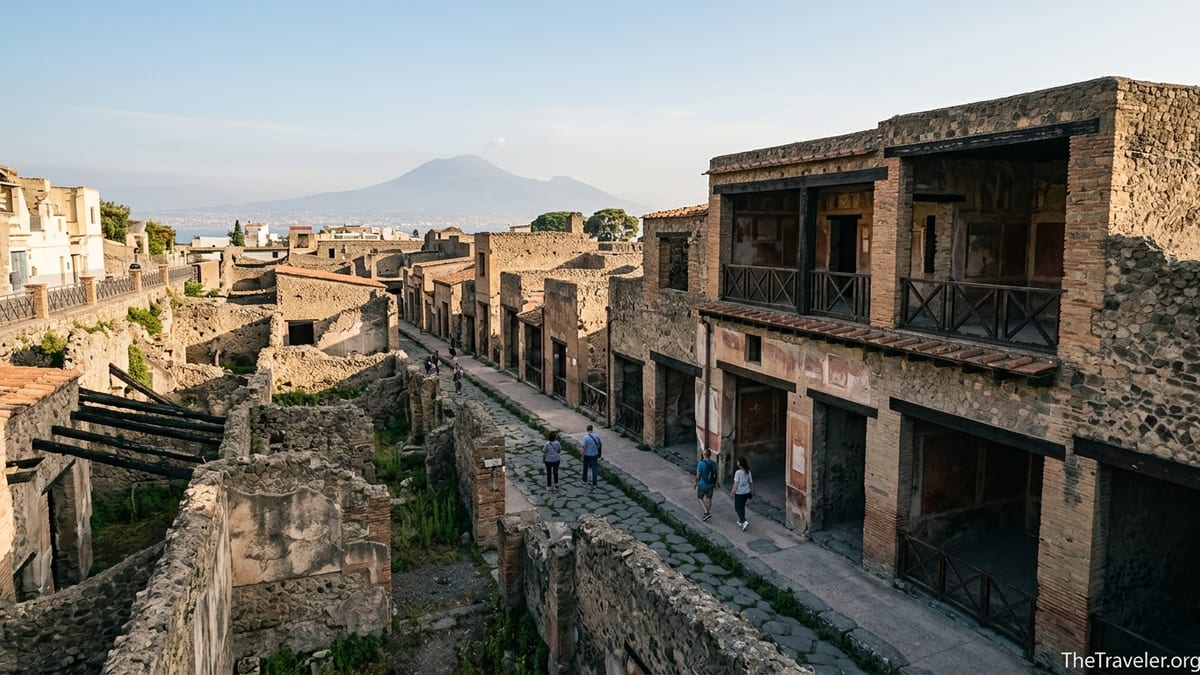
A Rare Three-Dimensional Roman Town
Most ancient sites ask you to imagine the missing pieces. At Herculaneum, many of those pieces are still there. The town was buried under up to 20 meters of fast-moving pyroclastic material that carbonized and sealed buildings, preserving upper floors, wooden beams, doors, beds, and even staircases in a way that simply does not survive elsewhere in the Roman world. Walking along the decumanus, you can literally look up and see blackened balconies and window frames still in place above your head, turning the site from a set of foundations into a three-dimensional streetscape.
This physical depth changes how travelers experience the past. In houses like the Samnite House and the House of the Relief of Telephus, you stand in rooms where both the ground floor mosaics and parts of the upper stories survive. Wooden shelving, carbonized chests, and staircases show how people moved vertically between workspaces and private rooms. Guides often point to soot-blackened rafters and explain how the town was entombed in minutes, not hours, helping visitors picture families rushing upstairs with valuables as the sky darkened.
Unlike larger, more sprawling Pompeii, Herculaneum’s compact footprint makes this three-dimensionality easier to grasp in a single visit. Many travelers report that two to three hours on site is enough to walk almost every excavated street, pausing in each house long enough to study details. That scale invites close looking: the groove where a sliding partition once ran, the worn threshold stones where countless sandals passed, the narrow alleyways that funneled neighbors together. For visitors who want to feel they truly “know” a place by the time they exit, Herculaneum’s size combined with its vertical preservation is a powerful draw.
There is also the physical sensation of being below the modern town of Ercolano. Stairs and ramps carry you down from today’s street level into a bowl of ancient masonry, reminding you at every turn that an entire community lies entombed beneath suburban apartment blocks. Travelers often comment that this literal descent makes the leap back in time feel more immediate than at open, flat sites.
Everyday Domestic Life, Frozen in Place
Herculaneum is particularly prized by repeat visitors for its glimpse into ordinary domestic life rather than grand public monuments. Because organic materials carbonized instead of rotting away, houses preserve an almost unsettling amount of household detail. In the House of the Wooden Partition, for example, you can see a hinged, folding room divider that still stands in place. Its charred slats and metal fittings show how inhabitants could close off a reception room for privacy or open it to impress guests, a practical detail that makes Roman notions of status and hospitality suddenly concrete.
In several dwellings, carbonized wooden beds, cupboards, and storage chests remain where their owners left them. One famous example is a small bedroom where the outline of a bed frame and the slats of a headboard are still visible against the wall. Nearby, shelves hold amphorae and jars, many of them discovered with traces of nuts, grains, or condiments when they were first excavated. Travelers who might glaze over at a museum case of “Roman pottery” often find themselves unexpectedly moved by the sight of a jar that still contains the last residue of someone’s daily staple.
Food is a recurring theme. Archaeologists have found carbonized loaves of bread in ovens at Herculaneum, their tops still scored into wedges by the baker’s hand. National Geographic and other outlets have highlighted how these loaves, with their string marks and perfect round shapes, have even inspired modern bakers to recreate ancient recipes. Seeing such a loaf in situ, in a cramped bakery off a narrow street, has become a memorable moment for many visitors. It turns abstract talk of “Roman diet” into the shock of discovering that someone’s dinner is still sitting on the shelf, 2,000 years late.
Even the small objects tell domestic stories. Charred wooden shutters with iron hinges, wall niches for household shrines, and simple terracotta lamps scattered on floors flesh out the rhythm of life inside these houses. When guides describe how a family might have gathered in an atrium lit only by those lamps, with the sound of the street drifting through the open doorway, the preserved fittings around you make the scene far easier to imagine than at ruins where only bare stone survives.
Shops, Baths, and Ancient “Fast Food” Culture
Travelers interested in the working life of a Roman town find Herculaneum especially rich. The main streets are lined with shops whose counters still display embedded dolia, the large jars used for storing and serving food and drink. These thermopolia were the ancient equivalent of snack bars or takeaway counters. Today, when visitors walk up to one of these marble-topped counters and peer into the round openings, guides will often invite them to picture a worker ladling out hot stew or wine to customers grabbing a quick meal between errands.
Prices are not posted, of course, but graffiti and parallels from elsewhere suggest that a filling snack might have cost the ancient equivalent of a few euros, affordable to laborers and artisans. That detail connects with modern travel budgets in a surprising way: after a morning exploring these long-vanished eateries, many visitors head back up into modern Ercolano to find a slice of pizza or a paper cone of fried seafood from a bar on Via IV Novembre, noticing continuities in the culture of quick, cheap street food.
The public baths are another highlight that keeps drawing culturally curious travelers. At Herculaneum’s Central Thermae, mosaic floors, stuccoed ceilings, and even wooden shelving for towels have survived in recognizable form. You can stand in the frigidarium staring at the patterned mosaic under your feet and then pivot toward a doorway whose wooden lintel is still intact. Audio guides and private tour leaders commonly walk visitors through a typical bather’s routine: paying a small entry fee, leaving sandals and clothes on the shelves, moving through cold, warm, and hot rooms, chatting with acquaintances along the way. For many, it feels like walking through a functioning spa that has simply fallen temporarily silent.
Workshops and storage areas also preserve telling details. Amphorae stacked near street-level shops hint at wine and oil trade routes across the Bay of Naples, while carbonized roof beams above suggest the storage lofts where extra stock was kept. In one building, the imprint of a ladder against a wall shows how workers moved between floors. Repeat visitors often say that these workaday traces, more than the elegant villas, give Herculaneum its special power to illuminate how Romans earned a living.
The Waterfront and the Human Cost of Eruption
If Herculaneum excels at showing the texture of daily life, it is equally uncompromising about how abruptly that life ended. One of the most haunting areas is the ancient waterfront. Here, excavations in the boat sheds uncovered the skeletons of hundreds of people who had gathered near the shore, apparently waiting for rescue by sea as Vesuvius erupted. Today, visitors can enter some of these vaulted chambers and see the remains arranged as they were found, often huddled in groups, with jewelry, tools, and coins scattered around them.
This setting affects travelers differently from the famous plaster casts of victims at Pompeii. At Herculaneum, the bodies were not preserved as hollow molds but as skeletons in a precise context: under arches, near the ancient shoreline, facing the sea. Interpretive signs and guide explanations describe how intense heat killed them instantly, even though many sheltered beneath the strong stone vaults. Visitors frequently describe emerging from this area in reflective silence, the sight of a child’s skeleton clutching an adult’s arm lingering in their minds long after they leave.
Nearby, the remains of a Roman boat discovered on the shore underline the drama of attempted escape and rescue. Exhibitions in Ercolano and Portici have displayed wooden planks from this vessel, along with tools and fittings, revealing how ordinary and workmanlike the craft was. It was not a grand warship but a practical boat, the sort of vessel you might imagine slipping along the coast on any calm morning. That ordinariness, preserved in cracked, salt-streaked timber, underscores how normal life had been on the day everything changed.
The waterfront zone also helps visitors visualize the original layout of the town. Today the sea lies hundreds of meters away, but standing at the edge of the excavated area you can look up at the high walls of volcanic debris and modern buildings and understand how much of ancient Herculaneum is still buried inland. Guides often use this vantage point to point out where more insulae and the famous Villa of the Papyri lie entombed, reminding travelers that what they see is impressive but still only part of the whole story.
The Villa of the Papyri and a Lost Roman Library
For many historically minded travelers, one of the strongest reasons to visit Herculaneum is its connection to the Villa of the Papyri, an enormous seaside villa whose plan inspired the Getty Villa in California. Although much of the villa remains buried, the parts that have been explored produced more than 1,800 carbonized papyrus scrolls, the only large-scale ancient library to survive from classical antiquity. The scrolls were long thought unreadable, but in recent years teams of researchers have used advanced X-ray imaging and machine learning to begin deciphering their contents.
News about the Vesuvius Challenge, an international competition that has successfully identified words and phrases within sealed scrolls, has reignited interest in Herculaneum among visitors who follow archaeology and digital humanities. Some travelers now plan visits specifically to stand near the site where the library once stood, then continue on to the National Archaeological Museum in Naples to see statues, busts, and small bronzes that were removed from the villa in the eighteenth century. The idea that new philosophical texts or even unknown works might still lie hidden in unexcavated rooms lends an air of open-ended discovery to the whole site.
On the ground at Herculaneum, you cannot yet wander freely through the Villa of the Papyri, but you can see statues and architectural fragments from it in situ and in local exhibitions. Occasional special tours and scholarly programs, advertised through local cultural institutions, focus on the villa’s layout and decoration, drawing a clientele of repeat visitors who return to Herculaneum not just as tourists but as amateur researchers following an unfolding story. The combination of tangible remains, like marble columns and mosaic fragments, with the invisible treasure of still-rolled scrolls, keeps the site at the forefront of conversations about what we may yet learn from the ancient world.
Crucially, the papyri make Herculaneum a place where travelers can connect not only with daily life but also with ancient thought. When guides explain that some of the deciphered scrolls preserve the writings of the Epicurean philosopher Philodemus, whose works influenced discussions of pleasure, fear, and the gods, visitors begin to see Herculaneum as a town where big ideas circulated alongside everyday commerce. That intellectual dimension is a key reason scholars, students, and curious travelers return, often bringing new reading and questions with them each time.
Manageable Crowds and an Intimate Visitor Experience
Another practical reason travelers keep choosing Herculaneum is the quality of the on-site experience. While visitor numbers can spike in peak summer months, the site is generally far less crowded than Pompeii. Many guests arrive mid-morning on a regional train from Naples, walk the ten minutes downhill to the entrance, and find that they can enter with little or no waiting even on busy days. Once inside, the relatively small area and well-signed paths make it easy to explore without feeling rushed or lost in a sea of tour groups.
This quieter atmosphere encourages slow observation. Couples linger over frescoed dining rooms in the House of the Stags, study the delicate wall paintings in the House of the Mosaic Atrium, or sit in the shade beside a garden to imagine the sounds and smells that once filled it. Photography is easier when you are not jostling for space, and many travelers enjoy being able to take unobstructed shots of mosaics, carbonized beams, or narrow streets leading to the sea. For solo travelers and families with children, the sense of safety and manageable scale can be especially appealing.
Ticket prices are another factor visitors weigh. As of 2026, a standard adult ticket to the Herculaneum Archaeological Park is typically lower than the full-price ticket for Pompeii, and various passes such as the Campania ArteCard or combined site tickets can offer additional savings. This makes it feasible for many travelers to visit more than once, perhaps combining a first, guided visit with a later, slower, self-guided walk focused on a favorite theme like domestic art or ancient foodways. Because the site is compact, even a repeat visit of just two or three hours in the afternoon can feel worthwhile.
Facilities around the park support this more relaxed mode of travel. Cafes and small restaurants line the streets between the Circumvesuviana train station and the entrance, offering espresso, pastries, and light lunches at prices that are typically lower than in the most tourist-heavy parts of central Naples. Budget-conscious travelers often stop for a quick coffee before descending into the ruins and then reward themselves with a sit-down meal afterward, using Herculaneum as both a historical destination and a gateway into a less touristed corner of the Bay of Naples.
Conservation, Research, and the Sense of a Living Site
Herculaneum is not a finished tableau but an active conservation and research project, and that ongoing work is one reason many visitors return. The Herculaneum Conservation Project, in cooperation with Italian authorities and international partners, has focused for years on stabilizing fragile structures, repairing drainage, and cleaning frescoes and mosaics. As a result, travelers who first visited a decade ago often notice that certain houses are now cleaner, brighter, and sometimes newly opened. Freshly conserved frescoes in a dining room or newly accessible upper rooms in a house can be enough to entice archaeology enthusiasts back for another look.
Seasonal closures and rotations, while occasionally frustrating, also contribute to the sense that the site is evolving rather than static. A house undergoing conservation in one year may reopen with improved lighting and interpretive panels the next. Visitors planning a second or third trip sometimes check recent reports or local news coverage to see which areas are currently accessible. When they arrive, scaffolding and conservators at work become part of the experience, giving a “behind the scenes” glimpse into how a fragile, open-air museum is kept from crumbling under the combined effects of weather, vegetation, and tourism.
Research related to Herculaneum extends well beyond the boundaries of the site. Studies of carbonized wooden furniture, textiles, and even brain tissue from some of the skeletons have been reported in scientific publications over the last decade, and the development of advanced imaging techniques for the papyri has drawn attention from technology and AI communities. Travelers who return to Herculaneum after following these stories in the news come with fresh eyes, ready to see the objects and spaces mentioned in articles by outlets like National Geographic or major newspapers. That interplay between cutting-edge science and on-the-ground experience keeps the site intellectually vibrant.
Finally, Herculaneum’s designation as part of a UNESCO World Heritage property, along with Pompeii and nearby sites, underscores its global significance. Informational panels on site explain the challenges of balancing access and preservation, including the impact of vandalism incidents and climate-related wear. For many visitors, especially those on repeat trips, supporting a site that is clearly being cared for with long-term sustainability in mind becomes a reason in itself to come back, to purchase official guidebooks, and to recommend Herculaneum responsibly to other travelers.
The Takeaway
Herculaneum has none of Pompeii’s vast forum or grand amphitheater, yet it exerts a powerful hold on travelers who want to move beyond postcard ruins. Its three-dimensional houses, carbonized wood and food, haunting waterfront, and links to a still-unfolding library make it one of the most revealing windows onto ancient Roman life anywhere in the Mediterranean. In a single, manageable visit, you can trace a path from bakery to bathhouse to family dining room, then down to the boat sheds where hope of rescue ended in an instant.
That combination of intimacy and scale is why so many visitors who come once resolve to return. Each new conservation project, each advance in reading the papyri, and each quiet hour spent contemplating a carbonized bed frame or a frescoed garden adds another layer of understanding. For travelers eager not just to see ruins but to feel, as closely as possible, what it meant to live in a prosperous Roman seaside town on an ordinary day in 79 CE, Herculaneum remains an essential, repeat-worthy stop.
FAQ
Q1. How long should I plan to spend at Herculaneum to appreciate daily Roman life?
Most travelers find that two to three hours on site is enough to explore most streets and key houses in detail, though history enthusiasts often stay half a day.
Q2. Is Herculaneum suitable for a first-time visitor to ancient sites, or should I see Pompeii first?
Herculaneum is excellent for first-timers because it is compact and less overwhelming than Pompeii, with clear signage and vivid, well-preserved houses that make interpretation easier.
Q3. Can I visit both Herculaneum and Pompeii on the same day?
It is possible to see both in a single long day using regional trains, but many travelers prefer to dedicate separate days so they are not rushed and can appreciate the differences.
Q4. What are the typical ticket prices for Herculaneum, and are passes available?
Standard adult tickets are usually slightly cheaper than Pompeii’s, and regional passes such as the Campania ArteCard or combined tickets can offer savings; prices are updated regularly, so checking close to travel dates is wise.
Q5. Are guided tours worth it for understanding ancient Roman life at Herculaneum?
A licensed guide or small-group tour can greatly enrich a first visit by connecting specific houses, shops, and objects to broader themes like food culture, bathing, and social status.
Q6. How crowded does Herculaneum get compared with Pompeii?
Even in peak summer, Herculaneum is generally noticeably quieter than Pompeii, with shorter entrance lines and more space inside houses, which many visitors find more conducive to reflection.
Q7. Is Herculaneum accessible for travelers with limited mobility?
The site has uneven ancient paving, slopes, and steps, but some routes are relatively level and staff can advise on the most accessible paths; those with wheelchairs or strollers should be prepared for some limitations.
Q8. What should I wear and bring for a comfortable visit?
Comfortable walking shoes, sun protection, and water are essential, especially in summer; many travelers also bring a light scarf or hat for shade and a small backpack for camera gear and snacks.
Q9. Are there facilities and food options near the archaeological park?
Yes, there are cafes, bars, and small restaurants between the train station and the entrance, along with restrooms at or near the site, so it is easy to combine a visit with a coffee or lunch stop.
Q10. Why do some travelers return to Herculaneum after already visiting once?
Repeat visitors often come back to see newly opened or conserved houses, follow developments in reading the Villa of the Papyri scrolls, or simply spend more unhurried time absorbing the site’s intimate atmosphere.