


Between the Atlantic Ocean and the Intracoastal Waterway in Fort Lauderdale, Hugh Taylor Birch State Park protects a rare pocket of subtropical wilderness. Just a short walk from high-rise condos and beach bars, visitors can step into shady coastal hammock forest, paddle a freshwater coastal dune lake, and share sandy trails with gopher tortoises, wading birds, turtles, butterflies, and even bright green iguanas. This guide focuses on the park’s wildlife and habitats, and offers practical, respectful ways to experience them on your next visit.
Get the latest updates straight to your inbox!
Where You Are: A Rare Coastal Refuge in the City
Hugh Taylor Birch State Park sits on a narrow barrier island along State Road A1A, directly across from Fort Lauderdale Beach and Sunrise Boulevard. The 174-acre park is often described as the city’s Central Park because it offers a surprisingly wild core in the middle of a dense resort district. Visitors usually arrive by car or rideshare, paying a modest per-vehicle entrance fee at the ranger station before driving the loop road past leafy picnic areas and trailheads.
The park protects a mosaic of habitats that are increasingly rare in urban South Florida: tropical maritime hammock forest, mangrove-lined estuary, beach dune, and a half-mile freshwater coastal dune lake often called Long Lake. You can stand at the rail of the seawall along the Intracoastal Waterway watching yachts pass, then within minutes be under a canopy of live oak, gumbo-limbo and sea grape where songbirds flit overhead and the city fades to a low hum.
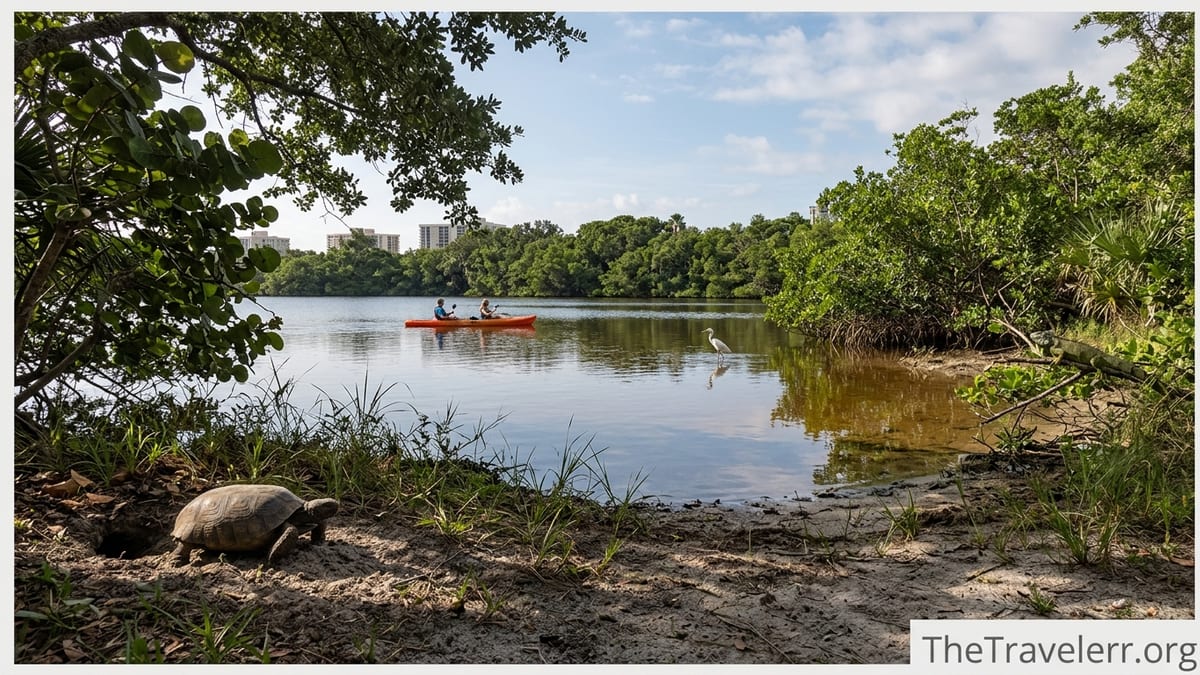
Most visitors experience the park along two main corridors. The first is the paved loop road, popular with cyclists, joggers and families towing kayaks or stand-up paddleboards toward the lake launch. The second is the network of short nature trails that weave between the road and the dunes, including the Coastal Hammock Trail and the mangrove boardwalk. These are prime places to encounter the park’s signature wildlife, from gopher tortoises grazing along the sandy shoulders to herons stalking in the shallows.
Because this green space is surrounded on all sides by development and busy roads, the animals here rely heavily on the protection the park offers. Staying on marked routes and giving wildlife a wide berth is part of what allows gopher tortoises to bask beside the same paths that carry weekend walkers and school groups.
Gopher Tortoises: The Park’s Signature Resident
Ask rangers what animal most symbolizes Hugh Taylor Birch State Park and they will often point to the gopher tortoise. These stout, sandy-brown tortoises dig burrows in well-drained soils along the park’s edges and in sunny clearings. Their tunnels can reach several meters in length and provide shelter not only for the tortoises but also for many other species that slip in to escape heat or storms.
You are most likely to see gopher tortoises in the late morning or afternoon, especially on cooler, dry days, grazing on low-growing plants near the road shoulders or on the sandy firebreaks that cut between the hammock and dune habitats. Drivers sometimes spot them crossing the paved loop or the entrance road. If you encounter one on the asphalt, the most respectful action is usually to slow or stop your vehicle and allow it to cross on its own. If a ranger is nearby, you can notify them if you are concerned about its safety.
It is illegal in Florida to harass, handle or relocate gopher tortoises without a permit, so visitors should never pick one up for photos, move it to a seemingly “better” location, or offer food. Human snacks such as lettuce from a picnic, chips, or fruit can make tortoises dependent and may also attract predators. Instead, observe them quietly from several meters away. A good rule is to stay far enough that the tortoise continues its normal behavior: grazing, walking or resting without pulling into its shell.
For photographers, the best approach is to kneel at a distance and use a longer lens or smartphone zoom rather than creeping closer. Light in the park’s open sandy patches is often harsh by midday, so many wildlife enthusiasts plan a morning walk on the Coastal Hammock Trail or the park’s interior paths when the sun is lower and the tortoises are more active but shade softens the contrast.
Birdlife: From Wading Birds to Urban Raptors
Because Hugh Taylor Birch State Park bridges the Intracoastal Waterway, a coastal dune lake and shady forest, it attracts a broad mix of bird species. Along the edges of Long Lake and the tidal mangroves on the west side of the park, visitors regularly see great blue herons, tricolored herons, snowy egrets and white ibis picking their way through the shallows. On a quiet weekday morning, you might watch anhinga drying their wings on submerged logs while cormorants dive nearby for fish.
Songbirds, including cardinals, blue jays and warblers in migration seasons, favor the mature hammock where the canopy of live oaks and cabbage palms provides shelter and insects. The shaded trails that run parallel to the main road are good birding routes, particularly soon after the park opens when traffic and jogger numbers are still low. Many visitors simply walk with binoculars and a free bird identification app, identifying species as they go.
Overhead, it is common to spot osprey circling with fish in their talons above the Intracoastal and the lake. Red-shouldered hawks occasionally perch on utility poles or tall snags near the park entrance, scanning for lizards and small mammals in the underbrush. During winter and early spring, migratory species sometimes move through, and local birders keep informal lists of unusual sightings such as peregrine falcons or rare warblers using the park as a coastal stopover.
To maximize your chances of productive birdwatching, consider renting a kayak from the concession at Long Lake or bringing your own paddlecraft to launch at the designated area. Paddling quietly along the narrow channel often brings you close to yellow-crowned night-herons tucked into mangrove roots, or moorhens and coots cruising in the lily pads. Keeping voices low and avoiding sudden movements helps you see more without disturbing feeding or nesting birds.
Turtles, Butterflies and Other Subtle Wildlife
Beyond charismatic tortoises and big wading birds, Hugh Taylor Birch State Park shelters a variety of smaller, often overlooked creatures. Freshwater turtles bask on half-submerged logs in Long Lake and sometimes surface beside kayaks, showing only their heads before pulling back under. Snorkeling is not a common activity here, so most visitors view turtles either from the shoreline or while paddling slowly along the margins.
Butterflies are abundant around sunny openings, particularly where wildflowers bloom along the edges of lawns, picnic areas and disturbed ground. Gulf fritillaries, zebra longwings and monarchs can often be seen drifting among firebush, tropical sage and other nectar plants. The park’s mix of native vegetation and a relatively low level of chemical lawn treatments compared with surrounding urban areas make it a useful refuge for pollinators in the middle of the city.
If you pause along one of the sandy interior routes or at the edge of the hammock, you may notice dragonflies patrolling for insects, bees visiting blossoms and small skinks or anoles darting between leaf litter and tree roots. Bringing a simple compact camera or phone macro lens can turn a short walk into a detailed exploration of these smaller residents, as long as you avoid stepping into sensitive groundcover or crushing plants while framing your shot.
Because many of these animals are sensitive to pesticides and trampling, the park posts regular reminders asking visitors not to pick wildflowers, break branches or venture off designated paths into restoration areas. Treat any roped-off zone or sign that mentions dune or vegetation restoration as a no-go area, even if it appears that no animals are present at that moment.
Snakes, Iguanas and Other Reptiles You Might Encounter
South Florida’s climate supports a variety of native snakes, and some of them inhabit Hugh Taylor Birch State Park. Most are nonvenomous species such as black racers and ribbon snakes that help control rodents and insects. These snakes are typically secretive, slipping away quickly if they sense footsteps on the trail. Visitors walking the shaded paths sometimes notice a thin, dark snake disappearing into leaf litter or crossing the asphalt early or late in the day when surfaces are cooler.
While venomous snakes are possible anywhere in wild Florida, sightings in this heavily used urban park are relatively uncommon compared with more remote preserves. Basic precautions keep risk low: watch where you step, especially when leaving a trail to reach a bench or viewing area; avoid putting hands under logs or into holes; and never attempt to handle or corner a snake for a closer look or photo. If a snake is resting on a path, give it space and allow it to move away on its own.
Perhaps the most conspicuous reptile in the park today is the green iguana, an invasive species that has colonized many canals, seawalls and parks across South Florida. Visitors frequently see these large lizards sunning on tree branches over the Intracoastal, basking near the park’s seawall, or grazing on low plants beside the lake. Adults can reach over a meter in length, with spiky crests and orange-tinged bodies during certain seasons, making them a striking part of many vacation photos.
Despite their visual appeal, green iguanas are not protected and can damage vegetation, burrow into embankments and compete with or disturb native species. As a visitor, you should still treat them humanely and avoid feeding or chasing them. If you are paddling and see iguanas on overhanging branches, maintain enough distance that they are not forced to leap into the water near your boat. During occasional winter cold snaps, stunned iguanas may fall from trees; rangers sometimes post notices about this phenomenon, and the safest course is to avoid touching any motionless reptile and report unusual situations to staff.
Coastal Dune Lake and Hammock: Understanding the Habitat
One of the most unusual features of Hugh Taylor Birch State Park is its freshwater coastal dune lake, locally known as Long Lake. This narrow, mile-long lagoon runs roughly parallel to the beach, separated from the Atlantic Ocean by dunes and the traffic of A1A. The lake likely formed when wind-built dunes created a barrier that trapped freshwater behind them, producing a calm, shallow channel now lined with cattails, mangroves and other wetland plants.
Because it sits just a short distance from saltwater yet remains fresh, Long Lake supports a mix of wildlife that would normally be spread among several different ecosystems: freshwater turtles and fish, wading birds that hunt in both brackish and fresh conditions, and invertebrates adapted to shifting water levels. Paddling or walking along the lake gives visitors insight into how barrier islands store and move water, buffering nearby developments from storms and providing wildlife corridors in an otherwise built-up landscape.
Inland from the lake, much of the park is covered by maritime hammock forest, a type of evergreen hardwood habitat now rare in Broward County. Here you walk under a closed canopy of live oak, paradise tree, cabbage palm and other subtropical species draped with epiphytes and vines. This shaded environment moderates temperatures and retains moisture, which helps a variety of animals that struggle in the open heat of parking lots and nearby beaches.
Closer to the Atlantic side, narrow strips of dune vegetation persist on the seaward edge of the park, including sea oats and other grasses that help hold sand in place. While visitors typically reach the beach by crossing A1A at designated crosswalks, the park’s beach access points remind people to stay off signed dunes and avoid disturbing marked sea turtle nests during nesting season. The continuity between dunes, hammock, lake and mangrove makes the park valuable not only for recreation but also for regional conservation.
How to Watch Wildlife Respectfully
Because Hugh Taylor Birch State Park is both a popular recreation area and a refuge for sensitive species, visitors play a major role in determining how well wildlife can coexist with human activity. One of the simplest but most effective practices is to move slowly and quietly, especially on narrow interior trails and along the lake. Instead of blasting music from portable speakers or phone speakers, choose headphones at a low volume so you can still hear approaching cyclists, other walkers and environmental sounds.
Maintaining distance is equally important. For animals on land, a rough guideline is to stay at least several body lengths away. If a gopher tortoise stops feeding and retreats into its shell when you approach, or if a bird repeatedly calls, bobs or takes flight as you near, you are too close. In those cases, step back until the animal resumes normal behavior. On the water, avoid surrounding birds or turtles with multiple kayaks or stand-up paddleboards, and give fishing herons and pelicans plenty of room to hunt.
Feeding wildlife is discouraged throughout the park. Handouts can lead to aggression, nutritional problems and unnatural crowding, whether the recipients are raccoons raiding picnic areas, squirrels begging on benches or iguanas gathering near popular viewpoints. Pack snacks in sealed containers, clean up crumbs and be proactive about using provided trash and recycling bins so that animals are not tempted to rummage among food waste.
Finally, consider timing your visit thoughtfully. Early mornings and late afternoons often provide the best combination of lower temperatures, softer light for photography and more active animals. On busy weekends in winter or spring, arriving near opening time can mean you paddle the lake or walk the hammock trails before mid-day crowds peak, reducing stress on wildlife and creating a more peaceful experience for yourself.
The Takeaway
Hugh Taylor Birch State Park offers an unusually rich wildlife experience in the heart of Fort Lauderdale, from gopher tortoises and freshwater turtles to wading birds, butterflies and the now-familiar green iguanas along the seawall. Its coastal dune lake and remaining maritime hammock embody ecosystems that have almost disappeared from much of the surrounding coastline, yet remain accessible here by a short walk or paddle.
By exploring slowly, respecting trail boundaries and giving animals the space and quiet they need, visitors can help ensure that the park remains a functioning refuge rather than just a backdrop for recreation. Whether you spend an hour strolling under the oaks or a full day paddling Long Lake and birdwatching along the Intracoastal, this pocket of subtropical habitat offers a vivid reminder of what South Florida’s barrier islands once looked like before continuous development.
On your next trip to Fort Lauderdale, consider setting aside beach time for a visit to this inland retreat. Bring water, sun protection, and curiosity, and you will likely leave with a deeper appreciation for how much life thrives in the green spaces between roads, canals and high-rises when those spaces are given room to breathe.
FAQ
Q1. What is the best time of day to see wildlife at Hugh Taylor Birch State Park? Early morning and late afternoon are usually best, when temperatures are lower, light is softer and animals such as gopher tortoises, birds and turtles are more active near trails and along the lake.
Q2. Where in the park am I most likely to see gopher tortoises? Gopher tortoises are often seen near sandy edges of the loop road, along interior firebreaks and in sunny clearings between the hammock and dune areas, especially on dry, cooler days.
Q3. Are there venomous snakes in Hugh Taylor Birch State Park? Venomous snakes are possible anywhere in South Florida, but sightings in this urban park are relatively rare. Stay on marked trails, watch where you step and never attempt to handle any snake you encounter.
Q4. Can I feed iguanas, squirrels or other animals in the park? No. Feeding any wildlife is strongly discouraged because it can cause animals to become aggressive, dependent on handouts and more likely to approach roads and picnic areas where they may be harmed.
Q5. Is it safe to kayak on the coastal dune lake around wildlife? Yes, as long as you paddle slowly, avoid chasing birds or turtles, and keep a respectful distance from animals on shore and in the water. Staying near the center of the channel when passing resting wildlife helps minimize disturbance.
Q6. Do I need special equipment to enjoy birdwatching in the park? Basic binoculars and a simple bird identification app are sufficient for most visitors. Many birds can be seen from trails, picnic areas and the lake shore without specialized gear.
Q7. Are there guided nature or wildlife tours available? Offerings can vary by season, but the park periodically hosts ranger-led walks or educational programs. Check the visitor information board near the entrance station when you arrive for current schedules.
Q8. What should I do if I see an injured animal? Do not attempt to handle or treat the animal yourself. Note its location as precisely as possible and report it to a park ranger or the ranger station so trained staff can respond.
Q9. Can I bring my dog on the trails while watching wildlife? Leashed dogs are allowed in many areas of Florida state parks, but they must be kept under control and off the beach and designated sensitive habitats. Even well-behaved dogs can disturb wildlife, so choose less crowded trails and avoid approaching animals while your pet is with you.
Q10. How long should I plan to spend in the park for a good wildlife experience? A two- to three-hour visit typically allows time for a short paddle on the lake or a walk on the hammock trails, plus pauses for birdwatching and observing tortoises or other wildlife along the way.