


Hugh Taylor Birch State Park in Fort Lauderdale is one of the most practical beach and park parking “hacks” on Florida’s southeast coast. With a single day-use fee covering everyone in your vehicle and an easy walk or tunnel to the Atlantic, it can be far cheaper and less stressful than circling for a metered spot along A1A. This guide explains how parking works at the park today, how to use the different gates, and how to decide if the park is the smartest place to leave your car for a beach day.
Get the latest updates straight to your inbox!
Understanding Entrance Fees and How They Compare to Beach Parking
Hugh Taylor Birch State Park charges a simple flat day-use admission at the main vehicle entrance on East Sunrise Boulevard. As of mid-2026, the official Florida State Parks schedule lists the fee at about 6 dollars per vehicle for up to eight people, 4 dollars for a single-occupant car or motorcycle, and 2 dollars per person for pedestrians and cyclists. You pay this once at the park gate, keep the receipt on your dashboard if requested, and you can generally move your car between lots inside the park without paying again that day.
That flat fee is what makes the park so appealing compared with Fort Lauderdale’s beachfront meters and garages. Along North Beach and Fort Lauderdale Beach Park, public city parking typically runs around 4 dollars per hour for nonresidents, with time limits that can make a full beach day very expensive. Spending six hours at the beach in a metered A1A space could easily cost 24 dollars or more, while the same group could pay that single 6 dollar park fee, leave the car in the shade, and walk to the sand.
The math gets even better for families or groups. A family of four who arrives at 10 a.m. and stays until late afternoon might spend 30 to 40 dollars in beach-lot fees or garage time if they park oceanfront. The same family using Hugh Taylor Birch would still pay roughly 6 dollars total to park all day. For many locals, that cost difference alone is why they buy an annual Florida State Parks pass and routinely use the park as their default beach-parking base.
One important nuance is that the park fee is for park entry, not a reserved parking space. During busy periods, lots can fill temporarily, especially near the Park & Ocean concession and the beach tunnel area. However, because the fee is per-vehicle day use rather than per-hour, most visitors still find it a more predictable and budget-friendly option than juggling meters or apps along the strip.
Park Hours, Gates and Vehicle Access Basics
The park is officially open from 8 a.m. to sunset every day of the year. In practice, that means vehicle gates open in the morning, and rangers or automatic systems begin clearing cars as the light fades. You should not expect to park a vehicle inside Hugh Taylor Birch after dark, and overnight parking is generally not allowed for regular day-use visitors. If you plan to stay late at nearby restaurants or beach bars, it is safer to move your car to a city garage or metered space before park closing time.
The primary vehicle access is via the main entrance on East Sunrise Boulevard, on the west side of the Intracoastal Waterway bridge. This is where virtually all day visitors pay their admission. The gatehouse typically has a ranger on duty collecting fees, answering questions about parking areas, and providing park maps. Once you pass through this point, a ring road leads to the various parking pockets, picnic areas, the lagoon, and the Park & Ocean area near the beach access.
There is also a secondary access point commonly referred to as the north gate, closer to the upper end of the park. While details can evolve, this entrance is more limited in its use and is not always open in the same way as the main Sunrise gate. Most first-time visitors, and almost anyone arriving by rental car or ride-share, should plan on using the main Sunrise Boulevard entrance for straightforward access, payment, and parking directions.
If you arrive on foot or by bike, you can enter without a car and pay the pedestrian or cyclist fee at the entrance station or via honor boxes, depending on how the park is staffed that day. Cyclists who plan to ride the loop road or connect to A1A via the tunnel often find this a relaxed and inexpensive way to reach the beach without worrying about parking at all.
Where to Park Inside the Park: Lots, Shade and Walking Distances
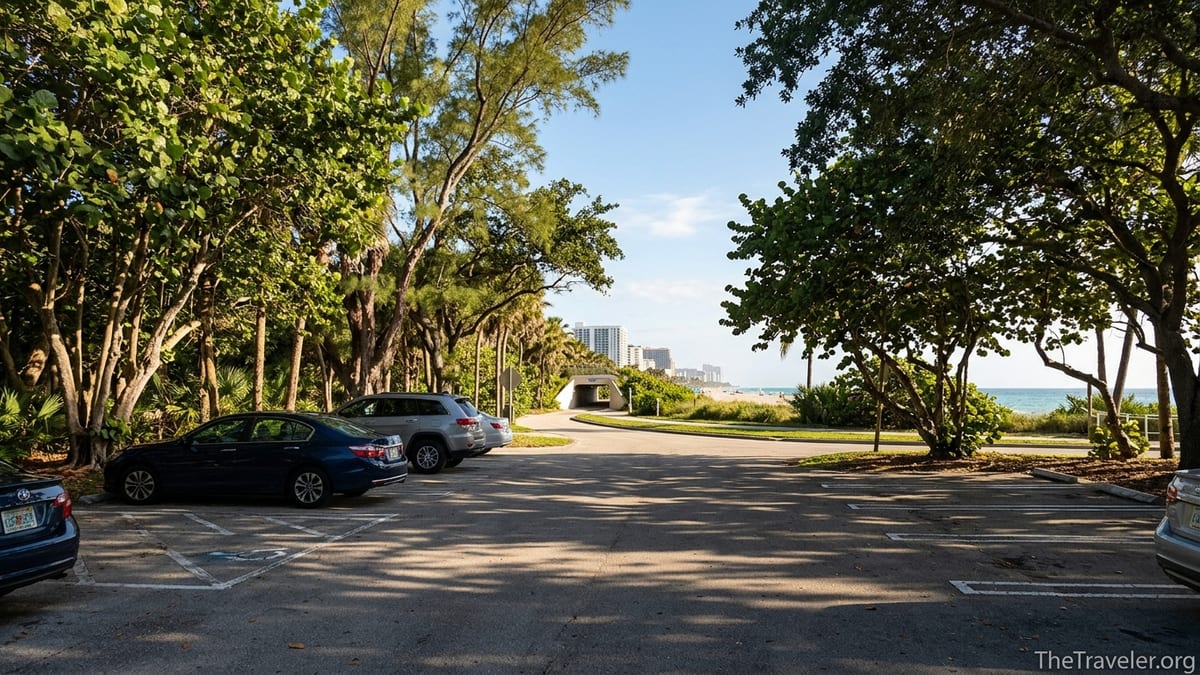
Once inside Hugh Taylor Birch State Park, you will find several distinct parking areas scattered along the loop road. Most are small surface lots tucked beneath mature coastal trees, with a mix of paved and packed-sand surfaces. The advantage of parking here, beyond price, is shade and a quieter setting than the exposed oceanfront lots along A1A. Drivers of rental cars often appreciate leaving vehicles under tree cover for several hours while the interior stays cooler.
The most popular parking clusters for beach-goers are near the Park & Ocean concession on the east side of the park and near the pedestrian tunnel that passes under A1A. If your priority is getting to the beach quickly, tell the ranger at the entrance and ask which lots currently have space close to the tunnel. On quieter weekdays, it is often possible to park within a short five-minute walk of the beach access, even arriving late morning.
Families with coolers, beach tents and small children often prefer to park in the easternmost lots. From there, you can either walk directly out to A1A via crosswalks or use the tunnel where available, depending on current park layouts and signage. For park-focused activities like picnicking, running or paddling the lagoon, interior lots near pavilions and trailheads may be more convenient than hugging the eastern edge.
Because there are only so many spaces, you should expect parking to spread out as the day goes on. It is common on sunny winter weekends and peak spring break days to see the lots near Park & Ocean fill first, with visitors then using more central or northern lots and walking or biking down to the beach gate. The overall walking distance is still manageable for most reasonably fit visitors, but anyone with mobility concerns may want to arrive earlier or consider accessible options closer to the beach edge.
Beach Access: The Tunnel, Crosswalks and Beach Gate Strategy
One of the signature features of Hugh Taylor Birch State Park is its safe pedestrian access to the Atlantic beach across the busy A1A corridor. Historically, an underground tunnel has provided a protected path beneath the traffic, linking the park to the oceanfront. The park and its partners have even invested in mosaic art and improvements around this beach tunnel entrance so that it stands out as a gateway for visitors walking to the sand.
In practical terms, beach access works in two main ways for drivers who park inside the park. First, you can walk to the beach tunnel area and pass under A1A, emerging near a signed entrance to the public beachfront. This is popular with families, joggers, and anyone uneasy about crossing multiple lanes of beach traffic. Second, in sections where permitted, you can exit the park to A1A at a controlled crosswalk and walk to the beach directly across the road. Signs and rangers typically direct visitors to whichever option is safest and most appropriate at the time.
Many visitors treat the park’s beach gate as a staging area. For example, a couple may park by late morning, carry only chairs and essentials across the tunnel to set up on the sand, then return to the car at midday to rest in the shade or enjoy lunch at a picnic table. Because they are not paying by the hour for parking, there is no pressure to move the car or watch a meter; they can freely go back and forth between the park and beach throughout the day.
If your main goal is the ocean and you care less about interior trails and lagoon activities, a smart strategy is to mention “beach tunnel parking” when you pay at the gate and ask the ranger which area to try first. On typical weekdays outside holidays, you may find a spot within a few rows of the tunnel access. On fully packed winter weekends, expect to park a bit farther away and allow 10 to 15 minutes of walking time to and from the beach gate.
Best Times to Arrive and How Busy Parking Gets
How crowded the parking gets at Hugh Taylor Birch depends heavily on the season, day of the week, and weather. In the quieter shoulder months and on typical weekdays, you can often arrive mid-morning, pay at the gate, and find a choice of shaded spots near your preferred area. Many local runners and dog walkers use the park early, then leave, opening spaces by late morning for beach-goers.
During peak tourism periods such as late December through March, spring break weeks, and major holiday weekends, demand for both beach and park parking surges. On those days, the most popular lots near the eastern edge and Park & Ocean can begin to fill by 9 or 10 a.m., with intermittent “lot full” periods late morning. Visitors arriving around midday on blue-sky Saturdays may be waved toward more central or northern lots or asked to circle until spaces open.
Afternoons can be easier than late mornings. Many families wrap up their beach time by 2 or 3 p.m., freeing up spaces throughout the park. If you are flexible and happy with a shorter late-afternoon beach visit and sunset stroll, arriving around 3 p.m. can be a surprisingly relaxed experience, with lighter traffic at the gate and more parking turnover.
Weather is another factor. On hot, humid summer days with afternoon thunderstorms in the forecast, the park may be quiet in the early afternoon as people dodge showers, then fill again after the rain when locals come out for cooler evening walks before sunset. If your schedule allows, checking live radar and timing your arrival for after a passing storm can sometimes mean plentiful parking and softer light on the beach.
Is Hugh Taylor Birch Cheaper Than Beach Lots in Real Life?
For most nonresident visitors who plan to spend more than a couple of hours near Fort Lauderdale Beach, using Hugh Taylor Birch State Park for parking is typically cheaper than paying for city-run beach lots. Consider a realistic example: a visiting couple wants to spend five hours on the sand and then grab an early dinner on A1A. If they choose an oceanfront meter at about 4 dollars per hour, they are likely to spend 20 dollars or more on parking alone, plus worry about topping up the meter or app while their time runs down.
If the same couple parks inside Hugh Taylor Birch, they pay roughly 6 dollars at the gate and park all day without watching the clock. They walk through the tunnel to the beach, enjoy the same sand and surf, then either return to the car and move it to a restaurant garage in the evening or shift the car before the park closes. Even factoring in a short additional move, their total parking cost usually comes in below what they would have paid to remain beachfront all afternoon.
The savings multiply with groups. A car of four friends staying beachside for six hours might otherwise pay nearly 30 dollars in parking. Inside the park, the same group pays that single day-use fee and can leave coolers and extra gear in the shaded car while they alternate between the sand, the lagoon and the Park & Ocean area. Over a week-long stay, using the park several times can easily offset the cost of a Florida State Parks annual pass for frequent beach-goers.
The main exceptions are very short visits or special city discounts. If you only plan to stop for an hour-long sunrise walk on the sand and your hotel offers discounted garage parking nearby, paying a minimal garage fee or even walking from your lodging may be simpler. Likewise, Fort Lauderdale residents with beach parking permits can access certain lots at reduced or prepaid rates, changing the equation. For most out-of-town visitors arriving by car, though, Hugh Taylor Birch remains one of the most budget-friendly and predictable parking choices close to the ocean.
Practical Tips for Making Parking and Beach Access Smooth
A bit of planning goes a long way to making the most of Hugh Taylor Birch as your parking base. Aim to arrive earlier on weekends, especially in the dry, busy winter season. Reaching the gate close to opening time, between 8 and 9 a.m., almost always guarantees easy parking near your preferred area, whether that is the beach tunnel, the lagoon for paddling, or a shaded picnic grove.
Bring what you need for the day in a compact, easy-to-carry setup. Because you will likely walk a short distance from your car to the beach gate or tunnel, collapsible beach chairs, a soft-sided cooler, and a backpack for towels and sunscreen are more practical than bulky hard coolers and rolling carts. Many visitors use the strategy of setting up a simple beach base, then returning to the car midday for a full lunch in the shade, refills of cold drinks, or a break from the sun.
Pay attention to signage when you park. Some stretches near facilities or trailheads have time limits, loading zones, or reserved accessible spaces. Rangers periodically patrol to ensure visitors are parked in designated areas and that fire lanes stay clear. If you are unsure whether a particular sandy shoulder is an official parking area, it is better to ask at the entrance or move to a marked lot than risk a ticket or tow.
Finally, remember that park hours end at sunset. If you plan to transition from beach time to nightlife, consider shifting your car to a city garage or metered area before dusk. A common pattern is to enjoy a long beach and park day using Hugh Taylor Birch, then move the car to a beach-area garage like Las Olas or another central facility in late afternoon before heading to dinner, ensuring that you are not racing back to clear the park just as the sky turns dark.
The Takeaway
Hugh Taylor Birch State Park offers one of the smartest parking and beach access combinations in Fort Lauderdale. A flat, modest day-use fee per vehicle covers everyone in your car, allows you to leave the vehicle in shaded lots, and gives you easy pedestrian access to the same Atlantic shoreline that drivers in beachfront meters are paying by the hour to reach.
If you are a nonresident visitor planning a multi-hour beach outing, especially with family or friends, using the park instead of oceanfront lots will almost always save money while adding the bonus of trails, lagoon views and quieter picnic spots. The key is to time your arrival with park hours, aim for the beach tunnel or eastern lots, and be prepared for a short but pleasant walk to the sand.
Whether you are a budget-conscious traveler or simply prefer a more relaxed, green approach to reaching the beach, Hugh Taylor Birch is worth considering as your primary parking base for Fort Lauderdale’s coastline. With a bit of planning around busy times and closing hours, it can turn an ordinary beach day into a full park-and-shore experience without the stress of watching a meter.
FAQ
Q1. How much does it cost to park at Hugh Taylor Birch State Park?
The park charges a day-use admission of roughly 6 dollars per vehicle for up to eight people, with slightly lower rates for single-occupant cars, motorcycles, and pedestrians or cyclists. Exact amounts can change, so check posted fees at the entrance.
Q2. Is parking at the park really cheaper than Fort Lauderdale beach lots?
For visits longer than a couple of hours, parking at the park is typically much cheaper than paying about 4 dollars per hour at city beach meters and garages. A full beach day that might cost 24 to 30 dollars beachfront often costs around 6 dollars inside the park.
Q3. What time do the park gates open and close for vehicles?
Hugh Taylor Birch State Park generally opens at 8 a.m. and closes at sunset every day. Vehicles must be out of the park by closing, so it is not suitable for late-night parking after dark.
Q4. Which gate should I use if I am driving?
Most visitors should use the main vehicle entrance on East Sunrise Boulevard, where you pay the day-use fee and can ask rangers for the best parking area based on your plans. The north gate is more limited and not the primary access for typical day-trippers.
Q5. How do I get from my parked car to the beach?
From the interior lots, you walk to the beach access area and either use the pedestrian tunnel under A1A or a signed crosswalk to reach the sand. The walk from many lots near the eastern edge is typically five to ten minutes.
Q6. How early should I arrive to find parking on busy days?
On peak-season weekends and holidays, aim to arrive between 8 and 9 a.m. for the easiest parking near the beach tunnel or Park & Ocean. By late morning on sunny winter days, popular lots can be full, and you may need to park farther inside the park and walk.
Q7. Can I leave my car in the park and stay at the beach after sunset?
No. Park hours end at sunset, and vehicles should be out by then. If you plan an evening along the beachfront, move your car from the park to a city garage or metered spot before closing time.
Q8. Are there shaded parking spots inside the park?
Yes. Many of the park’s lots sit under mature coastal trees, providing significantly more shade than the exposed beachfront lots along A1A. This makes the park especially attractive for long visits in hot weather.
Q9. Is there accessible parking and easier access for people with limited mobility?
Designated accessible spaces are typically available in key lots, and certain sections of the nearby beachfront have hard-surface approaches that make reaching the sand easier. If someone in your group has mobility needs, mention this to the ranger at the gate so they can direct you to the most suitable area.
Q10. Do I need cash to pay for parking at the park entrance?
The gatehouse generally accepts both cash and major cards, but payment options can occasionally vary. Having a card and some small bills on hand is prudent so you can pay the entrance fee regardless of any temporary system issues.