


Hugh Taylor Birch State Park is Fort Lauderdale’s unexpected slice of subtropical wilderness, wedged between the Atlantic Ocean and the Intracoastal Waterway. For first-time visitors, it can be both a convenient beach parking hack and a full day out in nature, with shaded trails, kayaking on a calm lagoon, and a relaxed beachfront restaurant all minutes from the high-rise hotels of A1A. This guide walks you through everything you need to know before your first visit, from entrance fees and parking to where to walk, paddle, eat and unwind.
Get the latest updates straight to your inbox!
Where the Park Is and Why It Belongs on Your Fort Lauderdale Itinerary
Hugh Taylor Birch State Park sits on East Sunrise Boulevard in Fort Lauderdale, between the Intracoastal Waterway and State Road A1A. In practical terms, it is directly inland from a stretch of Fort Lauderdale Beach, a few minutes north of the main Las Olas Boulevard beach area. Many first-time visitors staying in beachfront hotels along A1A are surprised to realize they can walk or take a short rideshare ride and suddenly be under a dense canopy of live oaks and sea grapes instead of palm-lined pavement.
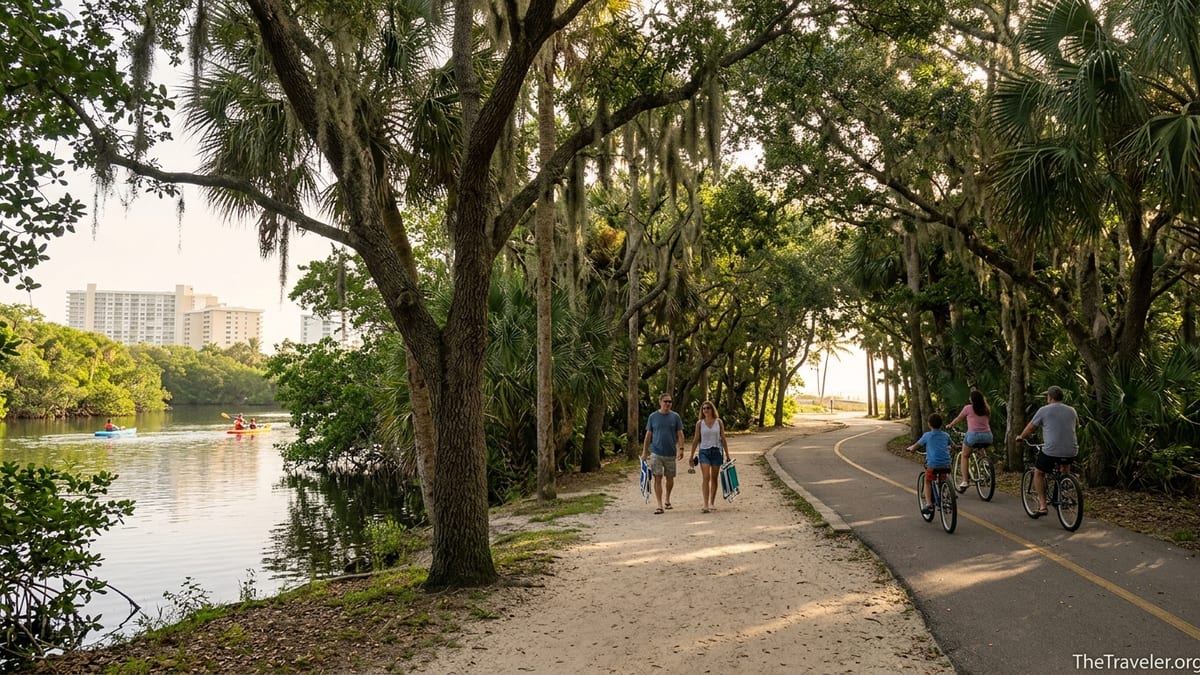
The park is compact compared with big Everglades areas, but for a city break it offers a mix that is hard to beat: shaded nature trails, a calm freshwater lagoon known as Long Lake, direct pedestrian access to the Atlantic beach, and Intracoastal vistas where mega-yachts cruise past mangroves. It feels like Fort Lauderdale’s “Central Park,” especially on winter weekends when locals come to jog the loop road, push strollers under the trees and picnic in the grass.
If you are in Fort Lauderdale without a car, the park still works as a half-day escape. Visitors staying near Sunrise Boulevard can walk in through the park’s pedestrian gate on A1A and be at the concession area within minutes. Those relying on rideshares can set their drop-off point to the main entrance on Sunrise, where you will find the ranger station, restrooms and maps.
Because the park is sandwiched between the beach and the waterway, it is especially useful for multi-activity days. A common pattern for first-timers is to arrive mid-morning, walk one of the short trails under the shade, rent kayaks on Long Lake through late morning, have a casual lunch at the park’s restaurant, then cross to the beach in the afternoon before heading back to the hotel to change for dinner.
Hours, Entrance Fees and Parking: What It Really Costs
Hugh Taylor Birch State Park operates like other Florida state parks, with simple day-use pricing at the gate. As of mid-2026, typical entrance fees are around 6 dollars per vehicle with two to eight people, 4 dollars for a single-occupant vehicle or motorcycle, and 2 dollars per person for pedestrians and cyclists. Frequent park users often buy a Florida State Parks annual pass, which usually pays for itself after several visits, especially if you also plan to visit other parks across the state.
The park is open daily from 8 a.m. to sunset, 365 days a year. That means if sunset is at 7:30 p.m., last light is your practical cutoff; park staff start moving visitors toward the exits in the early evening, and the beach access gate inside the park typically closes about half an hour before full park closing. If you want to catch sunset on the sand, you may be better off watching from the public beach outside the park after you exit.
Parking is straightforward once you are inside. There are paved lots along the park’s main loop road, including near the concession and restaurant area, near Long Lake, and at several picnic and trailhead areas. Day visitors pay the entrance fee at the ranger station and then park anywhere inside at no extra charge. Compared with paying per-hour metered parking directly on Fort Lauderdale Beach, many locals treat Hugh Taylor Birch as a value play: you pay once to enter, then park all day and still have short walking access to the same stretch of sand.
If you are arriving at peak times, such as a sunny Saturday in February around 10 a.m., it is worth coming a little earlier to secure a closer spot near the concession area. Once the main lots fill, rangers may direct you to spaces farther around the loop road. That is not necessarily a bad thing; a spot near the north end means quieter picnic areas and quick access to some of the less-trafficked trails.
Beach Access: Using the Park as Your Gateway to the Atlantic
One of the biggest surprises for first-time visitors is that Hugh Taylor Birch State Park includes its own dedicated beach access. While the park’s main acreage sits on the Intracoastal side of A1A, a pedestrian tunnel and gate connect the park interior to a sandy section of Fort Lauderdale Beach. Instead of paying by the hour at a beachfront meter, you can leave your car under the trees inside the park and walk a few minutes to the ocean.
To reach the sand, most visitors park near the central concession area, then follow signs toward the Beach Gate. You will either pass through a pedestrian tunnel under A1A or use a marked crossing, depending on which route is currently open. Expect a walk of roughly five to ten minutes from your car to having your feet on the sand, depending on where you parked and how quickly your group moves with beach gear.
The beach in front of Hugh Taylor Birch is classic Fort Lauderdale: soft tan sand, lifeguard towers at intervals, and views south toward the more developed hotel zone. It tends to be calmer than the party-heavy stretch near Las Olas, with more families, joggers and locals who know the quieter access points. Lifeguard coverage, when in effect, follows city beach hours, so always check the posted flags, watch for rip current advisories, and swim within the guarded areas.
A practical strategy for a full day is to set up your base on the sand in the morning, then retreat into the park during the hotter midday hours. Many families leave their umbrellas and chairs at the beach while they walk back to the park restaurant for lunch or bring kids to the shaded picnic areas and playgrounds. Just be sure not to leave valuables unattended, and remember that the Beach Gate inside the park will close shortly before sunset, so plan your return accordingly.
Trails, Biking and Exploring the Park on Foot
For a relatively small park embedded in a city, Hugh Taylor Birch offers a surprisingly varied network of trails and paths. The backbone of the park is a one-way paved loop road that runs for roughly two miles around the interior. This loop is popular with joggers, families pushing strollers, and cyclists who prefer smooth pavement. If you are a first-time visitor, driving the loop once shortly after you arrive is a good way to get oriented, because most trailheads, parking areas and the Long Lake launch points peel off this road.
Just off the pavement, you will find a mix of sandy and packed-earth nature trails that wind through coastal hammock, mangroves and pockets of tropical hardwoods. Short interpretive paths near the Terramar Visitor Center and along Long Lake give you a feel for what the barrier island looked like before high-rise condos. A common route for visitors with limited time is to park near the visitor center, walk a 20 to 30 minute loop under the canopy, then continue on to the lakefront.
Biking is allowed on the main loop road and on some designated multiuse paths, but not on narrow footpaths where bikes would damage roots or disturb wildlife. If you did not bring your own bike, the park’s concession typically rents beach cruisers and sometimes hybrid bikes by the hour or half-day. Expect prices that are competitive with rental shops along A1A, but with easier access to shaded riding. A realistic plan is to rent bikes for two hours in the late morning, ride the loop a couple of times, stop at scenic pullouts along the Intracoastal, then drop the bikes and transition to a picnic or kayak session.
Trail conditions vary with recent weather. After heavy summer rains, some low-lying paths can be muddy or temporarily closed, while winter and early spring usually offer dry, easy walking. Closed-toe shoes are a better choice than flip-flops if you plan to explore beyond the paved road, as roots, uneven sand and the occasional fire ant mound are all part of the environment. Bug spray is helpful at dawn, dusk and in more enclosed mangrove sections, especially in the wetter months from May through October.
Kayaking, Paddling and Water Activities on Long Lake
Long Lake, a narrow freshwater lagoon running down the middle of Hugh Taylor Birch State Park, is one of the best places in central Fort Lauderdale for calm-water paddling. Unlike the open Atlantic or busy Intracoastal, Long Lake is sheltered from wind and boat wakes, making it well suited to first-time kayakers, families with kids and anyone who wants a gentle introduction to South Florida paddling.
The park’s concessionaire, located near the lake, typically rents single and tandem kayaks, canoes and stand-up paddleboards by the hour. Prices change periodically, but visitors can expect a per-hour rate in line with other South Florida rental outfits. Many first-timers opt for a 1 to 2 hour rental, which is enough time to paddle the length of the lake at a relaxed pace, stop to watch turtles or wading birds, and take photos under overhanging trees.
If you have your own kayak or paddleboard, you can usually launch from designated spots along Long Lake after paying the standard park entrance fee. Parking near the lake and carrying your gear a short distance to the water’s edge is common. Because Long Lake is relatively shallow and narrow, motorized boats are not part of the scene; this keeps the experience quiet, with only other paddlers and the sounds of birds and wind in the trees.
Safety-wise, treat Long Lake like any other body of water in South Florida. Life jackets are required for each person in a boat, and children should actually wear them, not just sit on them. Alligators are possible anywhere there is freshwater in the region, though sightings here tend to be infrequent and the animals generally keep their distance. Give any wildlife you see plenty of space, avoid feeding animals, and follow any posted warnings at the launch points. Mid-morning is often the sweet spot in summer, when the sun is high enough for good visibility but the heat has not yet peaked.
Wildlife Watching and Nature Experiences
For an urban park, Hugh Taylor Birch can be surprisingly rich in wildlife, especially if you slow down away from the main road. Birdwatchers will find wading birds like great egrets and little blue herons along Long Lake, ospreys circling above the Intracoastal, and songbirds working the canopy in the coastal hammock. During spring and fall migration, the park acts as a green stopover for warblers and other small migrants that funnel along Florida’s Atlantic Coast.
On the ground, visitors commonly see brown and green anoles darting across paths, gopher tortoises in sandy clearings, and raccoons near picnic areas. In the water, look for turtles surfacing in Long Lake and the occasional manatee or dolphin in the Intracoastal, visible from the park’s western edges or from the nearby water taxi stop. None of this is guaranteed, of course, but even a casual stroller will usually spot some combination of birds, lizards and small mammals without trying very hard.
If you are visiting with kids, turning a short walk into an informal “wildlife scavenger hunt” can make the park more engaging. Challenge them to find three different kinds of birds, spot a lizard doing push-ups on a tree trunk, or look for crab holes along the mangrove fringe. Some days, park staff or volunteers run ranger-led walks or talks that introduce the park’s history and ecology. Ask at the ranger station when you arrive if any programs are scheduled during your visit.
Remember that this is genuine habitat, not a petting zoo. Feeding wildlife, especially raccoons and birds, may seem harmless, but it encourages animals to become aggressive and can lead to bites or scratches. Keep a respectful distance, store food securely when picnicking, and use zoom lenses rather than approaching animals closely for photos. Early morning and the last hour before sunset are usually the best times for both comfortable temperatures and active wildlife.
Food, Drinks and Family-Friendly Facilities
One advantage Hugh Taylor Birch has over more remote state parks is the convenience of on-site food and drink. Near the beach side of the park sits a casual restaurant and bar, often operating under the Park & Ocean name or a similar concept, with outdoor seating beneath tall trees and partial views toward the Atlantic. Menus typically focus on beach-friendly fare like tacos, burgers, salads and flatbreads, alongside local craft beers and tropical cocktails.
For a realistic example, a family of four might order two burgers, a fish taco platter, a salad, and soft drinks for the kids and spend an amount comparable to mid-range beachfront cafes along A1A. Prices reflect the prime location but are not wildly higher than elsewhere in central Fort Lauderdale. Service is generally counter or table service with a relaxed pace; this is the kind of place where sandy feet and casual clothes are the norm, not the exception.
If you prefer to self-cater, the park has multiple picnic areas with tables and grills scattered under the trees. Stopping at a Publix supermarket or a local deli on Sunrise Boulevard on your way in and packing a cooler with sandwiches, fruit and drinks can keep costs down, especially for larger groups. Remember that glass containers are typically prohibited in Florida state parks, so opt for cans, plastic or reusable bottles instead.
Families will appreciate the practical amenities: restrooms near major parking areas and the concession building, freshwater showers or rinse-off stations near the beach access, and open lawns where younger kids can run around. Strollers work well on the paved loop road and the main paths between the parking lots, though deeper sandy trails are better tackled with a baby carrier. Shade is one of the park’s greatest assets, which makes midday playground or picnic time much more comfortable than baking directly on the open beach.
Smart Tips for First-Time Fort Lauderdale and Birch Park Visitors
Combining Hugh Taylor Birch State Park with a broader Fort Lauderdale visit works best with a bit of planning. If you are flying into Fort Lauderdale-Hollywood International Airport and staying at a beach hotel, it is often easiest to rely on rideshares and walking rather than renting a car, at least for your first couple of days. The park sits roughly a 10 to 15 minute drive from many central beachfront hotels, and rideshare fares for a one-way trip are often comparable to a couple of hours of downtown parking.
Weather is the other big variable. From November through April, daytime highs are usually in the 70s and low 80s Fahrenheit, with lower humidity and fewer afternoon storms. These months are ideal for long walks and bike rides in the park. Summer and early fall are hotter and more humid, with regular afternoon thunderstorms. In that season, aim to visit the park early in the day; arrive around opening, walk or bike the trails before 11 a.m., paddle Long Lake late morning, then shift to indoor or shaded activities if the radar starts to light up.
In terms of packing, think “beach plus light hiking.” Bring a swimsuit, quick-dry shorts or a sundress, a light T-shirt, and sandals or water shoes for the beach, plus sneakers or light hiking shoes for trails. A compact daypack makes it easy to carry sunscreen, bug spray, a reusable water bottle, a small towel and a hat between the beach and the park interior. Even in winter, the South Florida sun is strong; apply reef-safe sunscreen before you leave your hotel and reapply regularly, especially after swimming or sweating.
Finally, remember that Hugh Taylor Birch is just one piece of Fort Lauderdale’s outdoor puzzle. You can easily pair a morning here with an afternoon exploring the shops and cafes along Las Olas Boulevard, a water taxi ride on the New River, or a visit to Bonnet House Museum & Gardens directly across from the park. For many first-time visitors, that combination of wild and urban, paddling and patios, is what makes Fort Lauderdale feel like more than just another beach town.
FAQ
Q1. What are the current entrance fees for Hugh Taylor Birch State Park?
The park generally charges around 6 dollars per vehicle with two to eight people, 4 dollars for a single-occupant vehicle or motorcycle, and 2 dollars per pedestrian or cyclist. Fees can change, so it is wise to confirm the latest rates just before your visit.
Q2. Is parking included in the entrance fee, and how hard is it to find a spot?
Once you pay the entrance fee at the ranger station, parking inside the park is included at no extra cost. On most weekdays and non-holiday mornings you can find a spot near the central concession area, but on sunny winter weekends the closer lots can fill, and you may be directed farther around the loop road.
Q3. How do I get from the park to the beach?
From the main parking and concession area, follow signs to the Beach Gate, which leads through a pedestrian tunnel or marked crossing under or across A1A. The walk from your car to the sand usually takes about five to ten minutes, depending on where you parked and how much gear you are carrying.
Q4. Are there lifeguards on the beach in front of the park?
The beach section accessible from Hugh Taylor Birch State Park falls within the City of Fort Lauderdale’s guarded beachfront, and lifeguards are typically on duty during standard city beach hours. Always check the lifeguard towers and posted flags on the day of your visit, as conditions and staffing can vary.
Q5. Can I rent kayaks or bikes inside the park if I do not have my own?
Yes, the park’s concession usually offers rentals of single and tandem kayaks, canoes, paddleboards and beach cruiser style bicycles. Rates are charged by the hour or half-day and are similar to other rental operators in the area, with the benefit that you start directly on Long Lake or the park’s shaded roads.
Q6. Is Hugh Taylor Birch State Park suitable for young children and strollers?
The park is very family-friendly. The paved loop road and main pathways work well for strollers, there are restrooms and picnic areas, and the shaded environment makes it easier to manage midday heat than on the wide open beach. For deeper sandy trails, a baby carrier will be more practical than a stroller.
Q7. What kind of wildlife might I see, and is it safe?
Common sightings include wading birds, ospreys, small songbirds, lizards, turtles and raccoons, with the occasional dolphin or manatee visible in the Intracoastal. As long as you do not feed animals, keep a respectful distance and supervise children, wildlife encounters are typically safe and one of the highlights of a visit.
Q8. Do I need to worry about alligators when kayaking on Long Lake?
Alligators are possible in any freshwater body in South Florida, but they are not commonly reported as a problem for paddlers here and generally avoid people. Wear a life jacket, stay in your boat, give any wildlife plenty of space, and follow any park advisories or instructions from the rental staff.
Q9. What is the best time of year and day to visit the park?
From November through April, cooler and less humid weather makes late morning and afternoon visits comfortable. In the hotter, wetter months from May through October, aim for early morning arrivals around opening time to enjoy trails and paddling before afternoon heat and thunderstorms become more likely.
Q10. Can I visit Hugh Taylor Birch State Park without a car?
Yes. If you are staying at a hotel along Fort Lauderdale Beach, you can often walk to the A1A pedestrian entrance in 10 to 20 minutes depending on your location. Otherwise, a short rideshare trip from most central areas of Fort Lauderdale will drop you at the main Sunrise Boulevard entrance, where you can explore on foot, rent bikes or join guided activities without needing your own vehicle.