


More news on this day
Hundreds of flights faced major delays on Monday after airspace restrictions were introduced across large parts of the United Kingdom, disrupting schedules for carriers and passengers and creating knock-on impacts for European routes connected to UK hubs.
Get the latest news straight to your inbox!
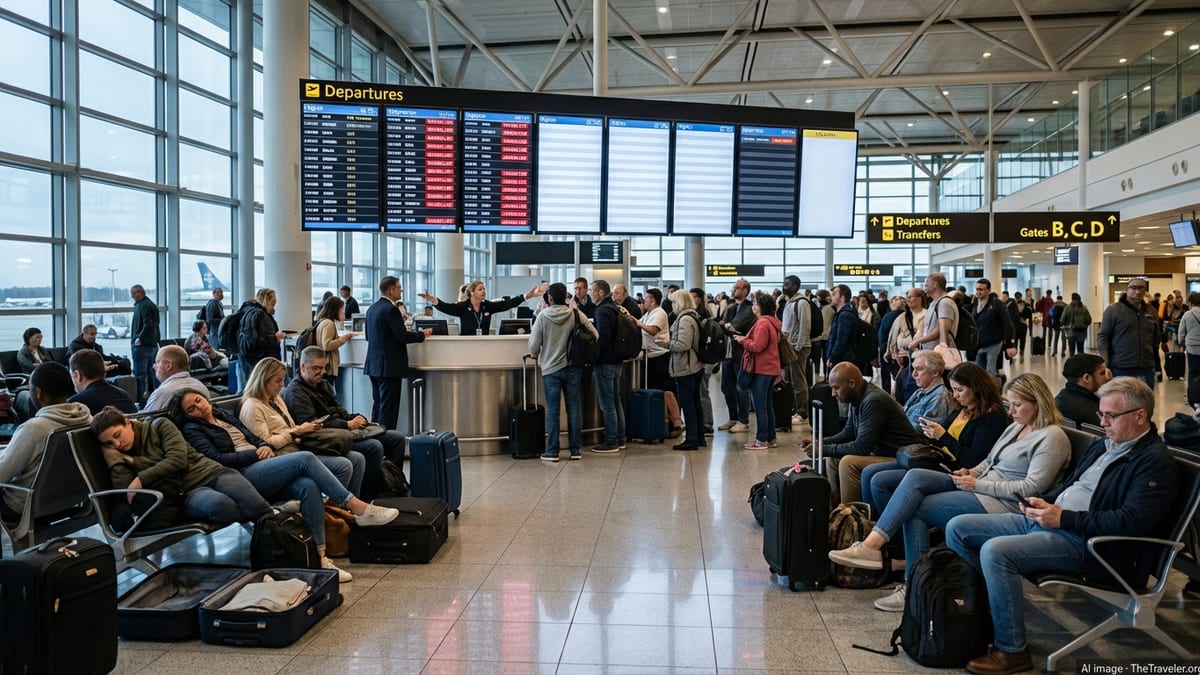
What happened and where disruption spread
Published coverage indicated the disruption stemmed from a technical issue affecting air traffic control operations, prompting capacity limits and traffic-management measures that reduced the number of aircraft that could safely move through impacted sectors. While flight operations continued, the restrictions slowed departures and arrivals, leading to growing queues of aircraft waiting for slots.
Reports described the heaviest impact on flights linked to Scotland, Northern Ireland, and the north of England, where schedules are tightly dependent on the affected air traffic control flows. Some airports farther south were less affected, but the nationwide network effect still reached flights transiting UK airspace and aircraft rotations that rely on on-time arrivals.
Even after the immediate technical problem was addressed, disruption typically persists because aircraft and crews end up out of position, and available runway and airspace capacity must be used to unwind delays. That recovery phase often creates uneven impacts, with some departures delayed hours while later services are cancelled to protect the rest of the day’s schedule.
How airlines and airports are managing the backlog
Airlines generally respond to air traffic restrictions by prioritizing long-haul and high-load services, consolidating frequencies where possible, and seeking later departure slots. When delays exceed operational limits, cancellations can follow, particularly for shorter routes where passengers can be reaccommodated more easily than on long-haul flights.
Public reporting on the day referenced major UK and Ireland operators and airports managing extensive rebooking demand and passenger care requirements. Many affected passengers were advised through airline channels to monitor flight status closely before leaving for the airport, as gate times can shift repeatedly when restrictions are being adjusted.
Airports also face pressure on stands and terminal space when late arrivals overlap with scheduled departures. When multiple waves of inbound aircraft arrive at once, the congestion can slow baggage handling and connections, and create long lines at customer-service desks as travelers seek rebooking options.
Passenger rights and practical steps for travelers
Publicly available regulator guidance in the UK emphasizes that airlines must provide care during long delays, including meals and refreshments appropriate to the waiting time, and hotel accommodation with transport when an overnight stay becomes necessary. Rebooking or refund options may also apply, depending on the passenger’s circumstances and the airline’s conditions of carriage.
Compensation can be more complicated during air traffic control disruptions, which are often treated differently from airline-controlled causes. However, passengers may still be entitled to care even when compensation is not owed, and they can typically choose between rerouting at the earliest opportunity or a refund if the flight is cancelled.
For travelers caught in the disruption, the most effective immediate steps are to confirm whether the flight is operating before traveling to the airport, save receipts for reasonable out-of-pocket expenses, and use the airline’s app or online tools for rebooking rather than waiting in terminal lines. For connecting itineraries, passengers may need to verify whether their onward flight is being held, retimed, or rebooked automatically.
Why the “all-UK” airspace effect can happen quickly
The UK’s air traffic network is highly interconnected. Even when a technical issue is localized to a specific center or system, restrictions can be applied across broader areas to allow systems to be stabilized, flight data to be reloaded, or traffic to be metered safely into constrained sectors.
In recent weeks, published coverage has described multiple UK air traffic control disruptions, including a major incident earlier in September that triggered wide restrictions and took days for schedules to normalize. NATS has also published a preliminary account of that earlier incident, describing how a software-related defect affected higher-altitude traffic management and required widespread restrictions to reset systems and restore normal flows.
That context has heightened sensitivity around resilience and contingency planning, because even short interruptions can scale into system-wide delays. For passengers, the practical reality is that airspace restrictions can cause disruptions far beyond the immediate area, especially for early-morning departures, tightly timed connections, and aircraft rotations that crisscross the UK and Ireland network throughout the day.