


More news on this day
Summer holidaymakers flying with Ryanair are being advised to brace for long queues and potential missed flights at 15 major European airports, as the airline highlights ongoing disruption linked to the European Union’s new Entry/Exit System for non-EU travelers.
Get the latest news straight to your inbox!
Fifteen airports singled out for summer disruption
According to recent coverage of Ryanair’s latest travel advisory, the airline has identified a group of 15 airports where passengers are most likely to face significant waits at passport control during the peak holiday season. The locations span popular sun and city destinations, and are spread across Portugal, Spain, Italy, France, Germany, Poland and Hungary.
Reports indicate that the airports highlighted by Ryanair include Lisbon, Tenerife South, Madrid, Lanzarote, Alicante, Malaga, Milan Bergamo, Milan Malpensa, Verona, Paris Beauvais, Berlin, Cologne, Frankfurt Hahn, Krakow and Budapest. These hubs serve millions of leisure travelers each summer, particularly families from the United Kingdom and Ireland heading to mainland Europe.
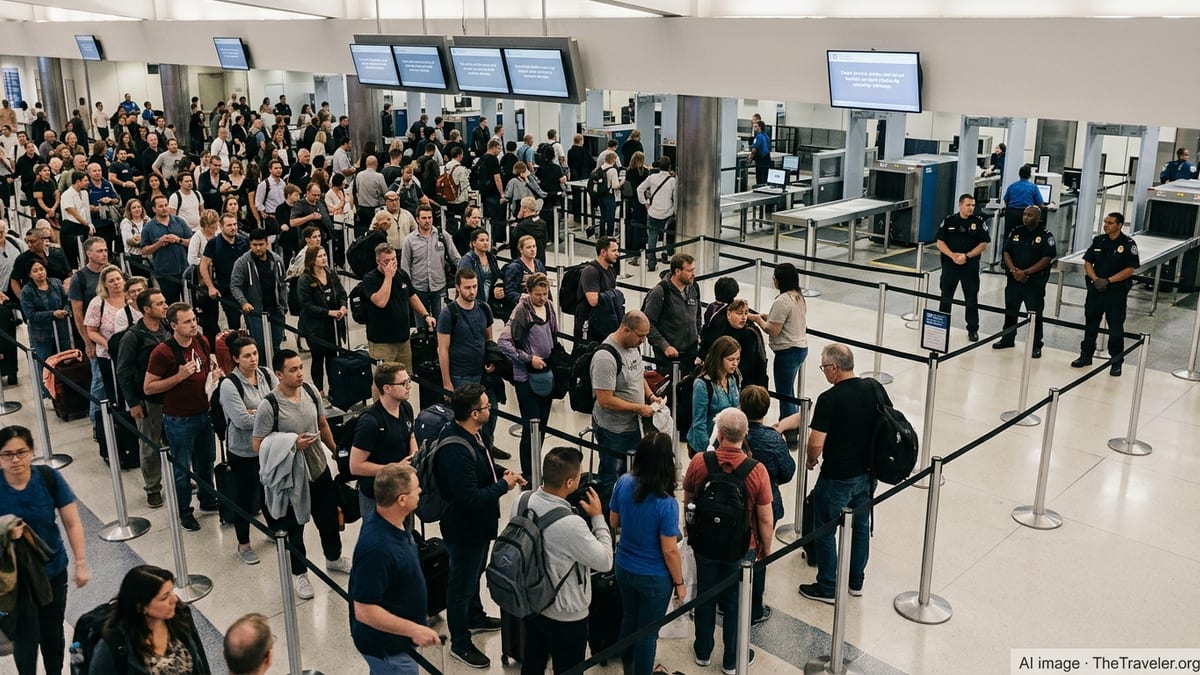
Ryanair’s warning focuses on long lines forming both at arrivals and departures, as border control staff process passengers through the new biometric checks now required for many non-EU nationals. While flight schedules at these airports remain largely intact, the concern is that passport queues could become long enough to cause passengers to miss departures or wait several hours to clear immigration on arrival.
Coverage of the advisory emphasizes that the affected airports are not necessarily experiencing operational failures in aviation services such as air traffic control or baggage handling. Instead, bottlenecks are concentrated at passport control points, where high passenger volumes are colliding with new procedures and infrastructure limits.
EU Entry/Exit System strains border control capacity
The difficulties highlighted by Ryanair are closely tied to the rollout of the EU’s Entry/Exit System, a new automated border regime designed to record the arrivals and departures of non-EU nationals entering the Schengen area. The system involves capturing biometric data, such as fingerprints and facial images, alongside passport details at the border.
Publicly available information shows that the system was introduced to strengthen security, reduce overstays and replace manual passport stamping with a centralized digital record. However, early reports from various European airports describe slower processing times for first-time registrations, especially when large numbers of travelers arrive within a short time frame.
Industry analysis suggests that airports which serve high volumes of UK leisure traffic are particularly exposed. Since the United Kingdom is no longer part of the EU or Schengen zone, British travelers heading to continental Europe must undergo the new checks, adding to pressure on border staff during school holidays and long weekends.
Travel experts note that many airports have been racing to expand biometric kiosks and reconfigure passenger flows, but that infrastructure upgrades and staffing adjustments take time. As a result, the first full peak summer with EES in force is unfolding as a real-world test of how well Europe’s border facilities can handle the added complexity.
Advice for travelers: arrive early and prepare for queues
In light of the warnings, consumer travel outlets are advising passengers flying from or into the 15 named airports to allow extra time for border formalities. For outbound flights, many commentators recommend arriving well ahead of the usual two-hour window, especially for morning departures and weekend travel dates when traffic historically surges.
Travel insurance guides point out that, in some cases, missing a flight because of long passport queues may not be covered by standard policies, depending on the terms and local interpretation of “extraordinary circumstances.” Passengers are therefore encouraged to read policy documents carefully and document their experience if they encounter severe delays at border control.
Families with young children or older travelers may also want to factor in the practical strain of standing in long lines after an early start or a late arrival. Some airports have implemented designated family lanes or priority processing for passengers with reduced mobility, but the availability and effectiveness of these measures vary from one location to another.
Information from airport operators and travel forums indicates that security screening and check in are generally running more smoothly than passport control at the highlighted airports. Nonetheless, passengers are urged to complete airline check in and bag drop as early as possible so that any remaining time at the airport can be devoted to clearing border checks.
How airports and authorities are responding
While Ryanair’s warning has drawn attention to the passenger impact, broader reporting across Europe shows that airports and national authorities are attempting to adapt. Measures range from opening additional border control booths during peak hours to installing more self-service biometric kiosks designed to speed up initial EES registration.
In some countries, interior ministries have announced temporary staffing increases at major gateways to cope with the surge in summer traffic. Aviation analysts say that these short term responses are likely to continue throughout July and August, while more permanent investments in technology and layout changes are planned for future seasons.
Policy commentators observe that the current situation reflects a tension between the EU’s security and migration management goals and the region’s reliance on seamless cross-border tourism. The EES is part of a wider package of digital border reforms, and its long term success will depend on how effectively airports and governments can reduce friction for legitimate travelers.
For now, the experience for many passengers appears uneven. Some travelers report clearing border controls in a matter of minutes, while others have described queues lasting one to three hours at certain times of day. The same airport can operate relatively smoothly on one afternoon and face severe congestion the next, depending on flight schedules and staffing levels.
What this means for summer travel across Europe
For the broader European travel landscape, Ryanair’s focus on 15 specific airports underscores how localized constraints can ripple through a regionwide network. When queues at a single hub stretch for hours, it can trigger missed connections, rebookings and knock-on delays for subsequent rotations of aircraft and crews.
Travel industry observers say that passengers choosing where and when to fly this summer may factor in the reported conditions at these airports, especially if they are traveling with children or on tight timetables. Some may opt for alternative airports in the same region that appear less congested, while others may adjust departure times to off peak periods where practical.
Despite the challenges, flight demand across Europe remains robust, with many routes operating close to full capacity during school holidays. That dynamic leaves limited flexibility for airlines to redistribute traffic away from the most affected airports in the short term, making it more important for travelers to plan conservatively.
For now, the central message emerging from public coverage of Ryanair’s warning is that summer trips through Lisbon, Tenerife South, Madrid, Lanzarote, Alicante, Malaga, Milan Bergamo, Milan Malpensa, Verona, Paris Beauvais, Berlin, Cologne, Frankfurt Hahn, Krakow and Budapest are still going ahead as scheduled, but may involve much longer waits at passport control than travelers have experienced in previous years.