

More news on this day
Hundreds of travellers were left stranded at Hamad International Airport in Doha on Thursday after 566 flights were cancelled or heavily delayed, paralysing Qatar’s flagship hub and disrupting global routes linking Europe, Asia, the Middle East and Australia.
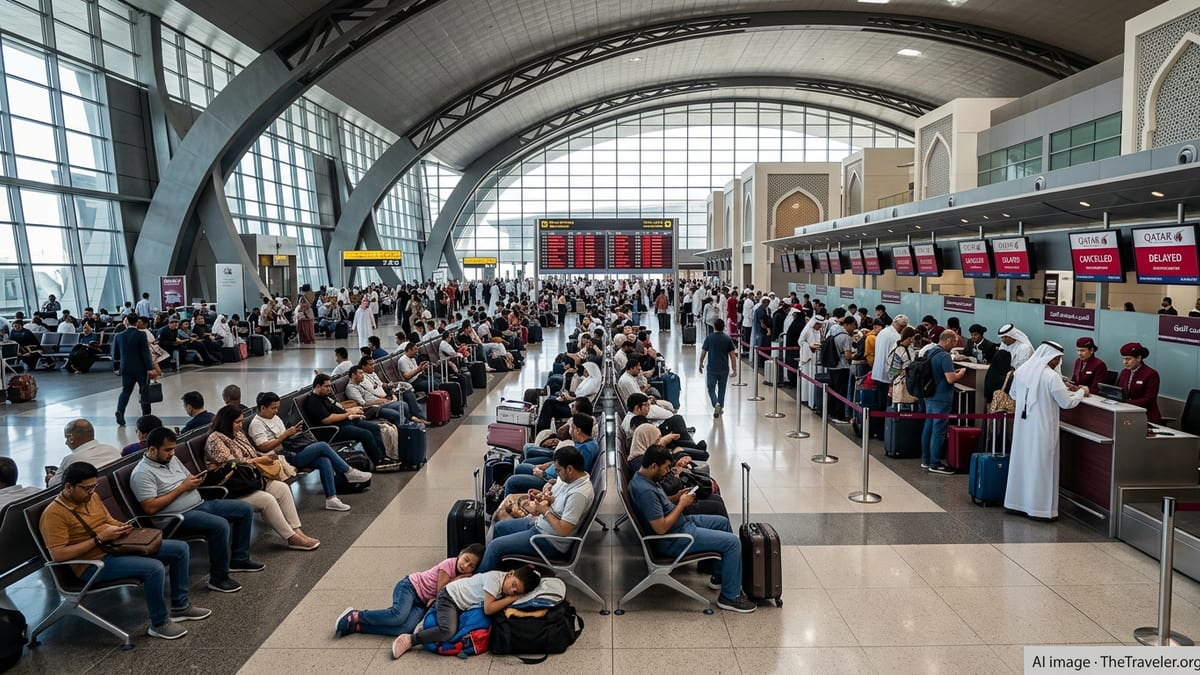
Severe Disruption at Key Gulf Transit Hub
The sweeping wave of cancellations at Doha’s Hamad International Airport followed the ongoing closure and restriction of airspace across parts of the Middle East, which has forced airlines to ground services, reroute aircraft and curtail schedules. The disruption has rapidly cascaded through one of the world’s most important connecting hubs, where Qatar Airways alone typically handles tens of thousands of passengers each day in transit between continents.
Operational data from aviation analytics firms and regional authorities on Thursday indicated that a total of 566 arrivals and departures touching Doha were cancelled within a 24 hour period, with hundreds more subject to rolling delays. The knock-on effect has rippled across airline networks, leaving travellers stranded far from home or their intended destinations as aircraft and crews are displaced around the region.
The cancellations have affected not just flagship long haul services but also shorter regional links that feed into Doha’s global network. With aircraft unable to operate through normal routings and turnaround times stretched, airlines have struggled to restore even a limited schedule, leading to growing backlogs of passengers waiting for scarce seats out of Qatar.
Multiple Airlines Hit as Qatar Airways Halts Regular Operations
Qatar Airways, the dominant carrier at Hamad International Airport, has kept regular flight operations temporarily suspended while Qatari airspace remains effectively closed, operating only a narrow band of relief services from alternative gateways such as Muscat and Riyadh. The airline has urged passengers not to travel to the airport unless they hold confirmed seats on rebooked flights and have received direct notification of new arrangements.
Other regional and international airlines have also been hard hit. FlyDubai has reported extensive cancellations and diversions on services that would usually feed through Doha and other Gulf hubs, while Etihad Airways continues to operate only a reduced and highly restricted schedule from Abu Dhabi, prioritising repatriation and essential travel. Malaysia Airlines and a string of European and Asian carriers have likewise shelved or diverted their Doha services, contributing to the overall tally of 566 affected flights.
Inside Hamad International Airport, passengers described scenes of crowded gate areas, long customer service queues and departure boards dominated by red "cancelled" notifications. Travellers reported limited real time information, with many relying on airline apps, social media updates and word of mouth to learn when, or if, they might be able to continue their journeys.
Global Routes to London, Bangkok, Cairo and Beyond Disrupted
The mass cancellations have disrupted a swath of key long haul routes that typically funnel through Doha, including services to major gateways such as London, Bangkok, Cairo, Madrid, Manchester, Melbourne and Amsterdam. Many of these city pairs rely heavily on Qatar Airways’ hub-and-spoke model, making Doha a crucial bridge for passengers travelling between Europe, Africa, Asia and Australasia.
Flights to and from London Heathrow and Manchester have seen particularly heavy disruption, stranding UK-bound travellers in Doha and at outstations across Asia and Africa. Travellers heading to or from Bangkok, Cairo and other major regional centres have faced similar uncertainty, as airlines suspend or reroute services while they await clarity on airspace restrictions and security assessments.
In Australia and Europe, the shock has been felt by passengers whose trips depend on overnight connections through Doha. Services linking Melbourne and other Australian cities to Europe via Qatar Airways are among those most affected, with travellers forced to seek alternative routings through other hubs or to delay travel entirely until more capacity can be restored.
Relief Flights Offer Limited Lifeline
In response to the mounting backlog, Qatar Airways has announced a limited programme of relief flights operating from Muscat and Riyadh rather than from Doha itself. These special services are focused on key long haul markets including London Heathrow, Berlin, Copenhagen, Madrid, Rome, Amsterdam and Frankfurt, and are intended primarily for customers who were already in transit or whose original flights were cancelled in recent days.
Airlines have stressed that these relief flights are not open for general booking and that priority is being given to stranded passengers based on original travel dates, ticket conditions and onward connection needs. Carriers are contacting eligible travellers directly, often at short notice, and advising everyone else to avoid heading to the airport in the hope of securing a standby seat.
While the added capacity offers some hope, aviation analysts say it is only a partial solution given the scale of the disruption. With hundreds of flights cancelled in Doha alone and thousands more across the wider region, it could take days for airlines to clear the backlog, even if airspace restrictions ease and normal routings can gradually resume.
Travellers Face Long Waits and Limited Options
For those still stranded at Hamad International Airport, the immediate reality is one of uncertainty and limited options. Many passengers have been offered hotel accommodation and meal vouchers, while others report sleeping in terminal seating areas as they wait for news of rebooking. Travel insurance hotlines and airline call centres have been inundated with requests for assistance, refunds and alternative itineraries.
Consumer advocates are urging travellers to document their experiences, keep receipts for out of pocket expenses and stay in close contact with airlines for updates on rebooking or potential compensation where applicable under local or international regulations. They also warn that capacity out of alternative hubs such as Muscat, Cairo and European gateways is likely to remain tight as airlines prioritise repatriation and existing ticket holders.
With no firm timeline yet for a full resumption of normal operations through Doha, passengers are being encouraged to prepare for extended delays, remain flexible on routing and dates, and consider postponing non essential travel. For now, Hamad International Airport, usually celebrated as one of the world’s most efficient transit hubs, has become the epicentre of one of the most severe airline disruption episodes the region has seen in years.