

I booked my ticket to Asturias for a practical reason, not a poetic one. Flights into Oviedo’s tiny airport were cheaper than Barcelona or Madrid on the August weekend I needed to escape. I had seen a few photos of colorful houses stacked above a harbor and some misty mountains called the Picos de Europa, but they barely registered. Northern Spain in my mind was a blur of rain, cider, and cows. I had no idea I was flying straight into one of the most beautiful regions I have ever seen.
Arriving on Spain’s Green Coast
The revelation began before the wheels even touched the runway. As the plane dipped toward the Costa Verde, the usual patchwork of brown Spanish plains never appeared. Instead, I saw a thick carpet of green running all the way to a jagged line of cliffs. Pale ribbons of sand flashed between dark rocks, and behind them, rolling hills climbed steadily toward a serrated wall of mountains. I later learned that Asturias is part of what locals proudly call “Green Spain,” a stretch along the Bay of Biscay where Atlantic weather keeps everything unexpectedly lush.
At the small Asturias Airport, there was no crush of tour buses or souvenir stands. The car rental agent shrugged when I asked how long it would take to drive to Cudillero. “Twenty minutes,” he said. “Maybe thirty if you stop at a viewpoint. You will want to stop.” He was right. Ten minutes later I was pulling off at an unmarked mirador, staring out at a coastline that looked more like western Ireland than the Spain I thought I knew: slate-colored sea, cliffs brushed with green, and waves curling into untouched coves.
Prices were a reminder that this was still a working region and not yet a polished resort strip. A roadside cafe set above the highway served me a strong coffee and a warm slice of tortilla for roughly the price of a vending machine snack in a big European airport. Behind me, a table of truck drivers argued about football while the television quietly replayed local news; in front of me, the Atlantic kept pounding the cliffs. The contrast was almost comical. I felt like I had stumbled into one of Europe’s last under-advertised corners.
The First View of Cudillero
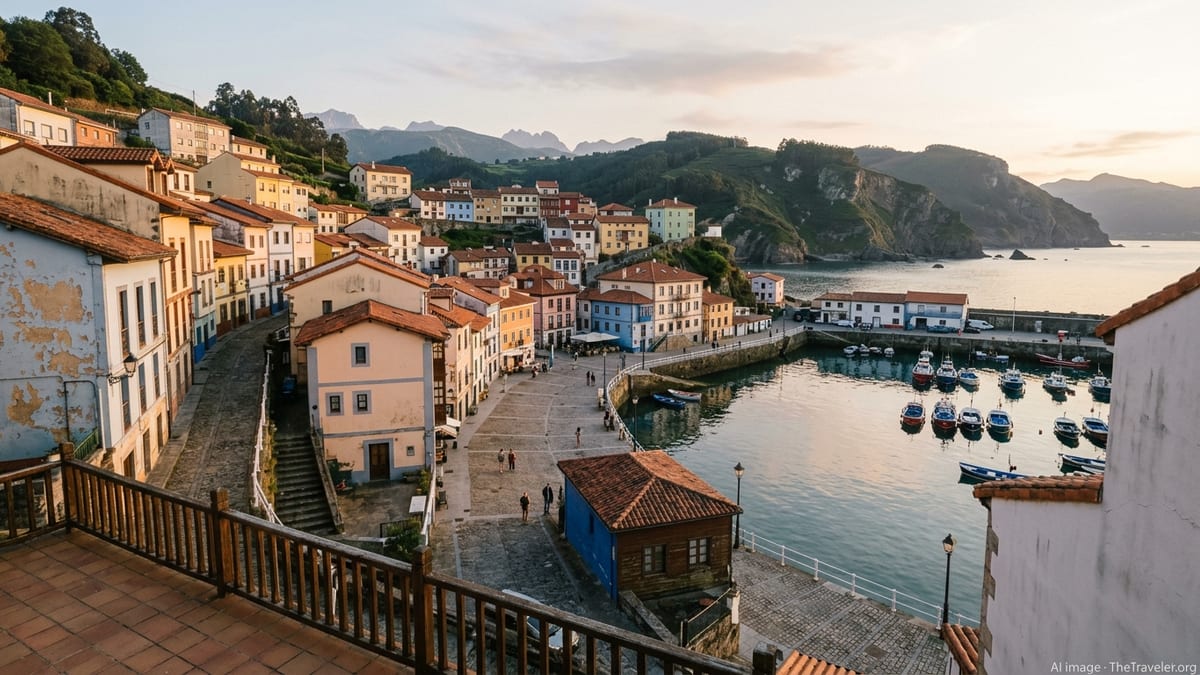
Cudillero was the photo that had hooked me on the flight search engine: a fishing village where houses in pastel colors seem to pour down a hillside into a tiny harbor. Even with that image in mind, nothing prepared me for stepping out of the car at the top of the village and looking down. The roofs appeared first, a mosaic of terracotta tiles, then the narrow lanes, then finally the harbor, a small bite taken out of the slate-blue Cantabrian Sea.
The village is often described by travel writers as an amphitheater, and walking down, you understand why. Houses are arranged in tight, curved rows around the water, as if every balcony were fighting for a first-row seat to the sea. Many of those facades, once simple fishermen’s homes, are now painted in electric blues, deep oranges, and dense greens that seem to glow whenever a break in the clouds lets sunlight through. Tourism has grown, especially in summer, but most of the voices you hear on the main square are still Spanish. Men in rubber boots haul crates of fish across the quay while visitors squeeze into terrace tables for plates of grilled sardines.
I checked into a small family guesthouse set two streets above the harbor. My room window framed the village like a living postcard: washing lines stretched between balconies, seagulls cutting across the sky, and, every so often, a plume of smoke from someone grilling fish on a tiny terrace. When I asked the owner where I should go for my first proper meal in Asturias, she simply pointed downhill. “Follow the smell of garlic and butter,” she said. “You cannot go wrong here.”
Tasting the Sea and the Mountains
Like many travelers, I had come with vague plans to hike in the Picos de Europa, the mountain range that rises so abruptly a short drive inland. Only later did I read that the national park, which spreads across Asturias, Cantabria, and Castile and León, has recently been highlighted by travel editors as one of the most spectacular landscapes on the planet, praised for the way its sharp peaks rise just a handful of kilometers from the ocean. It is rare to find alpine-style scenery so close to the sea, and you feel that tension everywhere here.
In Cudillero, dinner was the sea on a plate. At a simple restaurant facing the harbor, I sat under a striped awning while the last light slid off the painted houses. The server recommended a portion of merluza a la sidra, hake simmered in local cider, along with a shared platter of chipirones, tiny squid grilled until just charred at the edges. With a basket of bread and a bottle of Asturian cider, the bill came to less than what I had paid for a quick lunch in central Madrid earlier that year. Around me, families from inland Asturias were on their own summer escape, speaking in rapid Spanish and Asturian, ordering the same dishes with the matter-of-factness of locals who know that this abundance will still be here in September.
The next morning, I drove east along the coast toward Ribadesella and Llanes. The road wound between dairy pastures and glimpses of surf beaches, the mountains growing sharper on the horizon. Signs pointed toward places I had never heard of yet suddenly wanted to explore: Playa del Silencio, reportedly one of the most striking coves on the Asturian coast, and dozens of smaller beaches where the cliffs seemed to fold into the sea. Every few kilometers a cluster of houses would appear, announcing another fishing village hugging a natural inlet. In most, at least one bar advertised fresh fish stew or fabada, the rich local bean dish, chalked on a board for prices that would make most coastal resorts blush.
Into the Picos de Europa
It was only when I left the coast behind and pointed the car inland toward Cangas de Onís that I realized how abruptly Asturias changes character. Within half an hour, the landscape shifted from soft green hills to steep limestone walls. The road began to coil up through narrow valleys, following rivers that flashed clear and cold in the gaps between trees. In the distance, the Picos de Europa finally revealed themselves: jagged peaks, some still holding patches of snow even in late summer, rising more than 2,500 meters but sitting remarkably close to the coastline I had just left.
I based myself in a modest rural hotel outside Cangas de Onís, where limestone peaks towered at the end of the driveway and cows grazed casually beside the road. At breakfast, the owner spread paper maps across the table and circled classic routes around the Lakes of Covadonga, a pair of small glacial lakes that sit at over 1,100 meters in the heart of the national park. He advised arriving early, both to find parking and to see the water before the wind picked up. “If the surface is calm,” he said, “you will see the mountains twice, once where they are and once where they are not.”
The drive up to the lakes alone would have been worth the journey. The narrow road climbed quickly, snaking above the tree line, past grazing cattle and small stone shepherd huts. Each turn revealed more of the massif, sheer rock faces stacked against the sky. At the top, two lakes, Enol and Ercina, lay like small mirrors among the meadows. Despite their modest size, they felt immense because of what surrounded them: a ring of peaks that made it clear why this was the original core of one of Spain’s earliest national parks.
I followed an easy circular trail around the lakes, watching as low clouds rolled in and broke apart again, revealing new details in the rock every few minutes. Families with children, older couples with trekking poles, and serious hikers with heavy packs all shared the same paths. Every so often, a cowbell would ring out across the valley, reminding me that these mountains are not just a protected landscape but still a working pasture for local farmers. It was that combination of grandeur and grounded daily life that made the Picos feel different from other alpine regions I had visited.
Small Moments That Changed My Mind
Looking back, my sense of Asturias as quietly extraordinary did not come from any single famous viewpoint but from small, layered moments. There was the afternoon in Llanes when I walked through a historic center still enclosed by old ramparts, then turned a corner to find a small port where fishing boats bobbed in water that smelled clean and salty rather than diesel-heavy. A few streets away, surfers jogged down to a beach framed by cliffs, wetsuits unzipped to the waist, while a group of older men played cards in the shade of a centuries-old tower.
Another came on a gray morning in Ribadesella. The town sits where the Sella River meets the sea, its long urban beach curving out toward the open Atlantic. Joggers were already out as the tide slid back, leaving lines of foam on the sand. Colorful townhouses lined the promenade, evidence of a time when families made fortunes abroad and returned to build elaborate seaside homes. I bought a still-warm pastry from a bakery just off the main square and ate it on a bench facing the river, watching kayakers pass beneath a low bridge on their way toward the estuary.
Even the weather, something I had half-dreaded before the trip, became part of the charm. Asturias is not the place to come if you want cloudless skies for seven days straight. Rain arrives often and without much announcement. But that same Atlantic moisture is what keeps the hills and mountains so vividly green. More than once I watched a downpour roll in over the sea, soak the village, and then drift inland, leaving the cobblestones shining and the painted houses even more saturated than before. Fifteen minutes later, the cafes would slowly refill with people shaking water from jackets and ordering another round of cider.
Travel Practicalities in a Region That Still Feels Local
For all its natural drama, Asturias remains refreshingly approachable. Distances are short: the drive from Cudillero on the coast to Cangas de Onís near the Picos de Europa is roughly two hours, depending on stops, which makes it entirely possible to sleep by the sea and hike in the mountains within the same day. Rental cars are plentiful at the regional airport and in larger towns, and fuel, while not cheap, is similar in price to the rest of Spain. Public transport connects major centers, but the true magic of the region lies in the small detours and viewpoints that are easiest to reach with your own wheels.
Accommodation options range from simple guesthouses above village bars to small rural hotels tucked into valleys. In summer, particularly in August when much of Spain heads north to cool off, booking ahead is wise, but even then I found last-minute rooms at prices that would be considered off-season in more famous Mediterranean resorts. Many of these places are family-run, which means you are often getting local advice along with your room key: which fishing village is less busy that day, whether the road up to the lakes is open, where to find the quietest beach near Llanes.
Eating well is almost unavoidable. Menus lean heavily on what the sea and mountains provide: grilled fish, hearty stews, fresh cheeses from nearby pastures, cider poured from high above the glass in the traditional way. Even in coastal towns that now see more visitors, I often ended up in places where builders and fishermen in work clothes were eating at the next table, a good sign for both price and quality. It is a region where tourism supports the local economy but has not yet overwritten it.
The Takeaway
When I look back at my trip to Asturias, I struggle to understand how such a compact region can hold so much variety. Within a single morning you can drink coffee above a fishing harbor where colorful houses cling to a cliff, then drive inland and find yourself standing beside a glacial lake ringed by limestone peaks. Villages that in other countries would be headline destinations appear here almost casually, scattered along a coastline with hundreds of beaches and coves. Mountain views that would anchor entire tourism campaigns elsewhere are simply part of the daily backdrop for farmers and shopkeepers.
More than anything, Asturias reshaped my idea of what beauty looks like in Europe. It is not just in the glossy cities or on famous Mediterranean beaches, but also in places where the weather is changeable, where the streets still smell faintly of fish at the end of the day, where cows graze almost up to the road and villagers still gather in small squares at dusk. I arrived expecting a cheap flight and a green coastline. I left with the sense that I had seen one of the continent’s quiet wonders, the kind of place that changes you precisely because you never expected so much from it.
FAQ
Q1. Where exactly is Asturias and how easy is it to reach?
Asturias is a region in northern Spain on the Bay of Biscay. It has a small international airport near Oviedo with flights from several Spanish and some European cities, and it is also reachable by train or car from Madrid and other major hubs.
Q2. When is the best time of year to visit Asturias?
Late spring through early autumn is ideal, roughly from May to early October. Summer brings warmer temperatures and lively coastal towns, while May, June, and September often offer a balance of fewer crowds and still-pleasant weather.
Q3. Do I need a car to explore the coast and the Picos de Europa?
You can reach main towns by public transport, but a car makes it much easier to visit smaller fishing villages, secluded beaches, and high mountain viewpoints in the Picos de Europa on your own schedule.
Q4. Is Asturias very expensive compared with other parts of Spain?
Overall, Asturias is often more affordable than major Spanish cities and famous coastal resorts. Food portions tend to be generous, and mid-range guesthouses and small hotels can offer good value, especially outside peak August dates.
Q5. What kind of hikes can I do in the Picos de Europa if I am not very experienced?
The area around the Lakes of Covadonga offers well-marked, relatively gentle circuits suitable for beginners, while valley walks near Cangas de Onís and other villages provide mountain views without serious exposure or technical terrain.
Q6. Will I manage with only English in Asturias?
In larger towns and in some hotels and restaurants, staff often speak basic English, but in small villages Spanish is more common. A few phrases in Spanish, plus maps or translation apps, go a long way and are usually appreciated.
Q7. What is typical food and drink I should try in Asturias?
Local staples include fresh Atlantic fish and seafood, hearty bean stews such as fabada, regional cheeses, and Asturian cider, which is traditionally poured from height into the glass to aerate it.
Q8. Is the weather really as rainy as people say?
Asturias receives more rain than much of Spain, which keeps the landscape green. You can still have many sunny days, but it is wise to pack a light waterproof jacket and flexible plans in case showers pass through.
Q9. How many days do I need to see both the coast and the Picos de Europa?
With four to five full days you can comfortably combine at least one coastal base, such as Cudillero or Llanes, with time around Cangas de Onís and a day trip to the Lakes of Covadonga or another mountain area.
Q10. Is Asturias suitable for families with children?
Yes, the region works very well for families, thanks to safe beaches with gentle waves in some bays, easy walks around the lakes and valleys, and plenty of outdoor space in villages and rural accommodations.