


I used to think Rail Europe was a middleman I did not need. Why go through an extra platform, I figured, when you can book directly with national railways or use a Eurail or Interrail pass app? That confidence disappeared the moment I tried to stitch together a Paris–Zurich–Milan–Vienna–Prague itinerary on peak‑season trains, with a mix of passes and point‑to‑point tickets, and a tight calendar. By the time I boarded my first TGV, I had a completely different view of how and when Rail Europe actually earns its place in a multi‑country trip.
Get the latest updates straight to your inbox!
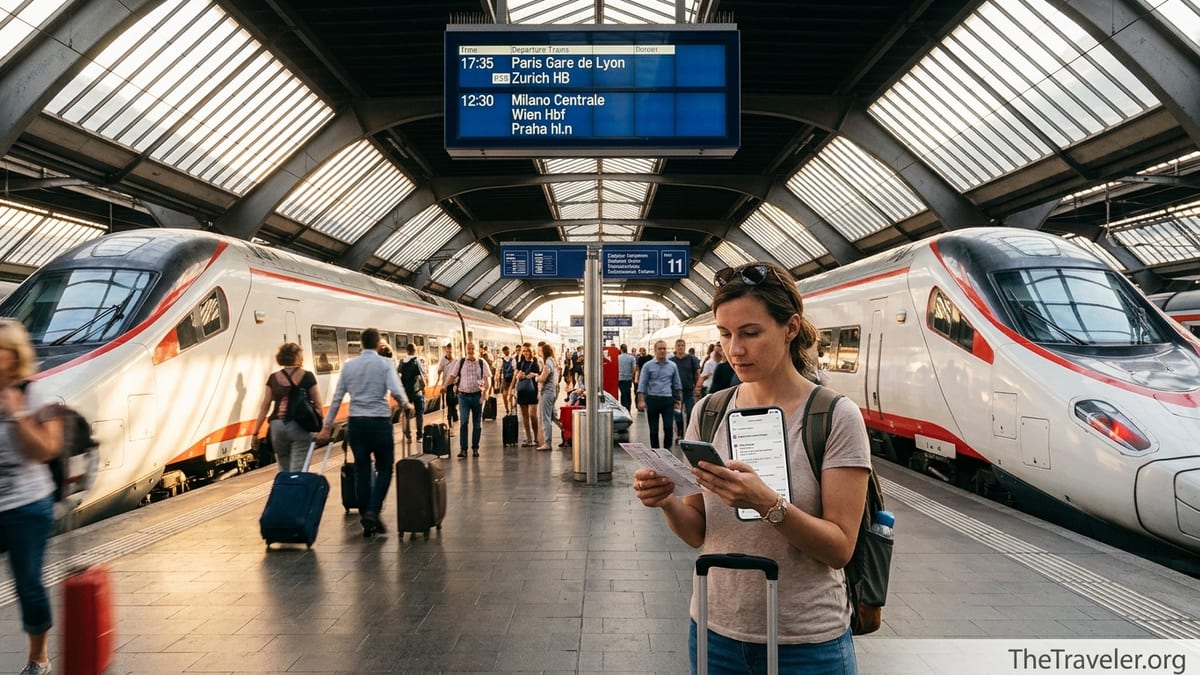
From Skeptic to Convert on a Five‑Country Itinerary
The turning point for me was a three‑week summer route that many North American travelers dream about: Paris to Zurich, onward to Milan, then over to Vienna and finally Prague. On paper, it looks simple. In reality, you are dealing with French TGVs and Lyria services, Swiss Federal Railways, Trenitalia and Italo in Italy, Austrian Railways, and Czech Railways, each with its own booking platform, seat reservation rules, and release calendars. I started out trying to book everything directly, with a Eurail Global Pass in mind, only to discover that some segments required separate reservations, others were cheaper as advance point‑to‑point, and a few popular trains were not even open for booking yet on the national sites.
I first landed on Rail Europe almost by accident, while searching for seat reservations on a Paris–Zurich TGV Lyria in July. The official French railway site showed limited passholder seats and kept timing out when I tried to use a foreign credit card. Rail Europe, on the other hand, listed the same train with clear “passholder fare” options and no need to navigate French‑language error messages. It was the first time I saw all the legs of my trip presented on a single interface that understood both regular tickets and the Eurail pass I planned to use.
Over the following days, I found myself returning to Rail Europe whenever I hit a wall elsewhere. A Vienna–Prague Railjet that refused to accept my US payment card on the Austrian site, an Italian Frecciarossa that appeared as “sold out” for passholders on one system but still showed seats on another, and a late‑evening Zurich–Milan EuroCity train with only a handful of discounted advance fares left. Each time, Rail Europe gave me a clear snapshot of what was realistically available, even if I ultimately bought a couple of those tickets direct when it made obvious financial sense.
By the time I boarded that first TGV out of Paris, I no longer saw Rail Europe as an optional extra. It had become the control center where I checked seat availability, compared pass versus point‑to‑point prices, and confirmed whether a dream routing was feasible before reshaping the rest of my itinerary around it.
What Rail Europe Actually Is (and Is Not)
Part of my initial resistance came from misunderstanding what Rail Europe does. It is not a rail pass in itself and it is not tied to a single operator. Instead, it is a booking platform that aggregates schedules, fares, and passholder reservations across dozens of European train companies, from SNCF in France and SBB in Switzerland to Trenitalia, Deutsche Bahn, Italo, Eurostar, Renfe, and others. For travelers, particularly those coming from North America, it functions as an English‑language front door into a complicated ecosystem of national railways and reservation rules.
This matters most when you are dealing with Eurail or Interrail passes. These passes give you flexible travel across 30‑plus countries, but they do not guarantee seats on high‑speed or overnight trains, and in busy countries such as France, Italy, and Spain you often need a paid reservation on top of your pass. Rail Europe specializes in those reservations. It understands when you are a passholder, surfaces the correct “with pass” fare, and lets you reserve seats on trains like TGV Lyria, Eurostar, or Spanish high‑speed services where passholders previously had to navigate fragmented systems.
What Rail Europe is not is always the cheapest option in every scenario. If you know that you are taking a simple Milan–Florence journey in shoulder season and you are happy to lock in a non‑refundable fare weeks ahead, buying a discounted ticket directly from Trenitalia might save you a few euros. Similarly, if you are only hopping from Paris to Lyon and back, the added flexibility of a global pass plus Rail Europe reservations may be unnecessary. The platform shines when complexity rises: multi‑country trips, mixed pass and ticket combinations, peak‑season weekends, and routes that cross borders in less obvious ways.
On my five‑country trip, for example, I did not use Rail Europe to book every single train. I bought a discounted advance ticket on a midweek Milan–Venice run directly from Italo because it was significantly cheaper. But for that crowded Friday Paris–Zurich TGV, and a Sunday afternoon Vienna–Prague Railjet when everyone seemed to be traveling, the clarity and consolidated view Rail Europe provided were worth more than the small booking fee added on top of the reservation.
How Rail Europe Simplified a Complex Multi‑Country Plan
The true value of Rail Europe showed itself when I started viewing my itinerary as a network rather than a list of separate journeys. Consider the Paris–Zurich–Milan stretch. Paris–Zurich is usually operated by high‑speed TGV Lyria trains, which require reservations for passholders. Zurich–Milan runs on EuroCity or similar services through the Alps, which also carry compulsory seat reservations and can be extremely popular in summer. When I tried to book each segment in isolation, it was easy to overlook how a fully booked Paris–Zurich afternoon departure would, in turn, disrupt my planned evening connection into Italy.
Within Rail Europe, I could enter Paris as my origin and Milan as my final destination on a given date, then see journey options that stitched both legs together, including the necessary change in Zurich. The system not only flagged which segments required reservations, it also made it clear when a tight 20‑minute connection in Zurich would be risky on a crowded Saturday. In my case, I changed my departure from Paris to an earlier TGV to protect the connection and secure seats on both trains in a single planning session.
A similar pattern played out later between Vienna and Prague. The Austrian and Czech sites each offered their own presentations of Railjet services, sometimes with minor fare differences. Rail Europe pulled those into one screen where I could compare a morning departure that gave me most of the afternoon in Prague versus a cheaper, slower option involving a regional connection. It also reminded me that with my Eurail pass, some of those fares boiled down to whether I could still find passholder seats on the most popular trains at my preferred times.
By using Rail Europe as an umbrella view, I avoided dead ends like discovering too late that the only remaining passholder seats on a crucial cross‑border train were at an awkward hour. Even when I ultimately purchased a particular ticket through a national railway for a slight saving, I had already used Rail Europe to test different days, times, and routes and to understand how each decision would ripple through the rest of the trip.
Passes, Reservations, and Point‑to‑Point: Finding the Right Mix
Before this trip, I assumed that once I bought a Eurail Global Pass, the hard work was over. In reality, the pass is just one component of a strategy that mixes flex days, mandatory reservations, and the occasional point‑to‑point bargain. Rail Europe helped me see where each piece fit best. On the Paris–Zurich–Milan leg, for instance, using my pass for both high‑speed segments made sense given their base fares and the high demand. In contrast, a simple Milan–Venice day trip in shoulder season was cheap enough with a direct advance ticket that it was better to save a flex day on my pass for longer distances.
Where Rail Europe proved especially useful was in highlighting how reservation fees stacked up. French TGV and cross‑border routes often carry higher passholder reservation charges than slower regional trains. When I searched Paris–Zurich with my pass, Rail Europe showed clearly that taking a slightly earlier departure or accepting a connection at an intermediate station could reduce the reservation cost, while still keeping travel within the same day. That allowed me to save both money and travel time without poring over multiple national booking engines.
The platform also helped with capacity management. In peak months, popular trains like weekend Eurostar services or Spanish high‑speed lines into Barcelona can sell out of their passholder quotas even when regular tickets are still on sale. Using Rail Europe, I could see at a glance which departures still had passholder availability and which were already full at my preferred times. When I saw limited passholder seats on a Sunday Vienna–Prague train, for example, I shifted my plans to travel earlier in the day, keeping my pass useful and avoiding having to buy an expensive last‑minute ticket.
The result was a hybrid approach: my pass covered the more expensive or logistically critical cross‑border legs, reserved through Rail Europe when necessary, while a handful of shorter regional trips were bought outright where that clearly worked out cheaper. Instead of being locked into a single method of travel, I used Rail Europe as a tool to decide, segment by segment, which option made the most financial and practical sense.
Real‑World Booking Scenarios Where Rail Europe Helps
Several concrete situations convinced me that Rail Europe is particularly valuable for certain types of travelers and routes. One memorable case involved a friend planning a France–Spain loop using a Eurail pass. For years, passholders struggled to book Spanish high‑speed reservations online, often needing to visit ticket offices in person. Now, with Spanish state‑owned trains more widely distributed through platforms like Rail Europe, my friend could line up her Paris–Barcelona and Barcelona–Madrid reservations from home, days or weeks before traveling, instead of gambling on last‑minute availability at a busy station in high season.
Another example occurred on a London–Paris–Amsterdam triangle. A couple from Chicago wanted to use a Eurail pass but were rightly worried about Eurostar’s mandatory reservations and limited passholder quotas. By checking Eurostar services via Rail Europe, they could quickly see which morning departures still had pass seats at reasonable reservation fees and which were already full, then build the rest of their trip around those anchor legs. They still ended up mixing in a discounted advance ticket on one leg, but Rail Europe had given them clarity to avoid planning around trains that were already essentially off the table for passholders.
Even families benefit when juggling several travelers at once. On my own itinerary, I booked a Zurich–Milan EuroCity for two adults and a teenager. Rail Europe displayed family‑friendly seating options and showed which carriages still had clusters of seats together before I committed. For a family of four doing a circular route such as Paris–Lucerne–Florence–Rome–Nice, being able to manage all those bookings from one account, with consistent English terminology and transparent reservation requirements, can de‑stress what might otherwise be a confusing series of national booking experiences.
Importantly, the platform is not just for passholders. If you are planning a shorter but still multi‑country trip, such as Munich–Salzburg–Vienna–Budapest over a week, Rail Europe lets you quickly compare regular fares against what a pass might cost for the same days. Many travelers discover that a pass makes sense once their route crosses three or more borders within a month, while others realize that simple point‑to‑point tickets bought in advance cover their needs. In both cases, the same interface provides the data needed to make that decision.
Limitations, Costs, and When to Skip Rail Europe
None of this means Rail Europe is a silver bullet. There are limitations and trade‑offs to understand. First, not every single regional or local train in Europe appears on the platform, and in some countries the very cheapest promotional fares may be available only through the national operator’s own channels. Travelers focused on a single country and happy to navigate local language sites can sometimes beat the prices they see on a multi‑operator platform, especially outside peak periods.
Second, Rail Europe usually adds a small booking fee, particularly for passholder seat reservations. On a complex multi‑country itinerary this can be a fair price to pay for the convenience of consolidated planning and English‑language support. But for a budget traveler stringing together a few short hops within one country, those fees might be more noticeable relative to the base fare. On a solo off‑season trip limited to, say, regional journeys within Germany or Italy, I would likely book directly and use Rail Europe only as a reference to double‑check times and connections.
Third, Rail Europe is ultimately subject to the same seat quotas and release patterns set by the underlying rail operators. If Eurostar chooses to restrict the number of passholder seats on a Friday afternoon service, no intermediary can magically unlock more. What a platform like Rail Europe can do is expose that scarcity early so you do not unknowingly plan a connecting itinerary around a train that is already full for passholders. It is a planning aid, not a back door into restricted inventory.
Finally, technology is only as helpful as the way you use it. Rail Europe works best when you approach your itinerary with at least a rough framework. On my trip, deciding in advance that I would be in Paris for four nights, then Zurich for two, Milan for three, and so on gave me enough structure to search specific dates and compare options meaningfully. If you are entirely improvising your route day by day in high summer, no booking platform can guarantee cheap or flexible seats on the most in‑demand trains at the last minute.
The Takeaway
My multi‑country rail journey across France, Switzerland, Italy, Austria, and the Czech Republic turned Rail Europe from something I had once dismissed into a platform I now consider essential whenever an itinerary spans several borders. It did not replace Eurail or Interrail, nor did it always beat national railway sites on price. Instead, it gave me a unified window into schedules, passholder reservations, and capacity across multiple operators, which proved invaluable as I threaded together time‑sensitive connections and peak‑season departures.
If you are planning a simple point‑to‑point trip within a single country at a quiet time of year, you may not need Rail Europe at all. But if your plans resemble the classic first‑time or return visitor arc of Paris–Zurich–Milan–Vienna–Prague, London–Paris–Amsterdam, or a Spain–France loop that crosses borders several times, using the platform early in your planning can save you from costly surprises and unrealistic assumptions. It helps you answer the practical questions that matter most: Will my pass actually get me on that train? Are there still seats at reasonable reservation fees? And how do changes on one leg ripple through the rest of the route?
In the end, Rail Europe did not make European rail simple. Rail is still a patchwork of policies, quotas, and reservation rules. What it did do was make that complexity visible early enough that I could work with it rather than be blindsided at the ticket counter. For a multi‑country rail trip, that visibility can be the difference between a relaxed, scenic journey across borders and a stressful scramble from one fully booked train to the next.
FAQ
Q1. Do I need Rail Europe if I already have a Eurail or Interrail pass?
In many cases it helps. Your pass covers the fare but not mandatory seat reservations on high‑speed and some cross‑border trains. Rail Europe is one of the easiest ways to book those reservations in advance across multiple countries and operators, especially if you prefer a single English‑language interface.
Q2. Is Rail Europe always cheaper than booking directly with national railways?
No. Sometimes national operators offer limited promotional fares that are slightly cheaper, particularly for simple domestic trips booked well in advance. Rail Europe often adds a modest booking fee, so it tends to be most valuable for complex multi‑country routes, passholder reservations, and situations where convenience and clarity are worth paying for.
Q3. Can I use Rail Europe without a rail pass?
Yes. Rail Europe sells standard point‑to‑point tickets on many European railways, as well as passes. If you are planning a shorter trip such as Munich–Salzburg–Vienna or Milan–Florence–Rome without a pass, you can still compare times and fares and book regular tickets entirely through the platform.
Q4. Does Rail Europe show every train and route in Europe?
It covers a wide range of national and private operators, including many high‑speed, regional, and cross‑border services, but not every single local or commuter train. In some countries, smaller private lines or very local services may only appear on regional sites. For most international and major intercity routes, though, Rail Europe provides strong coverage.
Q5. When should I rely on national railway websites instead of Rail Europe?
If your trip is confined to a single country, outside peak periods, and you are comfortable using that railway’s own site, booking direct can be slightly cheaper and may expose additional promotional fares. For example, a series of off‑peak regional trips entirely within Italy or Germany can often be managed directly without needing Rail Europe, especially if you do not hold a rail pass.
Q6. How far in advance should I book through Rail Europe?
That depends on the route and season, but for peak‑season travel on popular lines such as Paris–Zurich, London–Paris Eurostar, or Barcelona–Madrid, it is wise to look several weeks or even a couple of months ahead. Rail Europe will typically show availability as soon as the underlying railway opens bookings, letting you secure key long‑distance legs early and leaving shorter regional segments more flexible.
Q7. Does Rail Europe charge extra fees for passholder seat reservations?
There is usually a small booking fee on top of the reservation cost set by the railway. For a complicated multi‑country itinerary, many travelers consider this a reasonable price for the convenience of handling numerous reservations in one place. On very short or simple trips, those fees may feel proportionally higher compared with booking directly at a station.
Q8. Can Rail Europe help if a train I want is sold out for passholders?
It cannot create extra passholder seats where the railway has not allocated them, but it can quickly show you which alternative departures or nearby dates still have availability. That visibility lets you adjust plans early, perhaps leaving earlier in the day or shifting your itinerary to a less crowded time, instead of discovering the problem on the day of travel.
Q9. Is Rail Europe useful for families traveling together?
Yes. When booking for several people, Rail Europe can show seat availability and help you keep the group together, particularly on busy cross‑border or high‑speed services. Having all tickets and reservations in one account simplifies check‑in and ticket inspection, which can reduce stress when you are managing luggage, children, and connections.
Q10. What is the main benefit of Rail Europe for a multi‑country trip?
The core advantage is visibility and consolidation. Instead of juggling several national websites, languages, and payment systems, you can see schedules, fares, and passholder reservation options across many operators in one place. That makes it easier to design realistic itineraries, secure critical long‑distance legs, and understand how changes on one segment affect the rest of your route.