


More news on this day
As European tourism organisations refocus on slower, more sustainable travel, a trio of autumn hiking routes is emerging as a showcase for journeys that combine mountain scenery with vineyards, villages and historic landmarks.
Get the latest news straight to your inbox!
Dolomites Harvest Routes Link Alpine Peaks and Wine Culture
In northern Italy, regional tourism campaigns are placing renewed emphasis on autumn in the Dolomites, positioning the season as a quieter alternative to the crowded summer peak. Recent destination marketing highlights so-called "golden autumn" weeks, when larch forests turn amber and high pastures thin out, but valley trails and chairlifts remain open for walkers and casual hikers.
Promotional programmes in areas such as the 3 Zinnen Dolomites and South Tyrol package guided hikes with food events, farm visits and mountain-hut tastings. Weekly schedules for September and October combine high trails above Dobbiaco with evenings devoted to local specialties, suggesting that visitors are increasingly seeking itineraries where hiking is intertwined with regional cuisine and village life.
Alongside the high-mountain circuits, lower-altitude routes such as the Keschtnweg, or Chestnut Way, are being singled out for harvest-season tourism. Travel features describe the 60-kilometre trail between Bressanone and Bolzano as a multi-day walk through orchards, chestnut groves and wine-growing slopes, punctuated by farmhouse taverns serving new wine and seasonal dishes. The route’s modest elevation profile and frequent access points are being promoted as suitable for intermediate hikers and food-focused travellers.
Specialist tour operators and local agencies have responded with multi-day packages that blend sections of Dolomites hiking with vineyard tastings and cultural stops in historic towns. Itineraries marketed for late September and October typically combine moderate day walks with visits to family-run cellars, reflecting a wider trend toward itineraries where landscapes, harvest rituals and local traditions are presented as a single experience.
Camino de Santiago Emphasised as Autumn Cultural Corridor
Across the Iberian Peninsula, long-distance pilgrimage routes to Santiago de Compostela continue to attract walkers well beyond the summer months, with travel providers increasingly highlighting autumn as a comfortable window for multi-week journeys. Guide publishers and route planners note that September and October bring cooler temperatures to the French Way, the Northern Way and newer coastal itineraries, while services such as hostels and luggage transport remain widely available.
Travel accounts and promotional materials describe the Camino network as more of a cultural walking trip than a technical hike, a positioning that has proved appealing for first-time long-distance walkers. Autumn coverage emphasises the combination of emptying wheat fields in Castile, grape harvests in Rioja and Galicia, and religious architecture that ranges from Romanesque churches to baroque cathedrals. This blend of landscapes and heritage has led tourism bodies in Spain and France to continue framing the Camino as one of Europe’s most accessible cultural corridors on foot.
Newer variants are also being promoted to returning visitors and those seeking coastal scenery. Regional initiatives in Galicia publicise routes such as the Camino “A Orixe,” which follows the Atlantic shoreline before turning inland, described in tour catalogues as combining fishing villages, estuaries and forest paths over roughly 140 kilometres. Marketing for these itineraries often points to autumn’s thinner crowds and more stable weather on the ocean-facing stretches.
Online communities dedicated to the Camino report that spring and autumn remain the most popular periods for international walkers, particularly from North America and northern Europe. Discussions frequently highlight the social aspect of shared dormitories and communal dinners, while also noting that off-season departures allow for quieter stages and easier access to smaller lodgings in historic centres along the route.
Liberation Route Europe Brings Wartime Heritage to the Trail
Beyond traditional mountain and pilgrimage destinations, a pan-European trail network built around Second World War heritage is being prepared for a broader international push that includes the shoulder seasons. The Liberation Route Europe Foundation has developed an interconnected system of hiking and cycling paths linking battlefields, memorials and civilian stories across countries including France, Belgium, the Netherlands, Germany and Italy.
According to publicly available information from the organisation, the network is being promoted as a sustainable heritage destination, with a new campaign targeting North American visitors scheduled to launch in late 2025. The initiative places emphasis on off-season travel and the use of public transport, aligning with European policy priorities that seek to redistribute tourist flows away from summer peaks and the most saturated urban centres.
The trails themselves vary from short local loops to multi-day sections that thread through countryside once marked by front lines and liberation routes. Interpretive points along the way highlight personal narratives and lesser-known sites, encouraging walkers to engage with wartime history in smaller towns and rural districts that often fall outside standard city-break itineraries. Autumn, with its quieter visitor numbers and cooler conditions, is being promoted as a fitting time for reflective journeys of this kind.
Regional tourism partners in places such as Wallonia and northern Italy are integrating segments of the Liberation Route into broader walking and cultural offers, combining battlefield paths with village stays, museums and local gastronomy. Trail literature underscores that many sections follow existing rights-of-way and countryside tracks, allowing hikers with moderate fitness to mix remembrance-focused walks with more conventional landscape tourism.
Central European River and Vineyard Paths Gain Autumn Attention
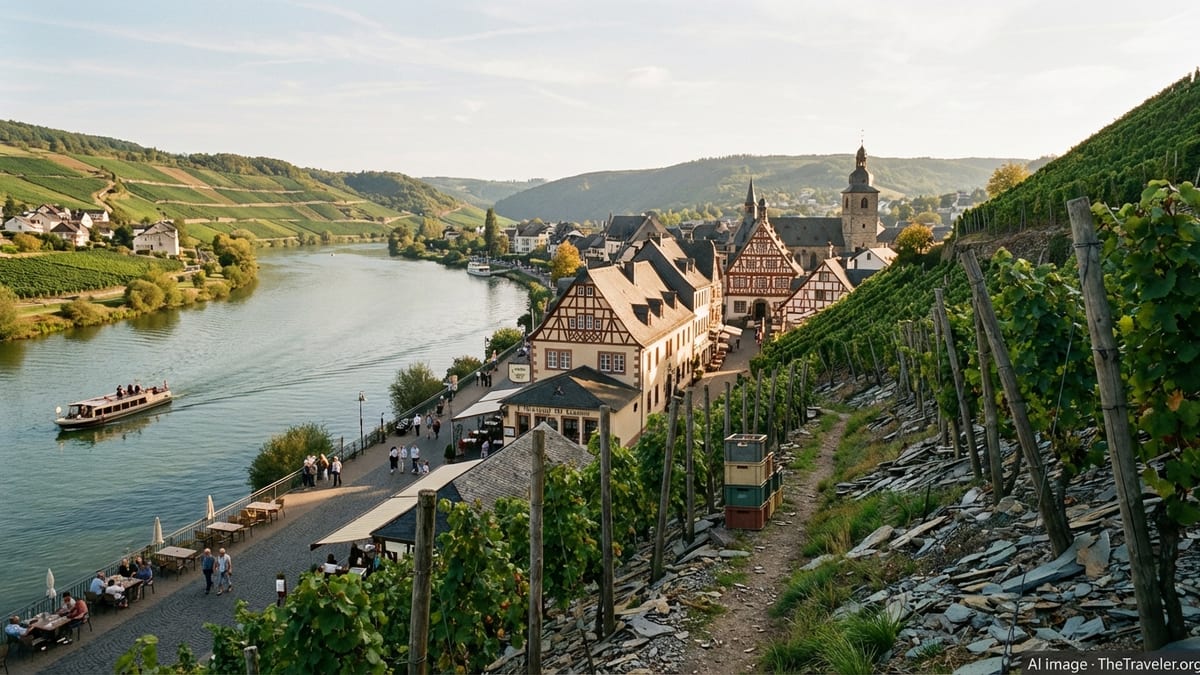
In addition to high peaks and long pilgrim roads, central Europe’s river valleys and wine regions are seeing increased attention as autumn hiking destinations. Walking-holiday providers highlight stages of routes along the Rhine and Moselle in Germany and the Wachau region in Austria, where terraced vineyards and castle-topped hillsides are framed by yellow and red foliage from late September into October.
Commercial itineraries often focus on flexible day-stage walks between historic towns, supported by luggage transfers and local rail connections. Descriptions of these tours stress that visitors can cover 10 to 20 kilometres per day on well-marked paths, then spend evenings in riverside villages sampling regional wines and traditional dishes. The model is marketed as an alternative for travellers who prefer cultural sightseeing and culinary experiences alongside moderate outdoor activity.
Destination guides describe autumn on these routes as a period when wine harvests, local festivals and changing colours coincide. Towns such as Trier on the Moselle or smaller villages along the Wachau are presented as bases where hikers can combine vineyard walks, monastery visits and seasonal events. This approach reflects a broader European trend in which hiking infrastructure is used not only for sport, but as a framework for exploring living cultural landscapes.
Across these varied routes, from the Dolomites and Camino de Santiago to river-valley vineyard paths and remembrance trails, current tourism messaging points to autumn as a key season for travellers seeking slower journeys. The focus on moderate distances, regional food and layered histories suggests that Europe’s hiking offer is increasingly framed around experiences that merge nature with culture rather than purely athletic goals.