


On my first morning in Istanbul, I joined the slow, shuffling line curling around Hagia Sophia’s northern side. I expected grandeur. I expected history. What I did not expect was how complicated, emotional and even confusing it can feel to visit this iconic building in 2026, when it is at once a working mosque, a heavily managed tourist site and a monument carrying the weight of global headlines.
Get the latest updates straight to your inbox!
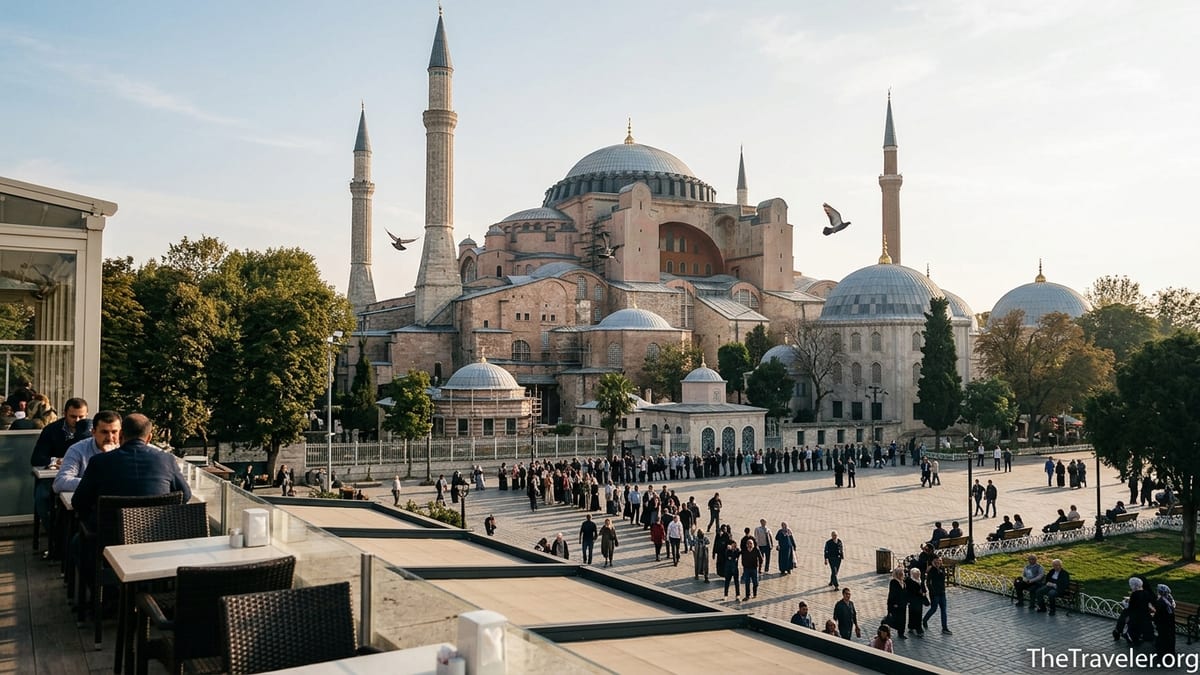
The First Surprise: You No Longer Enter as a Simple Museum Visitor
In my mind, Hagia Sophia still lived as the museum I had seen in guidebooks: buy a ticket, walk in the front, drift under the dome. In reality, the experience has been split into two very different worlds. The main floor is now primarily for worshippers, while most foreign tourists are routed to a separate entrance on the northeast side and guided up to the upper galleries. I joined a line of visitors who, like me, kept checking our phones to be sure we were even in the right place, because the entrance looks more like a side gate than the grand portal you might expect.
At the ticket area, the second surprise arrived in bold black digits: around 25 euros per adult for access to the upper gallery, with payment explicitly set in euros rather than lira. Several people in front of me stepped aside to whisper about whether it was worth it. One couple from Spain decided against going in at all, saying they had already spent heavily on Topkapi Palace tickets and a Bosphorus cruise. The contrast between the free mosque entrance for worship and the relatively high fee for the gallery visit catches many first time visitors off guard.
What struck me most was the sense of separation. Past visitors remember wandering the ground floor freely when Hagia Sophia functioned as a museum. Now, as a non Muslim tourist, your route is carefully channeled. The upper gallery is impressive and historically rich, but you are constantly aware that the heart of the building, the main prayer hall under the dome, is mostly off limits unless you are there specifically to pray.
Security Lines and Practical Realities I Did Not Anticipate
The next surprise came before I even saw a mosaic: airport style security. To enter the visitor route, everyone passes through metal detectors and bag scanners. On the morning I visited, security staff were brisk but calm, moving people along with a practiced rhythm. Large backpacks were pulled aside and a couple of visitors with rolling suitcases were turned away and directed to use nearby luggage storage services instead. Photography equipment was fine, but tripods were not allowed.
This security layer has grown more visible in recent years as visitor numbers have climbed and the building’s status has become more politically sensitive. In practical terms, it means you should build extra time into your schedule. On a sunny weekday morning in late spring, I queued for about 35 minutes from the back of the line to the ticket window, then another 10 minutes to clear security. Travelers I spoke with who came in high season reported waiting close to an hour at midday. The often repeated advice to visit early is not exaggerated.
Inside, there are more subtle controls. Certain side corridors are blocked by rope barriers, and there are attendants gently steering people away from prayer areas when they wander too close with cameras raised. Announcements remind visitors that it is an active mosque and ask for quiet. I noticed the security presence less after a while, but it shapes the entire visit in ways that might surprise anyone expecting a conventional museum atmosphere.
The View From the Upper Gallery: Awe Mixed With Distance
Ascending the long stone ramp to the gallery was the point when Hagia Sophia finally began to resemble the place I had imagined. The ramp, worn smooth by centuries of footsteps, twists upward until you emerge into the upper level that wraps around the main space. From here, the famous dome floats above like a shallow golden bowl, its sheer scale hard to process. Even if you know the dimensions in meters, standing there and seeing how small people look on the floor below is something entirely different.
Yet the perspective is not what older photos suggest. Because most tourists are now confined to the upper gallery, the main floor below is largely filled with prayer carpets and defined areas for worshippers. During non prayer times, a few people still move across the space, but many sections are roped off. It produces a curious feeling: you are simultaneously inside one of the world’s great buildings and yet kept at a distance from its central space. Several visitors around me commented quietly that they had expected to stand under the central dome itself, not only above it.
What softens that sense of distance is the chance to see details that can only be appreciated from above. From the gallery you can examine the Byzantine mosaics, including shimmering depictions of Christ, Mary and various emperors, that were uncovered during 20th century restorations. Up close, the tiny tesserae catch the light in an almost living way, shifting as you move. You can also trace the marble patterns on the walls and floors, an Ottoman Sultan’s balcony, and the monumental calligraphic roundels that proclaim the names of Allah, the Prophet Muhammad and early caliphs. The result is a layered panorama of Christian and Islamic art that simply cannot exist anywhere else in the same way.
Dress Codes and Cultural Expectations That Catch People Off Guard
Before arriving, I had read that Hagia Sophia has a mosque style dress code, but seeing how it plays out in practice was still eye opening. At the visitor entrance, there are large signs illustrating acceptable clothing. Shoulders and knees must be covered for everyone. Women are asked to wear a headscarf in or near active prayer spaces, and tight or very revealing clothing is strongly discouraged. On the morning of my visit, staff at the gate were actively turning away people in short shorts or sleeveless tops, sending them to buy inexpensive scarves and wrap skirts from nearby street vendors.
The scene outside has created its own little micro economy. On the plaza side streets, you can find stalls selling lightweight scarves for the equivalent of around 3 to 5 euros, as well as elastic waist long skirts designed specifically to meet mosque dress rules. I watched one group of friends from Germany improvise by buying colorful scarves and using them as both head coverings and wraps around their legs. Another visitor from Brazil ended up paying for a more expensive scarf after being told her cropped top was not acceptable even under a loose shirt.
These rules are not unique to Hagia Sophia. Istanbul’s famous Blue Mosque, just across Sultanahmet Square, enforces similar standards. But because Hagia Sophia still lives in many guidebooks as a museum rather than a mosque, the dress code seems to surprise more people here. The result is a short but stressful rush for some visitors who arrive in typical summer sightseeing outfits and then have to scramble to adapt. The simplest solution is to pack a light scarf and wear loose, knee length or longer clothing on the day you plan to visit.
Prayer Times and the Rhythm of a Living Mosque
Another aspect that changed the experience from what I expected is how tightly visiting hours are now woven around daily prayers. Hagia Sophia opens in the morning and generally welcomes visitors through early evening, but public access can pause or shrink around each of the five daily prayers, especially the important Friday midday prayer. On the day I visited, the tourist route to the gallery temporarily slowed around noon. A guard explained that certain zones were being cleared and asked visitors to wait a few minutes before moving further along the balcony.
This rhythm means your planning matters. Locals often suggest aiming to arrive early, between opening time and late morning, or in the late afternoon after the Asr prayer, when queues are shorter and the interior is calmer. Several travelers I met who arrived around mid day described a more hectic atmosphere, with large tour groups trying to squeeze their visits between prayer windows. One American family who had booked a private guide at around 11:30 a.m. reported spending much of their time being hurried along to avoid closures, which left them feeling more rushed than inspired.
The presence of worship is not a background detail. From the gallery, you can hear the soft murmur of prayers, the echoing cadence of Qur’an recitation over the sound system, and the call to prayer from loudspeakers outside. For some visitors, this spiritual atmosphere heightens the sense of awe, linking the building to its original purpose as a sacred space rather than a static museum. For others who chiefly came for architecture or art history, it introduces a tension between quiet contemplation and the bustle of tourist management. Either way, it is impossible to ignore, and it makes visiting Hagia Sophia feel fundamentally different from touring secular landmarks such as the nearby Basilica Cistern or Dolmabahce Palace.
The Emotional Weight of a Contested Monument
Before arriving, I was aware in a broad sense that Hagia Sophia had been at the center of political and cultural debates in recent years. What I did not foresee was how strongly that history would surface in casual conversations among strangers in the gallery. A Greek couple I met near one mosaic spoke of childhood stories in which Hagia Sophia symbolized lost heritage. A Turkish visitor nearby described feeling proud that it had returned to mosque status after decades as a museum. An American tourist, overhearing them, mentioned reading about UNESCO’s concerns over conservation and visitor management and admitted feeling torn about paying to visit a place caught up in such tensions.
The building itself carries these layered identities in stone. The great dome and many structural elements belong to its 6th century Byzantine origins, when it served as one of the most important churches in Christendom. After the Ottoman conquest, minarets were added, Christian iconography was covered or removed, and the interior was adapted as a mosque. In the 20th century, secular reforms turned it into a museum, and carefully planned restorations revealed some of the older mosaics again. Since 2020, its return to official mosque status has reoriented not only its religious life but also how the world talks about it.
Walking through the gallery today, you see this layered history everywhere: a mosaic Virgin and Child framed beyond enormous Islamic calligraphy, Byzantine crosses half hidden behind newer elements, Ottoman chandeliers hanging under a dome designed for a very different liturgy. The surprise is not that these layers exist. It is how visibly they coexist, and how much your reaction to them may depend on your own background. I left with more questions than answers about what such monuments should be in the modern world, and that complexity is part of what makes the visit linger in memory.
Practical Lessons I Learned the Hard Way
Among the more down to earth surprises were the small logistical lessons that only become obvious inside the building. One is that the upper gallery visit is more compact than many people expect. You follow a defined circuit along the balcony, with a limited number of vantage points over the main space. Restoration scaffolding may cover certain sections at any given time, and conservation work on the exterior and roof is ongoing. Some visitors in my group expressed disappointment that iconic views they had seen in older photos were partially blocked.
The second lesson concerns time. While guidebooks often recommend budgeting about an hour, I found that between queuing, security, navigating the gallery and pausing to take in details, a more realistic estimate is 90 minutes to two hours. Travelers who try to pair Hagia Sophia with another major attraction in the same tight window, such as Topkapi Palace just up the hill, often end up rushing both. During high season, a more comfortable plan is to dedicate a full morning or afternoon to Hagia Sophia and the surrounding Sultanahmet area, allowing room for coffee breaks and slower walks through the square.
Finally, the visit underscored the value of context. Audio guides and guided tours might seem like optional add ons when you are standing outside, staring at the ticket price board, but they dramatically shape how much sense the interior makes. On my first loop through the gallery I wandered mostly on my own, reading short signs and peering at mosaics whose figures I did not fully recognize. Only later, when I joined a brief English language tour, did the stories behind specific panels, imperial portraits and Ottoman additions fall into place. For a site as layered as Hagia Sophia, a bit of expert commentary can mean the difference between seeing interesting surfaces and actually understanding what you are looking at.
The Takeaway
Visiting Hagia Sophia in 2026 is not the straightforward museum stop many travelers still picture. It is more expensive for tourists than in the past, more controlled, more crowded at key times and more constrained in terms of which spaces you can freely explore. It is also one of the few places in the world where you can actively feel nearly 1,500 years of spiritual and political history pressing against the present moment, manifest in everything from prayer carpets under the dome to scaffolding on the walls and murmured arguments in the gallery.
What surprised me most was not simply the beauty of the building, impressive as it remains, but the mixture of awe and ambiguity it leaves behind. The practical realities are clear enough: arrive early or late in the day, dress modestly, prepare for security and queues, and budget for the gallery ticket if you want to see the mosaics and interior from above. Beyond that, each visitor must decide what it means to stand inside a monument claimed by multiple faiths, nations and narratives.
If you go with eyes open to those complexities, Hagia Sophia becomes more than just a ticked box on an Istanbul itinerary. It is a place that invites you to think about how we treat contested heritage, how we balance worship and tourism, and how buildings can carry arguments across centuries. That, more than any postcard view, is what stayed with me long after I stepped back into the sunlight of Sultanahmet Square.
FAQ
Q1. Can non Muslims still visit Hagia Sophia in 2026?
Yes. Non Muslims can visit Hagia Sophia via the designated visitor entrance, typically accessing the upper gallery and certain viewing areas while the main floor remains focused on worship.
Q2. Do I have to pay to enter Hagia Sophia?
Entry to the mosque for worship is free, but foreign tourists generally pay a ticket fee, around 25 euros, to access the upper gallery and structured visitor route.
Q3. What is the dress code for visiting Hagia Sophia?
All visitors should wear modest clothing that covers shoulders and knees. Women are expected to cover their hair in or near prayer areas, and very tight or revealing outfits may be refused at the entrance.
Q4. What is the best time of day to visit Hagia Sophia?
Early morning after opening or late afternoon before closing are usually the calmest times, with shorter queues and softer light, though actual crowd levels vary by season and day of the week.
Q5. Can I see the famous Byzantine mosaics?
Yes, several important mosaics are visible from the upper gallery, though some areas may be partially covered by conservation work and access routes are more limited than in the museum era.
Q6. How long should I plan for a visit?
Allow at least 90 minutes to two hours, factoring in security, ticket lines, walking the gallery and time to pause at key viewpoints. During busy periods, queues alone can add 30 to 60 minutes.
Q7. Are there prayer time closures I should know about?
Visitor access is adjusted around the five daily prayers, especially Friday midday. Certain zones may close briefly, and movement can be restricted, so check local prayer times when planning your visit.
Q8. Is photography allowed inside Hagia Sophia?
Non flash photography for personal use is generally allowed in visitor areas, but tripods and professional setups are usually not permitted, and photographing people at prayer should be avoided out of respect.
Q9. Is Hagia Sophia suitable for children and people with mobility issues?
Families do visit with children, but the long ramps, crowds and security lines can be tiring. The historic structure limits full step free access, so visitors with mobility concerns should plan carefully and allow extra time.
Q10. Do I need a guided tour to appreciate Hagia Sophia?
No, you can visit independently, but a guided tour or audio guide helps make sense of the complex history, mosaics and architectural details, and can make the higher ticket cost feel more worthwhile.