


Hagia Sophia in Istanbul is no longer just a museum stop where you buy a ticket, stroll in, and wander at will. Since its reconversion into a mosque, visiting now feels more like entering a living place of worship that also happens to be one of the most important buildings on earth. This guide explains, in practical terms, how the new rules work in 2026, what you can realistically expect on the ground, and how to plan a visit that is both smooth and respectful.
Get the latest updates straight to your inbox!
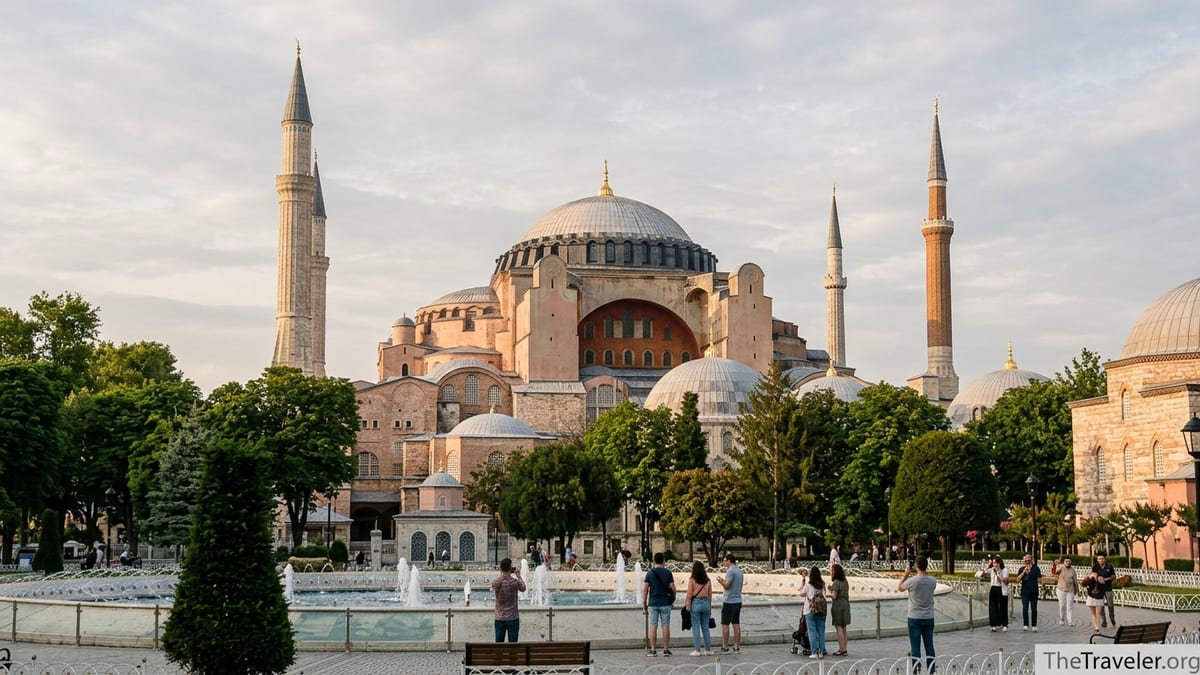
Hagia Sophia Today: What Has Changed for Visitors
For decades Hagia Sophia functioned as a state museum, with a single paid entrance and relatively free circulation inside. That changed in 2020 when it was reconverted into Hagia Sophia Grand Mosque. In 2026 there are now two overlapping realities: worshippers enter a functioning mosque, while visitors follow a managed route more like an organized heritage experience. The big shift most travelers notice is that the main prayer hall is treated primarily as sacred space, and many of the most famous mosaics are best seen from the upper gallery, which usually requires a timed ticket.
Practically, this means you should not expect to just show up, pay one simple fee, and wander every corner. On a typical busy summer day a traveler staying near Sultanahmet might pass by at 10 a.m. and see three different queues: one for security, another for ticketed upper gallery access, and an informal line of worshippers waiting for space to open near prayer time. This can look chaotic if you arrive unprepared, but once you know which line you belong in, the system usually moves steadily.
Another important change is the role of guides. According to recent visiting rules, licensed guides now give their main briefing outside and often cannot provide continuous commentary inside certain parts of the mosque, especially the upper gallery. This makes audio guides and pre-visit reading far more useful than they once were. If you want context on Justinian, the dome engineering, or the Deësis mosaic, you will get most of that information before you walk through the door or from your headset, not from someone talking loudly beside you.
Finally, Hagia Sophia’s visitor management is still evolving. Opening hours, prayer time closures and the balance between free worship access and ticketed heritage access have all shifted several times since 2020. In 2026 most travelers report that the upper gallery feels like a conventional paid monument visit, while the lower mosque area feels like a quieter, more devotional space. Plan with that distinction in mind and you will avoid much of the confusion that still surrounds the site.
Tickets, Prices and How the Different “Experiences” Work
The most confusing part of visiting Hagia Sophia in 2026 is that there is no single “ticket” that covers everything in one straightforward way. Instead, think in terms of experiences. First, there is entry to the mosque for worship, which locals and visitors can usually access for free when it is open between prayer services. Second, there is the paid visitor route, typically focused on the upper gallery where key mosaics and viewpoints are located. Third, there are commercial products wrapped around both of these, such as skip the line tickets, small group tours and audio guide packages.
As of mid 2026, a basic timed entry for the upper gallery typically costs in the region of 25 to 30 euros per adult when purchased through official channels, with a QR based audio guide often included in the price. Travelers who arrive without pre booking sometimes pay around that same amount at on site ticket machines or nearby kiosks, but risk finding later time slots already taken on very busy days. Children often receive discounted or free entry when added as separate zero price tickets, which families now commonly obtain through official ticketing platforms before they arrive to avoid extra queuing.
Skip the line packages sold by major operators usually start around 30 to 45 euros per person. These do not teleport you past security scanning, which everyone must pass through, but they normally allow you to bypass the slower on site ticket lines and move straight to the timed visitor entrance. For many short stay visitors, particularly cruise passengers on tight schedules, that time saving can be worth the premium. Higher end private or small group Old City tours that include Hagia Sophia, the Blue Mosque and the Hippodrome often range roughly between 80 and 200 euros per person or per group, depending on duration and inclusions.
Alongside this, there is a separate Hagia Sophia History Museum experience nearby, which focuses on digital displays and artifacts rather than the live mosque space. Some travelers accidentally buy a ticket to this museum believing it grants access to the upper gallery inside the mosque, only to discover on arrival that they are separate products. When booking online, check carefully whether you are paying for the upper gallery visit, a combined tour that includes surrounding sights, or only the external museum. If a deal looks significantly cheaper than the typical 25 to 30 euro range for the upper gallery, it may be a different product entirely.
Opening Hours, Best Times and Prayer Closures
Hagia Sophia’s visiting hours in 2026 follow a broad pattern similar to other major Istanbul sights but with added interruptions for prayer. The mosque generally opens to visitors early in the morning, around 8 a.m., and remains accessible until early evening, in many seasons until about 7 p.m., with last ticketed entry for the upper gallery usually 30 to 60 minutes before closing. These time bands can extend slightly in high summer and contract in winter, and they are always shaped around the five daily Islamic prayer times.
Friday is the trickiest day of the week. Because of the central midday congregational prayer, non worship visitor access to the prayer hall is limited for a wider window around noon. A traveler staying at a hotel in Sultanahmet might walk over at 11 a.m. on a Friday in June hoping to dip into the mosque and instead find the main door area full of lines of worshippers and security staff directing tourists away until after the service. If your time in Istanbul includes a Friday and Hagia Sophia is a priority, plan your visit for early morning or late afternoon that day, or choose another day entirely for the mosque and focus on museums instead.
For a calmer experience on any day, two windows stand out. The first is at opening time on a weekday, roughly between 8 a.m. and 9 a.m., when group tours are still gathering and day trippers from elsewhere in the city have not yet arrived in full force. Visitors who reach the square just as the call to prayer echoes across Sultanahmet Park often report being through security and into the building within 20 to 30 minutes. The second good window is the later afternoon, often after about 5 p.m., when organized tour groups thin out but there is still enough daylight to appreciate the interior.
On rainy winter days in January or February, indoor attractions like Hagia Sophia become even more popular, so queues can still be heavy in the middle of the day. In contrast, during the peak of summer heat in July and August, many travelers retreat to air conditioned restaurants between noon and 3 p.m., which sometimes makes the early afternoon slightly less crowded inside even if the security line in the sun still feels long. Whatever the season, budget extra time for security, and remember that no ticket type skips closures for prayer or official events, which can be announced at short notice.
Dress Code, Behavior and Photography Etiquette
Hagia Sophia is a working mosque and modest dress is enforced more consistently in 2026 than during its museum years. For both men and women, shoulders and knees are expected to be covered. Shorts above the knee, sleeveless tops, and very tight or transparent clothing often lead to delays at the entrance while staff direct visitors to cover up. For women, a headscarf is required in the mosque area. Many travelers now simply pack a light scarf or pashmina in their day bag to avoid relying on loaners, which may or may not be available and can cost around one euro when sold at the gate.
Shoes must be removed in certain parts of the prayer hall where carpets are laid for worshippers. Ticketed visitors to the upper gallery usually keep their shoes on because that level functions more as a museum style space, but if you pass through any clearly marked shoe removal area, follow the local pattern and use the provided racks or plastic bags. The general rule of thumb is simple: if you see carpeting and people preparing to pray, you are in a zone where mosque etiquette applies fully, regardless of whether you have a ticket in your hand.
Respectful behavior is expected throughout. Speaking quietly, avoiding running children, silencing mobile phones, and stepping out of the line of sight when someone is praying are common sense. Staff will often slow or stop visitors taking selfies in front of worshippers, especially during prayer times. In practice, this means you can still take photos of the interior, the dome and the mosaics, but long posed shoots, tripods and flash photography are discouraged and tripods in particular are frequently refused at security.
Dress code enforcement can feel strict but it is not meant to intimidate. Travelers who arrive dressed in long trousers or a modest skirt, covered shoulders and a simple scarf usually walk through without comment. Problems tend to arise when people step off a Bosphorus cruise in beachwear and try to visit Hagia Sophia and the Blue Mosque in the same outfit. If you plan to explore multiple mosques in one day, dressing for the strictest expected code and carrying a packable scarf is the most reliable strategy.
Guided Tours, Audio Guides and Independent Visits
The debate over whether to book a guided tour for Hagia Sophia has grown sharper since new routing and narration rules came in. Licensed guides are now limited in how much live commentary they can give inside certain parts of the building, especially the upper gallery, which in practice shifts much of the explanation to before you enter. As a result, the real value of a guide is now in the pre visit briefing on the square, the help with timing and ticket logistics, and the broader context they provide for the rest of the Old City, rather than a running lecture under the dome itself.
A typical small group tour might gather near the German Fountain in Sultanahmet around 8:15 a.m. A guide will walk the group past the Hippodrome, explain how Hagia Sophia’s massive dome compares to the nearby Blue Mosque, hand out headsets or pre print maps, and then coordinate entry to the ticketed gallery. Inside, visitors listen to an audio guide, then regroup outside afterward for additional stories or a walk over to the Blue Mosque. Travelers on cruise itineraries or short weekend breaks often find this structured approach reassuring because it compresses a lot into a half day without them having to navigate every line themselves.
Independent travelers who are comfortable using smartphone based audio guides can have an excellent experience without joining a group. The current app based audio, usually included with upper gallery tickets, runs around 45 minutes and covers the main historical milestones, major mosaics and architectural features in more than twenty languages. Many visitors choose to listen selectively, pausing the narration to sit along the gallery railing and absorb the view across the nave and down to the prayer carpets below.
If you prefer total flexibility, arrive early on a weekday, purchase or redeem your timed ticket for the gallery, and spend as long as you like inside, returning to specific spots after crowds move on. Couples who have already read about Byzantine history or watched a documentary on Hagia Sophia often report that this self guided style deepens their visit more than marching in a tight circle with a large group. For families with children, a hybrid works well: a brief orientation from a guide, then free time with the audio tour at everyone’s own pace.
Security, Accessibility and Practical Logistics
Security at Hagia Sophia in 2026 is comparable to what you would expect at a major international museum. Every visitor passes through a checkpoint with X ray scanning for bags and metal detectors for people. This is separate from ticket control, so even if you bought skip the line gallery access online you will still queue for security. Lines move fastest when travelers arrive with only a small daypack, minimal metal items and no restricted gear such as tripods, drones, large camera rigs, knives or scissors. Sealed water bottles are generally allowed, which matters in Istanbul’s hot summers.
From a practical standpoint, bringing a compact crossbody bag or a small backpack is best. A typical day traveler based in a Sultanahmet guesthouse often walks over with a half liter water bottle, a scarf, sunscreen, a wallet, and a phone. Anything more, especially bulky camera bags or shopping bags, will slow you down at the scanner and make it harder to move comfortably inside. There are usually no large cloakroom facilities directly at the mosque, so do not count on checking big luggage or baby strollers on site.
Accessibility remains a challenge. Official information notes that the ramps and stairs used for the upper visitor route are not suitable for many wheelchair users or travelers with significant mobility issues. In practice, staff sometimes direct visitors with limited mobility to alternative entrances for the lower level mosque area, but that access depends on conditions on the day and does not always include the upper gallery. If you or someone in your party uses a wheelchair or has difficulty with uneven stone surfaces, contact your accommodation or a reputable local tour operator well before you arrive to ask about current options and whether a private guide can assist.
Getting to Hagia Sophia itself is straightforward. Most visitors stay in or pass through the Sultanahmet district, which you can reach on Istanbul’s T1 tram line by alighting at Sultanahmet station and walking a few minutes uphill past the Basilica Cistern. Taxis from areas like Karaköy or Galata usually take 10 to 20 minutes in light traffic but can be much slower at midday, so aim to travel early if you have timed tickets. Nearby restaurants and cafes line the streets behind the mosque, making it easy to plan a late breakfast after a dawn visit or a tea break in the afternoon once you step back out into the square.
Combining Hagia Sophia with the Rest of Sultanahmet
For most travelers Hagia Sophia is the centerpiece of at least one full day in Istanbul’s historic core. The building sits at the heart of Sultanahmet, with the Blue Mosque facing it across a long park, the Basilica Cistern just downhill, and Topkapı Palace a short walk away along the tram tracks. How you sequence these sites will shape both your energy level and your experience of each place. A well planned route keeps you ahead of crowds and avoids backtracking through the same security lines.
One common pattern is to book an early morning timed ticket for the Hagia Sophia upper gallery, arrive at security around 7:45 to 8:00 a.m., and be inside by about 8:30. After spending 60 to 90 minutes under the dome, you can walk across to the Blue Mosque, which also applies a mosque style dress code and has its own prayer time closures. After a late morning exploration there, many visitors break for lunch at a simple lokanta on the back streets, then continue to the Basilica Cistern or the Archaeology Museums in the afternoon before looping around to watch the sunset from the terrace of a nearby hotel or rooftop cafe.
Another strategy is to divide the area into two half days. On one day you pair Hagia Sophia with the Hagia Sophia History Museum, which offers a quieter, more interpretive look at the monument’s past through digital reconstructions and artifacts. On the other day you focus on Topkapı Palace and the Harem, or perhaps a culinary walk through the nearby Sirkeci and Eminönü neighborhoods. This split works particularly well for families or anyone sensitive to crowds, as it keeps each block of time shorter and lets you retreat to calmer streets between headline sights.
Remember that Istanbul’s Museum Pass does not normally cover the mosque visit or the paid upper gallery route. It is still useful for nearby attractions such as the Archaeology Museums or Galata Tower, but you should plan and budget Hagia Sophia separately. If you are comparing a do it yourself approach with a pre packaged Old City tour, sit down with a map and approximate times. Often, once you account for ticket prices, tram fares, and meals, the difference shrinks, and your choice comes down to whether you value independent wandering or the structure of a guide.
The Takeaway
Visiting Hagia Sophia in 2026 is less like stepping into a static museum and more like entering a living monument where faith, politics and tourism meet under one vast dome. The logistics are more complicated than they were a decade ago, but they are manageable once you understand the basic distinctions: free worship access versus the paid upper gallery route, mosque etiquette versus sightseeing habits, and security lines versus ticket checks. Planning around these realities will save you time and frustration.
If Hagia Sophia has been on your bucket list for years, do not let the changing rules put you off. Build a flexible plan with a clear time window, modest clothing, and realistic expectations about what a ticket buys you. Decide whether you want the context of a guide or the freedom of an audio led visit, and allow yourself a quiet moment inside to look up at the dome rather than racing from one famous mosaic to the next. Combined with Istanbul’s streets, ferries and food, standing beneath that dome remains one of the world’s great travel experiences.
FAQ
Q1. Do I have to pay to enter Hagia Sophia in 2026?
In 2026 entering Hagia Sophia as a mosque for worship is generally free, but most visitors who want to see the upper gallery and key mosaics use a paid, timed ticket that typically costs around 25 to 30 euros per adult.
Q2. What should I wear to visit Hagia Sophia?
Dress modestly. Both men and women should cover shoulders and knees, and women are expected to wear a headscarf in the mosque area. Pack a light scarf and avoid sleeveless tops or short shorts to prevent delays at the entrance.
Q3. Are there specific visiting hours I should know about?
Hagia Sophia usually opens around 8 a.m. and closes in the early evening, often around 7 p.m., with last ticketed entry roughly 30 to 60 minutes before closing. Access to the mosque space pauses during prayer times, especially at midday on Fridays.
Q4. Can I use the Istanbul Museum Pass for Hagia Sophia?
In most cases the standard Istanbul Museum Pass does not cover Hagia Sophia’s paid gallery route or mosque entry. You should plan to buy Hagia Sophia tickets separately or book a tour that includes them.
Q5. Is photography allowed inside Hagia Sophia?
Yes, casual photography without flash is generally allowed in visitor areas, but tripods, large lighting setups and disruptive photo shoots are discouraged. Always avoid photographing people while they are praying and follow staff instructions.
Q6. How long should I plan for a visit?
Most travelers spend about 60 to 90 minutes inside Hagia Sophia itself, plus extra time for security and queuing. If you combine it with the nearby Blue Mosque or Basilica Cistern, expect to devote at least half a day to the area.
Q7. Is Hagia Sophia accessible for wheelchair users?
Accessibility is limited. The upper gallery visitor route involves ramps and uneven steps that are not suitable for many wheelchair users, although staff may assist visitors with mobility challenges to access some parts of the lower mosque area when conditions allow.
Q8. Do I need a guide, or is an audio tour enough?
The included audio guide is enough for many independent travelers, offering structured commentary in multiple languages. A licensed guide adds value if you want deeper context, help navigating tickets and prayer closures, or a wider Old City overview.
Q9. What is the best time of day to avoid crowds?
Early weekday mornings around opening time and late afternoons after about 5 p.m. tend to be quieter. Midday, especially in peak season and on Fridays, is usually the most crowded and most affected by prayer related closures.
Q10. Can children visit Hagia Sophia, and do they need tickets?
Children are welcome at Hagia Sophia. Younger children often receive discounted or free entry for the paid gallery route, but they may still need their own zero price ticket or reservation, so families should check current rules when booking.