


Few sights in the world inspire as much awe and debate as Istanbul’s Hagia Sophia. Once the greatest church of the Byzantine Empire, later an imperial Ottoman mosque, then a secular museum, and since 2020 a working mosque again, it has been at the center of both global admiration and controversy. In 2026, with new ticket rules, tighter crowd control and changing visitor expectations, many travelers are asking a blunt question: is Hagia Sophia still worth visiting, or has it become an overrated, overcrowded box to tick off in Istanbul?
Get the latest updates straight to your inbox!
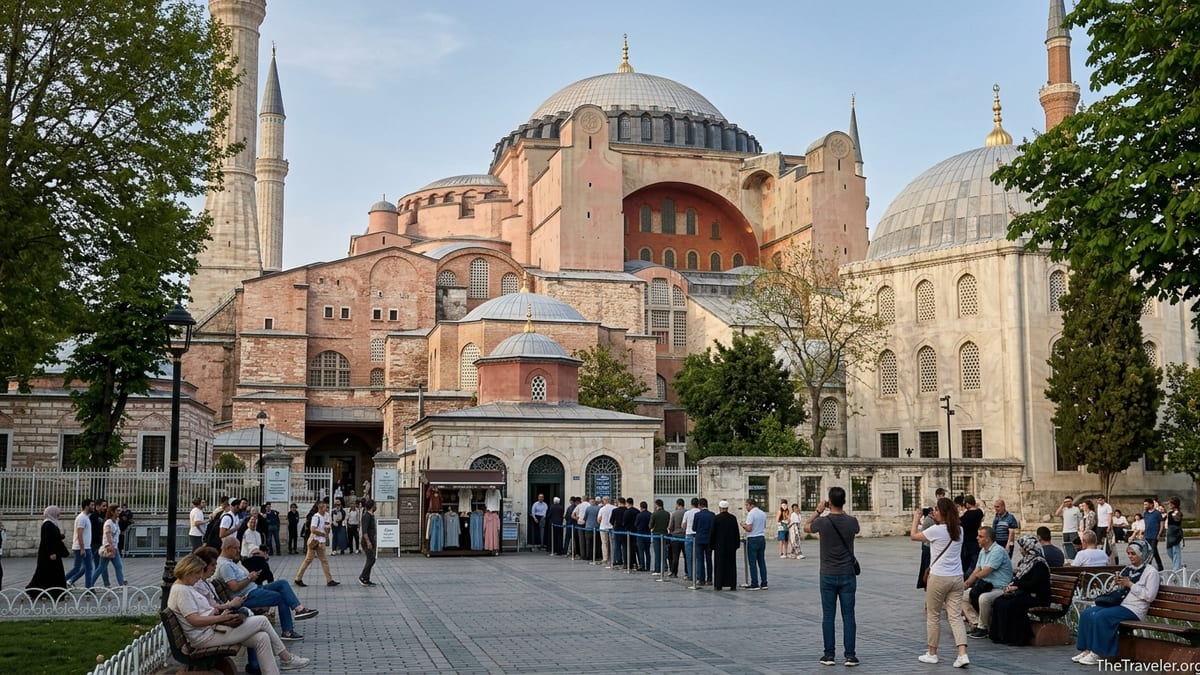
What Hagia Sophia Actually Feels Like in 2026
Hagia Sophia in 2026 is neither a quiet museum nor a fully open mosque in the way some guidebooks from a few years ago describe. It is a layered experience: part sacred space, part mass-tourism magnet and part under-pressure monument. Since January 2024, foreign tourists who want to see the historic interior follow a controlled route via a separate entrance to the upper gallery, usually paying around 25 euros for access. The prayer hall on the ground floor is free for worshippers, but is not treated as a general sightseeing area for non-Muslim visitors.
In practice, this means you may enter through security screening in Sultanahmet Square, pass signage that distinguishes the “visitor route” from the mosque entrance, and then climb the long stone ramp into the gallery. The first thing many travelers notice is not silence but the low roar of hundreds of footsteps and murmured commentary from guides. On a typical August afternoon, shoulder-to-shoulder crowds line the railings beneath the dome, smartphones held high as the call to prayer echoes below.
The building itself remains staggering. Standing in the upper gallery and looking across the nave, you can still see the colossal dome, the Arabic calligraphy medallions and, in places where the plaster has been cleared, the golden Byzantine mosaics. Yet the atmosphere is different from the museum days. Heavy carpets cover the marble floor; some Christian iconography is partially veiled; and many areas are cordoned off for conservation or worship. The result is an experience that can feel sublime to some and oddly constrained to others, depending on expectations.
Recent visitor reports and local guides suggest that a typical independent visit to the gallery, not counting the security line, lasts 45 to 60 minutes. Plan on adding at least 30 minutes more in peak season simply to clear the security and ticket queues, especially between midday and mid-afternoon when bus tours arrive in waves.
New Rules, Tickets and Practicalities That Shape Your Visit
Since the switch back to mosque status in 2020, visiting rules have been through several iterations, and 2026 visitors need to ignore outdated forum posts from before 2024. The key change is that foreign tourists generally pay a gallery ticket, while worshippers can enter the prayer area for free. In many recent seasons, the gallery ticket has hovered around 25 euros for non-Turkish visitors, collected either at an on-site ticket booth near the northeast side or via online resellers that bundle entrance with guided commentary.
Opening hours in 2026 are typically from 8:00 to 19:30 in summer and from 9:00 to 19:30 in winter, with last ticket sales roughly half an hour before closing. However, as an active mosque, parts of the building close to tourists for each of the five daily Muslim prayers, and midday on Friday can see the longest closure. Travelers who arrive at 12:30 on a Friday often find themselves standing in a stalled line until well after 14:00 while the main prayer concludes and worshippers exit.
The dress code also shapes the experience. Hagia Sophia follows conservative mosque standards: shoulders and knees covered for everyone; women must cover their hair. In 2026, scarf and body covers are still usually available at the entrance for a small fee, but they are thin, synthetic pieces that many travelers find uncomfortable in summer heat. A practical example: an American couple arriving in shorts and tank tops in July may need to buy two body wraps and a headscarf at the gate, adding 5 to 10 euros to the visit and a small stress spike as they scramble to cover up under the watchful eyes of security staff.
Security has become more robust as well. X-ray scanners and bag checks are standard, and large backpacks are discouraged. Tripods are often refused at the entrance. Independent travelers who are used to breezing into churches in Europe may find this slower pace surprising. On a busy spring Saturday, clearing security alone can take 20 to 30 minutes before you even reach the ticket line.
Is Hagia Sophia Overcrowded and Overpriced Compared With Alternatives?
Whether Hagia Sophia feels overrated often comes down to crowds and perceived value. Istanbul now receives tens of millions of foreign visitors per year, and Hagia Sophia is at the top of almost every itinerary. By mid-afternoon in high season, visitors report gallery railings three people deep along the central axis, with tour groups clustered around guides using whisper headsets in multiple languages. Moving from one window to another to photograph mosaics can feel like navigating a subway at rush hour.
Price comparisons sharpen the question. In 2026, the gallery ticket for Hagia Sophia is commonly around 25 euros for foreign visitors. By contrast, entry to the Blue Mosque remains free, though donations are encouraged. The recently restored Chora Church, another Byzantine masterpiece with vivid mosaics, also charges an admission fee, but because it handles fewer bus tours it can feel much calmer. Some travelers who visit all three sites in the same day report that the emotional impact of Chora or the peaceful inner courtyard of Süleymaniye Mosque actually surpasses their time in Hagia Sophia.
Crowd management is improving but not perfect. Newer rules route tourists directly to the upper gallery and keep the prayer floor for worshippers, which does help reduce some friction. Yet bottlenecks still form at narrow stairways and popular mosaic panels. Visitors frequently describe the experience as “shuffling” rather than strolling. For someone who imagines sitting quietly to absorb the architecture, the reality of squeezing past selfie sticks and group tours can feel like a letdown.
On the other hand, if you compare Hagia Sophia with other world icons that command premium prices and endure heavy crowds, it is not wildly out of line. The cost is similar to or lower than many major European cathedrals that now charge for entry or for dome climbs, and wait times are comparable to marquee sights like the Colosseum in Rome or the Sagrada Família in Barcelona. Framed this way, Hagia Sophia is not uniquely overpriced; it is simply operating at the scale of a global bucket-list monument.
When Hagia Sophia Is Absolutely Worth It
For many travelers, Hagia Sophia remains one of the most powerful places they will ever see. If you are drawn to history, architecture or interwoven religious traditions, it can be a once-in-a-lifetime experience that fully justifies the hassle and cost. Standing in the upper gallery and looking across at the 6th-century dome, with shafts of light cutting through the hanging chandeliers and the low murmur of prayer below, you are seeing in one frame the legacy of Justinian, the Ottoman sultans and modern Turkey.
This impact is strongest if you can visit at a quieter time. Arriving at opening hour on a weekday, particularly outside the peak summer months, can transform the visit. Picture a cool April morning: you arrive at 8:00, glide through a short security queue, and find the gallery with only a few dozen others. You have space to lean on the marble balustrade and trace with your eyes the curve of the dome, the glitter of the Deesis mosaic and the pattern of the carpets below. Even travelers who are normally skeptical of “must see” attractions often describe this sort of visit as deeply moving.
Hagia Sophia can also be worth it if you pair it thoughtfully with other sites. Joining a small-group walking tour that includes the Hippodrome, Blue Mosque and Hagia Sophia, for example, can turn the building from a crowded photo stop into a narrative centerpiece. A good guide might point out how the buttresses were added after the original dome partially collapsed, or how the Arabic calligraphy disc under the dome overlays earlier Christian iconography. Without this context, it is easy to simply wander and snap photos; with it, you begin to read the building as a palimpsest of empires.
Finally, for some Muslim visitors, praying inside Hagia Sophia is a profound personal milestone. Entering via the mosque entrance at prayer time, finding a place on the carpeted floor, and hearing the imam’s voice rise under the historic dome can feel incomparable. This experience follows different rules and rhythms from the tourist route, and for those who seek it for worship rather than sightseeing, the question of being “overrated” rarely applies.
When You Might Want to Skip It or Downgrade Its Priority
There are, however, very real scenarios in which Hagia Sophia may not be the best use of your limited time or budget. If you only have a single day in Istanbul, are visiting in peak summer, and can only reach Sultanahmet around Friday midday, you face the worst possible combination of heat, closure windows and crowds. In that case, many experienced travelers would advise prioritizing the Blue Mosque, the underground Basilica Cistern and a Bosphorus ferry ride instead, leaving Hagia Sophia for a future trip at a better time.
Travelers who are primarily seeking quiet contemplation or extended art viewing may also come away frustrated. Because tourists are now steered to the gallery and physically separated from the prayer floor, it is no longer possible to wander freely around every corner as in the museum era. Some of the most famous mosaics are partially shaded or viewed from oblique angles, and you may find it difficult to get close, unhurried looks at certain details. If your main passion is Byzantine mosaic art, the combination of Chora Church and smaller, less visited churches in the city might offer more satisfying viewing conditions.
Budget-conscious backpackers, especially those traveling long-term, sometimes decide the 25 euro gallery fee is better spent elsewhere in Turkey. In a country where that amount can cover a comfortable intercity bus ride or several restaurant meals, the calculation is understandable. A common real-world compromise is to admire Hagia Sophia’s exterior for free at different times of day, photograph it from the park between it and the Blue Mosque, and invest the saved money in exploring other historic mosques and museums that see fewer crowds.
Finally, some visitors are uncomfortable with the tension between sightseeing and worship. If you feel uneasy about taking photos during active prayer or being herded past people at prayer on the ground floor, consider focusing your energy on monuments where religious and tourist uses are more clearly separated. Istanbul offers ample alternatives that do not put you in the middle of this complex balancing act.
How to Visit Hagia Sophia in 2026 Without Losing Your Mind
If you decide Hagia Sophia belongs on your itinerary, a bit of strategy can significantly improve your experience. The first rule is timing. Aim for early morning entry at opening time, or later in the afternoon after around 16:00, avoiding the mid-day window and especially Friday noon prayers. For example, a traveler arriving on a Tuesday in May might book a 9:00 gallery slot, visit Hagia Sophia first, then move on to the Blue Mosque and nearby sights while the lines there build.
The second rule is to understand exactly which ticket you are buying. Online platforms and street-side agencies in Sultanahmet sell a dizzying range of options, from simple gallery tickets to multi-site guided tours. Read descriptions carefully to avoid accidentally paying twice for Hagia Sophia access or confusing the mosque with the separate Hagia Sophia history museum. A realistic price for a small-group Old City tour that includes commentary at Hagia Sophia plus other highlights is usually somewhere between 90 and 170 US dollars per person, depending on group size and inclusions.
Dress and gear matter too. Wear clothing that automatically meets the mosque dress code so you do not have to buy or borrow extra coverings. Choose breathable fabrics for hot months, and wear shoes that are easy to slip off if you plan to enter the prayer hall at permitted times. Leave bulky bags and tripods at your hotel to speed up security checks. A compact mirrorless camera with a wide-angle lens around 16 to 24 millimeters equivalent is ideal for capturing the dome and interior without needing elaborate gear that could slow you down at screening.
Finally, manage your expectations. Go in knowing that some areas will be off limits, that you will share the space with hundreds of other visitors, and that the experience will feel different from the hushed museum visits described in older travelogues. If you treat Hagia Sophia as a powerful, complicated place rather than a postcard-perfect backdrop, you are more likely to come away moved instead of disappointed.
Balancing Hagia Sophia With Istanbul’s Other Icons
Thinking of Hagia Sophia in isolation can distort expectations. It helps to see it as one highlight within a broader Istanbul itinerary. For many travelers, a well-balanced first day in the historic peninsula pairs Hagia Sophia with the Blue Mosque, the Hippodrome and perhaps the Basilica Cistern, leaving Topkapı Palace or a Bosphorus cruise for another day. Seeing the skyline from a ferry and watching the sun set behind the domes from the Galata Bridge can add a sense of place that any single monument cannot provide on its own.
Intentional sequencing can also temper crowd fatigue. One strategy is to visit the Blue Mosque at its opening, then walk directly to Hagia Sophia for a late-morning slot, breaking for an early lunch in a side street café before continuing to the Grand Bazaar. Another is to save Hagia Sophia for later in your stay, after you have explored less famous mosques like Rüstem Pasha or Süleymaniye, so that you can appreciate both what makes it unique and how it fits into the wider architectural tradition.
Remember that Istanbul’s appeal lies as much in its living neighborhoods as in its landmarks. A traveler who spends the morning at Hagia Sophia and the afternoon wandering through the backstreets of Fatih or taking a ferry to Üsküdar often ends the day talking more about those spontaneous encounters than about any particular mosaic. Hagia Sophia can be the peak of your Istanbul story, but it does not have to carry the entire narrative on its shoulders.
In the end, the smartest way to avoid seeing Hagia Sophia as overrated is to let it be one chapter in a richly varied trip, rather than the sole reason you came.
The Takeaway
So is Hagia Sophia worth visiting in 2026, or is it overrated? The answer depends less on the building and more on you. If you care deeply about world history, sacred architecture and the meeting point of empires, the sight of that vast dome, the surviving mosaics and the layered symbolism of a church-turned-mosque-turned-museum-turned-mosque again will almost certainly justify the ticket price and the crowds. Visited at a thoughtful time of day, with proper context, it remains one of the world’s great spaces.
If, on the other hand, you have little interest in the story behind the stones, dislike dense crowds, are on a very tight budget or can only visit at the most congested times, Hagia Sophia may feel like a stressful, expensive obligation rather than a joy. In that case, you might simply admire it from outside, prioritize other sites and leave the interior for another trip.
Hagia Sophia in 2026 is not a serene museum frozen in time, nor a pure place of worship untroubled by tourism. It is a living, contested, magnificent building adapting to enormous visitor pressure. Go prepared, with realistic expectations and a flexible plan, and it is far more likely to feel like a highlight than a disappointment.
FAQ
Q1. Do I have to pay to visit Hagia Sophia in 2026?
Foreign tourists generally pay for access to the upper gallery via a dedicated visitor entrance, with recent prices around 25 euros. Entry to the prayer hall on the ground floor remains free for worshippers, subject to mosque rules.
Q2. Can I still see the famous mosaics now that Hagia Sophia is a mosque again?
Yes, several key Byzantine mosaics are visible from the upper gallery, although some are partially covered or viewed from a distance. Access is more limited than during the museum era, but you can still see important examples of the original Christian artwork.
Q3. What is the best time of day to visit to avoid crowds?
Early morning at opening time or later afternoon after around 16:00 are usually the least crowded. Midday, especially between 12:00 and 15:00, tends to be the busiest, and Friday noon prayers create the longest closure window.
Q4. How long should I plan for a visit?
Most visitors spend about 45 to 60 minutes inside the upper gallery. In peak season, allow an extra 30 minutes or more for security and ticket queues, especially if you arrive in the middle of the day.
Q5. What should I wear when visiting Hagia Sophia?
Dress as you would for any conservative mosque: shoulders and knees covered for all visitors, and women should cover their hair with a scarf. Light, breathable clothing is useful in summer, and bringing your own scarf avoids having to buy one at the entrance.
Q6. Is photography allowed inside?
Non-flash photography for personal use is generally allowed in the visitor areas, but tripods and large professional setups are often restricted. It is good etiquette to avoid photographing people at prayer and to respect any temporary no-photo signs near sensitive areas.
Q7. Can non-Muslims enter the prayer hall?
Outside prayer times, the central prayer area on the ground floor is usually reserved and controlled, with tourists directed instead to the gallery. During active prayers, the space is primarily for worshippers, and visitors are expected to follow staff instructions and avoid treating the area as a viewing platform.
Q8. Is Hagia Sophia suitable for children and people with limited mobility?
The upper gallery is reached via a long, sloping stone ramp that can be tiring for small children and challenging for visitors with mobility issues. There are limited places to sit inside, and the dense crowds can be overwhelming, so families and those with mobility needs should plan rest breaks and consider whether everyone needs to go up to the gallery.
Q9. How does Hagia Sophia compare to the Blue Mosque?
Hagia Sophia is older and architecturally more hybrid, with its mix of Christian and Islamic elements, while the Blue Mosque is a classic Ottoman mosque famed for its blue tiles. The Blue Mosque remains free to enter, often feels more coherent as a place of worship, and can provide a calmer complement to the more crowded experience at Hagia Sophia.
Q10. If I have only one day in Istanbul, should I prioritize Hagia Sophia?
If you are interested in history and architecture and can visit outside the busiest hours, Hagia Sophia deserves a high place on a one-day itinerary. If you are very crowd-averse, on a tight budget, or visiting only during Friday midday, you might instead admire it from outside and focus on the Blue Mosque, Basilica Cistern and a Bosphorus ferry ride, saving the interior visit for a future trip.