


More news on this day
India’s largest airline is preparing a decisive move into true long-haul flying, with IndiGo’s planned Airbus A350 business class cabin poised to reshape how travelers move between India and Europe.
Get the latest news straight to your inbox!
A Low-Cost Giant Steps Into Widebody Territory
Publicly available fleet data shows that IndiGo has firm orders for at least 30 Airbus A350-900 aircraft, marking the carrier’s first foray into operating widebody jets at scale. The move builds on its dominant narrowbody presence at home and signals a shift from primarily regional operations toward intercontinental ambitions.
Investor presentations and industry analysis indicate that the A350-900s are expected to arrive from the second half of this decade, with configurations of more than 330 seats. That layout points to a relatively dense, efficiency-led design, but crucially one that incorporates a dedicated business class section for the first time on IndiGo widebodies.
According to aviation trade coverage, IndiGo intends to maintain a two-cabin structure on the A350, combining a branded business product with a large economy section. This approach mirrors its cost-conscious DNA while still allowing the airline to tap into higher-yield traffic on longer routes.
The decision to use the A350 platform is significant. The type has become the backbone of many full-service carriers’ long-haul networks, favored for its fuel efficiency and passenger comfort on sectors exceeding eight hours. IndiGo’s adoption of the aircraft positions the airline to compete more directly with established European and Gulf operators on India–Europe city pairs.
From IndiGo Stretch To True Long-Haul Business Class
IndiGo’s first steps into premium seating came with the introduction of “IndiGo Stretch” on select Airbus A321neo aircraft. Industry reports describe this product as a small, separate cabin with recliner-style seats, enhanced legroom and upgraded catering, aimed at business travelers on domestic and regional routes.
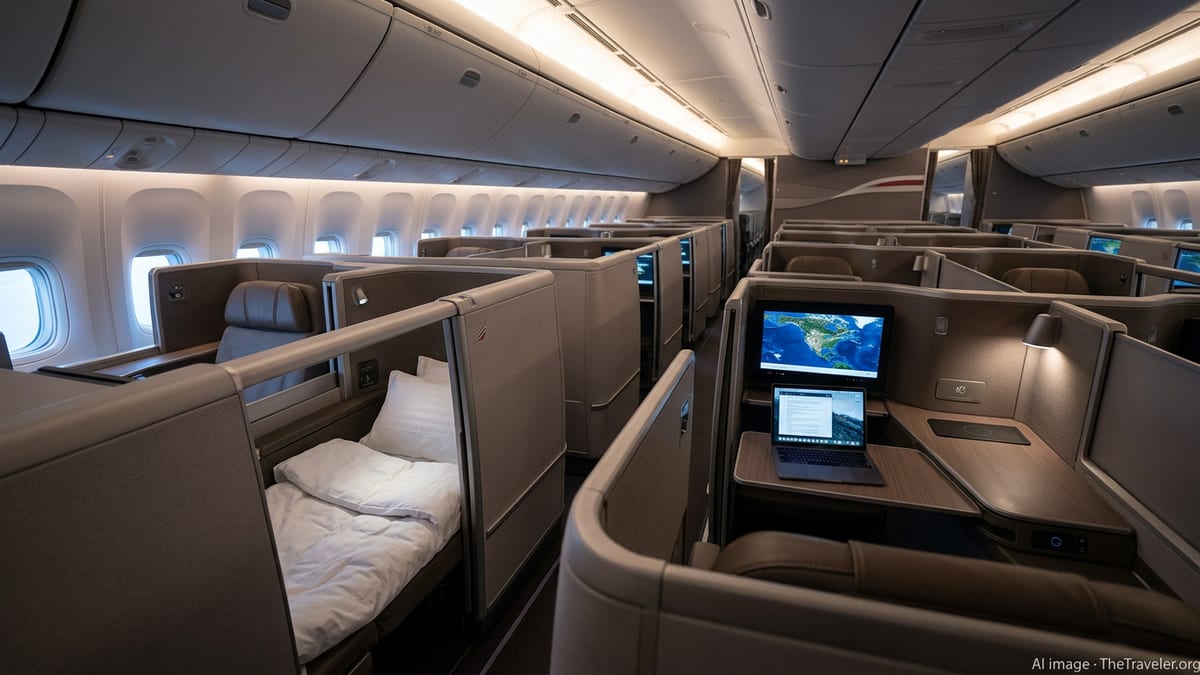
On the A350, the airline is expected to move beyond recliners toward a full long-haul business class experience with lie-flat beds, privacy features and more personalized space. Cabin layout assumptions circulating in aviation forums and specialist media point to a business cabin of roughly 30 to 40 seats, paired with a high-density economy cabin exceeding 280 seats.
Observers also widely expect the A350s to feature seatback in-flight entertainment across the aircraft, a departure from IndiGo’s current bring-your-own-device model. The shift reflects the demands of long-haul flying, where continuous connectivity, curated content and power at every seat are increasingly seen as baseline expectations.
While IndiGo has not publicly detailed the exact seat supplier or final layout, the direction of travel is clear. The A350 business class is being framed as a step change from the airline’s narrowbody premium experiments, designed expressly for overnight and ultra-long sectors that connect India with Europe and beyond.
India–Europe Market Braced For New Competitive Dynamics
The timing of IndiGo’s A350 business class plans comes as India–Europe traffic is expanding and diversifying. India is among the world’s fastest-growing aviation markets, yet a large share of long-haul passengers still connect through Gulf hubs or via European gateways instead of flying nonstop.
Network projections presented to investors suggest that IndiGo is targeting a mix of trunk European capitals and secondary cities for its A350 deployment. Nonstop or one-stop itineraries from major Indian metros to cities across Western and Central Europe could allow the airline to woo travelers currently splitting trips between multiple foreign carriers.
Analysts note that European and Gulf airlines have long relied on Indian-origin passengers to fill widebody cabins on routes to London, Frankfurt, Paris, Istanbul and beyond. A competitively priced, Indian low-cost carrier offering lie-flat business seats and a modern cabin on similar sectors could pressure fares and reshape alliances and code-share strategies.
The shift may also amplify competition within India. Full-service rival Air India already operates A350s on ultra-long-haul sectors, with suites-style business cabins and premium economy. IndiGo’s A350 strategy, if executed at scale, would give corporate buyers and leisure travelers a distinctly different value proposition built around lower base fares and simplified service tiers.
Cabin Design Trends Point To Lean Luxury
Across Europe and Asia, recent A350 cabin refits offer clues to the direction IndiGo might take. Airlines such as Lufthansa, Finnair and leisure-focused Edelweiss have introduced compact, privacy-oriented business suites on the A350, paired with premium economy and refreshed main cabins.
These designs prioritize high-density efficiency without abandoning comfort, often through staggered seating, clever storage and slimmer sidewalls that widen the usable cabin space. IndiGo’s A350 order suggests a similar emphasis on maximizing revenue seats while still delivering a credible business product that aligns with global expectations.
Industry watchers expect IndiGo to lean on modular seat families already proven on other A350 operators, balancing acquisition cost, reliability and quick maintenance with features like direct aisle access and improved personal space. The aim is likely to deliver what some analysts describe as “lean luxury” rather than an opulent, flagship-first concept.
For economy passengers, the wide cross-section of the A350 should enable relatively standard 3-3-3 layouts while maintaining acceptable seat width. Combined with modern lighting, improved air quality systems and lower cabin noise, the aircraft platform itself offers a noticeable upgrade over older twin-aisle types that still ply some India–Europe routes.
Implications For Travelers And Corporate Buyers
For Indian travelers, IndiGo’s business class-equipped A350s promise more nonstop options to Europe with a familiar brand and booking experience. Travel agencies and corporate travel managers are watching closely, as a competitively priced, widebody business class from a low-cost carrier could reshape contract negotiations and preferred-carrier lists.
On leisure-heavy routes, the presence of a modern business cabin may open up more opportunities for mileage redemptions and last-minute paid upgrades, depending on how IndiGo structures its ancillary revenue model. The airline has historically focused on unbundled pricing, and similar logic is likely to extend to the long-haul cabin with add-ons such as seat selection, lounge access and bundled extras.
For Europe-based travelers, IndiGo’s expansion may offer cheaper one-stop itineraries into secondary Indian cities, using the airline’s extensive domestic network for connections beyond its A350 gateways. This could increase pressure on rival carriers that rely on interline agreements or limited domestic feed once passengers arrive in India.
Ultimately, the introduction of A350 business class cabins at India’s largest airline underscores how quickly the country’s long-haul landscape is evolving. As IndiGo finalizes its cabin decisions and route maps, India–Europe passengers are likely to see more choice, sharper pricing and an increasingly competitive race for comfort at 35,000 feet.