


Sheraton is one of those names frequent travelers recognize instantly, whether they are racing through a conference in New York or drifting into a poolside nap in Hawaii. Now part of the Marriott Bonvoy portfolio, the brand stretches across hundreds of full-service hotels and resorts worldwide, promising a certain familiarity while still reflecting their local neighborhoods or coastlines. Understanding how Sheraton performs in both business and resort settings can help you decide when this classic name fits your next trip, and when a different Marriott flag or competitor might serve you better.
Get the latest updates straight to your inbox!
Where Sheraton Sits in Today’s Hotel Landscape
Sheraton began in the 1930s and grew into the flagship brand of Starwood Hotels before Marriott International acquired Starwood in 2016. Today the brand is positioned as an upper upscale, full-service option within Marriott Bonvoy, sitting broadly alongside Marriott Hotels and Westin, and above limited-service labels such as Courtyard or Fairfield. In practice that means you can expect on-property restaurants and bars, meeting space, fitness centers and often club lounges, rather than the stripped-back experience of select-service hotels.
The portfolio is wide. In 2015 Starwood introduced the Sheraton Grand label to designate top-tier properties in key urban and resort markets, such as Sheraton Grand Macao on the Cotai Strip and Sheraton Grand Doha Resort & Convention Hotel. These hotels typically have more polished design, enhanced dining and stronger group or convention facilities. At the same time, older legacy properties in North America can feel inconsistent, which is why Marriott has been rolling out a multi-year refresh program focused on brighter lobbies, open co-working areas and upgraded guest rooms.
For travelers, this means that “a Sheraton” in 2026 can describe very different experiences. A newly renovated downtown conference hotel might feel contemporary and businesslike, while a seventies-era resort that has not yet seen a full refresh can appear tired in its rooms but still win guests over with a stellar beachfront or convenient location. Doing a bit of property-level research before you book is essential.
Because Sheraton is a Marriott Bonvoy brand, all stays earn and redeem Bonvoy points. That matters if you are weighing, for instance, a Sheraton versus a nearby independent hotel for a four-night trade show in Chicago. The rate might be similar, but the ability to earn 10 Marriott points per U.S. dollar spent on room rate and incidentals can tilt the balance if you travel often enough to reach elite status.
The Business Traveler’s Sheraton: City Hubs and Convention Workhorses
Many travelers’ first association with Sheraton is the big-city conference hotel: a property like the Sheraton New York Times Square, a 1,700-plus room tower in Midtown Manhattan that offers roughly 60,000 square feet of meeting space and an executive conference center level. Here, Sheraton functions as a meeting machine, hosting corporate summits, trade shows and association conventions. Delegates might spend the day moving between windowless breakout rooms, a ballroom lunch and a quick treadmill session in the fitness center before slipping out to a Broadway show a few blocks away.
Room layouts in these business-focused Sheratons tend to emphasize work surfaces and connectivity. A standard king at a major U.S. city property will commonly include a long desk with multiple power outlets, an ergonomic chair and decent task lighting, along with a modern TV that doubles as a second screen via HDMI. Internet access is usually tiered, with basic Wi-Fi either included via a daily destination fee or free for Bonvoy members, and a faster premium tier for a supplement that can be justifiable if you are uploading large files or joining video calls.
Service and design, however, can vary. Reviews of Sheraton New York Times Square, for example, often praise its location for both business and leisure but note elevator waits at peak times and decor that still leans “late-90s business traveler chic.” That is typical of some large, older Sheratons that have not yet undergone the full new-brand renovation. By contrast, renovated properties like Sheraton Phoenix Downtown showcase the updated lobby concept, where the traditional front desk is replaced or supplemented with a communal table-style check-in and flexible seating that allows informal meetings, solo laptop work or a casual coffee without needing a separate business lounge.
On the pricing side, midweek business rates at big-city Sheratons commonly land in the 300 to 450 U.S. dollar range before taxes and fees in markets such as New York, Boston or San Francisco when booked a few weeks in advance during normal demand. Group blocks for conferences can sometimes bring that down, while high-demand periods like UN General Assembly week in New York can easily push nightly rates beyond 500 dollars. For travelers on a tighter budget, weekend stays may be significantly cheaper, especially in cities with heavy Monday to Thursday corporate demand.
From Boardroom to Beach: Sheraton as a Resort Brand
Far from the fluorescent brightness of convention foyers, Sheraton also has a strong presence in beach and leisure destinations. Sheraton Maui Resort & Spa, set along Kaʻanapali Beach where Black Rock meets the Pacific, is a prime example. The property spreads out in low-rise buildings wrapped around pools and lawns, with many rooms facing the ocean and direct access to snorkeling just off the rocky point. Guests discuss it as a classic Hawaiian resort: family friendly, comfortable rather than hyper-luxurious, with a focus on views, beach access and relaxed outdoor dining.
At resorts like Sheraton Maui or Sheraton Grand Macao, the guest room experience shifts toward vacation needs: more emphasis on balconies and outdoor seating, bathtubs big enough to soak in after a day in the sun, and family-oriented configurations. In Macao, for instance, the Sheraton Grand offers family suites that connect a master bedroom for parents with a children’s room featuring bunk beds, a craft table and an entertainment center with a large TV and gaming console. This allows parents to keep kids close while preserving a door they can close after bedtime.
Daily spend looks different at resorts as well. A family of four staying at Sheraton Maui in peak season might see room rates in the 600 to 900 dollar range for an ocean-view room, with resort fees, parking and on-property food and beverage adding a few hundred dollars per day. The trade-off is convenience: multiple pools right downstairs, on-site restaurants, a spa, kids’ activities and often easy access to off-site excursions like snorkeling tours or hiking trips arranged through the concierge.
If you are used to big-box business Sheratons, it is worth noting that resort service rhythms feel slower and more casual. Housekeeping may operate on more flexible schedules, pool loungers rather than desks become your “office,” and dress codes relax. For some guests this is the whole point; for others, especially remote workers who need guaranteed quiet or firm housekeeping times, it may require a bit more planning, such as requesting a room away from the main pool complex or confirming daily service hours at check-in.
Design, Rooms and the New “Gathering Lobby” Concept
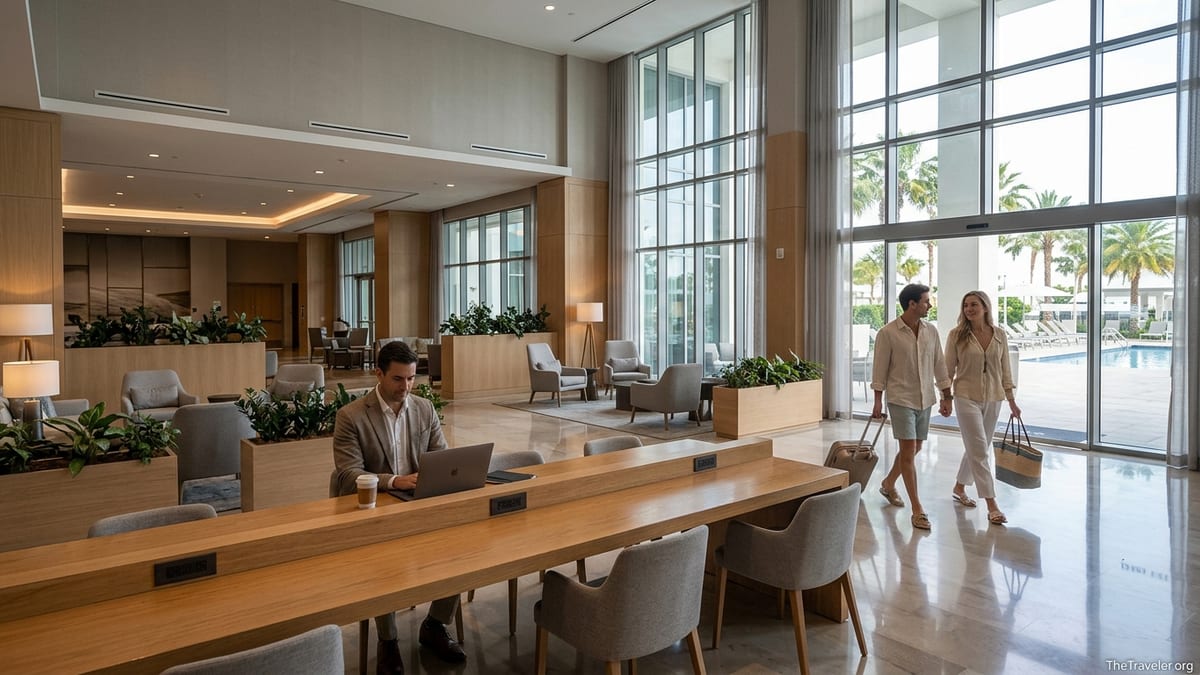
Across both business and resort properties, Sheraton’s design language is in flux. Marriott has been rolling out a refreshed look that emphasizes lighter woods, neutral textiles and multi-use lobby spaces. Instead of a cavernous, underused atrium with a solitary bar, newer lobbies feature clusters of sofas, long communal tables with power outlets and semi-enclosed pods where you can jump on a call. At some properties, you will also find grab-and-go markets replacing or complementing traditional gift shops, reflecting the habits of travelers who would rather pick up a barista coffee and a pre-packaged salad than sit down for a full lunch.
In guest rooms, the updated Sheraton standard moves away from dark, bulky furniture toward platform beds with upholstered headboards, integrated reading lights and sliding doors that separate bathroom and sleeping spaces. An example can be seen in photos and descriptions of refurbished Sheraton properties in the United States and Europe, where white linens, simple color palettes and larger showers are replacing older, tub-heavy bathrooms. However, because the global refresh is still in progress, you may encounter a patchwork of styles: one Sheraton in a city might feel brand new, while another across town still wears its early-2000s look with patterned carpets and heavy drapery.
For travelers sensitive to design, photos and recent reviews become an important research tool. If you scroll through images and see a lot of bright, airy rooms with simple lines and large walk-in showers, you are likely looking at a refreshed or newer-build Sheraton. If, instead, you see dark wood headboards, built-in armoires and shower-tub combos with patterned shower curtains, expect a more traditional aesthetic. That alone may not be a deal-breaker, especially if the rate is competitive or the location unbeatable, but it helps set your expectations.
Noise and layout are the other side of design that business and leisure guests experience differently. For instance, a Sheraton overlooking a busy urban avenue might insulate most road noise with double glazing, yet conference traffic in the corridors can still be noticeable. At resorts, the soundscape may be dominated by pool music and children’s play during the day, and quiet down once families head to bed. Requesting a higher floor in city hotels or a building slightly removed from the main pool complex in resorts can dramatically change your experience.
Meetings, Events and the Bleisure Sweet Spot
One of Sheraton’s enduring strengths is its capacity for meetings and events. Many of the brand’s flagship urban hotels offer tens of thousands of square feet of function space, along with seasoned banquet and AV teams used to handling complex programs. Sheraton Grand Macao, for example, bills itself as the largest Sheraton in the world and features extensive ballroom and breakout facilities that cater to regional conventions and incentive trips. In New York, Sheraton Times Square routinely hosts corporate town halls, product launches and multi-day internal conferences.
For planners, the appeal is the one-roof solution: sleeping rooms, plenary sessions, breakout space, catered meals and informal networking zones all in a single building, often with easy access to nearby restaurants and entertainment. Package pricing might include a daily meeting delegate rate covering room rental, standard AV, coffee breaks and lunch, or more customized arrangements where catering is itemized. While the exact numbers vary by market and season, it is not unusual for a full-day meeting package in a major city Sheraton to fall in the 150 to 250 U.S. dollar per person range before tax and service, including basic AV support.
The rise of “bleisure” travel, where guests tag leisure days onto work trips, plays to Sheraton’s dual nature. A manager flying to Orlando for a three-day leadership off-site at Sheraton Orlando Lake Buena Vista Resort, for instance, might bring their family, shifting from breakout rooms to pool time or a visit to nearby theme parks once the formal agenda wraps. Similarly, an attendee at a conference in Honolulu could schedule meetings during the week and a weekend of snorkeling or island touring afterward, using the same hotel as both office and base camp.
If you plan to combine business and leisure at a Sheraton, ask about corporate rates that allow extensions at the same price, and check how resort or destination fees apply on off-agenda days. In some cases, the negotiated group rate plus included perks such as daily breakfast or Wi-Fi can make an extra Saturday night at the conference hotel cheaper and more convenient than moving across town to a smaller property.
Navigating Value: Rates, Bonvoy and When Sheraton Makes Sense
From a value perspective, Sheraton occupies an interesting middle lane. It is typically more expensive than Marriott’s select-service options but often cheaper than luxury flags like JW Marriott or St. Regis in the same destination. For example, in a city such as Boston or Chicago on a typical autumn week, you might see a Sheraton priced in the low to mid-300s per night, while a high-end luxury competitor in a similar location pushes above 600 dollars. At resorts, Sheraton can offer a more approachable alternative to ultra-luxury neighbors while still delivering a full suite of amenities.
Marriott Bonvoy members can squeeze extra value out of Sheraton stays. Category and dynamic award pricing shift frequently, but it is common to find Sheraton redemptions in the 30,000 to 50,000 point per night range in many markets, with higher prices at peak resort properties. Utilizing the “fifth night free” benefit on redemptions, where the cost of a five-night stay is the points equivalent of four nights, can make a weeklong vacation at a Sheraton resort considerably more affordable if you have built up a points balance through work travel.
Elite benefits are another consideration. At many Sheratons, Platinum and Titanium Bonvoy members receive room upgrades where available, late checkout, and access to club lounges that provide breakfast and evening snacks. In practical terms, that can mean skipping a 25-dollar buffet charge each morning or transforming a light evening spread into a simple dinner when time is tight. On the flip side, some older Sheratons in the United States have closed their lounges or converted them to other uses, instead issuing daily breakfast credits. Checking recent guest reports will give you a more accurate picture of the benefits at a particular property.
When comparing Sheraton against competition, think beyond the brand name and weigh location, renovation status, and the total cost of your stay, including fees. In some destinations, a refreshed Sheraton might clearly outshine an aging competitor under a different flag. In others, a nearby newer-build Hyatt, Hilton or independent design hotel can provide a more appealing stay for a similar rate. The Sheraton name alone no longer guarantees a specific level of luxury; it is the individual property that matters.
The Takeaway
Inside the Sheraton experience today you will find both the solid, familiar backbone of a legacy global chain and a brand in the midst of reinvention. In business-focused city properties, Sheraton delivers scale, meeting infrastructure and loyalty benefits that appeal to road warriors and event planners who value predictability over flash. In resort destinations, it can be a comfortable, sometimes more affordable gateway to iconic beaches and family-friendly fun, even when room decor feels a step behind newer peers.
For travelers, the key is to match the specific property to your purpose. If you need elevator banks that can move 1,000 conference delegates between plenary sessions in Midtown Manhattan, a workhorse like Sheraton New York Times Square still makes strong practical sense. If your priority is waking up to Black Rock’s waves in Maui or giving kids their own bunk-bed hideout in Macao, Sheraton’s resort and Sheraton Grand offerings step in. Paired with Marriott Bonvoy’s earning and redemption structure, Sheraton continues to reward loyal guests who take the time to choose carefully.
Ultimately, the Sheraton logo on a skyline or beachfront tells you that you will find a full-service hotel or resort with a global standard of basics, but it does not replace the need for research. Look closely at photos, renovation dates and recent reviews, consider what matters most on this trip, and Sheraton can still be a very smart choice, whether you are measuring your stay in sessions and coffee breaks or sunsets and poolside naps.
FAQ
Q1. Is Sheraton a luxury brand or mid-range hotel chain?
It is generally considered an upper-upscale brand: more full-service and polished than mid-range hotels, but a step below luxury flags like St. Regis or Ritz-Carlton in the same portfolio.
Q2. Are all Sheraton hotels part of Marriott Bonvoy?
Yes. Since Marriott’s acquisition of Starwood, Sheraton operates fully under the Marriott Bonvoy program, so you can earn and redeem points and enjoy elite benefits at participating properties.
Q3. What is the difference between Sheraton and Sheraton Grand?
Sheraton Grand is a designation for top-performing or flagship hotels in key cities and resort destinations, typically offering upgraded design, amenities and meeting facilities compared with standard Sheratons.
Q4. How much does a typical night at a Sheraton cost?
Rates vary widely by city and season, but business-city Sheratons often range from about 200 to 450 U.S. dollars per night, while high-demand resorts can run higher, especially for ocean-view or suite categories.
Q5. Are Sheraton resorts good for families?
Yes. Many Sheraton resorts offer family rooms or suites, kids’ clubs, multiple pools and easy beach access, making them popular with families who want on-site amenities without ultra-luxury pricing.
Q6. Do Sheraton hotels include free breakfast?
Breakfast policies differ by property. Some include breakfast in certain rates or club lounge access, while others offer it only as a paid option or as an elite benefit for higher-tier Bonvoy members.
Q7. What should I look for when choosing a Sheraton for a business trip?
Focus on recent renovation status, proximity to your meetings, Wi-Fi quality, desk setup in rooms and the amount of meeting space if you are hosting events. Reviews mentioning updated rooms and modern lobbies are a good sign.
Q8. How do Sheraton resorts compare with other beach brands?
They typically offer a solid, full-service resort experience with pools, spas and multiple dining options, often at lower prices than ultra-luxury brands, though room design may be less cutting-edge at older properties.
Q9. Can I work remotely comfortably from a Sheraton?
In most cases yes, especially at renovated hotels with strong Wi-Fi and lobby co-working areas. Request a quiet room, confirm desk space and consider upgraded internet if your work is bandwidth-heavy.
Q10. Is Sheraton a good option for hosting a conference?
Many Sheratons are built around meetings and conventions, with large ballrooms, breakout rooms and experienced event staff, making them a reliable choice for conferences where you want everything under one roof.