


In an era when boutique hotels, lifestyle brands and short-term rentals compete for travelers’ attention, it might be tempting to think of Sheraton as a legacy name from another time. Yet step into a recently renovated Sheraton in Toronto, Dubai or Sydney and a different story unfolds. The brand that helped define the international business hotel is quietly but decisively reinventing itself, betting that community-focused spaces, flexible work environments and a truly global footprint still matter in a fragmented industry. For many travelers, meeting planners and owners, Sheraton remains one of the most relevant names in hospitality precisely because it is learning to bridge its storied past with the expectations of today’s guests.
Get the latest updates straight to your inbox!
A Legacy Brand With a Truly Global Footprint
Sheraton has been part of the backbone of international travel for decades, particularly for business and group travelers. Now folded into Marriott International’s powerful portfolio, Sheraton continues to operate one of the largest full-service networks in the world. As of late 2024, Marriott reporting shows roughly 200 Sheraton hotels globally under its core reporting definition, and industry sources commonly cite more than 400 when including franchised and pipeline properties. That scale means that in many markets, especially in Asia, the Middle East and Europe, a Sheraton is still one of the most recognizable full-service options in town.
For travelers, that footprint translates into practical advantages. A corporate road warrior flying from Chicago to Shanghai, then onward to Dubai or Warsaw, can reasonably expect to find a Sheraton near major business districts or key transport hubs. The Sheraton Shanghai Pudong or Sheraton Dubai Creek, for example, sit close to financial centers while still offering straightforward access to airports and public transit. This consistency reduces planning friction: loyalty members know they can earn and redeem points, and travel managers know they can negotiate global agreements anchored in a familiar brand.
The brand’s history of entering emerging markets also continues to pay dividends. Sheraton was an early international player in places like China and Eastern Europe, and many of those early flagship hotels have since been renovated rather than replaced. In cities such as Beijing, where the Sheraton Grand Beijing Dongcheng combines large-scale meeting space with updated rooms and public areas, the company’s long tenure has created deep relationships with local businesses and government agencies. That institutional trust still matters when conventions, trade fairs or diplomatic events are being planned.
From a macro perspective, Sheraton remains strategically important to Marriott because it fills a particular niche: global, upper-upscale, and heavily focused on meetings and corporate travel. While newer brands in the portfolio target lifestyle or luxury segments, Sheraton’s wide distribution and established name recognition continue to make it a workhorse for both occupancy and group demand across continents.
From Staid Business Hotel to “World’s Gathering Place”
For years, Sheraton’s biggest weakness was perception. Many travelers associated the brand with dated carpets, cavernous but lifeless lobbies and a generic business-hotel feel. Marriott’s leadership acknowledged this reality when it launched a comprehensive transformation of Sheraton’s design and service ethos, positioning the brand as the “World’s Gathering Place.” The idea was to turn the traditional lobby, once a pass-through space, into a modern public square for guests and locals.
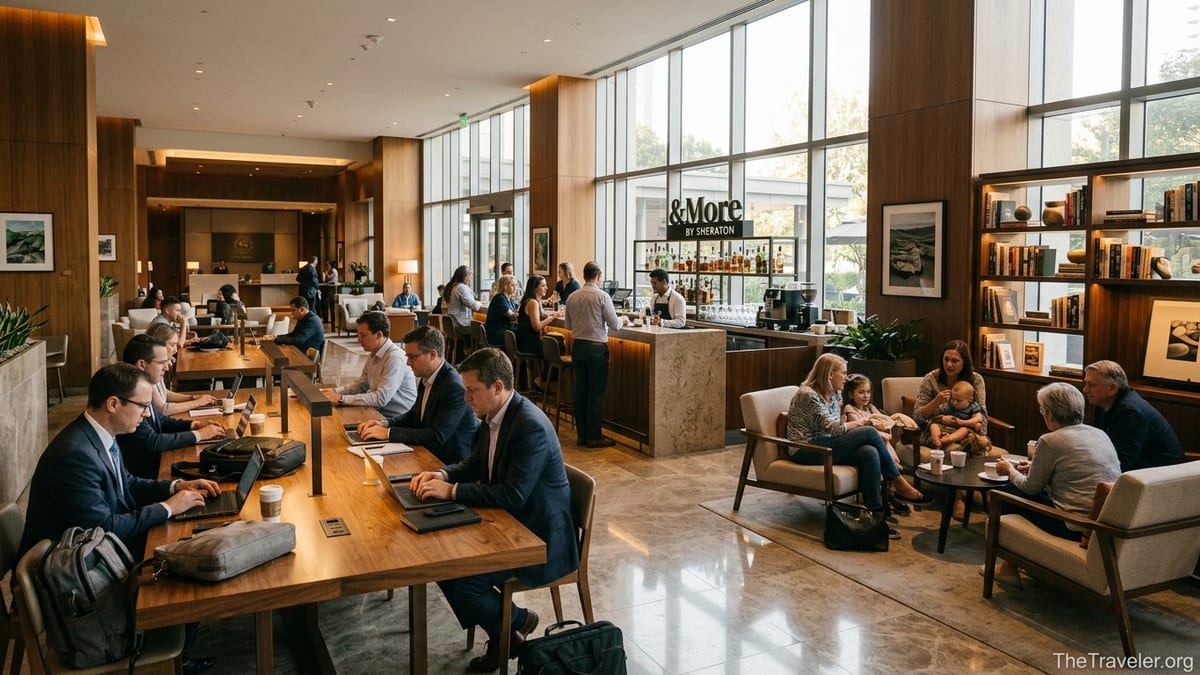
Walk into the Sheraton Phoenix Downtown today and you can see the concept in action. Instead of a single check-in desk and rows of empty armchairs, the lobby is anchored by &More by Sheraton, a hybrid coffee bar, café and wine bar. Guests tap away on laptops at communal tables in the morning, business travelers hold quick huddles in semi-enclosed studios at midday, and locals drift in for a glass of wine in the evening. The design encourages lingering, with a mix of bar-height seating, lounge chairs and library-style shelves that make the space feel more like a neighborhood hub than a transient hotel lobby.
A similar story plays out at Sheraton Gateway Hotel in Toronto International Airport. Historically, airport hotels were a last resort, chosen for convenience rather than atmosphere. After a multimillion-dollar renovation, the property reimagined its lobby as a bright, Toronto-inspired space with local art, flexible seating and &More by Sheraton integrated into the flow. For travelers landing late into Pearson or overnighting before an early departure, the lobby now functions as a comfortable place to answer emails, enjoy a proper drink, or simply decompress with runway views instead of retreating immediately to a room.
These examples show why Sheraton’s repositioning matters to the wider industry. The brand is proving that a large, legacy chain can meaningfully rethink its public spaces without losing the efficiencies of scale. By emphasizing gathering, co-working and local flavor, Sheraton is pushing competitors in the upper-upscale segment to rethink their own lobbies, coffee concepts and community programming.
Designing for Today’s Blurred Lines Between Work and Travel
The traditional business trip has changed. Many travelers now blend office duties with leisure time, extend stays into weekends or work remotely while on the road. Sheraton’s redesign focuses explicitly on these blurred lines, turning lobbies and lounges into functional workspaces while ensuring they still feel welcoming outside of office hours.
One key feature is the introduction of bookable glass-walled studios in many renovated properties. At Sheraton properties in major U.S. cities such as Denver and Seattle, guests can reserve these small meeting rooms by the hour to take a confidential video call or run a team huddle without committing to a full-day meeting room rental. For a consultant in town for a few days or a startup team meeting between flights, these spaces provide a bridge between the formality of a boardroom and the informality of a coffee shop.
Workspace zones in the lobby often come equipped with power outlets at every seat, wireless printing, and a mix of communal and semi-private seating. At the Sheraton Grand Sydney Hyde Park, for example, the lobby’s co-working-style tables are positioned near floor-to-ceiling windows that look out over the park, creating natural daylight and a sense of openness that many traditional office buildings lack. Guests can grab an espresso from &More in the morning, take calls in a quiet corner, and later slide into the adjacent bar area as the day winds down.
Importantly, Sheraton is designing these spaces so they feel equally appropriate for leisure travelers. Families passing through Sheraton Grand Macao, for instance, can use the same lobby seating to play cards or plan a day at nearby attractions, while digital nomads tap into high-speed Wi-Fi a few tables away. The ability to serve business meetings, solo workers and vacationing families in the same shared space is a competitive advantage that many smaller boutique hotels struggle to match.
Meetings, Conventions and the Power of Scale
Where Sheraton arguably remains most influential is in the meetings and events space. Many of the brand’s flagship properties were built with large ballrooms and extensive breakout rooms, making them natural homes for conferences, incentive trips and exhibitions. As group travel has rebounded, those features are again in high demand, and Sheraton’s global distribution means it can capture events that rotate across regions year over year.
The Sheraton Denver Downtown illustrates this well. Its expansive meeting facilities have long made it a favorite for national association meetings and corporate sales conferences. Recent renovations brought the public spaces in line with the brand’s new “gathering place” design, so delegates can move seamlessly from a 1,000-person general session into lobby zones that encourage spontaneous networking. Instead of dispersing immediately to their rooms, attendees are more likely to stay on property, grabbing a drink at the bar, continuing conversations around communal tables or finishing slide decks in the workspace areas.
In Asia, properties like Sheraton Grand Macao and Sheraton Grand Beijing Dongcheng serve a similar role. These hotels often host regional pharmaceutical conferences, auto industry launches or government-backed trade events, drawing attendees from across the continent. The ability to offer hundreds of rooms under one roof, reliable banquet operations and integrated technology infrastructure continues to make Sheraton a default choice for planners who need scale without true luxury pricing. When a multinational company decides to hold its Asia-Pacific leadership summit, choosing a Sheraton often simplifies logistics, from room blocks to catering to audiovisual support.
For Marriott, Sheraton’s meetings strength has strategic implications. Group business is typically booked months or years in advance and can stabilize revenue during leisure shoulder seasons. By investing in Sheraton’s event spaces and linking them closely with Marriott’s centralized sales and loyalty programs, the company ensures that Sheraton remains central to its strategy for corporate accounts and incentive houses. In that sense, Sheraton’s importance extends beyond individual stays to the broader ecosystem of global business travel.
Cultivating Local Connections and Community Programming
One of the most notable shifts in Sheraton’s recent evolution is its effort to engage not just hotel guests but local communities. Instead of treating the lobby as an enclave for travelers only, many properties now actively program events that invite residents inside, from book clubs and art installations to small markets and cultural performances. This approach helps differentiate Sheraton from purely transactional business hotels and aligns it more closely with lifestyle brands that celebrate locality.
A high-profile example is the collaboration between Sheraton and Reese’s Book Club. Select Sheraton hotels have launched lobby libraries curated with titles from the book club, creating cozy reading corners where guests and locals can browse, borrow or buy books. For a solo traveler staying at a Sheraton in Los Angeles or London, stumbling upon a curated shelf of contemporary fiction in the lobby is a small but telling signal that the hotel is paying attention to culture and not just room occupancy. For neighborhood residents, it gives them a reason to drop by for a coffee and linger, effectively blurring the line between hotel and community living room.
Some Sheraton properties are also experimenting with locally themed events to draw in residents. At urban locations in North America and Europe, lobby bars might host rotating pop-up collaborations with neighborhood bakeries, craft breweries or coffee roasters, allowing guests to sample local flavors without leaving the property. In Toronto, for instance, the redesigned Sheraton Gateway uses Toronto-centric art and design touches that reflect streetcar lines and city landmarks, signaling that this is more than an anonymous airport hotel.
These initiatives matter strategically because they protect Sheraton from being commoditized on price alone. In markets crowded with comparable four-star options, a hotel that can credibly claim to be part of the city’s social fabric gains an edge. It becomes the place where locals meet clients, where families gather before a big game, where business travelers feel plugged into real life rather than sealed inside a generic box.
Loyalty, Consistency and the Business Traveler Equation
While design and community are vital, Sheraton’s enduring relevance also rests on more practical fundamentals: loyalty recognition, predictable service standards and value for money, especially for business travelers whose companies foot the bill. Being part of Marriott Bonvoy gives Sheraton powerful advantages in this regard. Millions of frequent travelers accumulate and redeem points across Marriott’s ecosystem, and Sheraton remains one of the most available full-service redemption options in many cities.
Consider a consultant based in New York who spends half the year on the road. She might stay at Sheraton Grand Chicago Riverwalk during a client workshop, bounce to a Sheraton in Frankfurt for a trade fair, then use accumulated points for a weekend at a resort-style Sheraton in Bali. Across those stays, she can expect core amenities to be in place: a reasonably sized desk, reliable Wi-Fi, a gym that opens early, and food and beverage outlets that serve breakfast before an early flight. While the details differ, the baseline consistency reduces travel friction in a way that smaller independent hotels sometimes cannot match.
Price positioning is another part of the equation. Sheraton typically sits below true luxury flags like St. Regis or JW Marriott but above focused-service brands. For many corporate travel programs, that upper-upscale middle ground hits the sweet spot between comfort and cost. Daily rates at a renovated Sheraton in a major U.S. city might run in the mid-200s to low-300s in off-peak periods, climbing higher during major events, which is often more palatable to procurement teams than five-star alternatives. For travelers using personal funds or small-business budgets, Sheraton can offer a quasi-luxury experience without luxury-level prices, especially when booked in advance or with corporate discounts.
There is also an emotional loyalty that comes from familiarity. Many long-time road warriors have stories of Sheraton properties that effectively became second offices: the Sheraton New York Times Square for back-to-back Broadway-season meetings, the Sheraton Hong Kong Hotel & Towers overlooking Victoria Harbour for Asia trips. Even as décor and branding evolve, that sense of continuity gives Sheraton a place in the mental map of frequent travelers that newer concepts still have to earn.
The Challenges: Aging Portfolio and Fierce Competition
None of this is to say Sheraton’s position is unassailable. One of the brand’s clearest challenges is the uneven pace of renovation across its global portfolio. While flagship properties in North America, Europe and Asia showcase the latest “Gathering Place” design, other hotels still carry the look and feel of the previous era. A traveler who experiences a sleek Sheraton in one city and then checks into a tired, unrenovated property elsewhere may come away with mixed impressions of the brand.
Marriott’s strategy has been to prioritize high-profile and high-performing Sheraton hotels for full overhauls, often in partnership with property owners who invest tens of millions of dollars in upgrades. This takes time, particularly in markets where financing conditions are challenging or where owners are weighing whether to rebrand under a different Marriott flag altogether. For guests, the key is to pay attention to recent photos and renovation notes when booking. Choosing a Sheraton that has completed its redesign can dramatically change the experience, turning what might once have been a basic business stay into something closer to a modern co-working club with rooms upstairs.
Competition is also intense. Other global brands such as Hilton, Hyatt and Accor have their own upper-upscale offerings, and a wave of lifestyle-focused collections has trained travelers to expect bold design, localized food and drink and Instagram-ready common areas. In some cities, a traveler choosing between a renovated Sheraton and a trendy lifestyle hotel may prioritize aesthetics or nightlife over meeting space and loyalty benefits. Sheraton’s bet is that by combining genuinely improved design with the reliability of a big system, it can win both the heads and hearts of travelers, but the outcome varies by market.
Finally, the rise of alternative accommodations, from serviced apartments to home-sharing platforms, has shifted expectations around space and value. A family traveling to a beach destination might compare a Sheraton resort’s nightly rate with a multi-bedroom rental a short drive away. To compete, many resort-style Sheratons emphasize package deals, inclusive breakfasts or kids’ club access, effectively bundling experiences that independent rentals usually cannot provide. The brand’s success in this area will help determine whether it can hold onto leisure travelers who have grown accustomed to apartment-style stays.
The Takeaway
Sheraton’s enduring relevance in the global hotel industry rests on a blend of heritage and reinvention. It remains one of the few brands with deep roots in markets across North America, Europe, Asia and the Middle East, and its large-format properties are still central players in the meetings and conventions world. At the same time, the brand’s “World’s Gathering Place” strategy is reshaping lobbies, workspaces and community programming in ways that feel aligned with how people actually travel and work today.
For travelers, this means Sheraton is no longer simply the safe, slightly bland choice it might have been a decade ago. In many cities, particularly where renovations have been completed, it now competes head-on with newer lifestyle brands while offering the added advantages of Marriott Bonvoy, reliable meeting infrastructure and a familiar service playbook. For owners and investors, Sheraton’s scale, recognition and evolving design language continue to make it an attractive platform, especially in markets where large mixed-use or convention-oriented projects need a globally known flag.
There are still gaps to close, and not every property has caught up with the new vision. But taken as a whole, Sheraton’s transformation underscores a broader lesson for the hotel industry: legacy brands can matter more, not less, if they are willing to rethink their spaces, reconnect with local communities and adapt to the realities of modern travel. In that sense, Sheraton is not just surviving the current wave of change; it is helping define what the next generation of global business hotels will look like.
FAQ
Q1. Is Sheraton considered a luxury hotel brand?
Sheraton generally sits in the upper-upscale category rather than pure luxury. It aims to offer full-service amenities and comfortable rooms at a level below luxury flags such as St. Regis or Ritz-Carlton, though some individual Sheraton properties operate at near-luxury standards.
Q2. What makes the “new” Sheraton different from the old version?
The refreshed Sheraton focuses on open, flexible lobbies, co-working-style workspaces, integrated coffee and bar concepts, and more locally inspired design. Guests are more likely to find communal tables, glass-walled studios and social events instead of the closed-off, mostly empty lobbies that defined many older properties.
Q3. Are all Sheraton hotels already renovated to the new design?
No. Renovations are rolling out property by property, with many flagship and high-profile hotels already updated and others still in transition. When booking, it is worth checking recent photos or descriptions to see whether a particular Sheraton has completed its redesign.
Q4. How does Sheraton compare with other Marriott brands like Marriott Hotels or Westin?
Sheraton, Marriott Hotels and Westin all sit in a similar upper-upscale space but have different focuses. Sheraton leans into the “gathering place” concept and meetings, Marriott Hotels often emphasizes classic business travel, and Westin highlights wellness and sleep. In practice, individual properties can overlap, so location, renovation status and specific amenities may matter more than the label.
Q5. Is Sheraton a good choice for remote workers or digital nomads?
At renovated properties, Sheraton can work very well for remote workers thanks to lobby workspaces, plentiful power outlets, fast Wi-Fi and bookable studios. Digital nomads who value hotel services, loyalty points and on-site gyms may find the brand especially convenient, though they should confirm that their chosen property reflects the new design philosophy.
Q6. Do Sheraton hotels participate in Marriott Bonvoy?
Yes. Sheraton is fully integrated into the Marriott Bonvoy program, so guests can earn and redeem points, enjoy elite benefits where available and combine Sheraton stays with nights at other Marriott brands under a single loyalty account.
Q7. Are Sheraton hotels suitable for families on vacation?
Many Sheraton properties, especially resort-style locations, cater to families with larger rooms, pools and kid-friendly facilities. City-center Sheratons can also work well for families who prioritize walkability and access to attractions, though they may feel more business-focused than dedicated resorts.
Q8. How does Sheraton handle meetings and conferences?
Meetings and events are a core strength for Sheraton. Many hotels feature large ballrooms, multiple breakout rooms and on-site event teams. The updated lobby and workspace designs are intended to support networking before and after sessions, making Sheraton a popular choice for conferences and corporate gatherings.
Q9. Is Sheraton usually located in downtown areas or near airports?
Sheraton has a mix of locations. Many properties sit in central business districts near offices and convention centers, while others are attached to airports or serve as resort destinations. Travelers can often choose between multiple Sheratons in a metropolitan area depending on whether they prioritize city access, event venues or airport convenience.
Q10. How can travelers get the best value when booking a Sheraton stay?
Travelers often find better value by booking in advance, comparing flexible and prepaid rates, and leveraging Marriott Bonvoy discounts or corporate codes. Checking whether a hotel has recently been renovated can also improve the value equation, as updated properties frequently deliver a markedly better experience at a similar nightly rate.