


Wedged between glamorous Cannes and buzzing Nice, Antibes often flies a little under the radar on French Riviera itineraries. Yet this fortified seaside town, with its busy Provençal market, sandy coves, superyacht-filled harbor and neighboring resort of Juan les Pins, is increasingly chosen as either a relaxed base or a full‑day stop between bigger names. If you are planning a trip in 2026 and wondering whether Antibes deserves a place on your route, it helps to look at what it actually offers in practice, from hotel prices and train connections to real beach conditions and crowd levels.
Get the latest updates straight to your inbox!
Where Antibes Fits on a Modern French Riviera Itinerary
Antibes sits almost exactly between Nice and Cannes, about 25 minutes by regional train in either direction in normal conditions. From Nice’s main station, direct trains usually run at least twice an hour in season, with typical second‑class fares often under 10 euros each way if you buy a standard ticket rather than last‑minute flexible options. This makes Antibes easy to plug into a coastal itinerary that already includes Menton, Villefranche sur Mer, Eze, Cannes or Monaco.
In practical terms, many first‑time visitors choose Nice as a base because of its large hotel stock and airport, then slot Antibes in as a day trip. A very common pattern in 2026 travel forums is four or five nights in Nice with one day earmarked for Antibes and Cannes together, or Antibes paired with a half‑day in Juan les Pins. If you are short on time, this one‑day approach works well because the old town, main beach and harbor are compact.
Antibes also attracts repeat visitors who deliberately pick it over Nice or Cannes for a longer stay. Couples on a week‑long honeymoon, for example, often book a mid‑range sea‑view hotel such as Royal Antibes or a small apartment near the ramparts, then day‑trip by train to Monaco, Villefranche sur Mer and Cannes. They trade Nice’s nightlife and museum scene for Antibes’ smaller‑town feel, superyacht harbor walks and quick access to the calmer beaches of Cap d’Antibes and Juan les Pins.
Compared with more high‑gloss neighbors like Saint‑Tropez or Monaco, Antibes delivers a softer kind of Riviera experience. The skyline is dominated not by high‑rise hotels but by terracotta roofs and 16th‑century walls wrapped around the old town. Prices are not cheap, but dinner for two with a carafe of local rosé in Antibes’ lanes can easily run 20 to 30 percent less than a similar meal on Cannes’ Croisette, which matters over a weeklong stay.
Atmosphere: Old Town Charm, Market Life and Port Vauban
The first thing many visitors notice in Antibes is the walled old town. Inside, narrow streets like Rue Sade and Rue Aubernon are lined with pastel houses, flower boxes and a mix of bakeries, ice‑cream shops and small boutiques. Unlike some Riviera resorts that feel heavily seasonal, Antibes’ old town supports a year‑round local community, so you still see schoolchildren, residents shopping and workers commuting even in the shoulder months of April and October.
Marché Provençal, the covered food market just inland from the sea, is one of the town’s biggest everyday draws. In high season, stalls pile up with cheeses, charcuterie, olives and fruit, and it is common to see visitors assembling on‑the‑spot beach picnics: a round of goat cheese, a paper cone of olives, a baguette and a punnet of strawberries for a combined total that often stays under 15 euros for two people. For anyone on a mid‑range budget, using the market for breakfast or lunch several times during a stay can noticeably reduce restaurant costs.
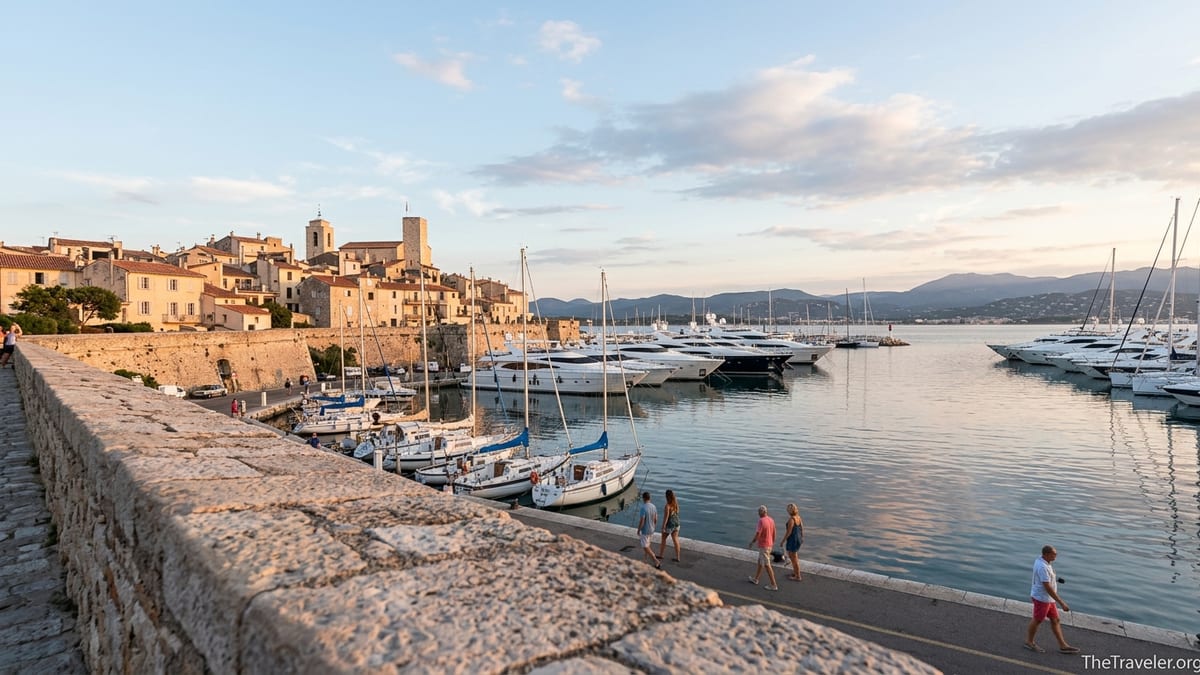
Step outside the arches of the market and you reach the ramparts and Port Vauban, often described as the largest leisure marina in Europe. A short stroll along the harbor brings you face to face with rows of superyachts moored along the so‑called “Quai des Milliardaires.” Watching crew load provisions and golfers practice on upper decks is a favorite free pastime, especially in late afternoon when the light is soft and the Alps are often visible behind Nice in the distance.
Antibes’ atmosphere shifts subtly between the old town and the waterfront. Within the lanes, evenings are about wine bars, small bistros and people lingering at café terraces. Down by the port and on the promenade toward Plage de la Gravette, the feel is more open and breezy, with joggers, families and travelers wandering between the harbor, beach and children’s playgrounds. For visitors who find Monaco too formal or Cannes too branded, this laid‑back mix often hits a sweet spot.
Beaches: What to Expect Around Antibes and Juan les Pins
One of Antibes’ strongest arguments for a spot on your itinerary is the access to genuinely usable beaches without needing a car. Plage de la Gravette, tucked just outside the old town walls, is a sandy curve protected by a breakwater. It is shallow and generally calm, which makes it popular with families and cautious swimmers. Because it sits five minutes’ walk from the Provençal market, it is easy to pick up picnic supplies and spend a few relaxed hours here between sightseeing stops.
Beyond Gravette, you have a string of shoreline options. To the east, Plage de la Salis offers another sandy stretch at the foot of Cap d’Antibes, with views back toward the old town ramparts. To the west, longer pebbly sections near Fort Carré appeal to those who like quieter spots. The trade‑off is comfort versus space: on the sand at Gravette and Salis you may find it crowded by late morning in July, while the more stony stretches near Fort Carré often have more room even in peak season, particularly towards early evening when locals come down for a twilight swim after work.
A major bonus is Juan les Pins, officially part of the commune of Antibes but with a distinct feel. Just ten or so minutes by local bus from Antibes old town, it lines up a series of sandy beaches backed by a promenade of cafés, gelato stands and beach clubs. Some beach clubs, such as the one at Hôtel Belles Rives, still lean into a classic Riviera glamour: striped loungers, waiter service, and lunch menus featuring grilled fish and chilled rosé, with daybed rentals commonly ranging from roughly 40 to more than 100 euros per person in high summer depending on front‑row placement and inclusions.
For travelers watching their budget, it is important to know that mixed in between Juan les Pins’ private sections are public beaches where you can simply drop a towel for free. On a typical September weekday, you might see local families set up on the public sand with coolers and fold‑up chairs, while couples and groups of friends opt for beach clubs a few meters away for the comfort of loungers and showers. This side‑by‑side setup makes it easy for a group with different budgets to still spend the day together.
Key Sights: From Picasso to Cap d’Antibes Walks
Beyond its sea‑and‑sand appeal, Antibes offers a compact set of sights that can comfortably fill a full day. The Picasso Museum, housed in the former Château Grimaldi overlooking the sea, is the headline cultural attraction. Picasso worked here in 1946, and today the museum shows a collection of his works alongside other modern art. As of 2026, standard adult tickets are typically priced in the range of single‑digit euros, with small variations for temporary exhibitions and combined passes; it is still notably cheaper than major national museums in Paris.
Visitors planning a short stay often pair the Picasso Museum with a walk along the ramparts. The views take in the harbor, the old town roofs and the curve of the coastline back toward Nice. Continuing north, walkers can reach Fort Carré in roughly 20 to 30 minutes from the old town depending on pace, either via the road or through the marina past the yachts. The fort itself, a star‑shaped 16th‑century bastion on a low hill, offers guided visits and expansive views over the port and town when open.
For those who enjoy coastal walking, the Cap d’Antibes headland offers one of the Riviera’s most scenic footpaths, the Sentier du Littoral. This roughly two‑hour loop in good weather skirts rocky coves, small inlets and occasional viewpoints over the Esterel mountains and the Bay of Angels. It is not suitable for flip‑flops or strollers, but for reasonably fit walkers carrying water and wearing proper shoes it can be a highlight of an Antibes stay. In high season, many visitors time it for early morning or late afternoon to avoid the strongest sun.
Culturally, Antibes also plays host to events that may shape whether it is worth a stop for you personally. Jazz enthusiasts, for example, often plan itineraries around the Jazz à Juan festival held each July in the pine grove by the sea in Juan les Pins, where artists such as Miles Davis and Herbie Hancock have performed over the decades. On festival nights, the town’s atmosphere changes noticeably, with music fans filling hotels, restaurants and the trains back toward Nice and Cannes after the shows.
Costs, Hotels and Dining: How Antibes Compares
Price is often the tipping factor when travelers choose a base on the Côte d’Azur. While individual deals vary widely, a typical mid‑range double room in central Antibes in June or September 2026 might fall in the approximate range of 180 to 260 euros per night when booked a few months ahead. Similar properties on Nice’s seafront or Cannes’ prime boulevard can easily push 250 to 350 euros or more in the same period, especially during major events.
Within Antibes itself, old town guesthouses and apartments tend to command a premium because of their atmosphere and proximity to the market and beaches. Slightly more modern hotels east of the center, near Salis Beach, can sometimes be better value while still keeping you in walking distance of the old town. Juan les Pins usually offers a spectrum from simple two‑star hotels a couple of blocks back from the sea to four‑ and five‑star properties directly on the water, which often draw couples on short seaside breaks.
Dining follows a similar pattern. In the lanes of the old town, neighborhood bistros routinely offer fixed‑price lunch menus in the 20 to 30 euro range, often including a starter, main and dessert. An example might be a salad of tomatoes and local mozzarella, a plate of grilled sea bream with vegetables and a simple tarte du jour. On the seafront, expect a premium: a main course of grilled fish or steak at a restaurant with harbor views can easily run 30 to 40 euros before drinks, particularly at sunset.
Self‑catering or semi self‑catering is straightforward in Antibes, which is another reason some travelers favor it over more resort‑like towns. In addition to the Provençal market, there are several supermarkets and wine shops within a short walk of the ramparts. Many visitors staying in apartments build a routine of coffee and pastries from the local bakery in the morning, market‑style picnics or quick panini for lunch, and then dinner out every second or third evening, which helps balance out Riviera prices.
Logistics: Getting In, Getting Around and Day Trips
Reaching Antibes is straightforward for most international travelers. From Nice Côte d’Azur Airport, you can take the tram to Nice Saint‑Augustin station and then board a regional train headed toward Cannes, Grasse or Marseille, all of which stop at Antibes. In normal traffic conditions, this airport‑to‑Antibes journey can take under an hour door to door, with the train portion alone often around 20 minutes. Taxis and private transfers are also widely used, with prices varying depending on season and time of day.
Once in town, Antibes’ compact size means you can walk to most places. The train station sits a short stroll from Port Vauban and roughly ten minutes from the old town walls. Local buses link Antibes with Juan les Pins, Cap d’Antibes and nearby suburbs, while regional buses and trains connect you to Cannes, Nice, Cagnes sur Mer and beyond. For travelers under 27, youth rail cards can reduce regional ticket costs, which benefits anyone planning multiple day trips along the coast.
As a base, Antibes works well for a week of coastal exploration. It sits roughly 20 to 30 minutes by train from Cannes and Nice, about an hour from Monaco in typical conditions, and within easy reach of smaller stops like Villefranche sur Mer and Cagnes sur Mer. This allows you to spend your evenings in the same town, getting to know local bakeries and bars, while still sampling the wider Riviera during the day.
If your itinerary is very short, however, logistics argue for Nice instead as a sole base. Nice combines the airport, major museums, a tram system and a denser network of hotels and restaurants. In that scenario, Antibes can still play an important role as a dedicated day trip: arrive mid‑morning, enjoy the market and Picasso Museum, swim at Plage de la Gravette or Salis in the afternoon, wander Port Vauban at sunset, have dinner in the old town, then take an evening train back to Nice.
Who Antibes Is Best For (and When to Skip It)
Antibes tends to appeal strongly to travelers who like a slower pace than central Nice but still want proper infrastructure, frequent trains and plenty of dining options. Couples seeking a romantic yet relaxed base, families with school‑age children who prefer sandy beaches over Nice’s pebbles, and remote workers combining Zoom calls with afternoon swims all regularly single out Antibes as a good fit.
If your priorities are beach time, local markets and scenic harbor walks, Antibes competes very favorably with other Riviera towns. It is especially compelling in late May, June and September, when the sea is swimmable and the evenings are long but the peak‑season crush of July and August has not fully hit or has just eased. During those shoulder periods, you are more likely to find tables at popular old‑town restaurants without reservations and enjoy quieter conditions on the Cap d’Antibes coastal path.
On the other hand, if nightlife, big‑city cultural offerings or luxury shopping are central to your trip, Antibes may feel a little small. Its bar scene is lively enough for a few nights, with wine bars and casual cocktail spots, but it does not rival Nice’s breadth of nightlife or Cannes’ cluster of high‑end clubs and designer boutiques. Similarly, museum‑focused travelers might prefer to base in Nice, which adds the Matisse Museum, the Museum of Modern and Contemporary Art and several smaller institutions to the mix.
There are also itinerary styles where Antibes is best experienced briefly rather than as a base. If you are driving from Marseille toward Italy over just three or four days, you may want to prioritize one overnight stop, such as Nice, and use your limited daylight to sample multiple towns rather than unpack fully in Antibes. In those situations, a four‑ or five‑hour stop for lunch, a harbor walk and a swim can still give you a satisfying taste of the town.
The Takeaway
Is Antibes worth visiting for your French Riviera itinerary in 2026? For most travelers, the answer is yes, with the exact role depending on your pace and priorities. As a day trip from Nice or Cannes, Antibes delivers a concentrated dose of old‑town charm, market life, sandy coves and superyacht harbor views in a single, walkable package. As a base for several nights, it offers a relaxed, village‑by‑the‑sea rhythm, solid train connections and more moderate prices than some famous neighbors, all while keeping Juan les Pins’ beaches and Cap d’Antibes’ coastal paths within easy reach.
Ultimately, Antibes shines for visitors who value atmosphere and daily rituals over blockbuster sights: morning coffee on a shaded square, a basket of market goods carried down to the sand, sunset on the ramparts with the lights of Port Vauban flickering on and a simple dinner in a stone‑walled alley. If that picture matches the kind of Riviera experience you are seeking, Antibes not only deserves a place on your itinerary, it may well become the town you remember most vividly when the trip is over.
FAQ
Q1. Is Antibes worth visiting if I am already staying in Nice?
Yes. Antibes makes an easy and worthwhile day trip from Nice, with frequent trains, a very different old‑town feel, sandy beaches and Port Vauban’s superyachts all within a compact, walkable area.
Q2. How many days should I spend in Antibes?
Many travelers are satisfied with one full day, but two or three nights allow time for the Picasso Museum, market visits, a beach day in Juan les Pins and a walk on Cap d’Antibes without rushing.
Q3. Is Antibes a good base for exploring the French Riviera?
Antibes works very well as a base if you want a quieter atmosphere than Nice but still need reliable train links to Cannes, Monaco and smaller coastal towns for day trips.
Q4. Are Antibes beaches better than those in Nice?
They are different. Antibes and Juan les Pins offer more sandy stretches, which many people find more comfortable for swimming and sunbathing, while Nice’s main beaches are mostly pebbles.
Q5. Is Antibes expensive?
Antibes is not cheap, but it is often slightly less expensive than staying right on the seafront in Cannes or in top locations in Nice. Using markets and picnics helps manage costs.
Q6. Do I need a car in Antibes?
No. The old town, main beaches and Port Vauban are easily walkable, and regular trains and buses connect Antibes with nearby destinations, so most visitors manage comfortably without a car.
Q7. What is the best time of year to visit Antibes?
Late May, June and September are especially pleasant, with warm weather and swim‑friendly sea temperatures but generally fewer crowds than in the peak holiday weeks of July and August.
Q8. Is Antibes suitable for families with children?
Yes. The sandy, sheltered beaches, playgrounds near the waterfront, relaxed restaurant scene and short walking distances make Antibes very practical for families with young or school‑age children.
Q9. How early should I book accommodation in Antibes?
For peak dates in July, August or during major events, it is wise to book several months ahead. For shoulder seasons, you can often find good options one to three months before arrival.
Q10. Is Antibes safe for solo travelers?
Antibes is generally considered safe for solo travelers. Normal city precautions apply, but walking between the old town, port and beaches is common well into the evening.