

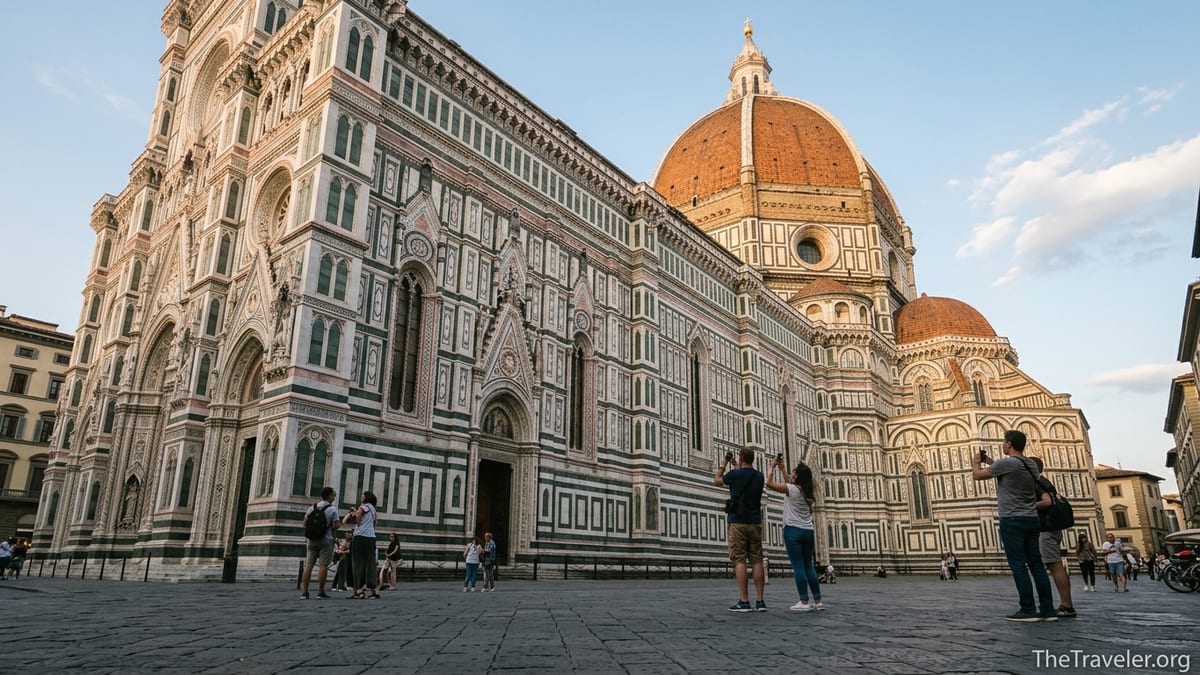
Standing in the heart of Florence, the Cathedral of Santa Maria del Fiore dominates both the skyline and most travelers’ wish lists. The striped marble facade, Brunelleschi’s vast brick dome and the bustle of Piazza del Duomo make it one of Europe’s most recognizable sights. Yet many visitors planning a short stay in Florence still wonder if it is really worth visiting the cathedral complex properly, or if admiring it from the square is enough. The answer depends on your interests, budget and tolerance for crowds, but with realistic expectations the Duomo can be one of the most memorable stops of a Florence trip.
Get the latest updates straight to your inbox!
What Makes the Cathedral of Santa Maria del Fiore Special
Florence’s cathedral is not just another church on an Italian itinerary. Begun in the late 13th century and crowned by Filippo Brunelleschi’s dome in the 15th century, it became a turning point in architectural history. The terracotta-clad dome, raised without modern scaffolding, remained the largest brick dome in the world and still defines the city’s silhouette as you approach by train or look out from viewpoints like Piazzale Michelangelo.
The cathedral itself, often called the Duomo, forms the centerpiece of a larger religious complex that includes Giotto’s bell tower, the Baptistery of San Giovanni, the archaeological remains of the earlier church of Santa Reparata and the Opera del Duomo Museum. All of this is concentrated around Piazza del Duomo, which makes it easy to experience several centuries of Florentine art and faith in one compact area.
Inside, the vast, relatively plain nave can surprise visitors expecting the ornate interiors of churches in Rome or Venice. The drama here lies in the scale of the space, the marble floor patterns and the views upward toward the frescoed interior of the dome, painted with a vivid Last Judgment. For many travelers, the real highlights are not the main nave but the climbs and the museum, which provide richer context and closer encounters with the art.
In recent years the Duomo complex has been among Italy’s most visited cultural sites, welcoming several million people annually. That popularity means some planning is required, but it also reflects how central the cathedral remains to Florence’s identity and to the story visitors come here to experience.
How Visiting Works: Tickets, Passes and What Is Free
One of the first surprises for many travelers is that entry to the cathedral nave itself is free. You can join the main line on the south side of the building, pass a simple dress code check and step inside without buying a ticket. However, everything most people associate with a “Duomo visit” beyond this, such as climbing the dome or the campanile or visiting the museum, now requires a paid pass and often a reserved time slot.
As of mid 2026 the Opera di Santa Maria del Fiore sells three main passes. The top tier Brunelleschi Pass, around 30 euros for adults, includes the dome climb, bell tower, Baptistery, Opera del Duomo Museum and the Santa Reparata archaeological area, with a 3-day validity and a mandatory reservation time for the dome. The Giotto Pass, around 20 euros, includes everything except the dome, while the Ghiberti Pass, around 15 euros, is focused on the museum, Baptistery and Santa Reparata. Reduced fares are available for children roughly between ages 7 and 14, and children under 7 are typically free with a paying adult.
These official passes are sold directly by the cathedral’s own ticketing system. Third-party “skip the line” products generally resell the same entitlements with a markup, sometimes adding a guided tour. The cathedral authorities explicitly note that external companies are not authorized to sell special front-of-the-line access for the free cathedral entrance, so paying extra will not eliminate the basic security queue required for everyone.
In practice, if you only want a quick look inside the nave and a few photos of the exterior, you can visit the Duomo without spending anything. If you want to climb or see the original artworks in the museum, budgeting for at least the Giotto or Ghiberti Pass is wise. Compared with other major Italian sites like the Colosseum in Rome or the Uffizi Gallery, the pricing is broadly in line but offers a multi-site experience spread over several days.
The Highlights: Dome, Bell Tower, Baptistery and Museum
For many travelers the single most memorable experience is the climb to the top of Brunelleschi’s dome. Reached via 463 narrow steps, this route winds between the inner and outer shells of the dome, passing close to the frescoes and culminating in a tight final staircase that delivers you to a terrace with panoramic views. On clear days you can see the Arno river valley, the hills around Fiesole and the terracotta roofs of Florence in every direction. Timed entries keep the flow steady, but in peak months June through September you still need to book ahead, often several days in advance.
Giotto’s bell tower, the free-standing campanile next to the cathedral, offers a slightly different but equally striking ascent. With about 400 steps and no elevator, it is a challenge for anyone with mobility issues, but there are several viewing platforms along the way. Many visitors appreciate that from the top you actually see the dome itself rising above the cathedral, which you obviously cannot from the dome terrace. If you are deciding between one climb and the other and you are prone to claustrophobia, the bell tower’s more open landings can feel less intense than the enclosed spiral stretches inside the dome.
The Baptistery of San Giovanni, currently undergoing a long-running restoration campaign on its interior mosaics, remains an atmospheric space even while some scaffolding or protective coverings are in place. The bronze doors, including the famous “Gates of Paradise,” are now preserved and displayed in the adjacent museum, while replicas stand outside. Stepping inside the Baptistery allows you to appreciate the octagonal geometry and golden mosaic ceiling that inspired artists for centuries.
Often overlooked but arguably the most rewarding part of the entire complex is the Opera del Duomo Museum. Recently redesigned and expanded, it houses original sculptures by Donatello, Ghiberti and others, the restored doors of the Baptistery, and contemporary installations that reconstruct the original medieval facade of the cathedral. Travelers who visit in the hotter months often appreciate that the museum is spacious, air-conditioned and comparatively calm. Many seasoned Florence visitors now recommend seeing the museum first to understand the story behind the cathedral before facing the crowds on the square.
Crowds, Queues and When to Go
Piazza del Duomo is rarely quiet. On a typical day in May or June, lines form by mid-morning for the free cathedral entry, and day-trippers from cruise ships and nearby cities swell the square until early evening. Recent visitor statistics show the Duomo complex welcoming well over a million paying visitors per year, on top of the many who only step inside the nave, which explains the dense foot traffic you will encounter around the cathedral steps.
For the free cathedral entrance, waiting 30 to 60 minutes in the middle of the day is not unusual in peak season. Early morning, shortly after opening, or later in the afternoon when many tour groups have moved on, are markedly better. Travelers who have purchased a pass and visited Santa Reparata or the museum often mention that they appreciated exploring those spaces during the hottest hours, then timing their cathedral visit for a quieter part of the day.
The dome climb is strictly timed, which reduces queuing but also means popular slots sell out. Mid-morning times disappear first for weekends between April and October. If your dates are fixed, booking as soon as you finalize your accommodation is sensible. The bell tower, museum and Baptistery are all covered by the same passes but rely more on capacity limits than exact time slots, so short waits at busy moments are still possible but generally manageable.
Season matters as much as time of day. In winter months, especially in January and early February, the square is noticeably less crowded and climbing the dome or tower can be more comfortable. In July and August, on the other hand, heat inside the stone stairways can be intense. Anyone with heart or respiratory issues should consider whether a 400-plus-step climb in summer conditions is wise and may opt for ground-level experiences and cooler seasons instead.
Is It Worth It for Different Types of Travelers?
For first-time visitors to Florence, the Duomo is almost always worth including, at least from the outside and with a brief look inside the nave. Even if you decide not to climb or purchase a pass, seeing the marble facade change color with the light, listening to the street musicians in the square and watching the dome glow at sunset gives you a powerful sense of place. Most travelers will want to at least step through the doors once, if only to appreciate the scale of the interior.
Art and architecture enthusiasts will get the most from a more comprehensive visit. Combining the museum with either the dome or the bell tower creates a satisfying narrative: first understanding how the cathedral was built and decorated, then seeing the city from the vantage point it created. For example, a traveler with a morning at leisure could book a 9:15 dome climb, spend an hour on the ascent and descent, then retreat to the museum for a deeper dive into the sculpture and panel work that once adorned the building.
Families have to balance cost, energy and attention spans. A family of four with two children over seven buying Brunelleschi Passes could spend around 80 to 90 euros for the full set of experiences, which is significant but can cover a full morning or afternoon across multiple days. Many parents report that children enjoy the physical challenge of the climbs more than a slow walk through the nave. The museum, with its large-scale models and dramatic installations, also often appeals more than traditional picture galleries like the Uffizi.
Travelers with tight schedules or mobility limitations need to be more selective. If you only have one full day in Florence and already plan to see the Uffizi or Accademia, spending several hours between lines and climbs at the Duomo may feel unbalanced. In this scenario, admiring the exterior, stepping inside briefly if the line is short and perhaps visiting the museum as a calmer alternative can still give you a meaningful connection to the cathedral without dominating your day.
Practical Tips to Make a Visit More Rewarding
Dress code is enforced at the cathedral and Baptistery, which can catch visitors off guard during summer. Shoulders and knees should be covered for all genders. Lightweight scarves, long shorts or skirts and linen shirts work well; having a shawl or large scarf in your bag can save you from being turned away on a hot afternoon. Flip-flops are usually accepted, but more supportive shoes are strongly recommended if you plan to climb.
Booking strategy matters. If the dome climb is a priority, secure a Brunelleschi Pass with your preferred time as soon as your dates are firm, then build the rest of your Florence plans around it. For travelers visiting in shoulder seasons like March or November, it is sometimes possible to find next-day or even same-day dome slots, but relying on this in July can easily lead to disappointment. The museum, Baptistery and bell tower are more flexible, so you can keep them as options for when you need a break from outdoor sightseeing or from the midday heat.
On the day itself, think of your visit in stages rather than as one long queue. For example, a realistic plan for a spring day might be to arrive around opening time to tour the nave when lines are shortest, then use your pass to head down into Santa Reparata’s archaeological remains. After a coffee on a side street away from the square, you could climb the bell tower in late morning, then retreat to the museum for air-conditioned exploration and restrooms. Breaking up the experience like this tends to feel far less exhausting than doing everything back to back.
Audio guides and guided tours can add value, especially in the museum where detailed explanations of individual works enrich the experience. The cathedral complex now offers an official app with audio content for the museum, which you can download to your own phone and use with personal headphones. Independent travelers who enjoy context but dislike group tours often find this a good compromise that also helps them move at their own pace.
Reasons You Might Skip or Limit Your Duomo Visit
Despite its iconic status, the Duomo is not a must-do in depth for every traveler. If you strongly dislike crowds, queuing or highly touristic environments, you may find the atmosphere in Piazza del Duomo overwhelming, particularly in the middle of the day. In that case, a brief early-morning walk through the square and a view from a quieter vantage point, such as the terrace of a nearby rooftop bar or the hill at San Miniato al Monte, might bring you more enjoyment than a full pass.
Travelers who are indifferent to religious architecture may also prefer to devote their limited time indoors to Florence’s painting and sculpture collections instead. The Uffizi Gallery and Accademia, where Michelangelo’s David stands, each offer a denser concentration of masterpieces in a single visit. A short exterior stop at the Duomo to appreciate the engineering feat of the dome can still fit into a walk between those museums without the need to stand in line.
Budget-conscious visitors might reasonably decide that paying for multiple climbs across Italy adds up quickly. If you are already planning to climb St Peter’s dome in Rome, the bell tower in Venice or the Torre Guinigi in Lucca, you may choose just one major ascent in Florence and invest the savings in a good meal or a lesser-known church like Santa Maria Novella. The key is to avoid feeling that you “should” tick off every paid component simply because they exist.
Lastly, those with significant mobility issues, vertigo or claustrophobia are likely to get better value from ground-level experiences. The tight stairways inside the dome and tower offer no elevator alternatives and limited opportunities to turn back once you are in the one-way system. For some travelers, sitting in the piazza with a coffee, visiting the museum’s wide, ramp-equipped galleries and perhaps attending a mass inside the cathedral may be a more comfortable and meaningful way to connect with the site.
The Takeaway
So, is the Cathedral of Santa Maria del Fiore worth visiting during a Florence trip? For most travelers, the answer is yes, provided you match the experience to your interests and energy rather than trying to do everything. At minimum, the cathedral deserves a slow circuit around its exterior and a thoughtful look up at Brunelleschi’s dome, whose silhouette has defined Florence for six centuries. Stepping inside the nave, when crowds allow, adds another layer of understanding of the city that produced the Renaissance.
For those willing to plan ahead and invest in a pass, pairing either the dome or bell tower climb with time in the Opera del Duomo Museum delivers the richest payoff. You gain both the sweeping views that fill postcards and the quiet, close-up encounters with the original sculptures and doors that once adorned the complex. With realistic expectations about queues, a little attention to dress code and a flexible approach to timing, the Duomo can become not just a box to tick but a memorable anchor for your days in Florence.
FAQ
Q1. Is the Florence Duomo free to visit?
The main cathedral nave is free to enter, but the dome, bell tower, Baptistery, museum and archaeological area all require a paid pass from the cathedral authority.
Q2. Do I really need to book the dome climb in advance?
In busy months from spring through early autumn, advance booking for the dome is strongly recommended because timed slots often sell out several days ahead.
Q3. Which is better, climbing the dome or the bell tower?
The dome offers a closer view of the frescoes and a famous ascent between its shells, while the bell tower gives excellent city views that include the dome itself and slightly more open landings.
Q4. How much time should I plan for a full Duomo visit?
To visit the cathedral, either the dome or bell tower, the Baptistery and the Opera del Duomo Museum at a comfortable pace, most travelers should allow at least half a day.
Q5. Is the Duomo suitable for travelers with mobility issues?
The interior of the cathedral and the museum are accessible to many visitors, but the dome and bell tower climbs involve hundreds of steps, no elevators and narrow passages.
Q6. What should I wear to visit the Duomo?
Dress modestly with shoulders and knees covered for all genders; light layers and comfortable closed shoes are best, especially if you plan to climb.
Q7. Are guided tours worth it at the Florence Duomo?
Guided tours or the official audio app can add useful context, particularly in the museum and during the climbs, but independent visitors can also have a rewarding experience with basic research.
Q8. Can I visit the Duomo and Uffizi on the same day?
Yes, but it makes for a full schedule. Many visitors pair a morning at the Duomo complex with an afternoon Uffizi visit, or vice versa, leaving time for breaks in between.
Q9. What is the best time of day to visit the cathedral interior?
Early morning around opening time or late afternoon tends to be quieter; lines are usually longest in late morning and mid-afternoon when tour groups arrive.
Q10. Is the Duomo still worth seeing if I skip the climbs?
Absolutely. The exterior, the free cathedral interior and especially the Opera del Duomo Museum together offer a rich experience even without ascending the dome or bell tower.