


More news on this day
Air travel across the Gulf is facing renewed turmoil after a fresh wave of Iranian missile and drone strikes targeted multiple countries, with new disruptions reported in the United Arab Emirates, Oman and Qatar as tensions around the Strait of Hormuz escalate again.
Get the latest news straight to your inbox!
Fresh Iranian strikes widen regional airspace risk
Published coverage from regional and international outlets indicates that Iran launched new missile and drone attacks on July 12 against several Gulf and neighbouring states, including Qatar, Oman, Bahrain, Kuwait, Jordan and the United Arab Emirates. The attacks follow recent United States strikes on Iranian military and port facilities linked to earlier incidents involving commercial shipping near the Strait of Hormuz.
Reports describe air raid sirens, loud explosions and interception activity across parts of the Gulf. Qatar, Bahrain and the UAE all issued alerts as air defence systems engaged incoming projectiles, while Oman reported impacts linked to strikes on port and logistics facilities. Iran has also announced the closure of the Strait of Hormuz to an “unauthorised” vessel route, a move that heightens concern for both maritime and aviation corridors that converge around the narrow waterway.
Travel analysts note that the latest escalation comes just months after a fragile ceasefire began to ease a war that has repeatedly spilled into Gulf airspace since late February. For airlines and passengers, the renewed exchange of fire is reviving operational risks that had only recently started to recede.
Dubai and UAE: alerts, interceptions and renewed uncertainty
In the United Arab Emirates, publicly available information shows that sirens sounded in the early hours of July 12 as authorities activated air defence systems over key population and transport hubs. Local media and international agencies report that missiles detected over UAE territory were intercepted outside the country’s borders, with officials later describing the situation as stable while maintaining heightened vigilance.
Dubai, one of the world’s busiest international aviation hubs, has already endured months of severe disruption since the outbreak of the wider conflict, including temporary airport closures, airspace restrictions and previous incidents involving debris near civilian facilities. Today’s interceptions did not immediately result in widely reported structural damage at airports, but industry observers suggest that risk assessments for flights into and over the UAE are likely to be reviewed again in light of the latest attacks.
Travel advisories issued earlier in the year highlighted how quickly operations at Dubai International and other UAE airports could be curtailed when threat levels shift. With Iran and the United States trading fresh strikes and the Strait of Hormuz again at the centre of a stand-off, airlines may opt for conservative routing or short-notice schedule changes even if the UAE keeps its airspace technically open.
Qatar and Oman: direct impacts near key aviation gateways
In Qatar, media coverage describes explosions and interception activity around the capital Doha, which is home to Hamad International Airport, a major global transfer hub. Previous waves of Iranian strikes earlier in 2026 led to significant closure periods and widespread cancellations at the airport, and the latest attacks appear to have prompted a renewed tightening of security measures, including shelter warnings and raised threat levels.
Oman has also moved back into focus after reports of drone and missile activity linked to strikes on coastal infrastructure and logistics facilities. The country has played a mediating role in efforts to de-escalate the broader conflict, yet its territory now figures in retaliatory action connected to the battle over shipping routes near the Strait of Hormuz. Any perceived risk to Omani airspace, particularly around Muscat and the northern exclave overlooking the strait, is closely watched by airlines because of the concentration of regional flight paths in this area.
While detailed, real-time disruption data remains limited, aviation tracking platforms and airport notices indicate that select services to and from Doha and Omani airports have faced delays, diversions or cancellations as carriers adjust routings to steer clear of active intercept zones.
Airlines re-route as Middle East aviation recovery stalls
The new attacks arrive at a sensitive moment for Gulf aviation. Data released in recent days showed that carriers based in the region had restored a large share of their pre-war schedules after months of heavily reduced operations, with some airlines in Bahrain and Kuwait even surpassing late-February flight volumes. Emirates, Qatar Airways and Etihad Airways had reportedly returned close to normal capacity on several long-haul routes, signalling a gradual recovery for hubs in Dubai, Abu Dhabi and Doha.
Industry reporting now suggests that this rebound is at risk. Each round of missile and drone fire has forced airlines to divert around large areas of closed or restricted airspace, adding flight time and operating costs while squeezing already thin profit margins. Earlier in the conflict, international aviation bodies cut their 2026 profitability forecasts, citing the Middle East war as one of the main reasons for weaker outlooks.
According to travel risk advisories and airline statements issued throughout the spring, carriers have relied on intricate detour corridors over the Arabian Sea and alternative routes via the Red Sea and eastern Mediterranean to maintain connectivity between Europe, Asia and Africa. The latest escalation, combined with Iran’s declared closure of the Strait of Hormuz to certain shipping, threatens to further complicate these workarounds if states tighten overflight restrictions again.
What travelers are seeing on the ground
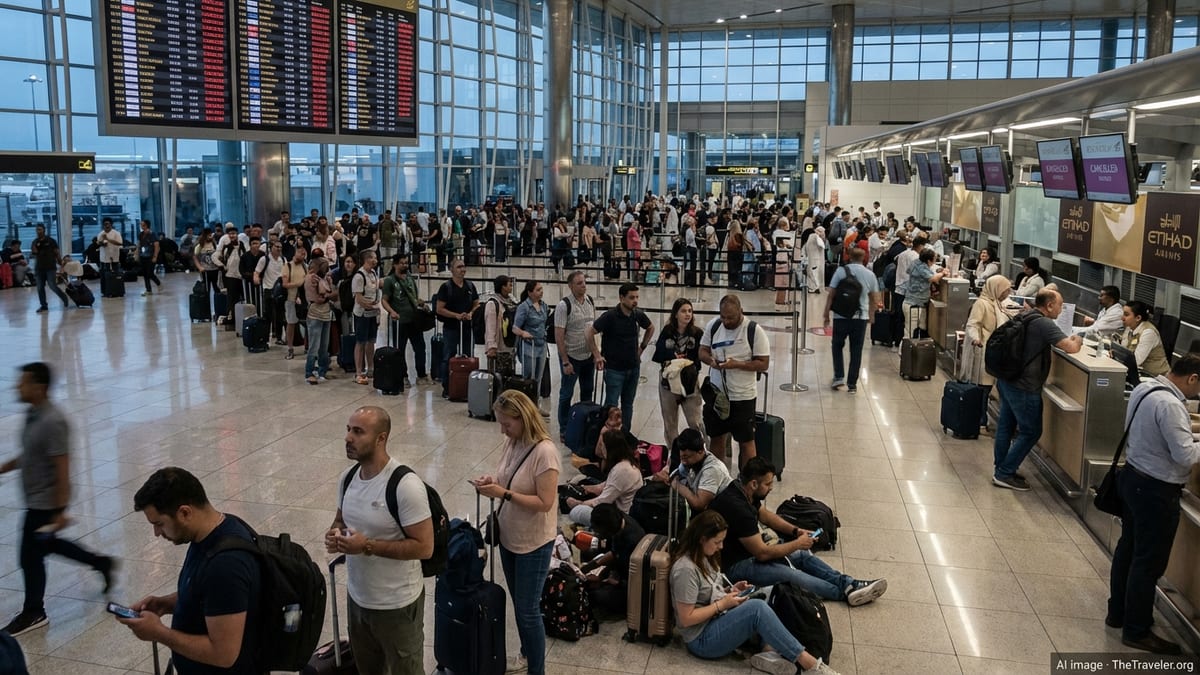
For passengers, the renewed volatility is most visible in the form of short-notice schedule changes, missed connections and extended journey times. During previous peak periods of the conflict, more than four thousand flights per day across multiple Gulf states were reported cancelled or diverted, leaving hundreds of thousands of travelers stranded and forcing airlines to mount large-scale rebooking operations.
Travel forums and airport information boards in Dubai, Abu Dhabi and Doha now show a familiar pattern of rolling delays and rerouted services, particularly on itineraries that would normally overfly or depart near the Strait of Hormuz. In some cases, aircraft are making prolonged detours over the Arabian Sea or northern routes that bypass high-risk zones, adding hours to long-haul trips.
Specialists in corporate travel and risk management advise that the situation can change quickly depending on the trajectory of cross-border strikes and any new restrictions announced by Gulf states. They recommend that passengers holding tickets to or through the UAE, Oman, Qatar, Bahrain or Kuwait monitor airline notifications closely, allow for generous connection times and prepare for the possibility of overnight stays if onward legs are disrupted.
While no major Gulf hub has yet announced a complete shutdown of civilian airspace in response to the latest strikes, the combination of Iranian attacks, US counterstrikes and uncertainty around the Strait of Hormuz means that the region remains one of the most unstable for aviation anywhere in the world, with Dubai, Doha and Muscat once again on the front line of global travel disruption.