


More news on this day
Fresh Iranian missile and drone strikes on Bahrain, the United Arab Emirates, Qatar and Kuwait are unleashing a new wave of airspace closures, mass flight disruptions and airport emergencies across the Gulf, reviving the specter of a prolonged Middle East travel crisis just as the region’s aviation sector was struggling to stabilize.
Get the latest news straight to your inbox!
Bahrain Tightens Airspace as Missile Sirens Trigger Flight Chaos
Bahrain has moved rapidly to align its airspace posture with neighboring Gulf states after a new round of Iranian missile launches targeted US-linked sites and critical infrastructure in the kingdom and beyond. Reports indicate that missile warning sirens sounded across parts of Bahrain as air defense systems engaged incoming threats, prompting immediate restrictions on overflight and diversions of civilian traffic.
Publicly available information shows that Bahrain, which hosts the US Navy’s Fifth Fleet, has activated emergency aviation procedures similar to those seen in the first days of the 2026 Iran war. Commercial tracking data and airline updates point to holding patterns, rerouted long haul services and a growing list of cancellations into and out of Bahrain International Airport as carriers avoid high-risk corridors above the central Gulf.
Aviation analysts say Bahrain’s latest measures mirror earlier crisis responses in which the kingdom temporarily curtailed arrivals and departures during major security incidents. While authorities have sought to keep at least limited connectivity open via tightly controlled corridors, industry briefings suggest that most nonessential flights are being postponed or consolidated, adding fresh uncertainty for transit passengers who rely on Bahrain as a niche regional hub.
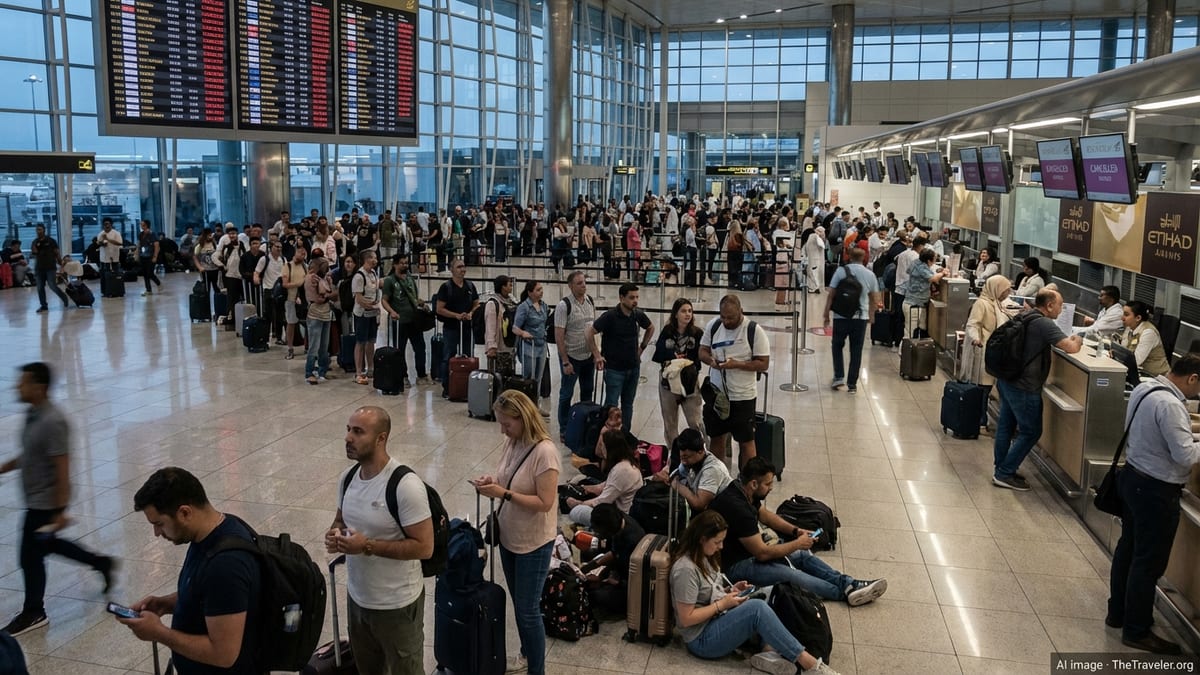
For travelers already on the ground, airport operations have reportedly shifted into contingency mode, with extended check in times, additional screening and rolling gate changes as airlines race to refile flight plans around the evolving threat picture. Travel management companies are advising passengers bound for Bahrain to prepare for last minute schedule shifts or rebook via alternative hubs where possible.
UAE, Qatar and Kuwait Move in Lockstep as Regional Skies Narrow
The United Arab Emirates, Qatar and Kuwait have effectively joined Bahrain in a coordinated tightening of Gulf airspace after Iran’s latest salvo, creating a dense belt of restrictions from the Strait of Hormuz to the northern Gulf. According to recent regional coverage, the UAE reported active interception of Iranian missiles and drones, while Qatar and Bahrain issued shelter warnings and Kuwait continued to report previous attacks on airport and logistics facilities.
This alignment has sharply narrowed safe routing options for airlines operating between Europe, Asia and Africa. Industry notices and operational bulletins indicate that multiple carriers are now skirting the Gulf entirely, tracking further west over Saudi Arabia, the Red Sea and Egypt or diverting north via Turkey and the Caucasus to avoid the most volatile segments of Gulf and Iranian airspace.
Qatar, home to one of the world’s busiest global transfer hubs in Doha, has been forced into a balancing act between maintaining its long haul network and safeguarding passengers from the risk of missile overflight. Past disruptions earlier in the 2026 conflict saw temporary halts to flights serving key Gulf neighbors and selective closure of arrival and departure windows, a pattern travel observers say is likely to reemerge as the latest barrage plays out.
In Kuwait, where earlier drone and missile incidents targeted Kuwait International Airport and adjacent fuel infrastructure, publicly available information shows that partial operational status has become the new normal. Schedules have been trimmed, night operations are periodically curtailed, and many international airlines are still operating with restrictions or have suspended services entirely on short notice.
Airlines Scramble With Diversions, Cancellations and Emergency Procedures
For airlines, the renewed crisis has immediately translated into a wave of diversions, cancellations and complex re-routing efforts. Flight tracking data on Sunday showed long haul services that would normally traverse the central Gulf instead making wide detours, adding hours to journey times and triggering knock on delays at downstream hubs in Europe and Asia.
According to published aviation briefings, some carriers had already shifted capacity away from Iran and parts of the Gulf in recent months, keeping contingency plans ready after earlier barrages on Bahrain, Kuwait and Qatar. The latest strikes have accelerated those plans. Several European and Asian airlines are now reportedly suspending direct services to the most affected Gulf airports or consolidating frequencies into a smaller number of daylight flights judged to carry lower risk.
Inside Gulf terminals, emergency procedures are again reshaping the passenger experience. Airport alerts, temporary evacuations of specific zones and the use of hardened shelters have been reported in previous waves of the conflict, and current local media coverage suggests that similar protective measures are being reintroduced as sirens sound and interceptions take place overhead. In parallel, ground handling operations are slowing as staff observe safety pauses whenever incoming threats are detected.
Travel insurers and corporate risk teams are responding by updating their security advisories, with many now categorizing nonessential travel to Bahrain, parts of the UAE, Qatar and Kuwait as high risk. Business travelers are being offered remote alternatives or rerouting via more distant hubs such as Muscat, Riyadh or Jeddah when itineraries cannot be postponed.
Ripple Effects Across Global Routes and Travel Confidence
The turbulence above the Gulf is rapidly radiating out across global networks. The Gulf corridor sits at the heart of many of the world’s most heavily trafficked long haul routes, linking Europe and North America to South and Southeast Asia, Australasia and East Africa. With airspace segments over Iran, Bahrain, Qatar, Kuwait and at times neighboring states subject to rolling restrictions, airlines have few efficient alternatives.
Operational data shared in logistics and humanitarian aviation snapshots earlier this year already pointed to severely constrained capacity for cargo and passenger flows through the wider Middle East. The latest Iranian strikes threaten to push those constraints further, with longer routings consuming more fuel, reducing payloads and elevating ticket prices on key city pairs. For time sensitive cargo, from medical supplies to high value electronics, transit times through traditional Gulf gateways are lengthening once again.
For leisure travelers, the perception of the Gulf as a stable stopover and destination region is under renewed pressure. After years of marketing investment to build the appeal of city breaks in Dubai, Doha, Manama and Kuwait City, travel brands now face a communications challenge as images of missile interceptions, sheltering passengers and darkened runways reverberate across social media and international news.
Tour operators selling winter sun packages and cruise add ons tied to Gulf airports are already reassessing their risk exposure. Trade bulletins suggest that some are quietly shifting capacity to alternative hubs in the eastern Mediterranean and Red Sea, while others are maintaining programs but adding more flexible booking terms to reassure hesitant customers.
A Prolonged Middle East Travel Crisis Back on the Horizon
Even before the latest exchange of fire, regional studies had described a Middle East travel and logistics system operating in a state of chronic disruption since the outbreak of the 2026 Iran war. Repeated closures of Iranian and neighboring airspace, along with missile incidents around major airports and shipping lanes, had stranded hundreds of thousands of travelers at various points over the past months.
The newest Iranian strikes on Bahrain, the UAE, Qatar and Kuwait risk hardening that pattern into a prolonged structural crisis. Each fresh escalation prompts airlines to revisit risk assessments, reduce overflight, and pull back capacity, incrementally eroding the dense web of connections that turned the Gulf into a global crossroads over the past two decades.
Industry observers note that the resilience of Gulf aviation has limits. While the region’s carriers and airports have shown an ability to restart quickly after individual attacks, the cumulative effect of sustained missile threats, intersecting airspace bans and uncertainty over the status of the Strait of Hormuz is beginning to reshape network planning decisions for the longer term.
For now, travelers with upcoming itineraries through Bahrain, the UAE, Qatar or Kuwait are being urged in public advisories to monitor airline communications closely, build in additional transit time, and remain prepared for abrupt changes in routing. With no clear off ramp to the confrontation between Iran and its rivals, the Middle East’s role as a predictable bridge between continents is once again in question.