


The wide curve of Baie des Anges is the first thing many travelers see as their plane descends into Nice. The turquoise water, lined by palm trees and the famous Promenade des Anglais, is one of the Riviera’s most photographed vistas. But is this long, pebbly bay actually worth your time once you are on the ground in Nice, or should you save your precious beach days for sandy coves elsewhere on the Côte d’Azur? The answer depends on what kind of traveler you are, how long you are staying, and what you expect from a Mediterranean beach.
Get the latest updates straight to your inbox!
What Exactly Is Baie des Anges?
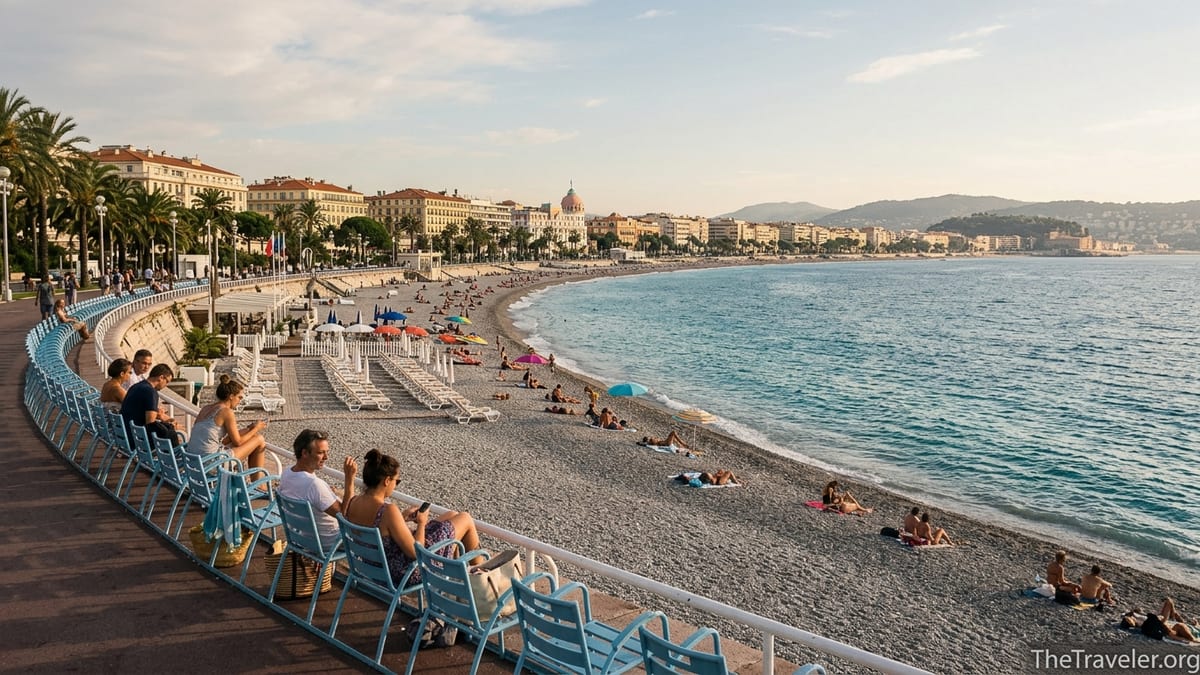
Baie des Anges is the large, natural bay that curves between Nice and Antibes on the French Riviera. In practice, when visitors talk about it, they usually mean the urban shoreline that runs in front of Nice itself, from the airport in the west to the foot of Colline du Château near the Old Town in the east. This is where the Promenade des Anglais stretches for around seven kilometers, framed by Belle Époque hotels like the Negresco and long rows of public and private beach clubs.
Unlike the sandy beaches many travelers imagine when they picture the Mediterranean, Nice’s stretch of Baie des Anges is made up almost entirely of smooth, grey pebbles. Those pebbles give the water its striking depth of color and help keep the sea very clear on calm days, but they also change how you experience the shore. You will not be building sandcastles here, and you will want proper beach shoes if you have sensitive feet.
The bay is intensely urban. Behind you are multi-lane traffic, buses, and tram connections; in front is open sea, with cruise ships and ferries often visible further offshore. This is not a secluded cove, but a lively city beach that feels integrated into everyday life in Nice. Locals jog before work, office staff eat takeaway salads on the pebbles at lunch, and in summer the after-work swim is almost a ritual.
Because the airport sits directly at the western end of the bay, planes often pass relatively low on approach, especially near the Phoenix Park and Nice Arenas district. Many travelers find this contrast between turquoise water and aircraft surprisingly dramatic and photogenic; others see it as a reminder they are on a busy stretch of coast rather than a remote hideaway.
The Pros: Why Baie des Anges Is Worth a Stop
For many visitors, the greatest strength of Baie des Anges is simple convenience. You can land at Nice Côte d’Azur Airport, hop on tram line 2, and be stepping onto the pebbles near Magnan or Jean Médecin in roughly 30 to 40 minutes for the price of a regular city ticket, rather than paying for a taxi. The beach is literally across the road from a dense grid of hotels, apartments, and restaurants, so you can go from your bed to the sea in minutes.
The setting is undeniably beautiful, especially in the early morning and golden hour. On a clear day the arc of the bay, backed by soft hills and the pastel buildings of Nice, looks almost painted. Even travelers who decide not to swim often spend an evening strolling the Promenade des Anglais with an ice cream from a local gelateria, stopping at the classic blue chairs to watch the light fade over the water.
Baie des Anges also works very well for travelers who want a beach day without giving up urban comforts. Private beach clubs along the Promenade des Anglais rent loungers and parasols by the half or full day, often including towel service and showers. Prices vary widely depending on the section of the bay and the month, but as a rough guide a sunbed and umbrella in high season can run from around 25 to 40 euros per person at central clubs, sometimes a little less if you go closer to the airport where demand is lower. That may feel steep, yet many visitors consider it fair value for a comfortable mattress over pebbles, waiter service to your chair, and direct access to the sea.
Finally, Baie des Anges can be a very social place. On a July afternoon you are likely to hear French, Italian, German, and English within a few meters. Groups of friends bring portable speakers and picnic coolers to the public beaches, while families gather around the shallow entry zones supervised by lifeguards in high season. If you enjoy people-watching and a sense of being in the middle of things, this bay offers that in abundance.
The Cons: What Baie des Anges Does Not Offer
Despite its postcard looks, Baie des Anges is not the right beach for everyone. The first surprise for many is the pebble shoreline. Even though the stones are mostly smooth, they can be uncomfortable to walk on, particularly where the shore slopes steeply toward the water. Without sturdy water shoes or sandals, getting in and out of the sea can be awkward, especially for families with young children or travelers with mobility issues.
The urban setting is another drawback if you are seeking tranquility. Traffic on the coastal road runs almost constantly, and although there are pedestrian crossings and separated promenades, you will never be far from the sound of engines, sirens, and buses. In summer, packed beach clubs and clusters of sunbathers mean that space and quiet are hard to find near the central sections around the Negresco and Opéra.
Water quality in Baie des Anges is generally monitored closely in summer, and on clear days the sea looks inviting. After heavy storms, however, runoff from the surrounding area and the Paillon river can cloud the water and temporarily reduce clarity. Locals often mention that they avoid swimming for a day or two after big downpours and keep an eye on posted flags indicating conditions along the Promenade. If your schedule is tight and you happen to arrive just after a serious storm, that can be a disappointment.
Lastly, travelers imagining gently shelving sand may find the entry into the water unexpectedly deep. The pebbly seabed drops off more quickly than on many sandy beaches, which means that within a few steps you may no longer be able to stand. Confident swimmers usually appreciate this, but nervous bathers or small children may be more comfortable elsewhere on the Riviera, where shallow, sandy floors such as those at Plage de la Gravette or Plage du Ponteil in Antibes are easier to manage.
Swimming, Safety, and Seasonal Realities
When conditions are good, swimming in Baie des Anges can be a pleasure. In summer, yellow buoys mark the zones reserved for bathers, keeping small boats and jet skis at a distance. Lifeguard stations appear on the main public sections from roughly June to September, and most beaches have at least two free outdoor showers and drinking water taps, which are very welcome after a salty dip.
Water temperature depends heavily on the month. By late May and June, many visitors find the sea comfortable for short swims, and by July and August it is usually warm enough for long, lazy sessions with only a light chill when you first enter. Strong swimmers and local open-water groups often continue to swim well into October, especially on calm, sunny days, though most casual visitors prefer the height of summer.
Pay attention to the flags posted along the beach. Green indicates normal conditions, orange typically means caution due to waves or currents, and red means swimming is officially forbidden. When the wind blows onshore, waves can break sharply on the steep pebble slope, making entry and exit much more physical. On such days it is common to see less experienced swimmers simply sit on the shore and enjoy the spectacle rather than attempt a dip.
Families should also be aware that beach services change by season. In August you can expect full lifeguard coverage on main sections, clearly marked supervised zones, rental pedal boats at some private clubs, and late-opening kiosks selling drinks and snacks. In April or early November, by contrast, there may be no supervision at all, beach clubs may be closed or under renovation, and the Promenade will feel more like an open-air gym and dog-walking route than a resort front. If your main goal is sunbathing with amenities, time your trip between roughly June and late September.
Access, Transport, and Where to Base Yourself
One of the reasons Baie des Anges remains so popular is that it is extremely easy to reach. Tram line 2 runs from Nice Côte d’Azur Airport along the bay and into the city, with stops such as Grand Arénas, Magnan, Alsace-Lorraine, and Jean Médecin giving quick access to different sections. From Jean Médecin, a ten-minute walk takes you to Place Masséna and the eastern end of the Promenade des Anglais, close to the Old Town beaches and the base of Colline du Château.
If you are staying directly on the Promenade, you might find that you almost never need public transport. Many mid-range and upscale hotels line the seafront between roughly Carras and the Negresco. You can step out of properties like the Mercure Nice Promenade des Anglais or the Radisson Blu further west and be on the beach in less than two minutes. This is ideal for early-morning swimmers or travelers who like to dip in and out between other activities.
Travelers on a tighter budget often look a block or two inland, where neighborhoods such as Carré d’Or and the streets around Avenue Jean Médecin offer more modest hotels and short-term rentals while still keeping the bay within easy walking distance. In these areas you might pay significantly less per night compared with a full sea-view room, but you will still be able to reach the pebbles with a five- to ten-minute stroll.
If Baie des Anges will be just one part of a wider Riviera itinerary, the transport connections from Nice make day trips simple. From Nice-Ville train station, a short walk inland from the bay, frequent regional trains run west to Antibes, Cannes, and Théoule-sur-Mer, and east to Villefranche-sur-Mer, Beaulieu, and Menton. This means you can spend one day swimming off the Promenade des Anglais and the next on a sandy cove below the old ramparts of Antibes without changing your base.
Comparing Baie des Anges With Nearby Alternatives
To decide whether Baie des Anges is worth visiting, it helps to compare it with other realistic options along the coast. If you want soft sand and gentle entry into the water, destinations like Antibes and Juan-les-Pins, less than 30 minutes away by train, may suit you better. At Plage de la Gravette in Antibes, for example, a small sandy bay enclosed by old fort walls creates a sheltered environment that is especially friendly to families and less confident swimmers.
For travelers seeking more rugged scenery and snorkeling, the shore east of Nice towards Villefranche-sur-Mer and Cap de Nice often wins out. Small coves like Coco Beach offer rocky platforms and ladders into deep, clear water, with views back over Baie des Anges and the port. These spots lack the continuous promenade and broad sweep of pebbles, but make up for it with a wilder feel and, often, slightly fewer crowds outside peak weekends.
If nightlife and a certain glamour are priorities, then Cannes, with its famous Croisette and beach clubs, or Saint-Tropez further west might hold more appeal. Those resorts pair sandy strands with designer boutiques, high-end dining, and a more overtly luxurious atmosphere. In this context, Nice and its Baie des Anges feel more like a working city that happens to have a major beach than a resort that happens to have a town.
The key is that Baie des Anges is almost impossible to avoid if you are in Nice for more than a few hours. Even travelers who spend most of their time in Old Nice, on day trips to hill towns, or in museums like the Matisse and Chagall often end up on the Promenade at least once, if only to watch the sunset. You may ultimately prefer the sand elsewhere, but the bay’s role as the backdrop to the city makes at least a visit hard to skip.
How to Make the Most of Baie des Anges
If you decide Baie des Anges deserves a place on your Nice itinerary, a bit of planning will help you enjoy it more. Start by choosing your section. The stretch around the Old Town and the Negresco is the most atmospheric, with easy access to cafes, gelato shops, and photo spots, but it is also the busiest and priciest for beach clubs. Head further west, towards Magnan, Lenval, and Carras, and you will usually find a little more space and slightly lower prices for loungers and drinks, at the cost of a longer walk back to the Old Town.
Think about timing. Locals often hit the water early in the morning before work, when the light is soft and the Promenade is filled with joggers and cyclists rather than beach crowds. Late afternoon into sunset, especially from roughly 5 pm onward in summer, is also magical; the heat has eased, the sea is still warm, and the hills behind Nice glow as the sun drops. Midday hours in July and August can be extremely hot, and shade is limited on the public sections unless you bring your own umbrella.
Because the pebbles can be hard on your body, consider packing or buying a foam mat or folding beach pad if you plan multiple days on the bay. Beach shoes are a worthwhile purchase, especially for anyone with knee or ankle issues. They are sold in supermarkets and beachfront kiosks throughout Nice for roughly the cost of a simple lunch and make every swim more comfortable.
Finally, remember that you do not have to build your entire day around the beach. One realistic pattern many travelers adopt is to spend the morning exploring the Old Town, markets, or museums, then return to the bay around 4 pm for a swim and a couple of hours of relaxation, followed by dinner in town. This way Baie des Anges becomes a refreshing interlude rather than the sole focus of your day.
The Takeaway
So, is Baie des Anges worth visiting during a trip to Nice? For most travelers, the answer is yes, provided you understand what it is and what it is not. It is an iconic urban bay with pebbly beaches, a lively promenade, and superb convenience, not a secluded strip of soft sand. If you value easy access from your hotel, dramatic sea views, and the ability to combine a swim with city sightseeing, it is an essential part of the Nice experience.
On the other hand, if your ideal beach day means warm, shallow sand underfoot, silence except for waves, and space to spread out, you may want to treat Baie des Anges as a scenic backdrop and save your extended lounging for nearby sandy alternatives like Antibes, Juan-les-Pins, or sheltered coves further along the coast.
In practical terms, most visitors will at least stroll the Promenade des Anglais, sit on the famous blue chairs, and dip their feet in the water. Whether you choose to spend a full day here or just an hour at sunset, Baie des Anges frames the city of Nice in a way no photograph fully captures. Experiencing it for yourself, even briefly, helps anchor the rest of your Riviera journey in a very real sense of place.
FAQ
Q1. Is Baie des Anges suitable for families with small children?
Baie des Anges can work for families, but the steep pebble slope and quicker drop-off mean it is less child-friendly than nearby sandy beaches such as those in Antibes. Many parents choose to let young kids paddle near the shore here, then plan at least one day trip to a gentler sandy bay.
Q2. Are the beaches along Baie des Anges free to use?
Yes, all of the public sections are free and open to everyone. You pay only if you choose to rent a lounger, umbrella, or services at a private beach club. Staying on the public part of the pebbles costs nothing beyond what you spend on food and drinks.
Q3. Do I need to reserve a spot at a private beach club in advance?
In peak season, especially on weekends and during major events, reservations are strongly recommended at popular beach clubs along the Promenade des Anglais. Outside the busiest weeks of July and August, you can often walk in earlier in the day and still find a lounger, particularly on the western stretches of the bay.
Q4. What should I bring for a comfortable day on Baie des Anges?
Beach shoes or sturdy sandals, a mat or towel thick enough for pebbles, high-SPF sunscreen, a hat, and plenty of water are the basics. If you plan to stay on the public beach for several hours, a compact umbrella or sunshade is very useful, as natural shade is scarce.
Q5. How clean is the water for swimming?
Water quality is generally monitored closely in summer and is usually good on calm, dry days. After heavy rain, runoff can cloud the water temporarily, and some locals prefer to wait a day or two before swimming again. Always check the flags and local notices along the Promenade.
Q6. When is the best time of year to enjoy Baie des Anges?
For warm sea temperatures and full beach services, aim for June through September. May and October can still offer beautiful days with fewer crowds, though the water is cooler and some clubs operate shorter hours or close entirely outside high summer.
Q7. Is Baie des Anges noisy because of traffic and planes?
There is consistent background noise from the coastal road, and near the airport you will see and hear planes taking off and landing. Closer to the Old Town, the aircraft noise is less noticeable, but Baie des Anges remains an urban bay rather than a silent, remote cove.
Q8. Can I visit other beaches easily from Baie des Anges?
Yes. From Nice-Ville train station, a short walk from the bay, regional trains connect quickly to Antibes, Cannes, Villefranche-sur-Mer, and other coastal towns. This makes it easy to combine a stay in Nice with day trips to sandy or more secluded beaches along the Riviera.
Q9. Are there showers and toilets on the beach?
Most main public sections of Baie des Anges have free outdoor showers and drinking water taps. Public toilets are more limited, but you will find facilities at certain points along the Promenade and in nearby cafes and restaurants, especially near the Old Town and central areas.
Q10. Is it worth staying in a hotel directly on Baie des Anges?
If sea views, easy access to the Promenade, and frequent swims are priorities, a seafront hotel can be very rewarding despite higher prices. Travelers focused more on exploring the wider region or watching their budget often stay a few blocks inland, where rates are lower yet the bay remains only a short walk away.