


Two curves of coastline, only a few minutes apart by train, offer two very different visions of the French Riviera. To the west, Nice’s Baie des Anges stretches wide and urban, lined with palm trees, traffic, grand hotels and pebble beaches packed with sunbeds. To the east, the bay of Villefranche-sur-Mer folds in on itself, a deep natural harbor cradling pastel houses and remarkably clear water. Both are beautiful, both are iconic, and both can fit into the same trip. The question is: which one leaves a deeper imprint on your memory?
Get the latest updates straight to your inbox!
Getting Oriented: Two Bays, One Coastline
Baie des Anges is the sweeping bay that frames the city of Nice, the unofficial capital of the Côte d’Azur. It runs roughly from the airport all the way around to the port area, with the famous Promenade des Anglais tracing its inner curve. Stand by the blue chairs on the promenade and you see the essence of the Riviera in a single frame: steel-blue water, a busy seafront road, Belle Époque facades, joggers, cyclists and planes lifting off from the airport at the western end.
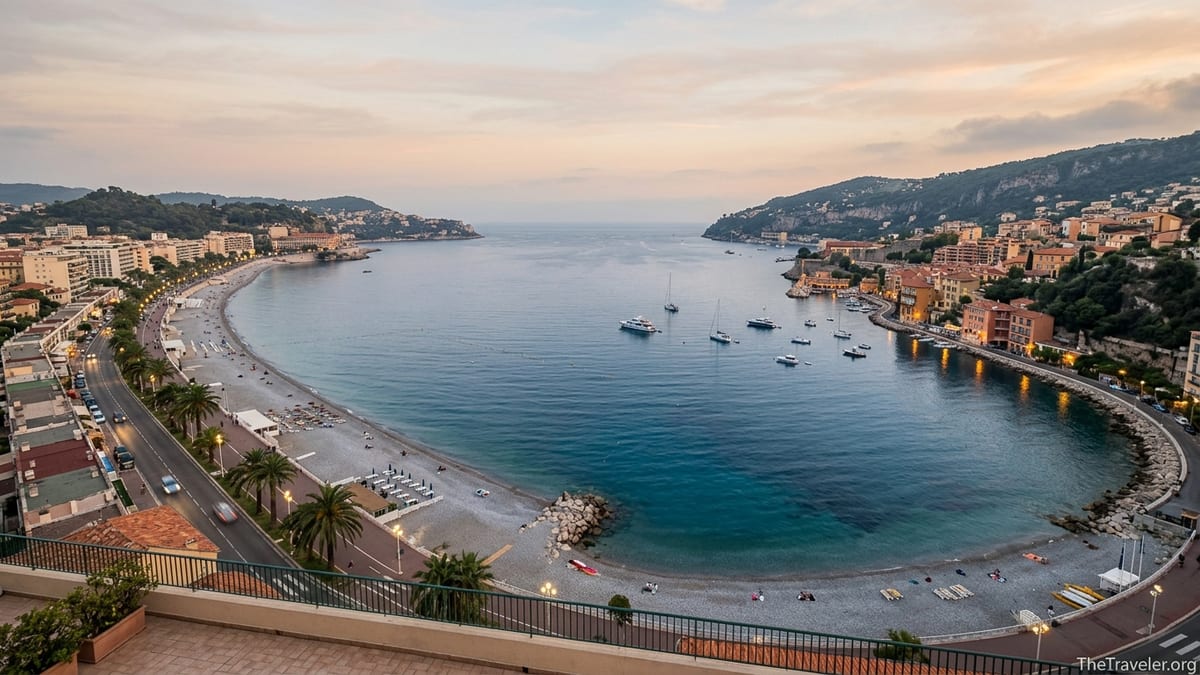
Villefranche Bay, sometimes called the rade de Villefranche, lies just a few kilometers east, beyond Mont Boron and Cap de Nice. It is one of the deepest natural harbors in the Mediterranean, which is why cruise ships often anchor here rather than in Nice itself. The old town climbs steeply from the quayside, its orange and ocher houses mirrored in water that is often strikingly clear and calm compared with the more exposed Baie des Anges.
In practice, the two are incredibly close. Trains from Nice to Villefranche-sur-Mer run frequently and take about 5 to 10 minutes, with tickets typically costing only a few euros. That makes it easy to stay in one base and get to know both bays, even in a short stay. Knowing what each delivers helps you decide which will be your “home” and which is better as a day trip.
Think of Baie des Anges as the big-city seafront, with everything that implies: energy, convenience, nightlife and crowds. Villefranche’s bay is more like a natural amphitheater: smaller scale, more intimate, and visually dramatic, particularly in late afternoon when the light softens on the village facades.
First Impressions: Skyline vs Amphitheater
Arriving in Nice, your first encounter with Baie des Anges is often from the airport tram or a taxi that sweeps right along the water. You see a wide ribbon of grey-blue pebbles, a constant line of people moving along the promenade, and a succession of hotels and apartment blocks facing the sea. The skyline is relatively low-rise but continuous, so your eye reads the bay more as an urban frontage than as a wild landscape.
Walk from the Jardin Albert 1er area toward the iconic Hotel Negresco and you feel how human the scale is: cyclists glide along the dedicated lane, families pause at playgrounds on the beach, and locals sit on the trademark blue chairs facing the sea. The impression is sociable and active. This is a bay that belongs to a city, and you are rarely unaware of cars, buses and the occasional siren passing just behind you.
Villefranche’s bay reveals itself differently. Many travelers step off the train at Villefranche-sur-Mer station and are met with an immediate panorama: the rails curve above the water and a path runs down to Plage des Marinières, the main beach. Across the bay, the houses of the old town cascade down to the harbor, with the headland of Cap Ferrat framing the opposite side. Megayachts and cruise tenders often dot the deep center of the bay, underlining its almost fjord-like depth.
Viewed from the water, perhaps on a paddleboard or rented kayak, Villefranche looks like a natural amphitheater of hills and pastel buildings cupping a pool of sheltered water. The impression here is of intimacy and depth rather than width and scale. Many visitors describe the moment they round the corner on the coastal path from Nice and see Villefranche spread out below as one of their “wow” memories of the Riviera.
Beach Experience: Pebbles or Soft Sand Underfoot
Baie des Anges is almost entirely pebble, and that shapes everything from how you walk into the sea to what kind of beach gear you might rent. Locals and repeat visitors quickly learn to bring sturdy sandals or water shoes, because the smooth grey galets can be slippery and unforgiving on bare feet, especially where the slope into the water is steep. On the upside, the pebbles keep the water very clear and the beaches relatively clean, with less sand tracked into hotels and apartments.
Along the Nice seafront you find a mix of public stretches and private beach clubs. At a private spot such as one near the Negresco area, you can expect to pay roughly 25 to 45 euros per day in high season for a sunbed and umbrella, sometimes more for front-row positions. That typically includes access to showers, loungers, and waiter service for drinks and food. Budget-conscious travelers can simply drop a towel on the public parts for free, though shade is limited and space can be tight on peak summer afternoons.
In Villefranche Bay, the main beach at Plage des Marinières curves gently around the inner shoreline. Here the surface is a mix of soft sand and small pebbles, much easier on bare feet and more forgiving for children. The bay is well protected by the surrounding headlands, so the water is usually calmer and often slightly warmer than on the more exposed Baie des Anges. This, combined with the shallow entry in many sections, makes it a favorite with families who want kids to splash safely near the shore.
Beach facilities in Villefranche are more low-key but still practical. There are seasonal snack kiosks, simple restaurants facing the water, and limited but affordable rentals of sunbeds in summer. Travelers often comment that they spend less here on a beach day than in Nice, simply because there are fewer high-end clubs and temptations. For some, the laid-back, almost village-style beach atmosphere is the most appealing part of Villefranche; for others who enjoy the buzz and variety of a big-city seafront, Baie des Anges will feel more stimulating.
Atmosphere & Aesthetics: City Energy vs Harbor Charm
Atmosphere is perhaps where the two bays diverge most clearly. Baie des Anges is busy from morning to late evening, especially between late spring and early autumn. Joggers and cyclists are out at sunrise, office workers cross the promenade on their commute, and by mid-morning, cruise excursion groups mingle with independent travelers snapping photos of the curve of the bay from the I Love Nice sign area. The soundscape blends waves with traffic, conversation and bus engines. Even at sunset, when the light turns the sea silver and pink, the promenade remains lively with street musicians and couples heading to dinner.
Visually, Baie des Anges offers long horizontal lines. From many points on the promenade, the horizon is a clean stroke of blue, with the airport, hills and distant Antibes anchoring the far end. At night, the city lights reflect in the water and the palm-lined boulevard glows softly. It is undoubtedly beautiful, but in an urban way: photographs often capture more people, architecture and infrastructure than pure landscape.
Villefranche’s bay feels quieter even on busy days. The old town’s lanes are narrow and stepped, with laundry sometimes hanging from wrought-iron balconies and cats sunning themselves on stoops. Down at the waterfront, the arcaded Rue Obscure and the small quayside restaurants form the human scale edge to a bay that is otherwise dominated by water and sky. Evening here brings a calmer mood: fishing boats rock gently at their moorings, lights from houses on the hills speckle the slopes, and the faint sound of cutlery and conversation drifts from terrace restaurants lining the harbor.
In photographs, Villefranche tends to read as a postcard: colorful houses reflected in deeply blue water, with Cap Ferrat rising green and rocky beyond. Because of the bay’s depth and shelter, the water often has a pronounced clarity; many visitors remark that they can see shoals of fish just meters from the shore. The overall effect is less of a big seafront boulevard and more of a pocket harbor village that happens to be embedded within some of the most valuable coastal real estate in Europe.
Accessibility & Practicalities: Where It Is Easier to Stay and Move Around
From a logistics standpoint, Baie des Anges is significantly more convenient for most travelers. Nice hosts the main international airport of the region, and the tram line from the terminal drops you close to the seafront within about 25 to 30 minutes. Many hotels and apartments along or just behind the promenade are easy to reach even with luggage, and taxi rides between the airport and central seafront hotels tend to be straightforward, if not particularly cheap in peak season.
Staying along Baie des Anges also puts you right on top of Nice’s public transport web. Buses and trams connect the seafront to the old town, train station and outlying neighborhoods, while regional trains from Nice-Ville station run along the coast to Antibes, Cannes, Monaco and Menton. This makes Baie des Anges an excellent base for exploring the wider Riviera using trains and buses instead of a car, something many travelers now favor to avoid congestion and parking costs.
Villefranche-sur-Mer, though smaller, is surprisingly accessible. The regional train between Nice and Villefranche usually takes less than 10 minutes and runs frequently throughout the day. A single ticket often costs under 5 euros, making it easy to commute between a hotel in Nice and a beach day in Villefranche, or vice versa. There is also a coastal bus route and even a scenic coastal walking path for those who enjoy long walks with sea views.
What Villefranche lacks in big-city infrastructure it makes up for in compactness. Once you step off the train or tender boat, everything important is within walking distance: beaches, the old town, small supermarkets, casual cafes and a handful of higher-end restaurants. The trade-off is choice. Nice’s Baie des Anges offers countless hotel categories, from budget chains set back a few blocks to icons like the Negresco on the promenade itself. Villefranche’s accommodation scene is more about small hotels, guesthouses and hillside rental apartments, some with spectacular terraces over the bay but fewer services than the large Nice hotels.
Activities & Experiences: What You Actually Do By Each Bay
On Baie des Anges, the experience revolves as much around the city as the sea. A typical day might include a morning swim at a public beach followed by a coffee in the old town, an afternoon visiting the Museum of Modern and Contemporary Art or wandering the market at Cours Saleya, and then an early evening stroll along the promenade before dinner. The seafront is also popular with runners and cyclists, and many visitors rent e-bikes or scooters to cover more of the bay quickly.
Water sports are present but somewhat secondary in Nice compared with more resort-focused towns. In season you can rent paddleboards, kayaks or jet skis from various operations along the bay, or join parasailing and boat excursions that depart from the port. Prices vary, but a short paddleboard rental might cost the equivalent of 20 to 25 euros, while a half-day boat trip along the coast could be upwards of 60 to 80 euros per person depending on the operator and inclusions.
Villefranche’s bay is more overtly about the water. The deep, protected harbor attracts yachts and cruise ships, which in turn support a network of boat tenders, kayaking, snorkeling and small-boat rentals. Many visitors spend long, lazy days rotating between swimming off Plage des Marinières, stopping for a simple lunch of socca or salade niçoise at a beachside cafe, then renting a paddleboard to hug the coastline towards Cap Ferrat. The clear water and boat traffic give the bay a quietly active feel.
Thanks to the depth of the bay, diving schools and snorkeling excursions also operate here, exploring underwater walls and the famous canyon that drops off not far offshore. Even if you never don a mask, simply watching the play of boats coming and going can be hypnotic, especially from a hillside terrace with a glass of local rosé. The town itself adds interest with cultural stops like the 16th-century citadel and the small but atmospheric Chapelle Saint-Pierre, decorated by Jean Cocteau.
Costs, Crowds & Seasonality: When Each Bay Shines
In summer, both Baie des Anges and Villefranche Bay draw substantial crowds, but the feel of those crowds differs. Nice absorbs visitors into a larger urban context. That can mean very full beaches near the center, long lines at ice cream stands and heavy traffic on the seafront road, but it also means you can usually find a table or a patch of beach somewhere if you are flexible and willing to walk a bit.
Villefranche, by contrast, can feel overwhelmed on days when large cruise ships anchor in the bay. Narrow streets and a small waterfront concentrate people, so a single morning’s worth of tender boats can dramatically change the mood from quiet village to bustling port. The beaches fill quickly, and restaurants along the quay may be fully booked for lunch. On such days, seasoned visitors either arrive early, retreat to the farther edges of Plage des Marinières, or time their visit for late afternoon when many cruise passengers have departed.
In terms of costs, Nice’s Baie des Anges offers both higher highs and lower lows. You can indulge in a beachfront room at a luxury hotel and dine at sophisticated seafront restaurants, or you can stay a few blocks inland in a simpler apartment and eat at neighborhood bistros where a set lunch remains relatively affordable. Villefranche’s dining scene leans toward mid-range, often with a “view premium” built in. A main course at a harborfront restaurant may cost a little more than in a non-touristy Nice neighborhood, but you are paying partly for the bay under your nose.
Shoulder seasons such as late April to early June and September to early October often show each bay at its best. In these months, water temperatures are usually pleasant, crowds are thinner, and prices for accommodation in both Nice and Villefranche can be noticeably lower than in July and August. In winter, Baie des Anges still offers promenade life, markets and city culture even when sea swimming is less appealing, while Villefranche’s bay becomes a quiet, photogenic backdrop for misty mornings and empty quays.
The Takeaway
So which Riviera coast leaves the bigger impression, Baie des Anges or Villefranche Bay? The answer depends largely on the kind of images and sensations you want to carry home. If your ideal memory is of an elegant city seafront, lined with Belle Époque facades, animated at all hours and seamlessly connected to museums, markets and nightlife, then Baie des Anges in Nice is likely to become your Riviera reference point. You may remember the long sunset walks, the sound of rollerblades on pavement, and the sight of planes rising over the curve of the bay.
If, instead, you picture yourself wading into unusually calm, clear water from a sheltered beach, looking back at a village clinging to steep hillsides while yachts swing quietly at anchor, Villefranche’s bay will probably come to mind first when you think of the Côte d’Azur. Its compact scale and amphitheater setting create a sense of arriving in a natural harbor that feels separate from, yet intimately close to, the urban bustle of Nice.
For most travelers, the ideal solution is not choosing one over the other but using their contrast to enrich a single trip. Base yourself in Nice along Baie des Anges for convenience, then spend long afternoons or a full day on Villefranche Bay to experience a gentler, more harbor-focused version of the Riviera. Or, conversely, stay in Villefranche for the village life and commute into Nice for museums and evening promenades. Seen together, these two bays tell the full story of the French Riviera: urban glamour and intimate harbor beauty, each highlighting the strengths of the other.
FAQ
Q1. Is Baie des Anges or Villefranche Bay better for swimming?
Villefranche Bay generally offers calmer, slightly warmer water and an easier sandy-and-pebble entry, which many swimmers and families find more comfortable than Nice’s steeper pebble beaches.
Q2. Which bay is easier to reach without a car?
Baie des Anges wins for sheer convenience because it fronts the city of Nice and is linked to the airport by tram, but Villefranche Bay is still very accessible by a short, inexpensive regional train ride from Nice.
Q3. Where will I find softer sand underfoot?
Plage des Marinières in Villefranche Bay has a mix of sand and fine pebbles and is noticeably softer than the larger pebbles that dominate the beaches along Baie des Anges in Nice.
Q4. Which area is better for nightlife and evening walks?
Baie des Anges is better for nightlife, with bars, restaurants and a lively promenade stretching along the seafront. Villefranche offers more low-key evenings focused on waterfront dinners and quiet harbor views.
Q5. Is Nice more expensive than Villefranche for a beach day?
A beach day on Baie des Anges can be pricier if you opt for private beach clubs and seafront dining. Villefranche’s simpler beach setup and fewer upscale clubs often make a day there slightly more affordable.
Q6. Can I comfortably stay in one place and visit the other bay on day trips?
Yes. Many visitors stay in Nice and take quick train rides to Villefranche for the beach, or base in Villefranche and hop into Nice for museums, shopping and evening strolls along Baie des Anges.
Q7. Which bay is better for families with young children?
Villefranche Bay is often preferred by families thanks to its softer beach, gentle slope into the sea and generally calmer water, though Nice also offers play areas and plenty of services along the promenade.
Q8. Where will I find more accommodation options?
Baie des Anges, via the city of Nice, offers a far wider range of hotels and rentals in all budgets. Villefranche has fewer properties, often smaller and more intimate, some perched on the hillsides with bay views.
Q9. Which bay offers the more iconic Riviera view?
Baie des Anges delivers the classic image of palm-lined promenade and city seafront, while Villefranche Bay provides the postcard harbor village scene. Both are iconic in different ways, so it depends on your personal taste.
Q10. If I only have one day, which should I choose?
If you prefer city buzz and want to combine the sea with markets and museums, choose Baie des Anges in Nice. If you want a quieter, more scenic harbor setting with relaxed swimming and lingering lunches, head to Villefranche Bay.