


Curving for several kilometers along the Mediterranean, the Baie des Anges is the glittering stage on which Nice lives its days. From early-morning joggers on the Promenade des Anglais to sunset cocktails on private beach decks, this bay concentrates many of the Riviera’s most cinematic views in one compact stretch of coast. With a little planning, you can turn a simple stroll into a day of superb viewpoints, memorable walks and gallery-worthy photos.
Get the latest updates straight to your inbox!
Getting Oriented: What and Where Is Baie des Anges
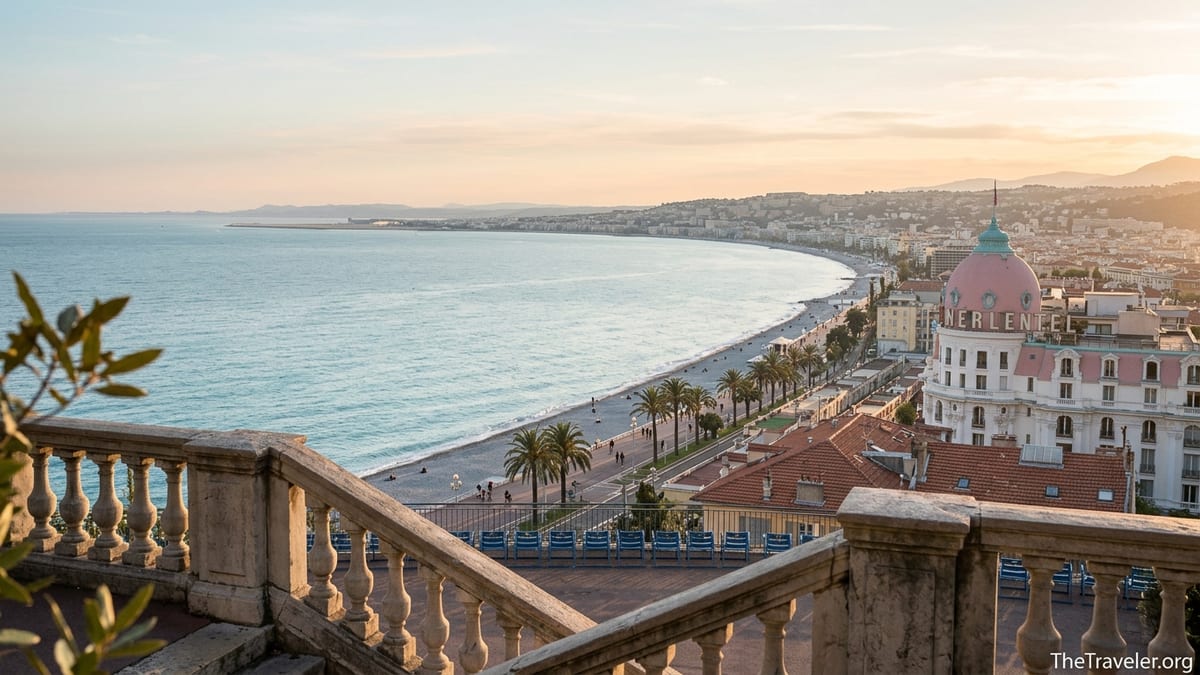
Baie des Anges is the wide, gently curving bay that frames Nice and several neighboring towns on the French Riviera. On a map, it runs roughly from the Cap de Nice headland in the east past Nice Côte d’Azur Airport toward Cagnes sur Mer and Antibes in the west. In practice, visitors experience it as a sequence of pebbly beaches, palm-lined boulevards and marinas set against that famously bright turquoise sea.
Within Nice itself, the bay is bordered by four easy reference points any visitor will encounter: the airport at the western end, the long Promenade des Anglais running beside the water, the historic Lympia port to the east and the wooded slopes of Mont Boron above the harbor. Most hotels and rentals marketed as “sea view” line the Promenade or sit just behind it, making the bay your constant companion from the moment you arrive.
Because the shoreline is largely open and walkable, you do not need a car to enjoy the best of Baie des Anges. A visitor staying near Place Masséna or in Vieux Nice can reach signature viewpoints such as Castle Hill, Rauba-Capeù and the start of the coastal path at Coco Beach on foot in 10 to 25 minutes. For longer stretches toward the airport or into neighboring towns, local trams and buses trace the same arc as the bay and are inexpensive by Western European standards.
Orientation matters for photography as well. The bay opens broadly to the south, which means sunrise and sunset light skim along the curve of the water rather than dropping directly behind the horizon. That side light is a major reason photos from Baie des Anges often show long pastel gradients and softly glowing façades.
Walking the Promenade des Anglais for Classic Bay Vistas
The Promenade des Anglais is the backbone of any Baie des Anges experience. This seafront boulevard runs for roughly 7 kilometers from the airport area to the eastern end near the old town, and it is almost entirely flat, paved and separated from traffic. Visitors use it for everything from leisurely evening strolls to sunrise runs and all-day people-watching from the famous blue chairs facing the water.
One of the most rewarding short walks begins around the Jardin Albert 1er gardens and heads west toward the Hôtel Negresco, a Belle Époque landmark with a pink dome that often appears in postcards of Nice. Covering that section at a relaxed pace takes about 20 minutes each way. Along the route, you pass clusters of public pebble beaches, stretches of painted blue chairs and a line of private beach clubs that set up sun loungers and parasols directly on the stones during the warmer months.
For photos, late afternoon into sunset works particularly well on the Promenade. The façades of pastel hotels and apartment blocks catch the golden light, while the curve of the bay leads the eye toward the airport and distant hills. If you are using a phone, standing on the elevated sidewalk beside the bike lane and shooting slightly downward can help you frame both the chairs and the sea without too much road in the foreground. With a camera, a moderate wide-angle lens, equivalent to around 24–28 millimeters on a full-frame body, fits in the sweep of the shoreline without distorting the horizon.
If you prefer quieter scenes, come just after sunrise. Even in high season, you will mostly share the Promenade with locals walking dogs, swimmers heading to the water and a handful of photographers. The water often looks at its clearest and calmest at this hour, and with the sun rising behind the hills, the bay shifts through shades of lavender and pale blue that are hard to capture later in the day.
Climbing to Castle Hill and Mont Boron for Panoramic Viewpoints
For the most complete views of Baie des Anges, you need a bit of elevation. The classic viewpoint is Colline du Château, often called Castle Hill, a wooded park that rises between the old town and the port. From the seafront just east of the Promenade, a free public elevator, a staircase and a sloping path all lead to the top in around 10 to 20 minutes, depending on your route and fitness level.
At the main Castle Hill terrace facing west, you see nearly the entire arc of the bay: the red-tiled roofs of Vieux Nice directly below, the palm-lined Promenade sweeping away toward the airport, and, on clear days, the western hills beyond. This is one of the best places in the city for wide establishing shots. A 16–18 millimeter equivalent wide-angle lens will capture the full curve of Baie des Anges, while a tighter 50 millimeter view lets you pick out details like the changing color of the water along different beaches.
Another vantage sits slightly higher within the same park, near the ruins of the old citadel and a man-made waterfall. From here, you can shoot back toward the port and Mont Boron, useful if you want images that include both sides of Nice rather than only the main bay. Mid-morning offers good light for these angles, with the sun high enough to illuminate the water but not yet too harsh. The park has shaded benches, a small café-style kiosk and public toilets, so it is practical to linger with a coffee and wait for the light to change.
If you have time and comfortable shoes, extend your viewpoint hunt to Mont Boron, the hill rising above the port. Buses run from central Nice up to the residential streets near Mont Boron park, from where signed paths lead to viewpoints that look back over Baie des Anges on one side and toward Villefranche-sur-Mer on the other. Many local photographers rate these higher views as some of the most impressive in the area, particularly in winter when you can sometimes see snow on distant Alpine peaks behind the city.
Exploring the Coastal Path from Coco Beach to Villefranche
While the Promenade des Anglais offers open, urban sea views, the coastal path known locally as the Sentier du Littoral around Cap de Nice reveals a more rugged side of Baie des Anges. The most accessible section starts near Coco Beach, a rocky public bathing spot a short walk east from the port along Boulevard Franck Pilatte. Here, steps and a signed path drop down to a narrow walkway that clings to the cliffs just above the water.
This route continues around the cape toward Villefranche-sur-Mer, weaving between flat rock platforms, concrete steps and short staircases cut into the stone. In places, waves can spray the path on windy days, so sturdy footwear and reasonable mobility are important. Most visitors walk an out-and-back section of roughly 45 to 90 minutes rather than committing to the full stretch between Nice and Villefranche, which can take several hours including climbs back up to the road.
For walkers and photographers, the attraction is intimacy with the sea. Unlike the main bay, where the shore is separated from the city by a broad boulevard, here you are just a few meters above the water. You can frame shots that include only rocks, white spray and impossibly blue shallows, giving the impression of a remote cove even though apartment buildings and restaurants sit just above you. Early morning or late afternoon once again work best to avoid midday glare, and a polarizing filter on a camera lens can help cut reflections and show the seabed more clearly.
Practical considerations matter on this path. There are no cafés or shops directly on the coastal trail, so bring water and, in warmer months, sun protection. Sections of the route include steep staircases where you gain or lose altitude quickly before rejoining the shoreline. Signage and barriers make it clear where access is allowed, but after heavy seas authorities may temporarily close short portions for safety or maintenance, particularly in winter and early spring. Checking with the city tourist office or recent local reports before setting out is wise if you are visiting outside the summer season.
Sunrise, Sunset and Seasonal Light over the Bay
The orientation of Baie des Anges gives the bay different characters at different times of day and different months. In summer, sunrise comes early and the sun emerges behind the hills to the northeast, painting the pebbles and façades with soft side light while the sea remains a cool blue-green. By evening, the glow shifts to gold and orange, with the sun setting off to the right as you look out from the Promenade. In winter, the sun tracks lower and casts longer shadows, often enhancing the textures of the water and the stones.
For sunrise, two spots are particularly rewarding. One is the eastern end of the Promenade near Rauba-Capeù, a small lookout between the main seafront and the port. Standing near the low sea wall, you can capture the bay’s curve as the first light touches the hotels and apartment buildings in the distance. The other is Castle Hill, where early risers find fewer crowds and calm, pastel skies. Even a simple phone photo from the main terrace at this hour often looks surprisingly refined, with the bay fading from lilac near the horizon to turquoise closer to shore.
Sunset brings out a different mood. Locals often gather on the pebbles with simple picnics from nearby bakeries and supermarkets, while visitors take aperitif drinks at private beach clubs or rooftop bars. Any point along the central Promenade between the Negresco area and the old town will give you a clear view of the sun dipping toward the western end of the bay. Some travelers like to time a walk so that they are crossing the Rauba-Capeù lookout or returning from the Coco Beach coastal path as the sky turns pink and orange, catching both the seafront and, briefly, the illuminated façades behind them.
Seasonally, the busiest months of July and August bring intense midday light and strong heat, which can flatten photos and make long walks less comfortable. Late spring, June in particular, and early autumn, especially September, offer a balance of warm temperatures, clear skies and gentler sun angles that often suit both walkers and photographers better. In shoulder seasons you are also more likely to find quieter moments on the Promenade and at popular viewpoints like Castle Hill, which can feel crowded in peak summer afternoons.
Best Real-World Photo Spots around Baie des Anges
Beyond broad categories of “promenade” and “hilltop,” certain specific spots around Baie des Anges have become favorites for both casual and serious photographers. One is the blue metal chairs that line sections of the Promenade. Framing a single empty chair facing the sea with the curve of the bay and distant hills behind it produces a simple, iconic image of Nice. At busy times, waiting a few minutes for a brief gap between passers-by is often all it takes to capture a clean composition.
Another prime spot is the Rauba-Capeù lookout mentioned earlier. The low sea wall here, painted in neutral tones, lets you rest a camera for stability and shoot along the curve of the shoreline toward the airport. People often capture long exposures at dusk from this point, smoothing the water while the city lights along the Promenade form a ribbon of warm color. Even with a phone, using a basic tripod or leaning against the wall to steady yourself will noticeably sharpen images taken at slower shutter speeds in fading light.
Castle Hill’s main terrace deserves a second mention purely as a photo location. From here, you can create classic postcard shots with the bay, Promenade, old town roofs and the white dome of the cathedral in one frame. Changing your position slightly along the railing can dramatically alter the composition, bringing foreground trees into play or clearing them out for a more open view. On windy days, watching for breaks in the movement of tree branches reduces blur intruding at the edges of your image.
Finally, for a more contemporary urban Riviera feel, look toward the western end of the bay near the airport. From public beaches such as Carras, you can photograph planes on final approach skimming above the sea, with palm trees and swimmers in the foreground. The contrast between leisure and infrastructure gives these images a different character from the classic historic-center shots, and the flatter stretch of coast here often shows subtle color bands in the water that are hard to see from higher, more distant viewpoints.
Practical Tips for Walking and Shooting the Bay
Experiencing Baie des Anges on foot rewards simple preparation. Distances can be deceptive when you are looking at a sweeping curve of coastline. The central section of Promenade des Anglais between the Negresco and the old town is quite compact, but walking from the old town all the way to the airport can easily take an hour and a half at a leisurely pace. Many visitors choose to walk one direction and then return by tram or bus, which are ticketed per ride or via short-term passes available from machines at main stops.
Footwear matters more on the pebbles and coastal paths than on the paved promenade. The public beaches along Baie des Anges consist of rounded gray stones rather than sand, which can be uncomfortable in thin flip-flops, especially if you are climbing over them to find a lower vantage near the waterline. Light trainers or sturdy sandals make it much easier to move between promenade and shore. On the Sentier du Littoral, closed shoes with good grip are advisable, particularly where the path narrows or includes steep staircases carved into the rock.
For photography, you do not need specialist gear to come home with strong images. A modern smartphone handled carefully can capture much of what makes the bay appealing: wide views, gentle colors and interesting textures in the water and stones. If you carry a dedicated camera, a light zoom covering approximately 24 to 70 millimeters full-frame equivalent gives you the flexibility to move between sweeping panoramas and tighter details, such as reflections in windows or silhouettes of palm trees against the evening sky. A small travel tripod or even a compact table-top model can expand your options at blue hour, when exposure times lengthen.
Weather is typically cooperative from late spring through early autumn, but the bay does have occasional windy or stormy days when waves break hard against the rocks and spray crosses sections of the promenade. These conditions can be dramatic for photos but require caution at the water’s edge, especially near Rauba-Capeù and along the coastal path at Coco Beach. After heavy seas, local authorities may temporarily fence off certain rock platforms or sections of the lower promenade, a reminder to keep an eye on posted notices as well as the sky.
The Takeaway
Baie des Anges is not just a backdrop to Nice but the thread that ties the city’s most memorable experiences together. From the everyday ritual of a stroll along the Promenade des Anglais to the exhilaration of seeing the entire bay laid out beneath you from Castle Hill, the coastline reveals new layers as you walk, climb and watch the light change.
By combining simple elements a sunrise walk on the seafront, a midday climb to a viewpoint, an afternoon on the coastal path and a sunset pause on the pebbles you can turn even a short stay into a sequence of distinct, grounded impressions. Each choice of vantage point, from blue chair to clifftop, subtly reshapes your sense of the bay’s scale and character.
With realistic expectations about distances, footwear and seasonal light, you do not need elaborate plans or equipment to enjoy Baie des Anges at its best. Follow the curve of the shoreline, look up to the hills and out to the horizon, and the bay will offer you countless walks and photo opportunities that feel specific, personal and unmistakably tied to this corner of the Mediterranean.
FAQ
Q1. Can I walk the entire length of Baie des Anges in one day? It is possible to follow most of the bay’s shoreline in a single day if you are reasonably fit, but it becomes a long outing. Many visitors prefer to focus on central sections in Nice on foot and then use local buses or the tram to cover the longer stretches toward the airport or neighboring towns, so they can save energy for detours to viewpoints such as Castle Hill.
Q2. Is the Promenade des Anglais suitable for wheelchairs and strollers? Yes, the Promenade des Anglais is wide, paved and mostly level, with ramps connecting it to many of the public beach access points. Some older side streets leading into the old town are steeper or cobbled, but the main seafront itself works well for wheelchairs and strollers, especially between the old town and the Negresco area.
Q3. When is the best time of year to photograph Baie des Anges? Late spring and early autumn often provide the best combination of light, weather and crowd levels. In May, June, September and early October, the sun sits at a comfortable angle for much of the day, skies are frequently clear and temperatures make longer walks more pleasant than in the peak heat of July and August.
Q4. Do I need hiking experience to walk the coastal path at Coco Beach? You do not need technical hiking skills, but you should be comfortable with uneven surfaces and staircases. The Sentier du Littoral section around Coco Beach includes narrow paths close to the water and some steep steps, so sturdy shoes and reasonable balance are important. Families with active children often enjoy it, but it is not ideal for strollers or anyone who struggles with stairs.
Q5. Are there public toilets and cafés along the main seafront? Along the Promenade des Anglais, you will find public toilets at intervals, especially near major beach accesses and closer to the old town. Numerous cafés, kiosks and beach bars line the inland side of the promenade, selling drinks, snacks and simple meals. On the more rugged coastal path around Cap de Nice, by contrast, there are no facilities directly on the trail, so plan accordingly.
Q6. Is it safe to walk the Promenade des Anglais after dark? The Promenade des Anglais remains busy into the evening, particularly in warmer months, with joggers, families and people heading to restaurants. As in any city, it is sensible to stay in well-lit areas, keep valuables secure and avoid isolated sections very late at night, but the main stretches around the old town and central hotels feel active rather than deserted after sunset.
Q7. Can I swim anywhere along Baie des Anges? Designated public beaches run along much of the bay in Nice, interspersed with private beach clubs that charge for loungers and services. Swimming is generally allowed off the public sections when conditions are safe, signaled by flag systems on lifeguarded beaches in season. On the coastal path, entry points to the water are more limited and can be rocky, so it is important to use established access points and be cautious of waves.
Q8. Where can I find the best panoramic view without a long climb? Castle Hill offers the best compromise between minimal effort and maximum view. The public elevator near the eastern end of the Promenade takes you most of the way up, leaving only a short, gentle walk to the main terrace. From there, you enjoy a sweeping panorama over Baie des Anges, the old town and, on the other side of the park, the port.
Q9. Are tripods allowed at popular viewpoints around the bay? Small tripods and travel-sized supports are generally tolerated on public promenades and viewpoints such as Castle Hill, provided you do not obstruct paths or set up large equipment in crowded areas. For more elaborate setups or commercial shoots on the beaches or promenade, local regulations may require permits, so it is wise to keep your gear discreet if you are simply shooting personal images.
Q10. How early should I arrive for sunrise or sunset photos? Arriving around 20 to 30 minutes before the official sunrise or sunset time works well for most locations along Baie des Anges. The most delicate colors often appear in the so-called blue hour just before sunrise and just after sunset, when the sky still holds light but city lamps have come on. Being in position a little ahead of time lets you explore compositions, adjust settings and watch how the light evolves.