


First‑time visitors to Rome tend to plan their church time around St Peter’s Basilica and a couple of historic favorites in the city center. Yet just a short metro ride down Via Ostiense stands another of Rome’s four papal basilicas, the Basilica Papale di San Paolo fuori le Mura, or Saint Paul Outside the Walls. Often overlooked and far less crowded, it raises a practical question for travelers working with limited days in the city: is it really worth venturing beyond Rome’s more famous churches to see it?
Get the latest updates straight to your inbox!
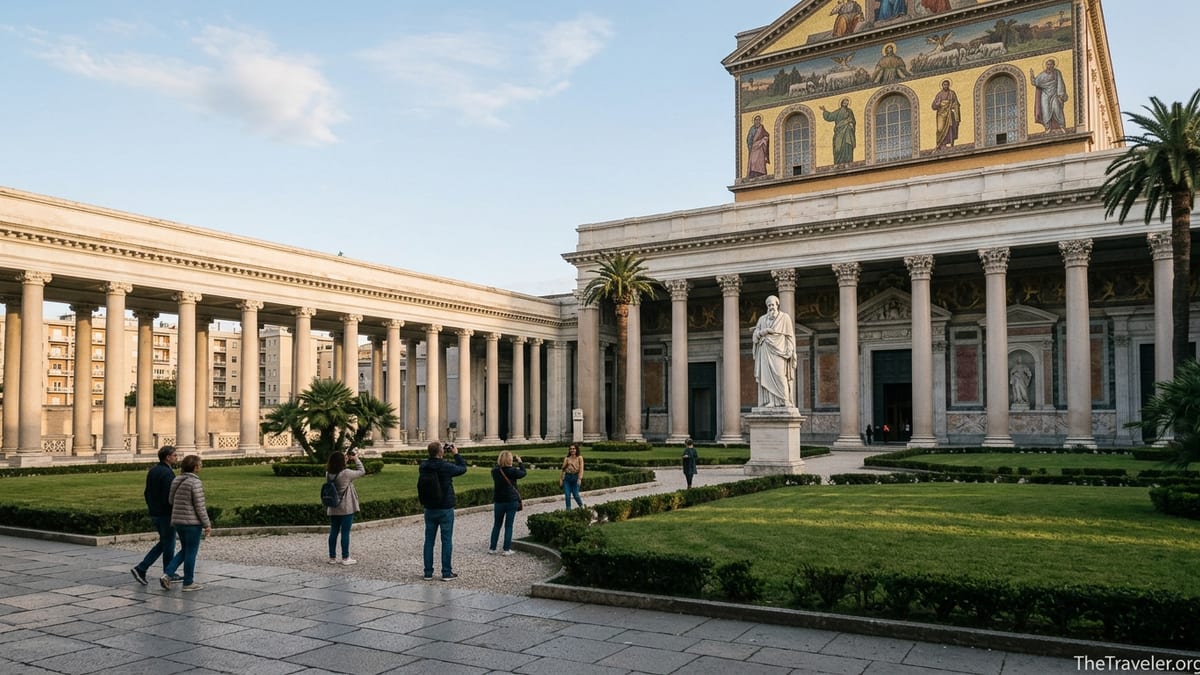
Why Basilica San Paolo Matters in a City of Icons
In a city where St Peter’s, the Pantheon, and Santa Maria Maggiore dominate itineraries, it is easy to assume you have seen the “best” of church architecture without leaving the historic center. Basilica San Paolo fuori le Mura quietly challenges that assumption. It is one of only four papal basilicas in Rome and, after St Peter’s, it is the second largest. The original Constantinian church was founded in the 4th century over the traditional burial place of the apostle Paul, which gives it a direct link to early Christian Rome that is hard to replicate elsewhere.
For travelers, this matters because it offers a different kind of encounter with Rome’s religious heritage. Where St Peter’s is shaped by Baroque exuberance and the experience of managing heavy crowds, San Paolo feels more monastic and contemplative. The current basilica largely dates to the 19th century reconstruction after a devastating fire in 1823, but its plan follows the ancient layout and incorporates medieval and earlier fragments. So while some artistic elements are newer than those in San Giovanni in Laterano or Santa Maria in Trastevere, the overall impression is of deep continuity rather than a showpiece created only for pilgrims and tourists.
Adding San Paolo to a trip is less about ticking a checklist of masterpieces and more about expanding your sense of what sacred space in Rome can feel like. If your only benchmark is the visual drama of the Bernini colonnade in St Peter’s Square or the exuberant ceiling of Sant’Ignazio, you may initially underestimate San Paolo. The reward for going is discovering how powerful a quieter, more spacious basilica can be, especially if you are already saturated with ornate Baroque interiors.
First Impressions: Space, Light, and Atmosphere
Most visitors approach San Paolo from the modern square and metro station at Basilica San Paolo. After a short walk, you step into an enclosed courtyard dominated by a white marble statue of Saint Paul, framed by a classical portico and a glittering facade mosaic. This outdoor atrium already feels different from the tight urban setting of churches like Santa Maria sopra Minerva. Palm trees, lawns, and the Benedictine monastery surrounding the complex shift the mood from urban sightseeing to something closer to a pilgrimage stop on the edge of the city.
Inside, the nave is what tends to win over skeptical travelers. It is vast and unexpectedly open, lined with double rows of marble columns that draw your eye straight toward the apse. Where many Roman churches rely on side chapels packed with altarpieces and tombs, San Paolo’s side aisles are relatively uncluttered. Light filters in through high windows and reflects off the marble floor, creating a luminous, almost abstract sense of space rather than a dark, crowded interior. Visitors often comment that for the first time in several days of sightseeing, they feel they can actually breathe inside a major Roman church.
Sound also plays a role in the experience. At St Peter’s, even early in the morning, you are rarely far from a tour group, a loudspeaker announcement, or the echo of thousands of footsteps. At San Paolo, you are more likely to hear the low murmur of prayer, the sound of a single organist practicing, or nothing at all. This quieter atmosphere makes it easier to notice details like the long series of papal portraits running beneath the clerestory windows or the subtle color variations in the marble columns. For travelers who value atmosphere as much as art history, that alone can justify the metro ride.
What You Actually See: Highlights That Stand Out
Even if you arrive with modest expectations, San Paolo offers specific sights that hold their own alongside Rome’s more famous churches. At the far end of the nave, the 19th‑century apse mosaic dominates the view, featuring Christ with saints including Peter and Paul against a golden background. It may not be as ancient as the mosaics at Santa Prassede or Santa Maria in Trastevere, but its scale and luminosity are striking. Beneath it, the baldachin over the high altar, by Arnolfo di Cambio from the late 13th century, preserves a jewel of medieval Gothic architecture in a largely later setting.
Beneath the altar lies the shrine of Saint Paul, traditionally believed to house his tomb. Today, a small window in the confessio allows visitors to glimpse the ancient sarcophagus and a marble slab engraved with “PAULO APOSTOLO MART” that was unearthed in archaeological excavations. For many Christian visitors this is an emotional highlight; for secular travelers it remains a powerful reminder that Rome’s churches are built over concrete layers of history, not just decorative surfaces.
One of the most memorable areas is the cloister, accessed through a side entrance for a modest fee that is usually in the low single digits in euros per person. Here, slender columns twist and spiral, some inlaid with colored glass mosaics, surrounding a small garden. Fragments of earlier church structures, inscriptions, and carved capitals line the walls like an open‑air lapidarium. Compared with the cloister at San Giovanni in Laterano, which sees more tour groups, San Paolo’s cloister often remains half empty, allowing photographers and architecture enthusiasts time to study column details or simply sit on a stone bench without feeling hurried.
The small museum areas, which may include access to portions of the archaeological remains under the basilica, add another dimension if you have time. You may see early Christian inscriptions, fragments of frescoes, or models of how the pre‑fire basilica looked. While not as extensive or dramatic as the underground levels at San Clemente, these spaces help you visualize how many lives and layers stand behind the seemingly unified interior you see upstairs.
Crowds, Practicalities, and the Question of Time
One of the strongest arguments for visiting San Paolo is practical rather than purely artistic. St Peter’s Basilica, especially from spring through early autumn, often involves queues that can run well over an hour even for travelers who have booked skip‑the‑line arrangements or timed dome access. Security screening, group management, and the sheer number of visitors turn a church visit into a small logistical exercise. Similar pressure is starting to affect popular city‑center churches when large tour groups arrive simultaneously.
San Paolo, by contrast, is rarely crowded. On a typical weekday morning outside major Catholic feast days, you may share the cavernous nave with only a handful of other visitors and a few locals stopping in on their way to work from the nearby business district. This means you can arrive without a reservation, clear the simple security check, and be inside in minutes. For travelers nursing sore feet after standing in line at the Colosseum or the Vatican Museums, this ease of access can feel like a luxury.
From a scheduling perspective, you can usually explore the main basilica in 45 to 60 minutes at an unhurried pace. Adding the cloister and small museum might stretch your visit to around 90 minutes. Considering that the metro ride from Termini station on Line B to Basilica San Paolo typically takes about 15 minutes, plus a short walk, you can realistically plan a two‑ to two‑and‑a‑half‑hour outing door to door from central Rome. This makes San Paolo a manageable half‑day addition even if you have only three full days in the city, especially if you pair it with a meal in the Ostiense district before heading back.
Entry to the main basilica is free, matching the general rule that churches in Rome do not charge admission. The small fee for the cloister and museum area is paid on site and tends to be low enough that budget travelers can include it without much concern. For comparison, climbing the dome at St Peter’s or visiting major archaeological sites can each cost several times more per person. If you are balancing expense and impact when choosing experiences, San Paolo offers a high return in atmosphere and beauty for a relatively small outlay of both money and time.
Comparing San Paolo With Rome’s “Big Three” Basilicas
To judge whether San Paolo is worth the effort, it helps to compare it with the better‑known churches that usually anchor a first visit. St Peter’s is unmatched in scale and in the density of world‑famous works, from Michelangelo’s Pietà to Bernini’s baldachin, and it has unique experiences such as the dome climb and view over St Peter’s Square. San Giovanni in Laterano, the cathedral of Rome, offers a powerful combination of early Christian history and Baroque redesign, with one of the most beautiful cloisters in the city. Santa Maria Maggiore showcases some of the finest early Christian mosaics in Rome along with ornate Baroque chapels.
Against this backdrop, San Paolo’s strengths are different. It does not try to compete with St Peter’s in sculptural showpieces or panoramic viewpoints. Instead, its appeal lies in proportion, rhythm, and the clarity of its basilican plan. Walk down the central nave and you feel the steady cadence of column after column, capped by simple arches and a flat wooden ceiling. For visitors familiar with early Christian and Romanesque architecture from other parts of Europe, this can feel like seeing a textbook illustration come to life at full scale.
San Paolo also invites you to experience papal Rome in a less centralized way. The row of round portraits of popes, running in medallions along the upper walls, visually asserts the continuity of the papacy from Peter onwards in a way that is both didactic and surprisingly moving when seen in person. While similar imagery exists elsewhere, the uninterrupted band here, updated as new popes are elected, provides a quiet reminder that the Catholic story in Rome is not confined to a single basilica or neighborhood.
If your time is very short and you must choose, most first‑time visitors still prioritize St Peter’s, at least one of the other central papal basilicas, and perhaps an atmospheric smaller church such as Santa Maria in Trastevere or San Clemente. But for anyone on a second visit, or for travelers who find themselves tiring of crowds and gilded chapels, San Paolo can feel like the missing piece that completes the picture of Rome’s major sacred spaces.
Beyond the Basilica: Neighborhood Context and Nearby Experiences
Another factor in deciding whether San Paolo is worth it is what else you can reasonably combine with the trip. The area around the basilica is not as atmospheric as Trastevere or the historic center, but it offers a glimpse of modern Roman life. Offices, university buildings, and residential blocks surround the church, and you will see students, commuters, and families going about their routines rather than clusters of tour groups. Spending a little time in a nearby café or pizzeria can provide a useful reset if you feel saturated by the crowds around Piazza Navona or the Spanish Steps.
Many visitors choose to pair San Paolo with the Ostiense district, just a couple of metro stops away. Ostiense is known for its street art, former industrial spaces, and casual dining scene, including popular Roman pizza and pasta spots at mid‑range prices. A realistic pattern for a half‑day outing might be to visit the basilica in the morning, when it tends to be quietest, then ride or walk back toward Ostiense for lunch. This combination contrasts the serenity of the cloister with the grit and creativity of a contemporary neighborhood.
If your interests lean strongly toward early Christianity and archaeology, you might also consider pairing San Paolo with a visit to the catacombs on the Via Appia Antica or the layered church of San Clemente on a different day. While these sites are not in the same immediate area, together they create a narrative arc that stretches from the graves of early Christians outside the city walls, through the Constantinian foundations of basilicas like San Paolo, up to later medieval and Baroque reinterpretations. In that broader context, San Paolo becomes a key link rather than an isolated side trip.
Practical details such as dress code and behavior are similar to those in other major Roman churches. Shoulders and knees should be covered, and visitors are expected to keep voices low, especially if a service is in progress. Because San Paolo is an active monastic community, you may see Benedictine monks moving through the complex or hear liturgical chanting if you happen to visit at the right time. This living dimension sets it apart from some historic churches that feel more like museums than active places of worship.
Who Will Appreciate San Paolo Most?
Not every traveler will value San Paolo in the same way. If your primary goal in Rome is to see headline artworks and take in sweeping city views, you may feel that the metro ride is less compelling than staying closer to St Peter’s and the historic center. The basilica does not feature a single artwork as internationally famous as the Pietà or the Caravaggios in San Luigi dei Francesi, and photography enthusiasts looking for rooftop vistas will not find a dome climb here comparable to those at St Peter’s or the Vittoriano.
However, certain types of visitors are likely to find San Paolo one of the most rewarding churches in Rome. Travelers who are sensitive to crowds, noise, and sensory overload often describe it as a relief after more intense sites. If you are visiting with children or older relatives who struggle with long queues and cramped interiors, the combination of easy access, clear sightlines, and open space can make the visit far more enjoyable than tackling several very busy churches in a single day.
Architecture and history enthusiasts will also find much to appreciate. The basilica offers a rare chance to experience the basilican plan at monumental scale without heavy later modifications. Standing near the entrance and looking straight toward the apse, you can clearly read the spatial hierarchy from nave to transept to sanctuary, something that is less obvious in more elaborately remodeled interiors. Combine this with the cloister’s rich medieval detail and the tangible presence of the apostle’s shrine, and you have a site that supports deeper reflection as well as casual enjoyment.
Finally, pilgrims and spiritually motivated travelers often report that San Paolo allows for a more personal form of prayer or contemplation than the high‑pressure environment of St Peter’s during peak season. Being able to sit in a side aisle, light a candle, and remain undisturbed for a meaningful stretch of time is not guaranteed in every major Roman church. If interior peace is a priority for you, this basilica may quietly become one of your favorite stops in the city.
The Takeaway
Judged only by headline fame, Basilica San Paolo fuori le Mura might seem optional compared with St Peter’s, San Giovanni in Laterano, or Santa Maria Maggiore. Yet fame is not always the best guide to value for travelers. San Paolo combines papal‑level historical significance with the practical advantages of low crowds, straightforward access, and free entry to the main church. Its strengths are experiential: spaciousness, light, and a contemplative atmosphere that contrasts sharply with the more theatrical feel of central Rome’s marquee churches.
If you have only a day and a half in Rome and are racing between the Colosseum, the Vatican Museums, and the Trevi Fountain, you may understandably decide to focus on the icons within walking distance of one another. But if your stay extends to three days or more, or if you are returning to the city and looking for deeper cuts that still feel quintessentially Roman, Basilica San Paolo is well worth the metro ride. Allow 90 minutes including the cloister, combine it with a simple meal in a nearby neighborhood, and you will likely come away with a richer, more balanced picture of Rome’s sacred landscape.
In the end, the question is less whether San Paolo is objectively better or worse than Rome’s other great churches, and more whether you value what it uniquely offers. If quiet grandeur, clear architectural lines, and a sense of living monastic tradition appeal to you, this is one site that deserves to step out from the shadow of its more famous counterparts on your next Roman itinerary.
FAQ
Q1. How do I get to Basilica San Paolo fuori le Mura from central Rome?
From Termini station, take Metro Line B toward Laurentina and get off at Basilica San Paolo. The ride typically takes around 15 minutes, followed by a short walk of a few minutes along clearly signed streets to the basilica square.
Q2. Is there an admission fee to visit the basilica?
Entry to the main church is free, in line with most Catholic churches in Rome. There is usually a small separate fee in the low single digits in euros to access the cloister and museum areas, which you pay at a desk inside.
Q3. How much time should I plan for a visit?
If you are mainly interested in seeing the nave, apse, and papal portraits, 45 to 60 minutes is enough at a relaxed pace. To include the cloister, museum, and some quiet time for reflection or photography, plan on around 90 minutes in total.
Q4. What are the usual opening hours?
Exact times can vary slightly by season and liturgical calendar, but the basilica typically opens from morning into early evening, with a mid‑day period when some areas may be partially restricted during services. It is wise to visit in the morning or late afternoon and to check current hours locally once in Rome.
Q5. Is there a dress code?
Yes. As in other major churches in Rome, shoulders and knees should be covered for both men and women. Light trousers, long skirts, and a scarf or light cardigan to cover bare shoulders are practical choices, especially in warmer months.
Q6. How does San Paolo compare to St Peter’s Basilica?
St Peter’s is more famous, larger, and packed with globally known artworks, but it is also much busier and often involves long lines and security queues. San Paolo offers a calmer, more contemplative experience with far fewer crowds, making it a good complement rather than a replacement.
Q7. Can I see the tomb of Saint Paul?
You cannot enter the tomb itself, but you can view the shrine beneath the main altar. A window in the confessio area allows you to see the sarcophagus traditionally associated with Saint Paul, along with related inscriptions and relics.
Q8. Is the basilica suitable for visitors with mobility issues?
The main basilica floor is largely level, and access from the square involves only modest gradients, which is helpful for visitors using wheelchairs or with limited mobility. Some museum or archaeological areas may involve steps or uneven surfaces, so it is best to ask staff on site about current accessible routes.
Q9. Is photography allowed inside?
Non‑flash photography for personal use is generally allowed in the main basilica and cloister, provided you are discreet and do not disturb worshippers or ongoing services. Tripods and professional equipment may be restricted, so if you plan more serious photography, check the rules with staff.
Q10. When is the best time of day to visit?
Weekday mornings outside major feast days are usually the quietest, with soft natural light filtering through the high windows. Late afternoon can also be pleasant, especially if you want to combine the visit with an early dinner in the nearby Ostiense or San Paolo neighborhoods afterward.