


Most travelers reach the Papal Basilica of Saint Paul Outside the Walls, or Basilica San Paolo, with a single image in mind: a long marble nave leading to a golden apse glittering with mosaics. They step inside, take a few wide shots on a phone, whisper that it feels calmer than Saint Peter’s, and move on. Yet this grand interior holds far more than first impressions suggest. From medieval floor patterns designed to move pilgrims’ feet, to a hidden gallery of papal portraits and a cloister where carved columns tell their own stories, San Paolo rewards anyone willing to slow down and look again.
Get the latest updates straight to your inbox!
The First Impression Most Visitors Miss
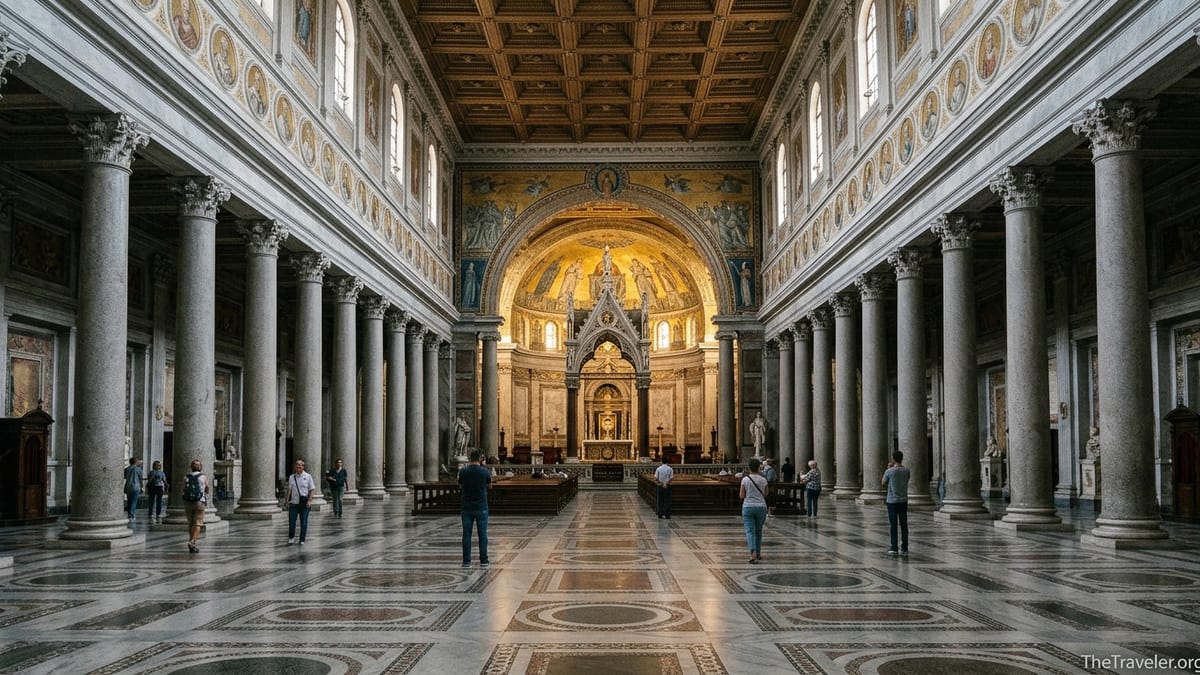
Walk through the great bronze doors into Basilica San Paolo and the initial sensation is pure scale. The nave stretches almost 100 meters, held up by ranks of granite columns in a space that can feel closer to a railway hall than a typical church. Many visitors instinctively tilt their cameras toward the apse, snap a photo of the golden mosaic of Christ, and rarely look back toward the entrance again. Yet that first glance hides a careful choreography. The basilica was rebuilt after a devastating fire in 1823, but the architects preserved the early Christian basilica layout and reused ancient columns, so what you see is a 19th century reconstruction layered over 5th century spatial ideas.
If you pause just a few meters inside and turn slowly, details begin to emerge. The side aisles are lower and darker than the central nave, so your eyes are drawn toward the bright, distant apse almost like a vanishing point. The 42 windows set high along the walls use translucent alabaster instead of clear glass, scattering daylight into a soft, milky glow. On a sunny afternoon the effect is subtle but powerful: the interior never feels harshly lit, even when the Roman sun is fierce outside. Stand near the center of the nave around late morning and look up; you will see how the light glances off the gilded coffered ceiling, picking out shapes you probably did not notice when you first rushed in.
Even the polished marble floor plays a role in this first impression. It reflects light like still water, doubling the depth of the nave when you look toward the apse. Travelers who arrive just after a rare Roman rain may find the interior slightly damp and the floor’s mirror effect even stronger. It is worth walking halfway down the central nave, then turning back toward the entrance for a second “reveal.” The statue of Saint Paul in the forecourt, the portico columns, and the mosaicked facade align through the doors, framed by the cool darkness of the interior like a living postcard many visitors never think to compose.
The Cosmatesque Floor and the Language Under Your Feet
Because the ceiling and apse grab attention, the floor beneath them is often overlooked. Yet the patterns at Basilica San Paolo are part of the same medieval design tradition that produced the famous mosaicked pavements of Santa Maria in Trastevere and San Clemente in central Rome. Known as Cosmatesque work, after a family of Roman marble artisans, these inlaid circles, braids and squares use recycled fragments of colored stone, including porphyry and serpentine, once prized in imperial buildings. Look closely along the central nave and near the transept and you will notice disks of deep purple and green marble set into creamy stone, connected by intricate chains of geometric motifs.
These designs are not just decoration. They help guide movement and mark important positions within the basilica. For example, as you approach the transept where the nave widens, the floor patterns gently shift to frame the main altar and the confession below it. If you stand directly in front of the Gothic ciborium that covers the tomb of Saint Paul and then look down, you will often find a denser, almost “woven” Cosmatesque band under your feet, signaling a space of special focus. On quieter afternoons, you can literally trace these patterns like a walking meditation, circling a porphyry disk, following a braided line toward the altar, then stepping back into simpler stone fields that feel more neutral.
Practical detail matters here too. The Cosmatesque inlays are centuries old and have been patched and polished many times. In certain side aisles you may find faint dips where generations of pilgrims have walked the same path, the tiny irregularities catching the light. Keen photographers sometimes crouch low to shoot along the floor, capturing reflections of columns in the polished marble. If you are planning your visit and thinking about footwear, this is one basilica where low, non-slip soles are helpful: the floor is quite smooth, especially in winter when humidity rises near the Tiber, and noticing the patterns is easier when you are not worrying about your footing.
The Apse Mosaic and Triumphal Arch Few Read Carefully
Every visitor notices the great apse mosaic, yet very few actually “read” it. Commissioned in the 13th century and later restored, the mosaic shows Christ seated against a deep blue background, flanked by Saint Peter and Saint Paul and two other saints. Below them, in much smaller scale, a medieval pope kneels at Christ’s feet, his name inscribed in Latin. On a typical day you will see people stand in the nave, zoom in for a phone shot, and move on without recognizing that the different figure sizes are a deliberate visual statement about humility and hierarchy.
To truly appreciate this mosaic, walk up the central nave until you are just before the steps that rise to the main altar and then stop. From here, Christ’s face becomes clearer, and you can see the gold tesserae set at slightly different angles to catch light. The effect is strongest around midday, when bright sunlight filters through the upper windows and makes the background shimmer as if alive. If you are visiting in late afternoon, the impression is quieter but no less striking. The colors shift toward warmer tones, and the smaller figures at the bottom, including the kneeling pope, emerge from shadow.
Just in front of the apse is the triumphal arch, decorated with an earlier mosaic band that survives from the 5th century. Many visitors do not realize they are looking at artwork more than 1,500 years old. The figures here are more rigid and stylized than those in the apse: apostles, symbols of the evangelists, and a central image of Christ appear in a solemn, frontal row. If you stand under the arch and look up, you can often spot differences in style where later restorations blended with the ancient work. Guides sometimes point out how the lettering along the arch’s base records a patron from the late Roman imperial era, a reminder that this basilica once stood at the edge of a busy road leading to the port of Ostia, already a major shrine long before the Middle Ages.
Because tripods are usually not allowed, travelers wanting to photograph the apse and arch together often lean on the nave’s central columns for stability and use a higher ISO setting on a camera or night-mode on a phone. A practical tip: step a little to one side of the central axis. From a slightly off-center position, you can align the Gothic ciborium, triumphal arch, and apse mosaic in a single frame, revealing the layered history of styles that most visitors, focused only on the golden background, never really see.
The Gothic Ciborium and Easter Candelabrum Up Close
At first glance, the white marble canopy above the main altar might seem like just another piece of church furniture. In reality, this Gothic ciborium from the late 13th century is one of the basilica’s most refined works of art. Many visitors view it only as a silhouette against the apse, missing the wealth of carved detail that becomes visible when you walk around it. The structure rests on four dark porphyry columns, rare stone that once signaled imperial status, topped with delicately carved capitals. Above, pointed arches carry a forest of pinnacles and tiny statues representing saints associated with Saint Paul and the monastic community.
To appreciate it, move slowly around all four sides, if the area is open when you visit. Look at the corners: you may spot figures of Saint Peter and Saint Paul opposite each other, with other saints and prophets filling the remaining niches. Even small elements such as the foliage curling along the edges show how medieval sculptors transformed hard stone into something resembling lace. If you visit in the late afternoon, low interior light will often graze the carvings and cast long shadows, emphasizing their three-dimensional quality in a way that mid-day light flattens out.
On the right side of the sanctuary stands another object most visitors overlook: the monumental Easter candelabrum. This tall, intricately carved marble column dates from the same general period and is decorated with scenes from the Bible and foliage motifs, again enriched with Cosmatesque mosaic inlays. In many photographs it disappears into the background, but in person it is nearly human-height and richly detailed. Walk up close and you will see small narrative reliefs stacked one above the other, telling a story that once would have been explained to pilgrims who could not read.
Today the Easter candle is usually lit only during specific liturgical seasons, so the candelabrum can seem dormant. Yet when you stand near it during a quiet weekday visit, you can often hear a faint echo of footsteps from the nave and notice how the column’s surface alternates between smooth, cool marble and rougher, re-carved sections where centuries of cleaning and restoration have left their mark. These textures are part of what makes Basilica San Paolo feel lived-in rather than museum-like, even though most tourist groups stop only briefly in front of the altar before being shepherded away.
The Papal Portraits: A Visual Timeline Overhead
Look above the arches that separate the nave from the side aisles and you will see a continuous band of circular portraits running the full length of the basilica. Many visitors assume they are generic saints and barely glance at them. In fact, they are a complete visual catalog of the popes, from Saint Peter to the present, each shown inside a round frame bearing his name. The idea dates back to the early Middle Ages and was re-created after the 19th century fire, with new portraits added as pontificates change.
For travelers, this gallery offers an unusual way to feel the sweep of church history without opening a guidebook. Start near the entrance and look for Saint Peter’s portrait, then follow the sequence along one side. You will notice shifts in style: some faces are sober and realistic, others more symbolic. The 20th and 21st century popes are particularly easy to recognize. Portraits of John XXIII, John Paul II, Benedict XVI and Francis show familiar faces translated into mosaic, reminding visitors that this is a living tradition rather than a closed chapter. When a new pope is elected, artisans create a fresh disk to continue the line, and scaffolding appears briefly in the nave while it is installed.
Practical travelers can turn this into an informal game, especially if visiting with older children or teens. Before entering, recall how many recent popes you can name, then see if you can locate their portraits and read their Latin names. On a typical weekday morning, the nave is quiet enough that you can stand still in the central aisle and use binoculars or a long camera lens to see the tesserae patterning each portrait. If you return to Saint Peter’s Basilica later in your trip, you may notice that while that church overwhelms with sheer decoration, it does not offer this same clear, linear narrative in its interior.
The Confession and Archaeological Levels Below
Many visitors know that Saint Paul is believed to be buried beneath the main altar, but few realize how much of that story you can actually glimpse from the basilica floor. In front of the altar, a low balustrade surrounds an opening known as the confession, where pilgrims can look down toward the apostle’s tomb. Peer through the railings and you will see a marble slab marked "PAULO APOSTOLO MART," a reference to Paul the Apostle and martyr, and a section of ancient masonry believed to be part of the original memorial over his grave.
Access to the deeper archaeological area directly under the basilica is controlled, and visiting it typically involves a modest additional fee paid at a small desk inside the complex. Recent travelers report that this underground visit costs only a few euros and takes about 20 to 30 minutes, depending on the guide on duty. For many, the experience is surprisingly intimate compared to the crowded excavations under Saint Peter’s. You may find yourself in a small group, following a guide along narrow corridors that reveal foundations, fragments of earlier floors, and sections of a necropolis whose tombs predate the basilica itself.
If you decide to explore below, bring a light jacket even in summer. The air is cooler and more humid underground, and the stone surfaces sometimes glisten slightly with condensation. Photography rules can vary, so it is best to assume that flash is not allowed and be prepared simply to observe. Emerging back into the vast light of the nave, you may notice the interior differently. The soaring columns no longer feel purely monumental but also protective, like a roof holding centuries of history that lie quietly beneath your feet.
The Cloister: A Quieter Masterpiece Next Door
One of the greatest treasures of Basilica San Paolo is technically not inside the main church at all but attached to its flank. Through a modest doorway off the right transept lies the 13th century cloister, a square courtyard framed by covered walkways and lined with some of the most refined Cosmatesque columns in Rome. Many tour groups never enter, treating it as an optional extra, even though the small entrance fee is usually just a few euros. For travelers willing to linger, the cloister offers an ideal pause from city traffic and a chance to see the basilica’s artistry up close.
The columns here come in pairs, each one different. Some twist like ropes, their surfaces inlaid with colorful glass and stone. Others are slender cylinders carved with vines, geometric patterns or tiny animals. The low afternoon sun often passes through the courtyard and skims across these surfaces, making the mosaics sparkle and casting shadows that emphasize each twist and cut. In the center, a simple lawn and a few shrubs create a calm, almost monastic atmosphere even when visitors are present. Take a slow lap around the cloister and you will find yourself compelled to stop every few meters to examine a new column design.
Along the cloister walls, stone fragments and carved slabs from earlier phases of the basilica are displayed like a lapidary museum. Latin and Greek inscriptions, broken cornices and reused sarcophagi trace how this site has evolved since late antiquity. One particularly striking piece is a Roman sarcophagus later reused in the Middle Ages, its pagan scenes partially reinterpreted in a Christian context. For historically minded travelers, this is where the abstract idea of “layers of Rome” becomes tangible. You can literally touch a marble block that once stood in an imperial public building and later found a second life in a Christian monastery.
Because the cloister is a bit removed from the main flow of visitors, it is an excellent place to rest between museum-heavy days. Benches along the walls allow you to sit and simply watch light move around the courtyard. On quieter mornings you may hear the faint chants of the Benedictine monks who still serve the basilica, drifting from elsewhere in the complex. Many travelers who make time for the cloister come away saying it was their favorite part of the visit, precisely because it feels like a hidden room in a well-known building.
Practical Ways to Experience the Interior Differently
Noticing these quieter details does not require specialized knowledge, only a small shift in how you move through the space. One simple approach is to divide your visit into two passes. On the first, walk straight up the central nave like everyone else, taking in the grand perspective and pausing briefly at the apse and confession. On the second, start again at the entrance but stay close to the left side aisle, moving slowly from column to column. From this angle you will see how the side chapels open like small theaters, each with its own altar, painting or relic often missed from the center.
Time of day matters as well. Mid-morning usually offers the best balance of natural light and relative quiet, especially outside the peak summer months. If you come in the late afternoon, plan to spend the last part of your visit in the cloister, where low sunlight can be magical. During major feasts and papal events the basilica can be busier, with certain areas roped off, but on an ordinary weekday you may find that you can stand almost alone under the nave’s coffered ceiling, listening to the soft squeak of shoes on marble and the occasional murmur from a distant side chapel.
Finally, consider pairing Basilica San Paolo with one of Rome’s more crowded major churches, such as Saint Peter’s or Santa Maria Maggiore, either earlier or later in the same day. Comparing them helps you appreciate what makes this interior distinct: its long, almost austere nave; its emphasis on mosaics rather than baroque fresco; and its sense of being slightly apart from the city, out along the ancient road to the sea. Many modern visitors mention that they enjoy the relative lack of commercial pressure here. While there is a small bookshop and a place to buy postcards, you are unlikely to be pushed through souvenir stands as you exit. That calm extends to the interior itself, which seems designed less to dazzle than to steady the traveler who has finally reached the tomb of Paul.
The Takeaway
Basilica San Paolo’s interior is often summarized in guidebooks as a “grand, early Christian-style hall rebuilt in the 19th century,” but that description barely hints at its layered reality. The vast nave is a stage where light, mosaic and stone play out conversations that began in late antiquity and continue in each new papal portrait added overhead. Underfoot, Cosmatesque patterns guide your steps, while above the triumphal arch and apse preserve some of Rome’s most important mosaic cycles. At the center, the Gothic ciborium and Easter candelabrum mark the apostle’s tomb with sculpted stories in marble.
Most travelers will spend less than an hour inside before moving on to their next Roman highlight. Yet with a little extra time and attention, the basilica becomes a place where you can feel the city’s history compress into a single interior: imperial spolia reused in medieval floors, a cloister that blends monastic calm with lively ornament, underground remains that recall a martyr’s grave by the roadside. The reward for slowing down is not simply better photographs but a more personal connection to one of Rome’s great churches, one that quietly invites you to keep looking long after the first golden impression fades.
FAQ
Q1. How long should I plan to spend inside Basilica San Paolo’s interior? Most visitors spend about 45 minutes, but if you want to notice the mosaics, papal portraits, cloister and archaeological area calmly, plan for 90 minutes to 2 hours.
Q2. Is there an admission fee to enter the basilica interior? Entry to the main basilica is typically free, but there is a small separate charge, usually just a few euros, for the cloister and the archaeological area beneath the church.
Q3. What is the best time of day to appreciate the interior details? Mid-morning offers soft light on the mosaics and relatively fewer crowds, while late afternoon can be ideal for the cloister, when low sun highlights the Cosmatesque columns.
Q4. Can I take photos inside the basilica? Non-flash photography for personal use is generally allowed in the main interior, but tripods are discouraged and rules may be stricter in the underground archaeological area and during services.
Q5. Do I need a guided tour to understand the interior’s symbolism? A guide can certainly enrich the visit, but you can appreciate many details on your own by moving slowly, reading the papal names under the portraits, and comparing the different mosaic styles in the arch and apse.
Q6. Is the interior accessible for visitors with limited mobility? The main nave has a level marble floor suitable for wheelchairs and strollers, though some side chapels, the archaeological area and parts of the cloister may involve steps or uneven surfaces.
Q7. What should I wear when visiting Basilica San Paolo? Dress modestly with covered shoulders and knees, as this is an active place of worship; comfortable, non-slip shoes are recommended because the polished marble floor can be smooth underfoot.
Q8. Are there particular days or times I should avoid because of crowds? Major religious feasts, Sunday mornings and times when large pilgrimage groups arrive can be busier, so if you want to explore the interior quietly, aim for weekday mornings outside peak holiday periods.
Q9. Is it worth paying extra to see the cloister and the area under the basilica? Yes, many travelers find that the small additional fee pays for some of the most memorable details, from the cloister’s intricate Cosmatesque columns to the closer view of the levels around Saint Paul’s tomb.
Q10. Can I attend a service to experience the interior in use? Regular Masses are celebrated daily, and attending one is a powerful way to experience the basilica as a living church, though some areas may be inaccessible and photography discouraged during liturgy.