


Rome has four great papal basilicas, but two often compete for a precious half day in a busy itinerary: the quiet, monumental Basilica of St Paul Outside the Walls (San Paolo fuori le Mura) and the powerful, history-laden Archbasilica of St John Lateran (San Giovanni in Laterano). Both are free to enter, both are deeply connected to the story of Christianity, and each offers a very different atmosphere. If you only have time for one, which delivers the better experience?
Get the latest updates straight to your inbox!
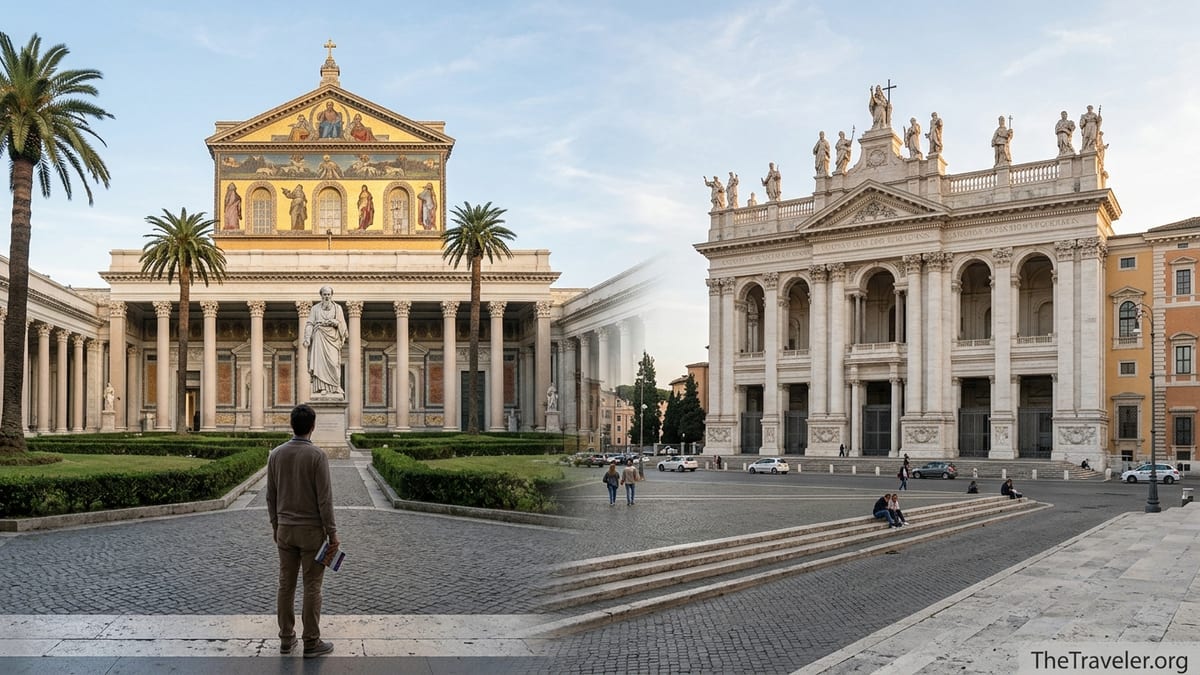
Why These Two Basilicas Matter
The Archbasilica of St John Lateran is Rome’s cathedral and the official seat of the Bishop of Rome, which means it is the Pope’s cathedral church and the highest-ranking of all Roman churches, even above St Peter’s. Its title as “Mother and Head of all the churches of the city and the world” is not just poetic language but an official designation, and you feel that authority immediately in its colossal façade and vast baroque interior.
By contrast, the Basilica of St Paul Outside the Walls is one of the four papal basilicas and the second largest in Rome after St Peter’s. Built over the traditional burial place of the apostle Paul, it has long been a major pilgrimage stop on the route of the Seven Churches of Rome. Its wide, open setting beyond the ancient city walls and its grand quadriportico courtyard give it a very different, almost monastic feel compared with the dense urban surroundings of St John Lateran.
For travelers, these different roles translate into different kinds of experiences. St John Lateran envelops you in layers of papal history, political power, and grand baroque art. San Paolo fuori le Mura offers quieter contemplation, golden light reflecting off mosaics, and a sense of spacious calm that many visitors find a welcome break from the crowds elsewhere in Rome.
Most itineraries cannot reasonably fit all four papal basilicas in a short visit. Understanding what each of these two offers in practice, from art highlights to logistics, helps you choose which one best matches your interests and your energy on a given day.
Atmosphere: Crowds, Noise and Overall Feel
St John Lateran is central and important, and you feel that in the foot traffic. It sees a steady flow of organized tour groups, school groups, pilgrims, and independent travelers filtering in from the San Giovanni metro and the nearby Lateran Palace complex. The interior can feel busy in the late morning and early afternoon, especially near the main altar and the side chapels. You will often hear multiple languages at once, a mix of quiet prayer and the low murmur of guides.
San Paolo fuori le Mura, by comparison, is almost always calmer. Because it sits well south of the historic center and requires a metro ride on Line B, fewer visitors make the trip. Travelers who go often report walking into a half-empty nave in the middle of the day, with only a handful of worshippers and small tour groups scattered under the coffered ceiling. The scale of the interior, with its forest of granite columns, makes even moderate crowds feel thinly spread out.
If you are sensitive to noise and jostling, San Paolo fuori le Mura usually wins. It is possible to stand in the center of the nave and hear your own footsteps on the marble floor, something that rarely happens at St John Lateran in high season. The courtyard of St Paul’s, with its palm trees and the large statue of the apostle, also offers space to sit quietly on the low steps and watch the light change on the 19th century façade mosaics.
That said, St John Lateran can be almost meditative in the early morning. The basilica opens around 7:00, and in the first hour you may share the space mostly with local worshippers on their way to work. At that time of day, the morning light comes in low through the windows and picks out the white sculptures of the apostles along the nave, a very different feel from the midday rush.
Art and Architecture: What You Will Actually See
St John Lateran offers a crash course in baroque architecture and Counter-Reformation aesthetics. The colossal façade, redesigned in the 18th century, sets the tone. Inside, the main nave is lined with immense statues of the twelve apostles in white marble, each in a dynamic pose that pulls your eye along the length of the church. The richly decorated coffered ceiling, the Cosmatesque floor patterns, and the elaborate baldachin above the papal altar create a richly layered visual experience that rewards slow looking.
One of the most powerful spots inside St John Lateran is the papal altar area, which can only be approached to a certain point by visitors but remains the symbolic heart of the basilica. Above it stands the Gothic-style ciborium, said to house relics of Saints Peter and Paul. The mix of medieval, Renaissance, and baroque elements makes this space especially photogenic, though you are likely to share it with groups listening to audio guides.
San Paolo fuori le Mura is dramatically different in style. After a fire in the 19th century, the basilica was rebuilt, keeping its early Christian basilica layout. The result is an enormous rectangular hall with five naves separated by rows of columns and a flat, gilded ceiling that emphasizes width and openness rather than vertical drama. The apse mosaic, with Christ in glory flanked by Saints Peter and Paul, glows in deep blues and golds and is one of the most impressive mosaic programs in Rome.
A unique highlight of San Paolo is the continuous line of papal portrait medallions set high up on the nave walls. Each circular mosaic shows a pope, starting with St Peter and running through to the current pontiff. Seeing this unbroken sequence of faces gives you a tangible sense of the length of Church history and is the kind of quiet detail many travelers later remember more vividly than yet another ornate altar.
Spiritual and Historical Significance
If your interest is church history and papal tradition, St John Lateran has a strong claim to first place. It is the oldest of the major basilicas, founded in the 4th century, and was the principal papal residence for centuries before the popes moved to the Vatican. Many important councils were held here, and the basilica’s status as the cathedral of Rome makes it central to Catholic identity. Standing in the nave, you are quite literally in the “mother church” of Roman Catholicism.
The wider Lateran complex deepens that significance. Just across from the basilica are the Holy Stairs (Scala Sancta), which tradition holds were brought from Jerusalem and associated with the Passion of Christ, and the Lateran Baptistery, one of the earliest Christian baptisteries. With a single visit to the area you can connect multiple strands of early Christian and medieval history, which is especially meaningful for travelers with a strong interest in religious sites.
San Paolo fuori le Mura carries its own, more focused spiritual weight. It is built over the place where the apostle Paul is believed to be buried. In the confessio area beneath the main altar, you can look down through a grill to see part of the sarcophagus identified with Paul. The atmosphere in this space is usually hushed, and many visitors, even those who are not religious, remark on the gravity of standing at what is widely regarded as the resting place of one of Christianity’s most influential figures.
Historically, San Paolo was also a major stop on traditional pilgrim routes. Before the modern boom in mass tourism, pilgrims would walk between the Seven Pilgrim Churches of Rome, of which both St John Lateran and St Paul Outside the Walls were core stops. Some modern visitors still follow this route on foot, but most will experience it through a single focused visit; choosing San Paolo allows you to connect specifically with the memory of Paul and the early Christian community beyond the city walls.
Practicalities: Location, Access and Time Needed
St John Lateran is easier to reach from most central neighborhoods. The basilica sits near the San Giovanni station, where metro lines A and C intersect, making it a straightforward ride from popular bases near Termini, Spanish Steps, or the Vatican. From Termini, the metro journey on Line A to San Giovanni typically takes under 10 minutes, plus a short walk of a few minutes to the basilica entrance. Several bus routes also pass nearby, and taxis can drop you right on the square in front.
San Paolo fuori le Mura requires a deliberate trip but is still simple to reach. It lies on metro Line B at the Basilica San Paolo station. From Termini, the ride is usually around 15 minutes toward Laurentina, followed by a three to five minute walk along a straightforward route. The basilica stands in a more modern neighborhood, so the approach is less scenic than St John Lateran, but the transition from urban streets to the quiet quadriportico is part of the experience.
In terms of time, most travelers can give St John Lateran around 60 to 90 minutes if they only visit the main basilica, and up to two or more hours if they add the cloister, baptistery, museum, or walk up to the Scala Sancta. San Paolo fuori le Mura typically requires at least 90 minutes once you factor in the courtyard, basilica interior, cloister, and museum, plus the slightly longer metro ride. Many visitors choose to pair St John Lateran with other central sights the same day, while San Paolo often works best as the anchor for a quieter half day.
For accessibility, both basilicas indicate step-free access to the main interior. St John Lateran has level access from the front piazza into the nave and staff can advise on elevators for the museum areas. San Paolo fuori le Mura’s main entrance and interior are on a single level, with wide aisles and relatively smooth floors, which some travelers with mobility concerns find easier to navigate than the more intricate layout around the Lateran complex.
Tickets, Opening Hours and Costs
For both basilicas, entry to the main church is free. At St John Lateran, the basilica typically opens around 7:00 and closes around 18:30. The attached museum, cloister, and baptistery operate on slightly later morning opening times, usually from 9:00, and close in the late afternoon. While schedules can change for liturgical events, these hours give plenty of flexibility for most itineraries, especially if you plan to visit after a morning at the Colosseum or before heading toward the San Giovanni neighborhood for dinner.
The paid areas at St John Lateran are still relatively modest in price compared with major museums. Combined tickets that include the cloister, baptistery, museum, and sometimes the Scala Sancta sanctuary are commonly under 20 euros for adults, with reduced prices for children and some discounts through city passes. For a couple or small family, that means adding perhaps 30 to 40 euros total to a day’s budget to explore the full complex with audio guides.
San Paolo fuori le Mura is similar in structure but slightly simpler. Entry to the main basilica is free, while the cloister and museum charge a modest fee, typically in the single digits per person. You can expect to pay roughly the price of a light lunch in Rome for two adults to visit both areas. Hours for the main church are generally from early morning to early evening, and the cloister and museum follow standard daytime hours. Since the basilica is less affected by organized group traffic than St John Lateran, queuing is rarely an issue outside special events.
Neither basilica currently requires advance booking for ordinary visits to the main church. This is a significant advantage compared with St Peter’s Basilica and the Vatican Museums, where many travelers must think in terms of timed entries or paid skip-the-line tours. For budget-conscious travelers or those who prefer to keep their days flexible, both St John Lateran and San Paolo fuori le Mura offer high impact experiences without the need for reservations or high ticket costs.
Photography, Atmosphere for Kids and Overall Comfort
For photographers, these two basilicas offer different challenges. St John Lateran’s baroque interior is richly decorated but can be visually busy, and capturing its scale without crowds in frame takes some patience. Early morning or late afternoon visits offer softer light and fewer tour groups. Wide-angle lenses or smartphone ultra-wide modes are particularly helpful to capture the length of the nave and the sequence of giant apostle statues.
San Paolo fuori le Mura is often easier to photograph. The wide, uncluttered nave and repeated columns naturally frame images, and the golden apse mosaic stands out clearly even on phone cameras. The exterior courtyard, with its palm trees, colonnades, and the large statue of St Paul, provides excellent vantage points for wide shots that capture both architecture and sky. Since the site tends to be quieter, you have more time to wait for a clean frame.
If you are traveling with children, San Paolo can be the more relaxed choice. There is room in the courtyard for small children to walk a bit before entering, and inside, the regular spacing of columns and the bright, open nave feel less oppressive than some darker, more ornate churches. The series of papal portraits can even become a kind of informal treasure hunt, letting kids look for different faces and expressions while you appreciate the art.
St John Lateran, while spectacular, demands more care with children. The mix of tour groups, devotional spaces, and side chapels means that you need to keep a closer eye on younger travelers and encourage quiet behavior, particularly near the high altar area. Still, for older kids and teens interested in history or architecture, the sense of grandeur and the link to the papacy can be very impressive and spark good conversation over gelato afterward.
So Which Basilica Offers the Better Experience?
Choosing between San Paolo fuori le Mura and St John Lateran depends less on which is objectively “better” and more on what you want from this part of your trip. If you seek a sense of the Catholic Church’s institutional heart, want to stand in Rome’s cathedral, and prefer to combine your visit with other central sites, St John Lateran has the stronger claim. It offers layered history, high-ranking religious significance, and easy access by metro or even on foot from parts of the historic center.
If, on the other hand, you are looking for calm, space, and an almost monastic atmosphere to balance the intensity of the Vatican and the Colosseum, San Paolo fuori le Mura may well offer the more memorable experience. Its luminous mosaics, the quiet presence of Paul’s tomb, and the relative scarcity of large tour groups create an environment that many travelers describe as unexpectedly moving.
For a first-time visitor with three full days in Rome who wants at least one major non-Vatican church on the itinerary, St John Lateran is usually the more strategic choice. You can visit after the Colosseum and Roman Forum, or pair it with a walk through the less touristy San Giovanni neighborhood. For a return visitor, or for anyone who has already seen St Peter’s and St John Lateran on past trips, San Paolo fuori le Mura is a superb way to deepen your understanding of Rome’s Christian heritage.
Ultimately, if your schedule allows, seeing both on different days will give you a fuller sense of how Christian Rome developed inside and outside the ancient walls. But if you can only fit one, think honestly about whether you are craving intensity and history in the city’s heart, or a quieter, more reflective encounter with one of Christianity’s earliest great shrines.
The Takeaway
Both St John Lateran and San Paolo fuori le Mura are among Rome’s most significant sacred spaces, and neither disappoints. St John Lateran excels for travelers who want to stand in the Pope’s cathedral, feel the weight of institutional history, and experience the full force of Roman baroque art in a central, easy-to-reach setting. It fits naturally into a busy sightseeing day and offers excellent value through its free entry and reasonably priced museum and cloister options.
San Paolo fuori le Mura shines for those who value atmosphere over convenience. The extra metro ride buys you quiet aisles, shimmering mosaics, and time to absorb the meaning of Paul’s tomb without being crowded. After days of wrestling with queues at the Vatican or the Colosseum, the basilica’s spacious, measured rhythm can feel like a gift.
If you are short on time and want a single, high-impact basilica beyond St Peter’s, choose St John Lateran. If you have already checked off the icons and are ready for a deeper, calmer encounter with Rome’s Christian story, make room in your itinerary for San Paolo fuori le Mura. Either way, you will come away with a richer understanding of why these two churches, in very different corners of the city, have drawn pilgrims and travelers for many centuries.
FAQ
Q1. Is St John Lateran or St Paul Outside the Walls easier to reach by public transport?
St John Lateran is generally easier because it sits by San Giovanni station on metro lines A and C, closer to most central neighborhoods, while St Paul Outside the Walls requires a slightly longer ride on metro line B to Basilica San Paolo and a short walk.
Q2. Which basilica is better if I only have one spare hour?
If you truly have only about an hour, St John Lateran is more practical thanks to its central location and compact access to major highlights inside the main nave.
Q3. Which basilica is less crowded and more peaceful?
St Paul Outside the Walls is usually quieter, with fewer large tour groups and a more spacious layout, making it feel more peaceful even in the middle of the day.
Q4. Do I need to book tickets in advance for either basilica?
No advance booking is normally required for the main churches at either site. You simply pass through security and enter, paying only if you choose to visit cloisters or museums.
Q5. Which basilica is better for art and architecture lovers?
St John Lateran is ideal if you love baroque sculpture, ornate ceilings, and papal symbolism, while St Paul Outside the Walls is better if you prefer expansive spaces, mosaics, and early Christian basilica layouts.
Q6. Can I visit both basilicas on the same day?
It is possible, but it makes for a long day. Many travelers prefer to pair St John Lateran with other nearby central sites and reserve St Paul Outside the Walls for a separate, quieter half day.
Q7. Are there dress codes at both basilicas?
Yes. As with other major churches in Rome, shoulders and knees should be covered at both sites, and hats removed inside. A light scarf or shawl works well in warm weather.
Q8. Which basilica is more suitable for children?
Both are suitable, but St Paul Outside the Walls tends to feel easier with children because it is less crowded and offers more space to move quietly without bumping into groups.
Q9. Is there a best time of day to photograph each basilica?
Early morning or late afternoon is best for both. At St John Lateran, these times reduce crowds, while at St Paul Outside the Walls they highlight the courtyard and apse mosaics with softer light.
Q10. If I am not religious, will I still enjoy these basilicas?
Yes. Many non-religious visitors appreciate them for their art, architecture, history, and atmosphere. Respectful behavior is expected, but you are welcome simply to observe and reflect.