


Basilica Papale di San Paolo fuori le Mura, often shortened to Basilica San Paolo, is one of Rome’s four great papal basilicas and a surprisingly peaceful escape from the city’s most crowded sights. Set along Via Ostiense, a short metro ride from the historic center, it rewards visitors with luminous mosaics, a vast cloister and a calmer, more contemplative atmosphere than St Peter’s. If you are planning your first visit, a bit of practical knowledge will help you make the most of your time there.
Get the latest updates straight to your inbox!
Understanding Where You Are Going and Why It Matters
Basilica San Paolo fuori le Mura, Saint Paul Outside the Walls, stands roughly at the second mile of the ancient Via Ostiense, southeast of central Rome. The “fuori le mura” part of the name is literal: the church was originally built outside the Aurelian Walls that once defined the city limits. Today the basilica anchors a quieter residential quarter near the Tiber, far from the tourist crush of the Colosseum or the Trevi Fountain, yet easily reachable on public transport.
This is one of the four papal basilicas of Rome, together with St Peter’s, San Giovanni in Laterano and Santa Maria Maggiore. For many Catholic pilgrims, visiting all four is an important spiritual itinerary, especially during Jubilee years. For secular travelers, that status still matters, because it explains why the complex feels more like a self-contained monastic enclave than a typical parish church, with its abbey, cloister and large forecourt.
The present basilica is largely a 19th-century reconstruction after a devastating fire in 1823, but it incorporates earlier elements and follows the same monumental footprint of the 4th-century church erected by Emperor Theodosius. You will immediately notice how different it feels from Baroque Rome: the interior is long, orderly and classical, with rows of columns and golden mosaics rather than the curves and fresco overload of somewhere like Sant’Ignazio.
Knowing this context before you arrive changes how you move through the space. You are not just stepping into “another church,” but into a layered site that has been rebuilt, enlarged and venerated over 1,500 years, with each phase still legible in the architecture.
How to Get There and Navigate the Area
For most visitors the simplest route is the Rome Metro. Basilica San Paolo is a stop on Line B, the dark blue line that runs between Rebibbia/Jonio and Laurentina. From Termini, the main railway and metro hub, trains to Laurentina typically reach Basilica San Paolo in around 15 minutes. You get off at the station called “Basilica San Paolo,” then follow signs out toward the basilica; it is about a 5-minute walk along Viale Giustiniano Imperatore and through a small park.
If you are staying near the Colosseum or Cavour, you can also board Line B there and ride in the Laurentina direction. A standard BIT ticket, valid for 100 minutes of travel on metro and buses, is usually enough for the round trip if you plan efficiently. Expect ticket prices to be similar to other Rome public transport tickets, and consider a 24-hour or 72-hour pass if you are combining the basilica with trips to the Vatican Museums or Trastevere later in the day.
Arriving by taxi or ride-hail is straightforward: ask for “Basilica di San Paolo fuori le Mura, Piazzale San Paolo 1.” From central areas such as Piazza Navona or the Spanish Steps, the ride time is often around 20–25 minutes in light traffic, longer at rush hour. This can be a good option if you are traveling with mobility issues or young children, or if you are heading onward from Fiumicino airport and want to drop bags before exploring the site.
Once you exit the metro station, the neighborhood feels noticeably more local than the centro storico. There are small bars serving espresso and cornetti, simple trattorias on side streets and a few bakeries where you can grab a slice of pizza before or after your visit. One practical detail: public toilets immediately around the metro are limited, so plan to use facilities at the basilica complex or in a café where you make a purchase.
Opening Hours, Tickets and Typical Costs
Compared with St Peter’s, visiting Basilica San Paolo is refreshingly simple. Entry to the main basilica is generally free, and you do not need advance tickets. The church typically opens in the early morning and remains accessible through late afternoon or early evening, with times adjusted for liturgical needs. On major feast days or during special celebrations, certain areas of the nave or presbytery can be closed to tourists, so it is wise to avoid planning your only possible visit for a high holy day unless you specifically want to attend Mass.
There is a separate admission fee for the cloister and the small on-site museum, which is where you will see some of the oldest architectural fragments and medieval art. Expect that cloister ticket price to be modest, in line with other Roman church museums: usually no more than the cost of a sandwich or a coffee and pastry in a local bar. You buy this ticket at a staffed desk by the cloister entrance; payment by cash is almost always accepted and card payment is increasingly common, though it is sensible to carry a small amount of cash just in case.
Unlike the Vatican Museums or the Colosseum, you will not be dealing with timed entry slots, third-party ticket resellers or bundled tours here. Most independent visitors simply walk in, spend an hour or two in the basilica and cloister, then continue their day. That absence of crowds and bureaucracy is part of the appeal. Nonetheless, during Jubilee 2025 there may be additional flows of pilgrims and possible time windows designated for groups passing through the Holy Door, which could affect access to parts of the nave for short periods.
If you prefer a guided experience, a handful of city-wide tours include San Paolo with other major basilicas, but many travelers opt instead to download an audio guide app or printed guide. This keeps costs low while still giving you context. Plan a modest budget for your visit: metro tickets, the cloister admission, a coffee stop and perhaps a small purchase from the basilica’s bookshop or religious-goods store.
Respectful Dress and On-Site Etiquette
Although Basilica San Paolo lies outside the Vatican, it follows similar standards for decorum. Shoulders and knees should be covered for all visitors who plan to enter the church, regardless of gender. In practice this means avoiding short shorts, strapless tops and very low-cut shirts. Many travelers carry a light scarf or large cotton bandana in their day bag, which can quickly transform a sleeveless dress into something acceptable. For men in summer, knee-length shorts with a breathable short-sleeve shirt are usually fine.
Enforcement can vary by day, but it is unwise to rely on laxity. If you are stopped at the entrance, you may be asked to cover up or refused access until you do. This happens more often in peak tourist season and during religious events. Note that the dress code applies to the interior sacred spaces, not to the open forecourt or the streets outside, so you will see locals in very casual clothing in the surrounding neighborhood, then putting on a layer before they go inside.
Once indoors, keep your voice low and switch your phone to silent. Photography is generally allowed without flash in the nave, transept and quadriportico, but staff may prohibit tripods, large stabilizers or professional lighting. In some side chapels and in the cloister, signs may request no photos at all, particularly during services or choir rehearsals. Respect these, even if you see other visitors ignoring them.
Food and drink are not permitted inside the basilica, and it is considered poor form to snack in the immediate vicinity of the main doors. Instead, use benches in the outer courtyard or head back toward the small park near the metro station if you need to eat. Remember that this is an active monastic community as well as a major church; monks and clergy are going about their daily life, and the quieter you keep your visit, the more you will appreciate the atmosphere.
What Not to Miss Inside the Basilica
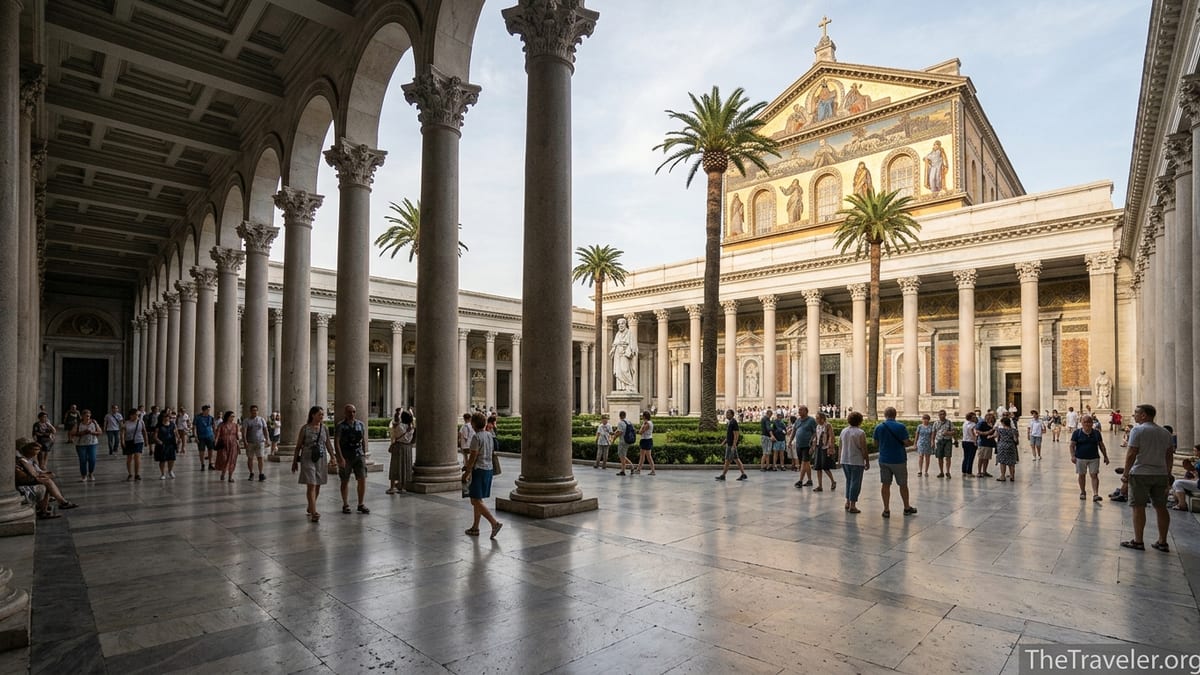
The experience begins even before you step inside. The enormous quadriportico, a four-sided colonnaded courtyard in front of the façade, frames a statue of Saint Paul and offers striking views of the basilica’s upper mosaics. On clear days in the late afternoon, the light catches the gold tesserae and palm trees, making this one of the best photo opportunities on the site. Take a moment to walk slowly across the courtyard rather than rushing straight to the doors.
Inside, the first thing that strikes most first-time visitors is the sense of space. The basilica has a five-aisled plan, with 80 granite columns leading your eye toward the apse. Along the upper walls you will see a continuous row of round portrait medallions depicting every pope from Saint Peter to the present day. Spotting familiar recent popes tucked among centuries of predecessors can be a fun way to engage younger travelers, and it reinforces the sense of continuity that defines this place.
The apse mosaic, a glittering 13th-century work rebuilt after the fire, shows Christ flanked by saints, with Saint Paul prominent. Below, the baldachin over the main altar, dating from the 13th century, shelters what tradition holds to be the tomb of the Apostle Paul. Even if you are not religious, the number of pilgrims praying quietly here helps explain why the basilica is arranged as it is. Nearby, look for the confession, a sunken area with a grate, often decorated with flowers and candles, marking the apostle’s burial site.
In the right transept you may find chapels and altars dedicated to various nations or religious orders, while the left side often hosts temporary displays or devotional shrines. Unlike St Peter’s, you are unlikely to be jostling shoulder-to-shoulder with large tour groups. This calm gives you time to notice details such as the Cosmatesque floors, the varied capitals atop the columns and the patterns in the wooden ceiling, all of which reward close, unhurried looking.
The Cloister, Museum and Quiet Corners
If there is one area worth paying extra for, it is the medieval cloister. Accessed from the right side of the nave, this four-sided courtyard is ringed with slender inlaid columns, many with spiral shafts and mosaic decoration in green, blue and gold. The atmosphere here feels worlds away from the traffic on Via Ostiense, and it is where many visitors say they finally feel they can process the abundance of art and history they have been seeing across Rome.
Along the cloister walls you will see fragments of ancient inscriptions, sarcophagi and carved reliefs recovered from earlier phases of the basilica and its cemetery. While labels are often concise, they give you a sense of just how long this place has been a focus of devotion. In practical terms, the cloister is also a good spot to sit in shade, refill your water bottle if a fountain is operating and take a break from walking. Benches along the walls are used by everyone from school groups to solitary pilgrims reading psalms.
Adjoining the cloister is a small museum, typically included in the same ticket, which preserves precious manuscripts, liturgical objects and art saved from the 1823 fire. The display is more traditional than interactive, but stepping through its rooms provides context that will help you read other Roman churches later. If you are short on time, you can move briskly through the museum and linger longer in the cloister, which most visitors find more memorable.
Elsewhere on the grounds, look for smaller green spaces and side passages that connect the basilica to the monastic buildings. Some doors are strictly for the community and will be marked as such; others lead to bookshops or reception areas where you can inquire about attending Mass or special liturgies. Even if you are not participating in services, pausing for a few minutes in one of these side spaces can give you a more three-dimensional sense of the community that maintains the site.
Planning Your Visit in the Context of a Rome Itinerary
Because Basilica San Paolo lies slightly off the usual tourist circuit, it is worth thinking strategically about when to go. Many travelers find that a morning visit works best: you can take Line B around 9:00 or 10:00, explore the basilica and cloister while they are still relatively quiet, then return toward the center for lunch around the Colosseum or in Testaccio. In the hotter months, this also helps you avoid crossing the quadriportico under intense midday sun.
If you are trying to visit several major churches in one day, pairing San Paolo with San Giovanni in Laterano and Santa Maria Maggiore makes thematic sense, as they are the other papal basilicas on the eastern side of the city. One realistic plan is to devote an entire half-day to San Paolo alone, especially if you want time to sit, reflect and perhaps attend a short service. Rushing through in 30 minutes simply to “tick the box” undercuts what makes the site special.
From a practical standpoint, metro disruptions or strikes do happen in Rome. If you know you must be back in the city center by a particular time, for a timed entry at the Colosseum for example, give yourself extra buffer. A typical visitor who leaves their hotel near Termini at 9:00 could easily travel to Basilica San Paolo, visit the basilica and cloister with unhurried appreciation and be back in the center by early afternoon, leaving space for other sights.
Families and travelers with mobility concerns should budget their energy. The basilica’s interior is mostly flat and wheelchair-friendly, but the sheer length of the nave and the detour through the cloister add up to significant walking. Using the metro avoids some of the uneven cobblestones that dominate the historic center, but there are still stairways and ramps in and around the station. If in doubt, consider a taxi one way and the metro back, breaking up the effort.
Nearby Food, Services and Practical Comforts
One advantage of Basilica San Paolo’s location is its proximity to everyday Roman life. Within a few blocks of the basilica and metro stop you will find neighborhood cafés where locals stand at the counter for their morning cappuccino, simple pizzerie al taglio selling slices by weight and small bakeries offering maritozzi and other Roman pastries. Prices here tend to be more in line with what residents pay than in the heavily touristed zones near Piazza Navona.
For a quick, affordable lunch, a typical pattern is to visit the basilica in the morning, then stop at a nearby bar for a panino or salad before heading back into town. Expect to pay only a few euros for an espresso and pastry at the counter, more if you sit at a table with table service. Around the metro station there are also small supermarkets and convenience stores where you can buy bottled water, fruit and snacks to carry with you, useful if you are continuing on to the catacombs along the Appian Way later.
Public restrooms inside the basilica complex are usually available but sometimes tucked away; ask a staff member or look for discreet signage. As anywhere in Rome, carry a small packet of tissues and hand sanitizer since supplies in public facilities can be inconsistent. The area immediately around the basilica feels like a normal urban neighborhood rather than a tourist hub, so basic precautions apply: keep bags zipped, do not leave valuables unattended on café tables and be mindful of traffic when crossing wide avenues.
Souvenir-wise, the on-site shop tends to focus on religious items such as rosaries, icons and books rather than generic “Roma” trinkets. If you are looking for something specifically linked to Saint Paul or to the Benedictine tradition associated with the abbey, this is the place to buy it. Prices for small items are usually modest, and proceeds help support the maintenance of the basilica and its community.
The Takeaway
Visiting Basilica San Paolo fuori le Mura is less about checking off a famous postcard view and more about experiencing the breadth of Rome’s spiritual and artistic heritage beyond the usual stops. With a short metro ride and a few hours of unhurried time, you gain access to a vast, luminous basilica, a serene cloister and a living monastic community that have quietly shaped the city’s story for centuries.
For first-time visitors, the key is preparation: understand the basic layout, observe a respectful dress code, budget a small amount for the cloister and allow enough time to absorb what you see rather than racing through. In return, you are likely to find a kind of spacious calm that can be hard to come by elsewhere in Rome, especially in peak season.
Whether you come as a pilgrim completing the circuit of the four papal basilicas, an architecture enthusiast tracing the evolution from early Christian forms to later reconstructions, or simply a curious traveler looking for a quieter corner of the city, Basilica San Paolo rewards the effort. Build it into your itinerary not as an afterthought, but as a highlight in its own right.
FAQ
Q1. Do I need a ticket to visit Basilica San Paolo fuori le Mura?
Most of the basilica is free to enter and you do not need a ticket. There is usually a small separate fee only for the cloister and museum area.
Q2. What is the easiest way to get to the basilica from central Rome?
The simplest route is to take Metro Line B in the direction of Laurentina and get off at the “Basilica San Paolo” stop, then walk about five minutes to the church.
Q3. How much time should I plan for a first visit?
Plan at least 1.5 to 2 hours if you want to see the nave, spend some time at the tomb of Saint Paul and visit the cloister without rushing.
Q4. Is there a dress code, and how strict is it?
Yes. Shoulders and knees should be covered inside the basilica. In practice this means no short shorts or strapless tops. A light scarf or cardigan works well as a cover-up.
Q5. Are photos allowed inside the basilica and cloister?
Non-flash photography is generally allowed in the main nave and quadriportico. In some chapels and parts of the cloister, signs may restrict or forbid photos, and these rules should be respected.
Q6. Can I attend Mass even if I am just a visitor?
Yes. Regular Masses are celebrated, and visitors may attend provided they behave respectfully, arrive on time and avoid wandering around to sightsee during the liturgy.
Q7. Is the basilica suitable for visitors with limited mobility?
The main interior is mostly flat and relatively accessible, with wide aisles and few steps. Some areas, such as parts of the cloister or museum, may involve stairs or uneven surfaces.
Q8. Are there places to eat near the basilica?
Yes. The surrounding neighborhood has local cafés, pizzerias and small supermarkets. Prices are typically moderate and geared toward residents rather than tourists.
Q9. Is Basilica San Paolo very crowded like St Peter’s?
Usually it is significantly quieter. While group visits and pilgrim flows can increase numbers at certain times, the basilica rarely feels as congested as St Peter’s Basilica or the Vatican Museums.
Q10. Can I combine a visit here with other nearby sights?
Many travelers combine Basilica San Paolo with a walk in the Ostiense district, a visit to Testaccio or an afternoon trip to other major churches, using Metro Line B and Line A to connect efficiently.