


Premium economy has shifted from niche experiment to core cabin on many long haul airlines, and Emirates is now investing heavily in its own version. By late 2026 the Dubai based carrier has fitted premium economy to well over a hundred aircraft and plans to reach close to 100 destinations. For travelers planning long flights through Dubai, the key question is whether Emirates Premium Economy justifies the extra cost over standard Economy, especially when Business Class remains far more expensive. This article takes a detailed, independent look at the seats, service, pricing and real world trade offs so you can decide if the upgrade makes sense for your style of travel.
Get the latest updates straight to your inbox!
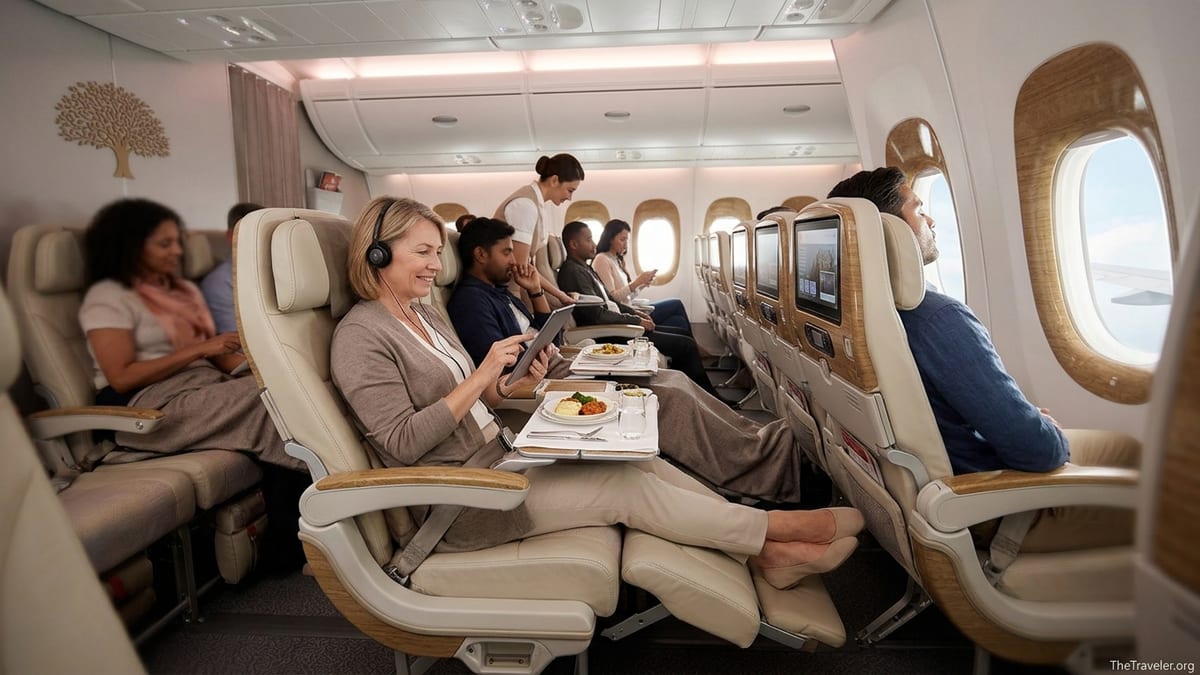
What Emirates Premium Economy Actually Offers in 2026
Emirates launched premium economy on selected Airbus A380s and is now rolling it out across retrofitted Boeing 777 300ERs and new Airbus A350s. The idea is simple: a noticeably more comfortable seat, quieter cabin and upgraded dining without the huge jump to Business Class. In practical terms that means more legroom and width than Economy, deeper recline, leg rests or footrests, larger entertainment screens, better food and drinks, and priority style touches such as earlier boarding on many routes.
Compared with Emirates Economy, the main gains are space and a calmer environment. Economy remains relatively competitive on the A380, but on many 777s the standard economy seat is narrower with a tighter feel, so premium economy creates a bigger comfort gap. Compared with Business Class, however, premium economy is still a recliner seat in a shared cabin, not anything close to a private suite or lie flat bed. It is best viewed as an enhanced economy product, not “business lite.”
The passengers who tend to benefit most are taller travelers, anyone flying overnight sectors of seven hours or more, and those who struggle with leg or back discomfort in regular economy seats. Couples and solo leisure travelers often value the extra comfort for one long leg of a trip. For business travelers, premium economy can be attractive when corporate policies restrict Business Class, or when they are paying out of pocket and want an upgrade that helps them arrive more rested without quadrupling their airfare.
At the same time, Emirates Premium Economy will not suit everyone. Travelers who mainly value privacy and guaranteed real sleep on board will still find Business Class in another league. On short daytime flights of five hours or less, some passengers conclude that the extra space is pleasant but not worth several hundred dollars more. Understanding the concrete differences in seats, service and prices is crucial before you pay the premium.
Seats, Space and Comfort: A380, 777 and A350 Compared
On the Airbus A380, Emirates installs 56 premium economy seats at the front of the main deck in a 2 4 2 layout. Manufacturer and airline materials describe a seat width of about 19.5 inches with up to 40 inches of pitch, meaning legroom that is roughly 8 to 9 inches greater than typical economy rows. The seat reclines about 8 inches into a cradle position with a leg rest and footrest, which together make a noticeable difference on overnight flights. The cabin feels spacious, with higher ceilings and a separate, fairly small section that stays quieter than the main economy cabin behind it.
On retrofitted Boeing 777 300ERs, the same Recaro premium economy seat is installed in a similar 2 4 2 configuration, again with pitch up to around 40 inches and width close to 19.5 inches. This represents a bigger step up from 777 Economy, where Emirates often uses a 10 abreast layout that can feel tight for broad shouldered or tall passengers. Feedback from recent flyers on Dubai to Houston and Dubai to Tokyo routes suggests that the extra legroom and softer cushioning on the 777 are particularly noticeable compared with the older economy cabins on that aircraft type.
The new Airbus A350 fleet introduces an updated premium economy seat with electric controls and a privacy screen. Emirates states that these seats are about 20 inches wide with pitch up to 39 inches. Recline and leg support are adjusted via a simple panel, and the privacy screen between seats can be raised to create a more cocooned feel, especially for solo passengers in aisle seats. Early passenger reports from Dubai to Edinburgh and Dubai to northern Europe routes describe the A350 premium economy as the most refined version so far, with a modern cabin feel and excellent noise levels.
Across all three aircraft types, the entertainment screens in premium economy are larger than those in Economy, with high definition displays in the 13 to 13.3 inch range on recent A380 retrofits and even larger on some new A350s. Each seat offers both AC power and USB charging. Overall cabin lighting and finishes follow Emirates’ updated design with wood effect trim and Champagne colored upholstery, a step that visually signals a premium product but also subtly improves the sense of space and calm during flight.
Cabin Service, Dining, Drinks and Amenities
Emirates positions premium economy service somewhere between Economy and Business, with several elements pulled from the higher cabin. In premium economy you are generally welcomed with a drink in a real glass, often sparkling wine, which sets a different tone from the standard economy boarding experience. Meal services feature upgraded menus, with main courses often plated more attractively and served on china with metal cutlery. Portions are not dramatically larger than Economy, but presentation and variety tend to be better, and appetizer and dessert options are closer to what some airlines offer at the lower end of Business Class.
Across reviews from 2024 to 2026, passengers frequently mention that the soft drinks, tea and coffee service in Emirates Premium Economy feels more attentive than in the rear cabin, with refills easier to request and crew spending more time in the smaller cabin. Alcohol selection includes complimentary beer, wine and spirits similar to Economy, though certain premium labels and cocktails remain reserved for Business Class. The difference many travelers notice most is not the exact drink list but the speed and friendliness of service when the cabin is nearly full.
Amenities in premium economy include a pillow and blanket of slightly higher quality than economy, usually a soft throw style blanket rather than the thin blue economy version, and sometimes an amenity kit with socks, eye mask and dental items on longer overnight routes. Headphones are noise reducing rather than noise cancelling and are a step above the basic economy sets. Wi Fi pricing is the same as in Economy, although some frequent flyer elites may receive complimentary access through their status rather than the cabin alone.
In terms of airport experience, Emirates Premium Economy does not automatically include lounge access. Check in lines may be shorter where a dedicated premium economy counter exists, and boarding is typically called after Business Class and First but before Economy. That helps with overhead bin space and settling in, yet the overall ground experience remains closer to Economy than to Business. Travelers who care strongly about quiet workspace, showers and dining before the flight will still need paid lounge access or a credit card with lounge benefits.
Where You Can Fly Emirates Premium Economy in 2026
Emirates has been rapidly expanding its premium economy network. Company and industry updates in 2026 indicate that more than 130 aircraft now carry the cabin, including a large portion of the A380 fleet, a growing number of Boeing 777 300ERs, and new Airbus A350s joining during 2025 and 2026. Strategic statements suggest a goal of offering premium economy on close to 100 destinations by the end of 2026, with more than 80 routes already regularly scheduled as of mid year.
Specific city pairs that commonly see Emirates Premium Economy include trunk routes such as Dubai to London Heathrow, Dubai to New York JFK, Dubai to Sydney and Melbourne, Dubai to Singapore, and Dubai to Paris and Frankfurt. Expansion has also focused on secondary European cities such as Oslo, Stockholm and Nice, as well as southern hemisphere routes such as Dubai to Perth and Adelaide. In the Americas, the Barcelona to Mexico City fifth freedom service has received a retrofitted 777 with the new cabin, creating an interesting premium economy option that does not require a connection through Dubai.
Availability can still change by season, day of week and aircraft rotation. The most reliable way to check is through Emirates’ booking engine for specific dates, then double checking the seat map for a distinct premium economy cabin between Business and Economy. Some third party booking sites may show only “Economy” and “Business” while still selling premium economy as a higher economy fare, so it is worth verifying directly with the airline before you commit, especially if the extra space is crucial for medical or mobility reasons.
When a trip involves connections, you may find premium economy on one sector but only Economy on a shorter connecting leg. Emirates generally prices this as a mixed cabin ticket, with the long haul leg in premium economy and the shorter hop in Economy. In practice that means you get the premium economy experience only on the eligible flight, though your baggage allowance and some fare conditions may reflect the higher cabin across the ticket. Travelers should read the fare rules for each segment and not assume that one premium economy leg upgrades the entire journey.
Hard Numbers: How Prices Compare to Economy and Business
Pricing is one of the most important variables in deciding whether Emirates Premium Economy is worth it. Fares fluctuate constantly, but recent searches in late 2026 show some consistent patterns. On busy trunk routes such as New York to Dubai in the northern winter, a return Economy ticket might price around 1,000 to 1,300 US dollars, with Premium Economy often in the 1,800 to 2,300 dollar range and Business Class starting well above 4,500 dollars. That places premium economy at roughly 60 to 100 percent more than Economy, but still far less than half of Business.
On Europe to Dubai routes such as London Heathrow to Dubai, off peak Economy returns sometimes appear around 600 to 800 pounds sterling, with Premium Economy between 1,000 and 1,400 pounds and Business from 2,000 pounds upward. On medium haul routes where premium economy is available, such as Dubai to Singapore or Dubai to Johannesburg, the premium over Economy may sometimes be narrower, perhaps 40 to 70 percent higher, especially outside holiday peaks. By contrast, last minute or peak holiday travel can see gaps of more than 1,000 dollars or euros between Economy and Premium Economy, reflecting strong demand for extra comfort.
Upgrade costs also vary when moving from an existing Economy booking. At online check in or at the airport, Emirates sometimes offers fixed price upgrades if premium economy seats remain unsold. Passengers have reported figures in the 400 to 800 euro range one way on long haul flights such as Dubai to Europe, while others have mentioned higher amounts on transpacific and US routes. These examples are anecdotal and can change at any time, but they illustrate how upgrade pricing can approach or exceed the original base fare in Economy. That makes it essential to compare the total cost of buying Premium Economy from the start versus gambling on a last minute upgrade offer.
One way to make sense of the price difference is to calculate the additional cost per flight hour. Suppose you are choosing between a 900 dollar Economy ticket and a 1,700 dollar Premium Economy ticket on a 14 hour sector between Dubai and the US west coast. The premium economy option costs 800 dollars more. Dividing that by 14 hours gives around 57 dollars per flight hour for the extra space, better food and quieter cabin. Each traveler must decide whether that hourly cost is worthwhile compared with spending the money on a better hotel, activities at the destination, or saving toward a Business Class deal on another trip.
Who Benefits Most: By Trip Type and Traveler Profile
On overnight long haul flights of eight hours or more, Emirates Premium Economy tends to deliver the most value. The combination of extra legroom, deeper recline and leg support allows many passengers to find a semi comfortable sleeping position that is hard to achieve in standard economy. Tall travelers in the 6 foot and above range often report that being able to extend their legs without hitting the seat in front is the single biggest improvement, especially on the Boeing 777 where economy pitch can feel tight.
Couples traveling together appreciate the 2 4 2 layout, as window pairs on the A380 and many 777s allow two people to sit together without a third stranger in the row. Families sometimes book premium economy for parents while older children stay in Economy, or they may place one adult in premium economy and the other parent with younger children in economy to manage costs. For small children, the extra recline is not as important as space to move around, so families should weigh whether the premium is better spent on extra checked baggage or a hotel stopover to break a very long journey.
For business travelers whose companies will not pay for Business Class, premium economy can be the difference between arriving semi rested and arriving exhausted. The more supportive seat, smaller cabin and upgraded menus help some passengers feel that they have had a productive rest even without a flat bed. However, others note that they still cannot sleep properly without lying flat, and therefore prefer to save company or personal money by staying in Economy and investing in a better hotel room on arrival.
Daytime flights present a different calculation. On a six or seven hour daylight sector from Dubai to Europe, the extra space and nicer dining make the journey more pleasant, but many travelers do not feel they recover enough time or comfort to justify several hundred dollars more. In those cases, premium economy often makes sense when the fare difference is relatively small, such as 200 to 300 dollars more one way, or when a medical condition or very tall height makes standard economy genuinely uncomfortable rather than merely inconvenient.
Drawbacks and Limitations Travelers Should Know
Despite the attractive marketing, Emirates Premium Economy has real limitations. The most obvious is that the seat does not convert into a bed. Even with 8 inches of recline and a leg rest, you remain in a seated position. Passengers who have sampled both premium economy and Business Class on Emirates consistently describe the difference in sleep quality as dramatic. If your priority is to arrive fully rested after a 14 hour sector, and you can find a competitive Business Class fare, premium economy is unlikely to be a true substitute.
Privacy is another constraint. Premium economy cabins are smaller than the main economy cabin, which keeps noise levels down, but they are still open spaces with multiple seats in a row. There are no closing doors or fully enclosed shells, and you are still reliant on the habits of neighbors who may talk, watch films without headphones or move around frequently. The A350’s electric privacy screens between seats improve things slightly, but this is still far from the single aisle access, staggered or suite layouts common in modern Business Class.
Aircraft availability can also be an issue. Emirates continues to retrofit and redeploy aircraft, which means an advertised premium economy route may occasionally be served by a plane without the cabin on certain days or during seasonal schedule changes. In those cases the airline usually rebooks passengers into Economy and may offer a partial refund or miles, but expectations should be set accordingly. Travelers who absolutely require extra legroom for medical or mobility reasons should have a back up plan, such as reserving exit row or bulkhead seats where possible.
Finally, Emirates Premium Economy can be expensive relative to the additional comfort it provides. Some frequent flyers argue that on many routes the product is priced as if it were a small step down from Business, rather than a larger step up from Economy. Comments from regular travelers in 2025 and 2026 often mention fare gaps of 800 to 1,200 dollars between Economy and Premium Economy on busy travel dates. For some, that premium delivers clear value. For others, especially those who still struggle to sleep without a bed, the extra recline and better meals do not justify the cost compared with sticking to Economy and spending the difference elsewhere.
Passenger Feedback: Common Praises and Complaints
Recent passenger reviews across travel blogs, aviation sites and discussion forums paint a broadly positive but nuanced picture of Emirates Premium Economy. Many travelers praise the spacious seats on the A380 and A350, noting that legroom feels comparable to or better than premium economy products from other major carriers. Several reviewers describe sleeping four to six hours on overnight flights between Dubai and Asia or Europe, something they find very difficult in standard Economy. The overall ambiance of the cabin, with softer lighting, quieter surroundings and higher quality finishes, is often singled out as a major plus.
Food and beverage service draws generally favorable comments, with multiple passengers comparing the quality to what some competitors serve in business on regional flights. Travelers highlight details such as sparkling wine in real glasses after boarding, well seasoned main courses and desserts that feel like a step above economy. Crew attention is also consistently praised, with many saying that the smaller cabin makes it easier to request water, snacks or extra tea and coffee without long waits.
On the negative side, recurring complaints revolve around pricing, sleep quality and expectations that are not properly managed. A noticeable group of passengers reports that they did not sleep significantly better in premium economy than in economy, despite the extra recline, and felt the upgrade cost was out of proportion to the benefit. Others express frustration when last minute aircraft swaps remove the premium economy cabin they booked, leaving them in Economy with little compensation beyond a partial refund of the fare difference.
Some travelers also comment that while Emirates Premium Economy is a very strong product, the airline’s marketing occasionally oversells it as a near business class experience. Passengers comparing it directly with Emirates Business Class, especially on the A380 with its bar and fully flat seats, invariably judge Business to be in a completely different category. For prospective buyers, the key lesson from this feedback is to view premium economy as an enhanced economy seat that can significantly improve comfort, but not as a discounted version of Business Class.
How to Decide: When Emirates Premium Economy Is Worth It
For many 2026 travelers, the most rational use of Emirates Premium Economy is selective. The cabin is most compelling on overnight or ultra long haul flights such as Dubai to North America, South America or Australasia, particularly when the price difference over Economy is moderate rather than extreme. If the premium works out to 30 to 60 dollars per flight hour and you value extra space, you may judge that a fair trade for arriving with less fatigue. Tall passengers, those prone to back or leg pain, and travelers who must be reasonably functional on arrival for work or important events are likely to see the greatest benefit.
On daytime or shorter sectors of six to eight hours, premium economy becomes more of a discretionary comfort purchase. It may still be worthwhile if you find a sale that prices the cabin only a few hundred dollars above Economy, or if you combine it with a longer overnight leg in the same cabin. In contrast, when the price gap exceeds several hundred dollars each way and you do not expect to sleep much regardless of seat type, it may be more logical to stay in Economy and allocate that budget to hotels or experiences on the ground.
Comparing with Business Class is another important step. On some off peak dates, especially ex Europe or ex Asia, Emirates occasionally prices Business Class sales at levels that are only 50 to 70 percent more than Premium Economy. When that happens, travelers who care most about real sleep and privacy may be better off upgrading again to Business, gaining a fully flat bed, more personal space and a far superior airport experience. Conversely, when Business remains three or four times the price of Premium Economy, the middle cabin offers a way to significantly improve comfort without a huge financial leap.
Ultimately, deciding whether Emirates Premium Economy is worth it in 2026 comes down to your priorities on a specific trip, the exact fare difference you face, and how much you value in flight comfort compared with what you could buy on the ground. If you go in expecting a spacious, well finished recliner seat with upgraded service in a quieter cabin, you are likely to be pleased. If you expect a near business class experience or a guaranteed full night of sleep, you may be disappointed. Make your decision using concrete numbers per flight hour and a realistic sense of your own sleep habits, and Emirates Premium Economy can be either a smart upgrade or a luxury you can happily skip.