


For many travelers, Helsinki Airport is their first encounter with Finland: a quiet, light filled terminal famous for Nordic design and efficient operations. In recent years it has also become one of Europe’s key transfer hubs, raising a practical question for anyone planning a trip through the Finnish capital: is Helsinki Airport actually easy to use in real life, or does its reputation gloss over hidden bottlenecks and frustrations? Drawing on recent awards, operator updates and fresh traveler reports, this guide looks at how the airport performs from curb to gate.
Get the latest updates straight to your inbox!
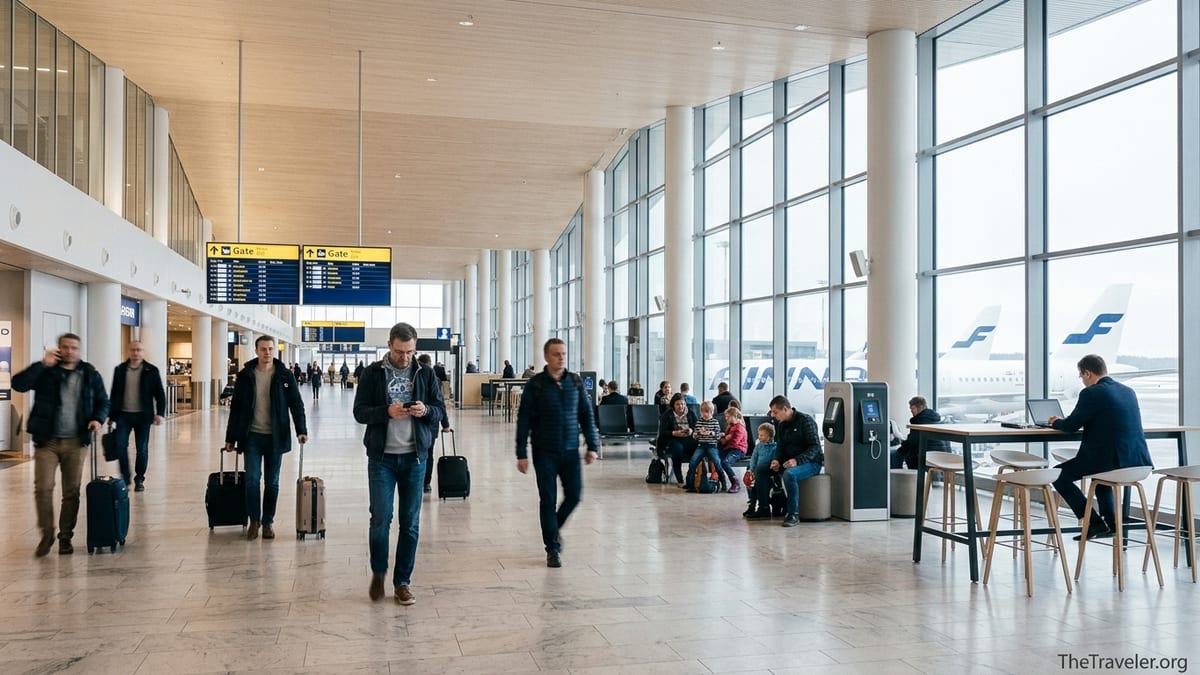
Helsinki Airport’s Reputation vs Traveler Reality
Helsinki Airport consistently ranks among Europe’s better performing hubs for passenger experience. In 2024 it was again named the best airport in Northern Europe in the Skytrax global survey, with passengers praising its comfort, cleanliness and staff service. Independent ratings currently classify it as a 4 Star Airport, a level that reflects strong but not flawless performance across facilities and customer service. These accolades set high expectations for anyone passing through.
Travelers arriving today find a modern, single terminal layout serving both Schengen and non Schengen flights, with domestic and European routes typically using gates in the low 30s and long haul flights to Asia and North America departing from the higher numbered non Schengen gates. Walking times between most European gates are often quoted around 5 to 10 minutes, and even the farthest non Schengen gates are usually reachable in roughly 10 to 15 minutes at a relaxed pace. For many passengers this compact footprint is one of the biggest advantages compared with sprawling hubs like Frankfurt or Paris Charles de Gaulle.
At the same time, traveler feedback shows that experience can vary by time of day and how well prepared you are. Peak morning banks on weekdays and periods of rule changes at security have produced temporary queues and frustration, particularly among transfer passengers tight on time. Overall, though, the balance of recent reports suggests Helsinki remains easier to navigate than most similarly busy European airports, especially for those willing to follow signage and arrive with a modest time buffer.
In other words, the reputation is broadly earned, but the airport is not immune to the same pressure points seen elsewhere: security rules, passport control peaks, and occasional confusion around ground transport and late night services.
Finding Your Way: Layout, Signage and Digital Maps
The ease of using any airport starts with wayfinding. Helsinki Airport’s main strength here is its single terminal concept. All check in, security, and boarding operations are concentrated in one integrated building with a clear separation between Schengen and non Schengen zones rather than multiple disconnected terminals. For a traveler connecting from, say, a Finnair flight from London to a Finnair service to Tokyo, that means staying within one continuous space instead of changing terminals by bus or train.
Signage around the building is multilingual, with Finnish, Swedish and English everywhere and additional languages such as Chinese or Japanese in key transfer corridors. Overhead signs are large, color coded and supported by consistent pictograms. A traveler arriving from North America and heading to an intra Schengen connection can usually follow a simple sequence of signs from arrivals through passport control to transfer security and onwards to gates in the low numbers without needing to ask staff for directions.
To complement physical signs, the airport operator has invested in digital navigation tools. In 2025 a new 3D terminal map was rolled out, designed to let passengers search for a specific gate, shop or café and then see the walking route on their phone. The map can be rotated and zoomed, making it easier to understand different levels and to judge walking times. In practice, a traveler landing at gate 50 and looking for a pharmacy or a children’s play area can pull up the map, tap the destination and see a route before deciding whether to stop or head straight to the connecting gate.
Real world accounts suggest that most travelers find the combination of clear physical signage and digital maps more than sufficient. Complaints about getting lost are rare compared with anecdotes about confusion at larger airports. When problems do occur, they tend to involve special cases, such as passengers following crowd flow rather than the “Transfer” signs, or people arriving late at night when some information desks are closed.
Security, Passport Control and Recent Bottlenecks
Security and border control are the points where an otherwise smooth airport can suddenly become stressful. At Helsinki, the last two years have included both stretches of very short queues and brief periods of disruption. One well documented episode came in early September 2024 when the European Union’s stricter 100 milliliter liquids rule was reintroduced. Many travelers arrived at Helsinki Airport still carrying large liquid items in their cabin bags and had to repack at the checkpoint. The result was a few days of heavier congestion and missed flights for some passengers, particularly those on tight Finnair connections.
According to the airport operator, those problems were largely resolved within a week as additional staff were deployed and travelers adapted. By mid September, media reports described security waiting times at Helsinki’s busy early morning peak as around 5 to 10 minutes. Even so, that short burst of disruption highlights how sensitive airport experience is to rule changes and passenger preparation. On normal days, travelers with standard luggage and familiar with liquids and electronics rules generally move through quickly, especially outside of the early morning and late afternoon banks.
Passport control performance depends on whether you are entering or leaving the Schengen area and what time your flight arrives. Travelers connecting from Asia or North America into Schengen sometimes report waits of 20 to 40 minutes at passport control during busy mid morning waves when several long haul flights arrive close together. At quieter times, the same process can take under 10 minutes using the automated gates for eligible passport holders. For non Schengen departures, the outbound passport check is usually faster, since flows are more spread out through the afternoon and evening.
The takeaway for passengers is pragmatic. Helsinki is often quicker and calmer at security and border checks than many peers, but it is not magically immune to queues. Leaving at least two hours before departure from the city center, and allowing more time during school holidays or winter storms, remains good practice even at this relatively efficient hub.
Transfers, Short Connections and Overnight Stays
Because of its geographic position between Western Europe and Asia, Helsinki Airport has built much of its business on quick transfers. Finnair schedules many flights with tight minimum connection times, sometimes around 35 minutes between certain Schengen and non Schengen routes. Travelers used to sprawling airports are often skeptical that such short connections are realistic, but frequent flyers through Helsinki report that these tight transfers are regularly achieved when flights arrive on time.
A typical example would be a passenger arriving from a domestic flight from Oulu and connecting to an international service to St Petersburg via Helsinki. With carry on luggage only, they might step off the arriving aircraft, follow “Transfer” signage, pass through passport control if needed, and be at the onward gate in under 20 minutes. Travelers on longer intercontinental connections, like Tokyo to various European cities via Helsinki, often remark that the ability to walk between gates without shuttle buses is a major advantage, especially in winter when outdoor transfers at other airports can be uncomfortable.
However, short connections are inherently risky when delays occur. Several traveler reports describe near misses when inbound long haul flights parked at distant non Schengen gates and then faced queues at transfer security or passport control. For travelers who are risk averse, booking at least 60 to 90 minutes between flights through Helsinki is a safer choice, particularly when traveling with children or checked baggage that must be transferred between aircraft.
For overnight stays, the experience is more mixed. Helsinki Airport operates around the clock, but parts of the terminal are quiet after midnight and some shops and restaurants close in the late evening. A few travelers report sleeping overnight landside or airside in quiet seating areas or semi dark gate zones, making use of sleep pods and reclining chairs where available. While airport staff generally tolerate peaceful overnight stays, the environment is not as optimized for sleeping as some larger hubs with dedicated 24 hour transit hotels.
Ground Transport, Taxis and Access to the City
Ease of use does not stop at the terminal doors. One of Helsinki Airport’s biggest practical advantages for visitors is its integrated rail connection. A dedicated station beneath the terminal offers frequent trains to central Helsinki, with journey times of roughly 30 minutes to major downtown stops. Trains run in both directions via two alternative loops, and ticket machines are located in the arrivals hall and at the platform entrance. For independent travelers arriving with moderate luggage, especially during rush hours, the train is often the simplest way to reach the city center.
Besides rail, frequent buses connect the airport with various suburbs and regional destinations. However, for many visitors the decision is between train and taxi. Here, first time travelers should be aware of occasional price confusion. Local discussions in 2024 highlighted that official taxi stands sometimes advertise a fixed fare in the region of 35 euros to downtown Helsinki. While this is not extreme by Nordic standards, ride hailing apps such as Uber and Bolt often quote slightly lower prices for the same journey, closer to the high 20 euro range depending on demand. The difference is not enormous, but some travelers feel misled when they realize they paid a premium simply by walking to the first visible taxi queue.
For the most straightforward experience, travelers can compare the train ticket price to app based taxi fares on arrival and choose based on budget and luggage. For example, a solo traveler with a cabin bag might find the train cheaper and faster during peak traffic, while a family of four with large suitcases arriving late at night could find a door to door taxi more comfortable, even at a modest premium. Rental car desks are clustered in a clearly signposted area connected to the terminal, but driving into central Helsinki is rarely necessary or convenient for short stays.
Overall, the combination of underground rail, clear signage for buses and generally transparent pricing makes getting to and from Helsinki Airport more straightforward than in many European capitals. The main caveat is to check taxi prices before accepting a ride from the stand and to be aware that late night options are more limited than in a 24 hour megacity.
Comfort, Services and What Travelers Notice Most
Inside the terminal, Helsinki leans heavily into Finnish design aesthetics and a calm atmosphere. High ceilings, natural wood surfaces and large windows with views of the apron create a sense of light and space uncommon in many older airports. Many travelers comment on how quiet the terminal feels compared with similarly sized hubs, with fewer constant announcements and a more relaxed pace even during busy times.
The airport has invested in seating, charging points and workspaces. Power outlets are widely available, and there are several quiet zones and dedicated work areas where passengers can use laptops. Families benefit from children’s play areas in both Schengen and non Schengen zones, while nursing rooms and accessible restrooms are relatively easy to find using overhead signs and the digital map. There are multiple lounges, including airline operated spaces and an independent pay in lounge that offers basic hot and cold food, drinks and Wi Fi for a fixed fee. In 2025, a new co branded executive lounge opened in cooperation with a Finnish financial group and an international lounge operator, adding capacity for premium and pay in customers.
Food and shopping options are solid rather than overwhelming. Travelers find the usual mix of Nordic coffee chains, international fast food outlets, duty free shops and Finnish specialty stores selling local design, cosmetics and chocolate. Prices reflect Finland’s high cost of living: a basic coffee and pastry can easily cost around 7 to 10 euros, and sit down restaurant meals are more expensive than in southern Europe. On the positive side, quality is generally good and service standards are polite and efficient, which many travelers note as a distinguishing factor compared to similarly priced airports elsewhere.
Wi Fi is free and widely reported as reliable throughout the terminal, which makes it easier to manage last minute bookings, check onward transport, or call ride hailing services on arrival. For travelers with long layovers, some choose to leave the airport entirely and visit nearby attractions such as the Flamingo entertainment and spa complex, a short taxi or bus ride away, or to head into central Helsinki by train if they have more than six hours between flights.
What Recent Traveler Stories Reveal
Beyond awards and operator claims, everyday passenger stories provide a more nuanced picture of how easy Helsinki Airport really is to use. On traveler forums and social media, several themes appear repeatedly. Many visitors describe security and border staff as professional and generally friendly, noting that interactions feel less rushed or confrontational than at some larger hubs. Others recount consistently smooth transfers where even short connections worked thanks to clear directions and short walking distances.
At the same time, not all experiences are positive. A minority of passengers report instances of curt service or confusion, particularly when language barriers arise or when travelers approach a staffed booth that appears open but is not actually processing passengers. Some recount early morning or pre holiday queues at security where under prepared passengers with large quantities of liquids slowed down lines, reinforcing the importance of packing correctly. A few long haul travelers arriving from Asia mention that queues at passport control can feel long when several flights land back to back, even if the actual waiting time is still under an hour.
Ground transport stories also reveal learning points. Several visitors have shared public service announcements about taxi pricing, noting that using a ride hailing app from just outside the terminal often results in a noticeably lower fare than taking the first car at the official stand. Others praise the train connection for its reliability, pointing out that even in winter weather the rail link has been a more dependable choice than road transport in icy conditions.
Overall, the pattern is consistent: when travelers are informed and allow reasonable time, Helsinki Airport delivers a smooth, easy to use experience that lives up to its strong ratings. When problems do arise, they tend to be linked to tight schedules, misunderstanding of security rules, or not checking transport options beforehand rather than inherent flaws in the terminal design.
The Takeaway
So, is Helsinki Airport easy to use? For most travelers the answer is yes, especially compared with many other European hubs of similar size. The single terminal layout, clear multilingual signage, new 3D digital maps and integrated rail station all work together to make navigation straightforward. Short walking distances and generally calm spaces mean that even first time visitors can often move from curb to gate without drama.
However, like any busy international airport, Helsinki has its pressure points. Security can slow down when rules change or when many passengers forget to prepare liquids and electronics. Passport control queues build at peak arrival waves from Asia and North America. Prices for food and taxis are high by global standards, and late night services are more limited than in larger cities. Travelers who cut timings too fine, arrive with disorganized bags, or rely solely on assumptions about ground transport are the ones most likely to encounter stress.
For those planning a trip, the most practical approach is to treat Helsinki as a well designed, user friendly hub that still rewards preparation. Aim for realistic connection times, read up on liquids rules before packing, compare taxi prices with the train on arrival, and use the digital maps to locate services. Do that, and you are likely to experience the airport in the way many seasoned travelers describe it: compact, efficient and unexpectedly pleasant.
FAQ
Q1. Is Helsinki Airport easy to navigate for first time visitors?
Yes, most first time visitors find Helsinki Airport straightforward. The single terminal layout, clear overhead signs in several languages and digital 3D map make it relatively simple to move from arrivals to departures or between gates without getting lost.
Q2. How much time do I need for a transfer at Helsinki Airport?
Many travelers successfully make official minimum connections of around 35 minutes, but for comfort it is wiser to aim for at least 60 minutes between flights, and 90 minutes if you need to clear passport control or are traveling with children or checked baggage.
Q3. Are security queues usually long at Helsinki Airport?
On most days security queues are moderate, especially outside early morning peaks. During busy periods or after rule changes, lines can build, so arriving at least two hours before departure is still a sensible guideline.
Q4. What is the best way to get from Helsinki Airport to the city center?
The train from the station under the terminal is usually the best balance of speed and price, taking about half an hour to central Helsinki. Taxis and ride hailing cars are also available, with app based services often slightly cheaper than fixed fares from the official taxi stand.
Q5. Is Helsinki Airport good for short overnight stays or sleeping in the terminal?
Some travelers do sleep overnight in the terminal, using quieter gate areas or dedicated rest zones, but services are reduced late at night and the airport is not optimized as a full 24 hour transit hotel. For more comfort, a nearby airport hotel is a better choice.
Q6. How family friendly is Helsinki Airport?
Helsinki Airport is generally family friendly, with children’s play areas, nursing rooms and plenty of seating with charging points. The compact layout helps families move between gates without long walks, though food prices can feel high for those on a budget.
Q7. Are the staff at Helsinki Airport helpful to international travelers?
Most reports describe staff as professional and reasonably friendly, with good English skills. While isolated complaints exist, particularly during busy periods, overall interactions with security, check in and information staff are rated positively compared with many other major airports.
Q8. Is Wi Fi reliable and free at Helsinki Airport?
Yes, the airport offers free Wi Fi throughout the terminal. Travelers generally report that the connection is stable and fast enough for streaming, video calls and managing bookings during layovers.
Q9. Can I make a very short connection when arriving from outside Schengen?
It is possible, and many do, but a very short connection when arriving from outside Schengen carries risk because you must clear passport control and possibly transfer security. If you prefer a stress free experience, consider booking a slightly longer connection time.
Q10. Is Helsinki Airport a good place for a long layover?
For layovers of more than five or six hours, Helsinki Airport works well. You can relax in lounges, explore shops and cafés, or take the train into central Helsinki if timing allows. For very long daytime layovers, combining some airport time with a quick city visit can make the most of your stop.