


Isla Holbox has gone from backpacker secret to glossy social media star in less than a decade. The low-key sand streets, golf carts instead of cars and long empty stretches of shallow turquoise water still exist, but so do rising prices, heavier crowds in peak season and very real logistical quirks. If you are weighing Holbox against other Mexican beach destinations for a trip in late 2026 or 2027, it helps to look closely at what the island is really like now, how much you are likely to spend and what limitations you need to plan around.
Get the latest updates straight to your inbox!
What Holbox Is Like Today and Who It Suits
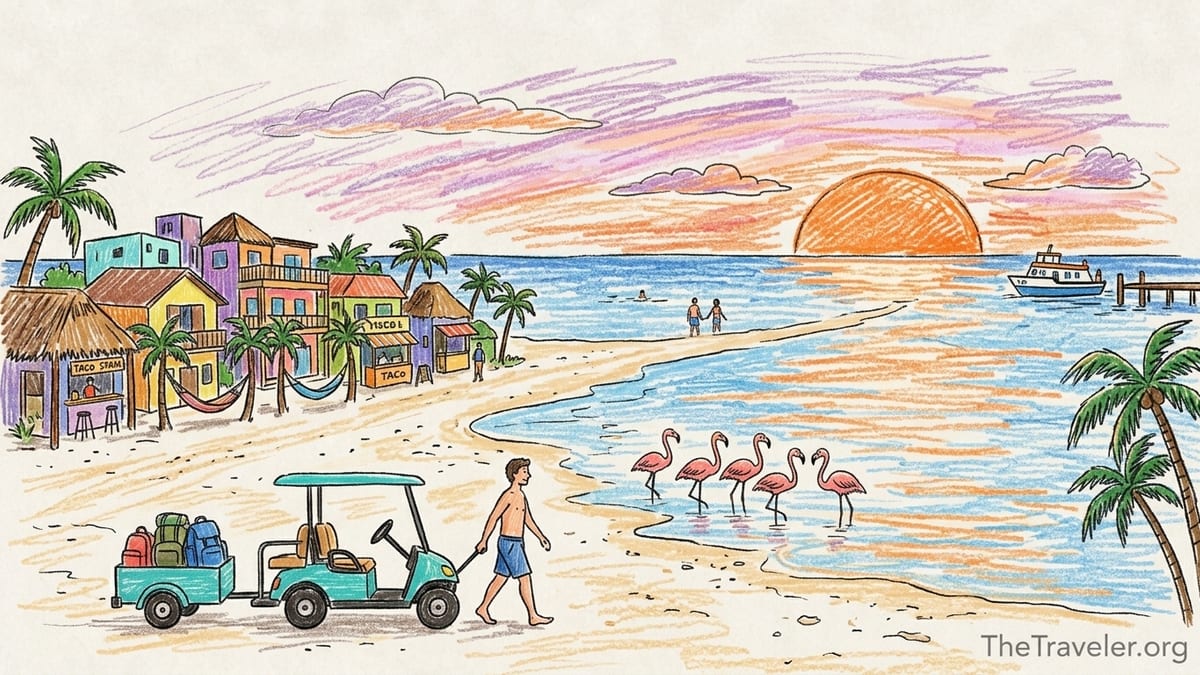
Holbox sits off the northeast tip of the Yucatán Peninsula, inside the Yum Balam protected area. It is reached from the small mainland port of Chiquilá and remains technically car-free for visitors, which is part of the appeal. There are no big city skylines, and much of the main town is still a grid of sandy streets lined with small hotels, taco stands, cocktail bars and tour kiosks. At the same time, development has accelerated along the beachfront, with more boutique hotels, beach clubs and even international brands appearing in recent years, so the island no longer feels like an untouched fishing village.
The main draw is the combination of wide, shallow beaches and a relatively relaxed atmosphere compared to places like Cancún, Playa del Carmen or even nearby Isla Mujeres. Instead of loud mega-clubs, evenings center on sunset drinks at beach bars, dinner at small restaurants in town and the occasional live music set. Recent traveler reports from early and mid 2026 describe Holbox as lively but still walkable and manageable if you stay close to town, with the caveat that it can feel crowded on holiday weekends when ferries and golf carts are busy and restaurant waits stretch past an hour.
Holbox is best suited to travelers who value atmosphere and scenery over full resort infrastructure. If you are comfortable with patchy sidewalks, occasional flooding after heavy rain and very limited medical services, the island rewards you with long sandbars you can wade for hundreds of meters, sunrises on the mangrove side and sunsets over the open Gulf. Those expecting perfectly manicured beaches, flawless roads and nonstop entertainment usually do better in more developed resort areas.
Families with children, couples and solo travelers regularly visit. Families often appreciate the shallow water off the main beaches, while couples focus on boutique hotels with on-site beach clubs. Solo travelers tend to base around the central square where cafes and bars cluster together. The main caveat for any group is that Holbox’s infrastructure has lagged behind its popularity, so you need to plan for the occasional outage or weather disruption as part of the experience rather than a surprise.
How to Reach Holbox and Understand the Ferry Logistics
Reaching Holbox almost always involves flying into Cancún, taking ground transport to Chiquilá and then a short ferry across to the island. The drive from Cancún Airport to Chiquilá takes around two and a half hours by road, usually via the toll highway and then smaller roads. Travelers can book shared shuttles, private transfers or make the trip independently by rental car or long-distance bus. As of late 2026, private shuttles from Cancún Airport to Chiquilá commonly quote prices in the region of 180 to 260 US dollars each way for a small group in a van, while shared services reduce the cost per person but add extra travel time and stops.
For independent travelers, buses from Cancún or Valladolid to Chiquilá are a lower-cost option. The main long-distance bus operator serves Chiquilá several times a day from Cancún central bus station and from Mérida and Valladolid, with fares often in the range of what you might pay for a typical intercity trip elsewhere in the Yucatán rather than resort premiums. Schedules change seasonally, so it is worth confirming current departure times shortly before you travel and allowing a generous buffer when connecting with flights, especially in the wet season when roads can slow down due to heavy rain.
From Chiquilá, the ferry crossing to Holbox generally takes about 20 to 25 minutes. Two main companies, Holbox Express and 9 Hermanos, run boats that alternate, meaning there is usually a departure roughly every 30 minutes from early morning until the evening. Information compiled in autumn 2026 indicates that combined service starts around 5:00 in the morning and runs until about 21:30 in both directions. A standard one-way ticket for adults costs about 300 Mexican pesos, or slightly more on some official tariff lists, and there are discounted fares for children and residents of Quintana Roo. Tickets are bought in person at the small terminals in Chiquilá or Holbox on the same day in most seasons.
It is rare to need to prebook ferry tickets, and boats are used to handling luggage for holidaymakers. The main constraint is timing. On busy Christmas, Easter and summer holiday weekends, long lines at the pier can form in the middle of the day, and the last evening ferries may sell out. Travelers arriving on late flights into Cancún risk missing the last departure, so many choose to spend a night in Cancún or Chiquilá if their plane lands after late afternoon. Parking lots in Chiquilá typically charge a daily fee for leaving a rental car, and several local companies offer open-air, though usually secure, lots a short walk from the pier.
What It Really Costs: Accommodation, Food and Activities
Holbox is no longer a reliably low-budget destination, but it still offers a spread of price points. Recent price aggregations using global hotel search data suggest the average nightly rate across all properties on Holbox sits a little above 100 US dollars, with budget hotels and guesthouses often clustering around 40 to 60 dollars per night and higher-end beachfront boutique hotels and small resorts commonly charging anywhere from about 200 to over 400 dollars per night in the busiest months. Booking platforms in late 2026 show that a three-star hotel on an upcoming high-season weekend typically lists around 130 to 150 dollars per night, while many four-star options fall between roughly 200 and 260 dollars.
Real traveler reports from 2025 and early 2026 back up this spread. Some visitors describe staying in simple but well-located hotelitos in town for under 100 dollars per night, while others recount splurging on design-forward beachfront suites at around 500 dollars per night during February and March. For a rough budget, two people staying in a mid-range hotel near the beach should expect to spend in the region of 150 to 250 dollars per night in high season, a bit less in the shoulder months of May, early June, October and early November, and sometimes more on New Year’s week and Easter.
Food prices reflect the island’s popularity but have shown some softening according to recent traveler discussions, especially as more mid-range and casual spots open. A simple breakfast of huevos rancheros, fruit and coffee in a local cafe might cost the equivalent of 7 to 10 US dollars per person, while a fish taco lunch at a casual stand could fall in the 5 to 12 dollar range depending on drinks. Dinner for two at a busy but not luxurious restaurant, with a shared appetizer, two mains and a couple of cocktails, often lands around 45 to 70 dollars in current reports. Fine-dining style venues featuring tasting menus, wine pairings or elaborate seafood plates can run notably higher.
Activities add another layer to the budget. Classic Holbox excursions, such as boat trips to see whale sharks in season, three-island tours or kayak paddles through mangroves, are priced closer to what you would pay in developed Caribbean destinations than in remote backpacker towns. Whale shark tours are usually among the most expensive, often quoted in the low to mid hundreds of US dollars per person, partly because they involve fuel-intensive boat rides out to open water with licensed guides and strict regulations. Shorter excursions like bioluminescence night tours or mangrove kayaking run considerably less and can fit into a mid-range budget more easily.
Cash, Cards and the Practicalities of Island Life
Holbox has a reputation for inconsistent banking infrastructure. An advisory note from Mexican authorities about visiting Holbox has long recommended arriving with enough cash, pointing out that for years there was only a single ATM and no full bank branches on the island. Although additional machines and card-accepting businesses have appeared as tourism has grown, reliability still fluctuates. Visitors in 2025 and 2026 regularly report that ATMs sometimes run out of cash for hours at a time, especially on busy weekends, or that transaction fees and limits are higher than on the mainland.
In practice, most mid-range and upper-end hotels, established restaurants and beach clubs accept major credit cards. However, street food stalls, small family-run eateries, independent tour guides and casual services like laundry and local taxis using golf carts often prefer or require cash. Several recent travelers describe a mixed approach working best: withdrawing a main stash of pesos at the airport or in Cancún, then using island ATMs only as backup. For a typical week-long stay, many visitors feel comfortable bringing the equivalent of several hundred US dollars in pesos per person to cover daily expenses, tipping and any situations where card payments fail.
Other day-to-day details also matter more on Holbox than in cities. Electricity cuts, while not constant, still occur, particularly during storms or periods of high demand. Most modern hotels have backup systems to keep at least fans and essential lighting running, but simple guesthouses may rely entirely on the grid. Water pressure in some neighborhoods can be modest, and tap water is not potable, so buying bottled or filtered water is standard. Mobile reception has improved, yet some international visitors still find service patchy, especially away from town or during island-wide network issues. Downloading offline maps and key reservations in advance is useful.
Transportation on Holbox centers on walking, bicycles and golf cart taxis. From the ferry pier to hotels on the main part of the island, many travelers simply walk on sand streets while porters with tricycle carts offer luggage help for a small fee. Golf cart taxis wait near the pier to take guests and suitcases to more distant hotels, with fares quoted by zone. Short rides cost less and are often shared, while hiring a cart privately for trips to far-flung beaches increases the price. Because roads can be rough and puddled after rain, comfortable sandals or shoes make day-to-day exploring easier than flip-flops alone.
Seasonal Limitations: Rain, Hurricanes, Sargassum and Wildlife
Seasonality shapes life on Holbox more than many first-time visitors realise. Broadly, December through April is the dry season, with warm temperatures and lower rainfall, which aligns with peak tourism. From around June through October, the region enters its rainy and hurricane season, when storms and heavy downpours are more frequent and some unpaved streets flood. While many travelers still enjoy visiting in these months, particularly for lower hotel prices in parts of May, June and September, they need to be more flexible about ferry delays, temporary power failures and rescheduled excursions due to rough seas.
Holbox is relatively fortunate when it comes to sargassum, the drifting seaweed that has heavily affected many Caribbean beaches. Satellite-based monitoring by Mexican authorities, as well as independent trackers and recent on-the-ground reports from mid and late 2026, often show the Holbox area with very low sargassum accumulation compared with destinations such as Cancún and parts of the Riviera Maya. Visitors sometimes encounter turtle grass or seagrass residue on parts of the shore, but these natural elements generally differ from the large, smelly sargassum mats that can blanket beaches further south.
Wildlife seasons are another key factor. Holbox is famous for whale shark encounters, which usually occur from around mid May to mid September, with many operators targeting July and August as the most reliable months. Tours take guests by boat to areas offshore where these large filter-feeding sharks gather, and regulations typically limit how many people can enter the water at once and how close they may approach. Because the prime whale shark period overlaps with the wet season and the early part of the Atlantic hurricane season, sea conditions can be choppier, and occasional tour cancellations due to weather are normal.
Bioluminescence, another draw, appears in varying intensity throughout the year and is less tightly tied to a single season, though darker nights and fewer clouds can improve visibility. Local guides often recommend specific moon phases for the most striking effect. Birdlife, including flamingos and other coastal species, varies by month as well. Overall, visitors who are flexible on dates and willing to accept occasional weather-related hiccups may prefer the shoulder months around late November or early December and late April or early May, which offer a mix of reasonable weather and somewhat lighter crowds.
Growth, Overcrowding and Environmental Pressures
The phrase “growing Mexican island destination” fits Holbox closely in 2026. In just a few years, the number of hotels, restaurants and tours has expanded significantly. Travelers who visited in the early 2010s often remark that what was once a low-rise cluster of small inns has evolved into a more developed strip of boutique properties along the beach, with new construction pushing further west and east from the town center. At the same time, authorities and local groups face the challenge of protecting mangroves, dunes and the Yum Balam reserve while accommodating ever higher visitor numbers.
Recent discussions among returning visitors paint a mixed picture. Some feel that Holbox’s charm has eroded, pointing to new branded properties, busier streets and higher prices than they remember, and in a few cases say they prefer to explore less known coastal towns or Pacific-side villages like Mazunte or Puerto Escondido instead. Others report that despite growth, Holbox still feels slower and more human-scale than major resort corridors and that staying in smaller hotels or guesthouses away from the busiest blocks preserves much of the earlier magic.
Environmental pressures show up most visibly in waste management, road conditions and occasional water quality concerns after heavy rain. The sandy streets that tourists love can become deep puddles that linger, especially in the wet season, which complicates delivery trucks, emergency vehicles and everyday errands. Local authorities have invested in improvements, but the pace of growth continues to strain the system. Visitors who wish to support more sustainable practices often favor tours that keep group sizes small, follow wildlife guidelines and avoid operators who feed animals or crowd nesting sites.
Responsible visitation also means being realistic about capacity. Choosing not to rent large gas-powered golf carts simply for fun, minimizing plastic waste by refilling water bottles at hotel dispensers and respecting dune vegetation all help reduce the footprint of each trip. While the island’s future balance between tourism and conservation remains uncertain, traveler choices in the coming years will influence whether Holbox leans more toward a dense beach resort or maintains pockets of the quieter, nature-focused character that drew people originally.
So, Is Holbox Worth Visiting and How Much Should You Budget?
Whether Holbox is worth visiting in 2026 depends largely on your expectations. If you imagine an undiscovered paradise at bargain prices, you are likely to be disappointed. The island is busy in peak season, hotel rates in prime locations can rival those of better-known resort destinations and infrastructure sometimes lags behind demand. Power cuts, muddy streets after storms and fluctuating ATM reliability are real. If, however, you are looking for a relaxed island with no high-rise towers, mostly pedestrian sand streets, easy access to shallow turquoise water and an atmosphere that is still more barefoot than nightclub, Holbox continues to deliver exactly that for many travelers.
In terms of budgeting, a realistic mid-range estimate for two people visiting in high season might include flights to Cancún, ground transport to and from Chiquilá, ferry tickets, accommodation, food and a few excursions. For a week, that often translates into several hundred dollars for transfers, around 1,000 to 1,700 dollars in lodging if you choose mid-range hotels, and daily spending of 80 to 150 dollars for meals, drinks and casual activities, with more added if you book premium tours such as whale shark expeditions. Visiting in the shoulder seasons and choosing modest guesthouses can reduce accommodation costs substantially without eliminating the island’s main pleasures.
Holbox is best thought of as a low-rise island resort with lingering rustic edges rather than as a pure budget hideaway or a fully polished luxury enclave. Its growth has brought higher prices and crowds, but also more dining options, better ferry connections and a broader range of stays, from central hotelitos attractive to solo travelers to upscale beachfront suites and family-friendly properties with pools. For travelers willing to plan around seasonal limits, bring enough cash, accept a few quirks and focus on the beaches, wildlife and sunsets rather than perfection, Holbox remains a compelling stop on a Mexican Caribbean itinerary.
The decision, ultimately, is about trade-offs. If you value easy logistics, predictable weather and extensive medical facilities, you may gravitate toward larger resort hubs. If, instead, you are drawn to places where you still walk on sand to dinner, watch bioluminescence in the shallows at night and accept a bit of unpredictability as part of the story, Holbox is still very much worth considering, even as it continues to grow.