


More news on this day
British travelers planning autumn and winter trips to Italy are being urged to review official guidance after the UK government kept in place strengthened safety warnings linked to recent unrest and a heavy security presence in Milan.
Get the latest news straight to your inbox!
Heightened UK guidance after October unrest
The UK Foreign, Commonwealth and Development Office (FCDO) continues to flag an elevated risk of disruption in parts of Italy following a wave of nationwide demonstrations in October that turned violent in Milan and several other cities. Updated foreign travel advice for Italy notes reports of riots, looting and clashes with police in northern urban centers, with Milan singled out for an increased deployment of police and military personnel in key districts.
The FCDO’s Italy advice, last revised in late October, highlights that further demonstrations may take place in major cities and warns that protests can flare with limited notice. Travelers are advised to avoid large gatherings, monitor local media and be prepared for sudden changes to transport and access in central areas. The advisory covers all of Italy, including Milan and other major hubs such as Rome, Turin, Bologna and Naples.
While the overall UK assessment does not call for people to cancel holidays or business trips, the language on public order has been tightened compared with earlier this year. Publicly available information shows that the unrest is being treated as a civil‑order issue rather than a broader security emergency, but officials have opted to retain the stronger wording until the risk of renewed flashpoints is judged to have eased.
Other governments, including those of the United States, Canada, Ireland and Australia, continue to list Italy as a destination where large demonstrations and strikes occur and can turn confrontational, but without advising against travel. Their advisories broadly align on urging visitors to steer clear of protests and to anticipate disruption around city‑center squares, transport hubs and government buildings.
Milan remains focal point under tight security
Milan has become the symbolic center of the current unrest, with widely shared images in mid‑October showing damaged shopfronts, burning barricades and running clashes around Piazza Duomo and nearby streets. Public reporting points to a mix of protest movements converging in the city, including students, trade unions and cost‑of‑living campaigners, as well as groups opposed to large infrastructure projects and preparations for the 2026 Winter Olympics.
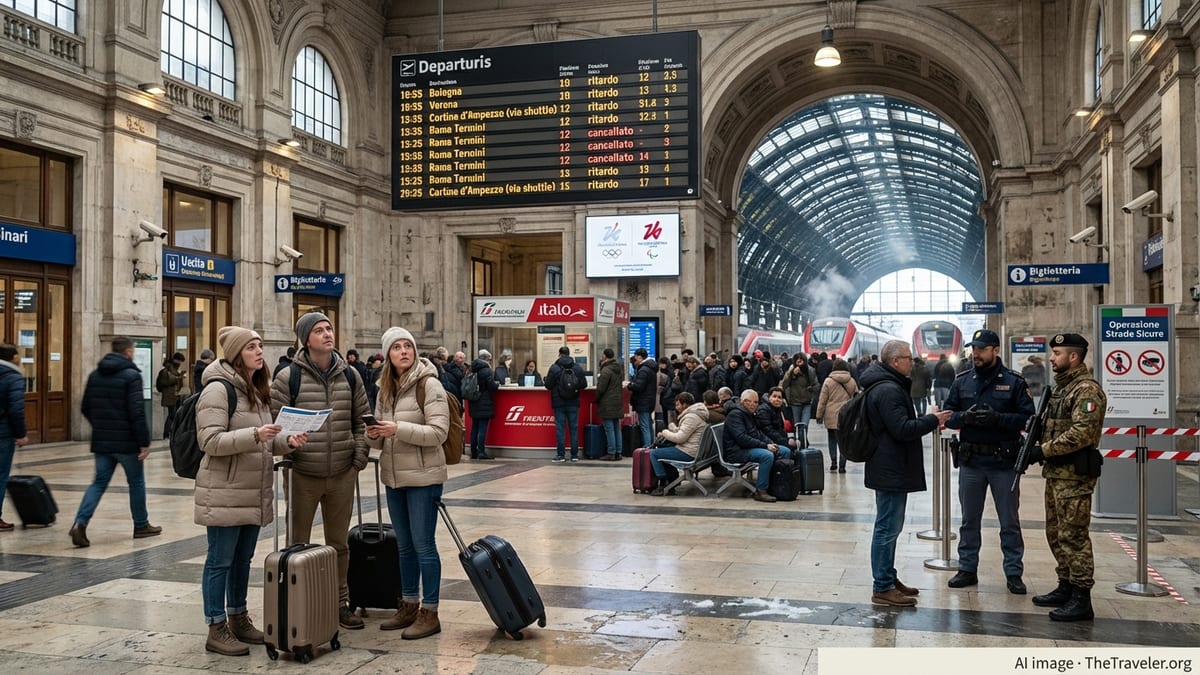
In response, Italian authorities have significantly reinforced security in Milan, deploying additional police and military patrols to transport hubs, commercial thoroughfares and key tourist corridors. Recent travel advisories reference this visible security build‑up, noting that visitors may encounter bag checks, temporary street closures and diversions, particularly in the historic center and around main railway stations such as Milano Centrale and Cadorna.
Despite the imagery of earlier clashes, public accounts from residents and travelers in late October and early November describe an atmosphere that can shift quickly from normal city life to localized tension when marches form. Many report that tourist areas, museums and restaurants have remained open, but that certain streets have been sealed off at short notice when demonstrators approach or when security forces move to prevent gatherings from reaching sensitive sites.
Published coverage from European media outlets underscores that recent nationwide protest days brought far fewer incidents of serious violence than the peak of the disturbances in Milan on 17 October. However, the memory of those scenes and the possibility of renewed confrontation have led the UK and other governments to keep a cautionary tone for visitors heading to Lombardy’s capital in the coming weeks.
Impact on travel plans, transport and major events
The latest FCDO update for Italy was issued alongside notice of a 24‑hour national strike running from the evening of 29 October to the evening of 30 October, reflecting the broader climate of industrial and social unrest. Publicly available information from airlines, rail operators and local transit providers shows that strike days can disrupt long‑distance trains, regional services, metro and tram lines, airport ground handling and even taxi availability, with knock‑on delays lasting beyond the formal strike window.
Several foreign travel advisories now recommend that passengers check timetables carefully in the days around strikes and large protest actions, build extra time into journeys to and from airports, and stay in close contact with carriers. Travelers heading to or from Milan Malpensa and Linate airports, or transiting through central rail stations, may be most exposed to short‑notice cancellations and platform changes.
The unrest also overlaps with preparations for upcoming large‑scale events in northern Italy, including trade fairs and sports fixtures in the Milan area. Risk assessments circulated in advance of the 2026 Winter Games have already highlighted the potential for protest activity around Olympic‑linked developments and infrastructure. Observers note that while most recent demonstrations have focused on economic and social concerns, activist networks opposed to major construction projects have used the broader wave of unrest to amplify their campaigns.
For leisure visitors, travel industry bulletins indicate that tour operators have not announced large‑scale cancellations for Milan or other Italian cities. Instead, companies are emphasizing flexible booking policies, encouraging customers to register contact details for rapid updates, and in some cases advising that itineraries remain subject to adjustment if specific neighborhoods become inaccessible on certain days.
How the UK advisory compares with on‑the‑ground reality
The decision by the UK to keep its reinforced wording in place comes as independent accounts from travelers present a more mixed picture on the ground. Posts from visitors in late October describe being only dimly aware of protests unless they happened to pass near key demonstration routes, and many report that popular attractions, restaurants and shopping streets have continued to operate as usual outside the immediate protest zones.
At the same time, there is a recurring message in public forums that the situation in Milan and some other northern cities remains fluid. Users report that demonstrations have tended to be announced with relatively short notice, and that once marches begin, police lines and impromptu roadblocks can cause sudden detours. Those staying near central squares or major avenues have described hearing sirens and helicopters during peak protest hours, even if their own movements were only marginally affected.
Security analysts note that Italy has long experienced frequent demonstrations and transport strikes, and that the present wave fits into a wider pattern of European social unrest linked to inflation, housing pressures and employment concerns. What sets this period apart, according to published research on the 2026 protests, is the speed with which disparate groups have coordinated via social media and messaging apps, sometimes outpacing official efforts to predict where the largest gatherings will form.
Against this backdrop, the UK advisory appears calibrated to remind travelers that conditions can change quickly, even when streets seem calm. Government travel pages stress that no trip can be guaranteed safe, and urge visitors to take out comprehensive insurance, stay informed about local developments and be ready to change plans if circumstances deteriorate.
Practical guidance for travelers heading to Italy
For those due to visit Milan or other Italian cities in the coming weeks, the clearest message from public advisories and traveler reports is to stay flexible. Visitors are encouraged to check official travel advice from their home country before departure and during their stay, sign up for email alerts where available, and follow local news sources to gauge whether demonstrations are planned near their accommodation or key sights.
Travel information platforms suggest that visitors build a margin of time into journeys that rely on public transport, particularly when traveling to airports or making rail connections. On days when marches or strikes are announced, travelers may want to avoid scheduling tight transfers or non‑refundable time‑sensitive activities in central Milan and other protest‑prone areas.
Basic safety recommendations repeated across multiple advisories include steering clear of large crowds, not attempting to cross police lines or film confrontations at close range, and leaving an area quickly if the atmosphere shifts or fireworks and projectiles are used. Travelers are also advised to carry identification, keep valuables secure in crowded places and maintain up‑to‑date contact information with their airline, tour operator or accommodation provider.
While images of unrest have raised understandable concerns, there is no broad call from major governments to avoid travel to Italy. The current UK stance reflects a desire to balance that reality with a more cautious reading of events in Milan and beyond, signaling that visitors can still enjoy the country’s cities and cultural attractions, provided they remain alert to the possibility of renewed protests and follow the evolving official guidance.