


Most travelers arrive in Pisa with one goal in mind: a quick photo with the Leaning Tower before heading back to Florence, Cinque Terre or Lucca. In the rush, one of Italy’s most remarkable religious buildings is often treated as an afterthought. The Baptistery of St John, standing just opposite the cathedral in Piazza dei Miracoli, raises a fair question for anyone planning a tight itinerary: is it really worth going inside, or is a look from the grass enough?
Get the latest updates straight to your inbox!
Understanding What the Baptistery Actually Is
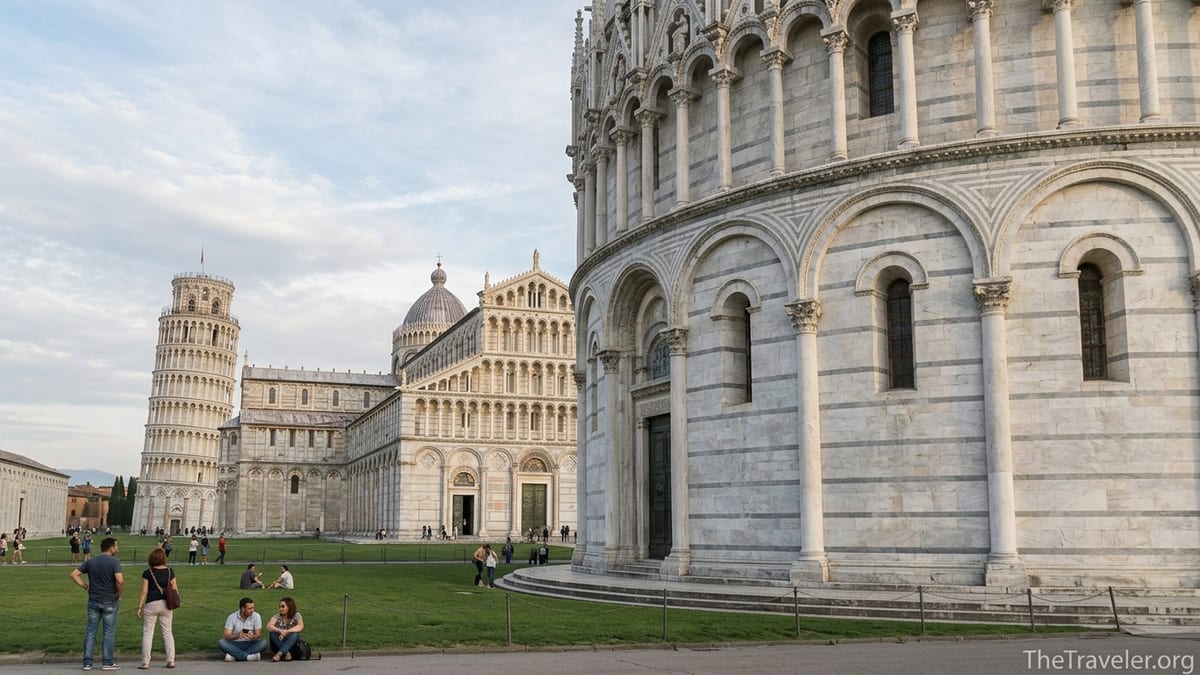
The Baptistery of St John is not a side chapel or a minor annex. It is the largest baptistery in Italy and often cited as the largest of its kind in the world, a free-standing building devoted specifically to the sacrament of baptism. Rising to around 55 meters in height and more than 100 meters in circumference, it dominates the western side of Piazza dei Miracoli and, measured to the top of the statue of St John, is marginally taller than the Leaning Tower itself. From the lawn, its white marble shell looks almost like a heavy stone crown wrapped in arches and statues.
Construction began in the mid-12th century under the architect Diotisalvi, when Pisa was one of the great maritime republics of the Mediterranean. That early phase gave the building a solid, Romanesque character, with rounded arches and powerful columns. Work continued for more than a century, and later architects, including Nicola and Giovanni Pisano, added upper levels in the then-new Gothic style. The result is a hybrid exterior that offers a small architectural lesson in stone, visible even if you never buy a ticket.
Step closer and you notice details that are easy to miss from a distance: blind arcades carved with geometric patterns, sculpted figures on the upper levels and the play of different marbles in the façade. For travelers who appreciate architecture or art history, this evolution from Romanesque base to Gothic crown is one of the main reasons the Baptistery deserves separate attention from the Leaning Tower.
Crucially, this is not an isolated monument. It forms one side of a UNESCO World Heritage ensemble along with the cathedral, the tower and the monumental cemetery. Thinking of the Baptistery as an integral part of that four-piece composition rather than a “bonus” building can help reframe whether you want to dedicate time to it.
The Acoustics: A Sound Experience You Will Remember
The single most convincing argument for going inside the Baptistery is something you cannot photograph: the sound. The building’s vast, largely empty interior behaves like a stone echo chamber. Guides, custodians or occasional volunteers often demonstrate this by singing short notes or a simple chant from the upper gallery. The sound hangs in the air for several seconds and seems to weave into harmonies with itself as the notes overlap.
Travelers commonly report that this brief acoustic demonstration is among their most memorable experiences in Pisa. You may see small groups gather quietly near the center of the space, waiting for a staff member to step up to the gallery. When the voice rises, even from a single singer, it feels as if a small choir has suddenly appeared. You do not need to understand music theory to appreciate how unusual this is. Many visitors who were initially skeptical about paying for an extra ticket walk out describing the Baptistery as a highlight of their day.
The interior’s stripped-back design is part of what makes the acoustics work. Aside from the central baptismal font, a marble pulpit and a few pieces of sacred furniture, the space is remarkably uncluttered. There are no heavy pews and few textiles to absorb sound. For anyone interested in how architecture shapes experience, this is a textbook case you can literally stand inside. If you have teenagers or travel companions who are less excited about art but enjoy unusual sensations, this is the detail that often wins them over.
It is worth noting that the singing is not a guaranteed performance timed to the minute, and practices can change. On busy days in high season, demonstrations are relatively frequent. On quieter winter afternoons, you may need to wait patiently or content yourself with testing the echo using your own soft voice when the space is not crowded.
Artistic Highlights: What You Actually See Inside
From a purely visual standpoint, the Baptistery is more restrained than the cathedral across the lawn, but there are still several features that merit a closer look. At ground level, the hexagonal baptismal font commands the center of the space. It is here that infants and, historically, adults would have been baptized, including notable Pisans such as Galileo Galilei. The symbolic separation of the baptistery from the main church reinforced the idea that baptism was a passage into the Christian community before a person could fully participate in worship.
Near the font stands the marble pulpit by Nicola Pisano. Completed in the 13th century, it is decorated with panels showing scenes from the life of Christ and the Last Judgment. Art historians point to this pulpit as a pivotal work in the development of Italian Gothic sculpture, with figures that show a new interest in classical drapery and three-dimensional form. For travelers who have seen the more famous pulpit in the cathedral of Pisa or in Siena, comparing these carvings side by side deepens an understanding of how Tuscan sculpture evolved.
The upper gallery, which you can access via a staircase, offers a different perspective on both the artwork and the architecture. From here, you can look down into the baptismal font and across the circular space, noticing the rhythm of columns and arches that might be hard to appreciate from below. Through the windows, there are compelling framed views of the cathedral’s striped marble walls and the Leaning Tower’s arcades. Photographers often find that some of their most distinctive shots of Piazza dei Miracoli come from this level inside the Baptistery rather than from the usual vantage points outside.
If your time in Tuscany includes major churches in Florence, Siena or Lucca, the Baptistery’s interior will not feel overwhelmingly ornate by comparison. Its appeal lies more in the combination of space, light, sound and a handful of carefully placed artworks than in a dense concentration of frescoes or gold. Knowing this in advance can help calibrate expectations and avoid disappointment if you are anticipating something as lavish as Florence’s Duomo.
Tickets, Prices and How It Fits With a Leaning Tower Visit
From a budget perspective, the Baptistery is usually accessed as part of a combined ticket for Piazza dei Miracoli’s monuments. At the time of writing, a basic combination ticket that includes the Baptistery, the cathedral and other monuments such as the Camposanto or museums commonly costs in the approximate range of the mid-teens of euros per adult. Adding the climb up the Leaning Tower is a separate supplement, lifting the overall cost toward the high twenties or low thirties per adult. Exact figures change regularly, so it is wise to check current prices when you plan.
The good news is that you rarely have to buy a standalone Baptistery ticket. If you already intend to climb the tower, you will almost certainly purchase a combo that includes at least one or two additional monuments for only a modest extra cost. In that scenario, skipping the Baptistery is less a matter of saving money and more about how you allocate your time and energy. For families or groups, this can make the decision easier: once you have the passes in hand, walking into the Baptistery becomes a low-effort add-on.
Timed entry is mainly applied to the Leaning Tower, where ticket slots can sell out well in advance during peak season. The Baptistery, cathedral and Camposanto are usually more flexible, with entry based on general opening hours and capacity limits. Many travelers visiting from Florence on a half-day excursion choose a morning tower slot, spend time on the lawn and then visit the Baptistery and cathedral in the late morning or early afternoon before returning to the station. If you are arriving around midday, reversing that order and saving the tower for later can help distribute crowds.
For practical planning, count on spending around 20 to 30 minutes inside the Baptistery if you walk slowly, observe the details, climb to the gallery and perhaps wait for an acoustic demonstration. Rushing through in under ten minutes is possible, but you will not get much more than a quick lap and a few snapshots. Building half an hour into your schedule makes the experience feel deliberate rather than incidental.
Comparing It With Other Italian Baptisteries
One way to decide if the Baptistery of St John in Pisa is worth your time is to compare it with similar buildings you may see on the same trip. The baptistery in Florence, just opposite the Duomo, is smaller, older and famous for its bronze doors and glittering mosaic interior. The baptistery in Parma is pink Verona marble with elaborate sculptural decoration and a completely different atmosphere. Visiting all three gives you a mini-course in how regional tastes and theological priorities translated into architecture.
Compared with Florence’s baptistery, Pisa’s feels more spacious and acoustically dramatic but less visually dense. If your itinerary already includes Florence and you are particularly interested in medieval mosaics and bronze reliefs, you might find the interior of Florence’s structure more compelling. On the other hand, if you are drawn to spatial experiences, sound and the dialogue between Romanesque and Gothic forms, Pisa’s Baptistery holds its own very well.
It can also be helpful to think about how much exposure you will have to large churches in general. Travelers on longer Italian itineraries often reach a point where they joke about having seen “too many churches.” In that context, the Baptistery’s relatively focused space can be a strength. Instead of yet another multi-aisled basilica, you get a contained environment with a clear central function. For architecture enthusiasts, it becomes a case study in how a single-purpose religious building can be designed.
For visitors who have already spent time in Siena or Lucca before reaching Pisa, the Baptistery offers continuity with the marble stripes, carved pulpits and sculptural styles of those cities. In this sense, Pisa’s monument is not only worth visiting in isolation but as part of a broader conversation among Tuscan religious buildings of the 12th and 13th centuries.
Who Will Appreciate the Baptistery Most?
Not every traveler values the same things, and being honest about your preferences will help you decide whether to walk past the ticket barriers. The Baptistery tends to reward certain types of visitors especially well. Architecture and history enthusiasts, for example, are likely to appreciate the building as a rare opportunity to walk through a transitional structure that bridges Romanesque solidity and Gothic verticality. They may linger over column capitals, exterior statues and the pulpit carvings that reveal changing ideas about the human figure.
Music lovers and anyone sensitive to sound are another group for whom the Baptistery can be a highlight. If you are the sort of person who enjoys hearing organ recitals in churches or acoustic performances in unusual spaces, the reverberation inside will likely fascinate you. Travelers have described simple sung notes there as “spine-tingling” and “one of those travel moments you think about months later,” even when they were not expecting anything special.
Photographers and content creators often find that the Baptistery offers unique angles not available from ground level in the square. Shots from the gallery that frame the cathedral and tower in the same image, or details of the marble floor and font seen from above, can add variety beyond the classic “holding up the Leaning Tower” pose. If building a visually varied photo set is part of your travel goals, this is another argument in favor.
On the other hand, some travelers will be content with exterior views only. If you are on an extremely tight schedule, traveling with small children who are restless indoors or simply feel “churched out” after a week of sightseeing, you might reasonably prioritize time sitting on the grass, grabbing gelato or exploring the streets beyond the piazza instead.
Practical Tips for Making the Most of Your Visit
To get the best experience from the Baptistery, timing and small practical choices matter. Morning visits often come with softer light filtering through the upper windows and slightly lighter crowds, especially in shoulder seasons. Late afternoon can also be atmospheric as the sun lowers behind the cathedral. Midday in high summer tends to be the busiest and brightest, which can flatten photographs and make the interior feel more crowded.
Dress codes at Piazza dei Miracoli are generally relaxed compared with some more conservative churches, but it remains a functioning religious site. Shoulders covered and knee-length shorts or skirts are sensible, both for respect and for comfort in the often cool interior. The marble floor can feel chilly even in warm weather, so bringing a light layer is not a bad idea if you are sensitive to cold.
If you hope to hear the acoustic demonstration, allow some unstructured time inside. Avoid plugging in headphones for audio guides the entire time. Instead, spend a few minutes quietly observing and listening. When the space falls silent, you can hear the faint hum of voices and footsteps transform into a soft background echo. If a staff member begins to sing, resist the urge to film every second on your phone. Taking a short video is understandable, but the sensation is most powerful when you simply stand and listen.
Finally, consider pairing your Baptistery visit with the Camposanto Monumentale or one of the museums in the square if your ticket allows. Together, they round out the story of Pisa’s religious complex and balance the more obviously touristic thrill of climbing the Leaning Tower with a deeper understanding of the city’s spiritual and artistic heritage.
The Takeaway
So, is the Baptistery of St John in Pisa worth visiting beyond the Leaning Tower? For many travelers, the answer is yes, provided expectations are aligned with what the building truly offers. You will not find a riot of frescoes or endless chapels. Instead, you encounter a single, powerful volume of space where sound, light and stone work together in a way that is hard to experience elsewhere.
If your schedule allows around half an hour and your ticket already includes entry, the Baptistery becomes an easy and rewarding addition that turns a quick Leaning Tower photo stop into a more rounded encounter with Piazza dei Miracoli. Architecture fans, music lovers, thoughtful photographers and anyone curious about how medieval people marked the ritual of baptism will likely come away grateful they stepped inside.
On a day packed with Tuscan highlights, you may still choose to prioritize the countryside, Florence’s museums or a long lunch over yet another historic building. But if you decide to give Pisa more than a passing glance, the Baptistery is one of the city’s clearest reminders that there is much more here than a famously tilted tower.
FAQ
Q1. Is the Baptistery of St John in Pisa really worth going inside if I am short on time?
Yes, if you can spare 20 to 30 minutes and already have a combo ticket, going inside is usually worthwhile for the unique acoustics and views from the upper gallery. If your time is extremely limited and you must choose between the Leaning Tower and the Baptistery, most visitors still prioritize the tower, but many later say the Baptistery was an unexpected highlight.
Q2. How much does it cost to visit the Baptistery?
Prices change regularly, but the Baptistery is typically included in a combined ticket with other monuments in Piazza dei Miracoli. Expect to pay in the mid-teens of euros for a basic monuments ticket, with an additional supplement if you add the Leaning Tower climb. It is uncommon to buy a ticket for only the Baptistery.
Q3. Do I need to reserve a time slot for the Baptistery like I do for the Leaning Tower?
In most cases you only need a timed reservation for the Leaning Tower. The Baptistery usually operates with general admission during opening hours, subject to capacity. You can normally walk in at any time on the day covered by your ticket, though very busy periods may involve short waits.
Q4. What is the best time of day to visit the Baptistery?
Morning and late afternoon often offer the most pleasant experience, with softer light and slightly fewer crowds. Midday in peak season can feel more crowded and harshly lit. If you are visiting on a half-day trip from Florence, consider timing the Baptistery either soon after you arrive or shortly before you leave, depending on your Leaning Tower slot.
Q5. Can I hear the famous acoustics during every visit?
The building’s echo is always present, but the short sung demonstrations by staff are not guaranteed on a strict schedule. They tend to occur fairly often on busy days, but not necessarily at set times. Even without an official demonstration, you will notice the reverberation of normal conversation and footsteps, and sometimes small groups gently test the acoustics with a few quiet notes.
Q6. Is the Baptistery suitable for children?
Yes, many families find it manageable and interesting for children. The circular space, central font and echoes can capture kids’ curiosity, and the visit is relatively short. Very young children should be closely supervised on the upper gallery, where there are railings but still potential fall risks, and parents should be mindful of keeping noise respectful.
Q7. How does Pisa’s Baptistery compare with the one in Florence?
Florence’s baptistery is smaller and renowned for its bronze doors and mosaics, while Pisa’s is larger, more open inside and famous for its acoustics and mixture of Romanesque and Gothic forms. If you are interested in space and sound, Pisa’s may appeal more; if you are focused on mosaics and sculpture on a smaller scale, Florence’s might feel richer.
Q8. Is there a dress code for visiting the Baptistery?
There is no strict, heavily enforced dress code, but it is still a religious building. It is respectful to cover shoulders and avoid very short shorts or skirts. Comfortable, non-slip footwear is advisable, as the marble floors and stairs can be smooth and occasionally slippery, especially in wet weather.
Q9. How long should I plan to spend inside the Baptistery?
Most visitors are satisfied with about 20 to 30 minutes. This allows time to walk around the ground floor, study the baptismal font and pulpit, climb to the upper gallery, take photographs and wait briefly in case an acoustic demonstration occurs. Rushing through in under ten minutes is possible but less rewarding.
Q10. If I am on a strict budget, should I still pay to include the Baptistery?
If every euro counts, you may decide to enjoy the Baptistery from the outside and focus your paid entry on the Leaning Tower or just one interior monument. However, if you can afford a combined ticket and want to get more out of your time in Pisa than a single tower climb, including the Baptistery usually adds good value in terms of experience per euro spent.