


Most travelers arrive in Pisa with one goal in mind: a quick photo with the Leaning Tower before moving on to Florence, Lucca, or the Cinque Terre. Yet a few steps away stands a building that quietly upstages the tower in originality and mystery: the Baptistery of St John. This circular giant of marble is far more than a picturesque backdrop. For visitors who pause and look closely, it reveals a layered story of engineering experiments, artistic ambition, and tiny human details almost everyone else walks right past.
Get the latest updates straight to your inbox!
A Building Caught Between Two Worlds
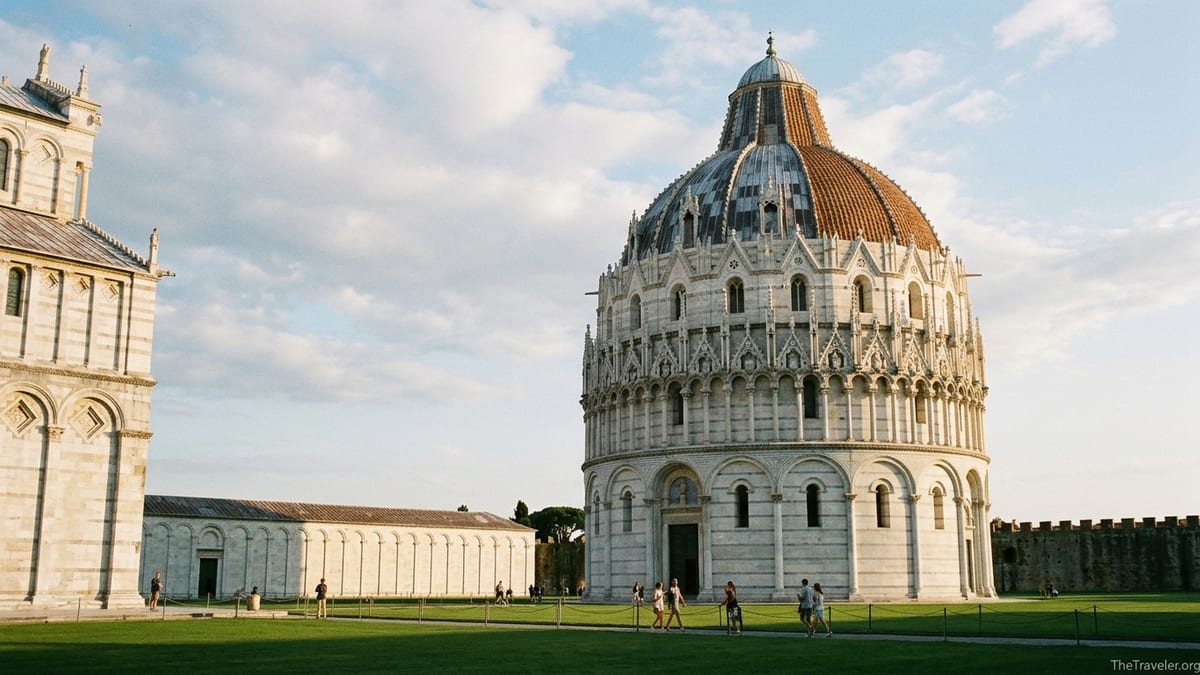
Seen from a distance, the Baptistery’s white marble shell looks calm and uniform. Up close, you can read nearly two centuries of changing taste in its skin. The lower level, begun in 1152 under the architect Diotisalvi, is solidly Romanesque, with round arches and comparatively simple blind arcades that echo the façade of the cathedral across the lawn. Higher up, the style changes mid-stream. Slender pointed gables, lace-like tracery and a forest of tiny pinnacles belong to a very different, Gothic sensibility that took over as construction dragged on and generations of craftsmen succeeded one another.
Most visitors snap a few pictures and move on without tracing this stylistic shift with their eyes. Try standing near the ticket office and letting your gaze climb from the heavy arcades at ground level to the airier, more vertical language above. It is the architectural equivalent of watching Europe move from the age of massive Romanesque abbeys to the soaring cathedrals of the high Middle Ages, compressed into a single shell of stone. Local guides sometimes point out that if you compare your photos carefully, the lower and upper façades almost look like they belong to two different buildings stitched together.
There is another subtle contrast hiding in plain sight. Walk around to the cathedral side and notice how the dome over the Baptistery seems half silvery, half warm. One half is covered in lead sheets, the other in terracotta tiles, a practical solution to wind and weather that unintentionally gives the building a two-tone cap. In midday light the contrast is easily washed out; in late afternoon, when the sun comes from the west, the red tiles glow against the grey metal and the effect becomes obvious, especially in close-up photos.
Because most people view the Piazza dei Miracoli from the classic angle that captures tower, cathedral and Baptistery in one frame, they often miss these quiet mismatches. Walking a full circuit around the building and looking up as you go is one of the simplest ways to see a more complex, less postcard-perfect Pisa.
Acoustics That Turn the Whole Space into an Instrument
Inside, the Baptistery feels surprisingly bare. The walls are plain, the floor is patterned but not overbearing, and ornament is heavily concentrated in a few focal points. Many first-time visitors assume there is not much to see and head straight for the exit. What they do not realize is that the most extraordinary feature here is invisible: the sound. The building is capped by a rare double dome, with an inner conical structure and an outer hemispherical shell. That layered geometry, combined with a ring of thick stone, produces an extremely long reverberation that has been studied by acousticians using modern modeling.
In practice, it means that a single sung note launched into the space can hang in the air and build harmonies with itself for several seconds. Staff from the Opera della Primaziale, which manages the monuments, sometimes demonstrate this by singing a short scale or a simple chant from the gallery. Even when the Baptistery is crowded, you can watch people fall silent as the sound swirls up into the dome and descends like a soft echo. Recordings made by travelers often capture this moment more vividly than any video of the Leaning Tower.
Most visitors never try the experiment themselves. If the building is moderately quiet and there is no posted prohibition, step to the edge of the central space, face upward, and sing or hum a single, steady note. Even a soft “ah” will bloom into a chord as reflections bounce between dome and walls. You can hear different effects as you move: near the center, the sound is pure and enveloping; closer to the walls, you pick up more flutter and interference. Acoustics researchers who have analyzed the building’s decay time remark that its reverberation approaches that of some large concert halls, which is striking for a free-standing medieval baptistery.
The practical side of this design is historically rooted. Before microphones and loudspeakers, priests speaking or chanting from the center had to reach people standing around the font and along the perimeter. The double dome effectively amplifies human voices. Today, that same design invites travelers to experience the building with their ears as much as with their eyes, though you will notice that most tour groups hurry through with barely a pause for quiet listening.
The Font, Pulpit and a Hidden Geometry
The eye is naturally drawn to the octagonal baptismal font near the center, created in the mid-13th century. Pilgrims usually photograph its marble basins and move on without noticing that the entire interior is carefully organized around a play of shapes. The round shell of the Baptistery contains a ring of columns that forms a dodecagon, a twelve-sided polygon. Inside that ring, the font is eight-sided. On the upper level, the famous pulpit carved by Nicola Pisano follows a hexagonal plan. Circle, twelve, eight, six: the geometry steps inward like a sequence, a pattern scholars have likened to a kind of sculpted counterpoint.
For a casual visitor, this might sound abstract, but you can see and feel it on the floor. Stand just inside the main entrance and let your gaze trace the line of columns; they mark out the invisible edges of the dodecagon. Then walk to the font and run your hand along one of its corners, counting all eight. Finally, look up at the pulpit and notice how its six support columns land, not randomly, but in dialogue with the shapes below. Medieval designers rarely left such alignments to chance.
The pulpit itself repays close inspection. Many guidebooks mention that it marks an early moment in European sculpture when figures regain a sense of weight and classical drapery, but travelers often overlook small narrative touches. In the scene of the Nativity, for instance, you can pick out a weary Joseph seated to one side, head in hand, and the tiny heads of the ox and ass peering toward the Christ child. These are details that disappear in a quick snapshot from the aisle; you need to walk right up to the reliefs and follow the sculpted story panel by panel.
Another often-missed element is the relationship between the font and the floor around it. Originally, baptisms here would have been by immersion, with adults stepping down into the water. Over time, as practices shifted toward pouring water over infants, the deep font and its wide basin took on more symbolic value. Modern visitors see only a dry marble structure, but if you stand at the very center of the basin and look up to the oculus in the dome, you get a strong sense of vertical connection that once aligned earth, water and sky in a single ritual axis.
Spolia, Griffins and Stories in the Stone
On the outside, the Baptistery’s decorative program looks consistent at first glance: rows of blind arches, marble inlays, a rhythm of columns and gables. Hidden within that order are individual stones with long histories. Medieval Pisa was a powerful maritime republic that brought home objects from around the Mediterranean. In the Baptistery, as in the nearby cathedral, you can find reused Roman columns and capitals integrated into the design. Their carved acanthus leaves and classical proportions differ subtly from the medieval work around them, like older voices in a younger choir.
Look especially at the portal facing the cathedral. The flanking columns carry foliage carvings that are more deeply undercut and naturalistic than others nearby, suggesting antique models the medieval sculptors studied and adapted. Higher up, small figures and animals peek out from the cornices and gables. Some of the most intriguing are griffins, lions and other hybrid creatures that reflect a blend of Christian symbolism and influences from Islamic art, which Pisan merchants would have encountered through trade and warfare.
Because visitors are usually focused on framing the Leaning Tower in their shots, very few step close enough to the Baptistery’s walls to see these details. If you spend five minutes walking slowly along the base and scanning the capitals, you will start to notice mismatched stones, worn inscriptions and even faint graffiti from later centuries. On the north side, where crowds thin out, it is easier to appreciate how the builders reused older marble blocks, turning the exterior into a coded archive of the city’s connections to the wider Mediterranean world.
Inside, spolia appear in more subtle ways. Certain columns in the inner ring show variations in veining and tooling that point to different sources. Conservation studies carried out for recent restoration work have mapped these differences to understand how the building was assembled over time. While those technical documents are not on display, their results are visible if you take the time to compare one support to the next. The Baptistery becomes less a single, unified object and more a collage of stones, each with its own journey to this spot.
A Monument That Leans in Its Own Quiet Way
The Leaning Tower dominates every discussion of Pisa’s architecture, but it is not the only structure on the Piazza dei Miracoli with a tilt. Engineers monitoring the site have noted that the Baptistery, cathedral and even the monumental cemetery show slight deviations from vertical due to the same unstable soil that caused the campanile’s dramatic lean. To the naked eye, these tilts are subtle, easy to miss amidst the visual drama next door, yet they are part of the shared story of a city built on alluvial ground.
If you stand on the far side of the piazza, near the ticket pavilion, and align your camera so that the tower is just out of frame and the Baptistery is centered, you can sometimes detect a gentle off-vertical line in the drum. Photographers posting online have remarked that, when you straighten the cathedral in editing software, the other buildings suddenly seem to list a little, as if the famous tower’s misbehavior has quietly spread. These effects are small enough that they do not affect a casual visit, but they underscore the long-term challenges of preserving the ensemble.
Ongoing monitoring and maintenance are more noticeable on the Baptistery today than many visitors expect. You may see discreet scaffolding sections, patches of recently cleaned marble that look brighter than their neighbors, or survey markers near the base. These are traces of a continuous campaign to stabilize foundations, replace deteriorated iron cramps, and gently clean centuries of soot and biological growth from the stone. Tourists often interpret fresh scaffolding as an inconvenience, but for those who look more closely it is evidence that the monument is treated as a living structure, not a frozen relic.
Paradoxically, the very fame of the Leaning Tower encourages people to treat the rest of the square as static scenery. Recognizing that the Baptistery, too, is subtly moving, settling and being actively cared for adds a dynamic layer to what might otherwise feel like a postcard stop. The next time you are tempted to pose with your hands “holding up” the tower, consider instead a photograph that captures the quieter, almost imperceptible lean of its neighbor.
Light, Time of Day and the Almost-Empty Interior
Inside many Italian churches, visitors are overwhelmed by paintings, altars and gilded ceilings competing for attention. The Baptistery of St John offers a different sensation: spaciousness and restraint. The interior walls are mostly undecorated, and the upper zones that once held more elaborate finishes are now subdued. As a result, light and shadow become the main visual actors. Narrow windows high in the drum admit shafts of daylight that drift across the inner dome and the ring of columns, creating constantly shifting patterns on the stone surfaces.
Most group tours time their visits to Pisa for late morning or early afternoon, when the square is brightest and the tower photographs best. Inside the Baptistery at that hour, the light can feel flat, washing out the texture of the marble. Independent travelers who arrive earlier or linger into the late afternoon encounter a very different atmosphere. When the sun is low, beams slip in at oblique angles, carving sharp shapes on the floor and accenting the ribs of the dome. Photographers on architecture forums often share images of this light play, noting that it is at these off-peak hours that the building most fully reveals its volume.
The relative emptiness of the interior is not accidental. For centuries, the Baptistery had a single primary function: baptism. It did not need multiple side chapels or a deep forest of altars, because regular worship took place in the cathedral next door. That specialized purpose still shapes your experience as a visitor. The broad central space around the font remains uncluttered, inviting you to walk freely and test the acoustics without weaving around pews. Many travelers come away describing the interior as “simple but majestic,” surprised by how much impact can be achieved with such limited furnishings.
To make the most of this simplicity, allow yourself at least ten or fifteen minutes inside rather than treating it as a quick detour between the tower and the cathedral. Choose a spot along the inner ring of columns, lean back, and watch how the light moves. Listen for the echo of footsteps and occasional song drifting from the gallery. The longer you stay, the more you notice: the faint color variations in the marble floor, the wear on certain stair treads leading up to the gallery, the small iron grills protecting what were once open windows in the drum.
Planning a Visit: Practical Nuances Most People Miss
On a typical spring or summer day, many visitors to Pisa buy a basic combination ticket that includes the cathedral and one additional monument. Faced with a choice between climbing the Leaning Tower or entering the Baptistery and Camposanto, most opt for the tower, leaving the Baptistery relatively quieter despite its location in the very center of the square. For travelers interested in architecture or photography, this imbalance can be an advantage. It is often possible, especially outside of the busiest midday window, to find moments when the interior feels calm enough to appreciate its sound and geometry without jostling crowds.
Entrance procedures and ticketing details can change, but at the time of writing, access to the Baptistery is usually included in mid-range combined tickets from the Opera della Primaziale Pisana, while the tower requires a more expensive, time-slotted reservation. This pricing subtly nudges budget-conscious visitors toward the Baptistery, yet even they may rush through, focused on squeezing in as many sights as possible in a short stopover. Building an extra half hour into your schedule specifically for the Baptistery is one of the simplest ways to transform a routine Pisa stop into a more memorable experience.
Another nuance most people miss is the timing of the acoustic demonstration. Staff often choose specific times to sing from the gallery, and these times are not always advertised prominently in advance. If you enter and hear a guide mentioning an upcoming demonstration, consider lingering rather than moving on to the next monument. Hearing the building “played” as an instrument often becomes the highlight of a visit, especially for travelers who have already seen many Tuscan churches and are looking for something different.
Finally, pay attention to small, temporary details: conservation notices near the entrance, small fences marking areas of ongoing work, or discreet sensors fixed to columns. These are clues to the Baptistery’s current chapter, evidence that the building you are visiting in 2026 is not exactly the same one described in older guidebooks. In a decade, the marble may be a shade cleaner, small cracks may be stabilized, or access routes may be adjusted. Treating these changes as part of the story, rather than as annoyances, enriches the experience.
FAQ
Q1. What is the Baptistery of St John in Pisa used for today?
The Baptistery is primarily a historic monument open to visitors. While its original function was for baptisms connected to the cathedral, today it serves mostly as a cultural, architectural and acoustic attraction, with occasional religious ceremonies or concerts.
Q2. Why are the acoustics of the Baptistery considered special?
The Baptistery has a rare double dome and thick stone walls that create a very long reverberation. A single sung note can echo and blend with itself for several seconds, making the whole interior feel like a resonant musical instrument.
Q3. Do I need a separate ticket to visit the Baptistery?
Access is typically managed through combination tickets sold for the monuments of the Piazza dei Miracoli. The Baptistery is often included in mid-range ticket options, while climbing the Leaning Tower requires a higher-priced, time-slotted ticket. Always check current details when booking.
Q4. How much time should I plan for a visit inside the Baptistery?
Many people spend only five minutes, but allowing at least fifteen to twenty minutes lets you appreciate the acoustics, walk around the font, study the pulpit and observe how the light changes inside.
Q5. Can I hear the acoustic demonstration every day?
Staff members perform short vocal demonstrations at selected times, which can vary with the season and visitor numbers. They are not guaranteed on every visit, so consider it a bonus rather than a certainty.
Q6. Is the Baptistery suitable for visitors with limited mobility?
The ground floor, where the font and main interior space are located, is generally accessible, though surfaces are uneven in places. Access to the upper gallery involves stairs and is not suitable for all visitors. Check current accessibility information before your trip.
Q7. Are photography and video allowed inside?
Non-flash photography for personal use is usually allowed inside the Baptistery, but regulations can change and may restrict tripods or professional equipment. Always follow posted signs and staff instructions.
Q8. What is the best time of day to visit the Baptistery?
Early morning and late afternoon tend to be quieter and offer more dramatic light inside. Midday visits are busier and the interior light is flatter, though still impressive.
Q9. How does the Baptistery compare to the Leaning Tower as an experience?
The tower offers a famous climb and panoramic views, while the Baptistery offers an immersive interior experience of sound, space and light. Many travelers find that the Baptistery feels more contemplative and less crowded than the tower.
Q10. Is the Baptistery undergoing restoration work?
Conservation and monitoring are ongoing, and visitors may see localized scaffolding or cleaning campaigns on the exterior. These works are part of long-term efforts to preserve the building and usually do not prevent access to the main interior space.