


First-time visitors to Pisa often arrive expecting one star attraction: the Leaning Tower. Yet it is the two great religious buildings beside it, the Baptistery of St John and the Cathedral of Santa Maria Assunta, that most profoundly shape how travelers remember the Square of Miracles. If you only have limited time, or want to decide where to focus your budget and attention, understanding how these two monuments differ in atmosphere, architecture and visitor experience can help you choose which one will leave the bigger impression.
Get the latest updates straight to your inbox!
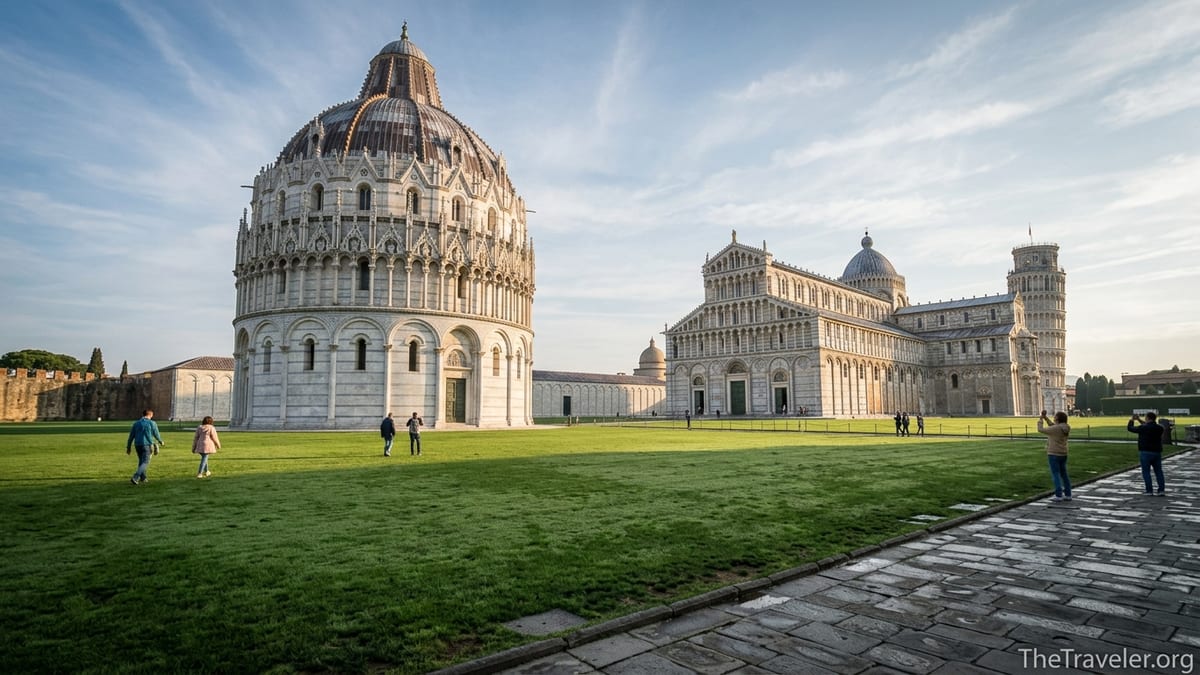
Piazza dei Miracoli at First Glance
Most visitors step into Piazza dei Miracoli after a 20-minute bus or train ride from Pisa Centrale, emerging from the city walls into a sudden expanse of bright green lawn and blinding white marble. To the right rises the Leaning Tower, straight ahead the huge bulk of the Cathedral, and nearest the walls a circular, domed building: the Baptistery of St John. All three belong to the same medieval religious complex, but in practice many day-trippers from Florence or Cinque Terre only properly explore one or two of them.
The Cathedral is free to visit if you hold any paid ticket for the monument complex, while the Baptistery usually requires a specific ticket or a combined pass that might cost around 20 euros when bundled with other sites like the Camposanto and museums. In high season, tour operators and official vendors sell timed-entry passes that let you coordinate a Baptistery visit, a Cathedral time slot and, for those who wish, a Leaning Tower climb in a single morning or afternoon.
From the grass, your first emotional reaction is often scale. The Cathedral dominates the center of the piazza with its tiered marble façade and deep portico, while the Baptistery appears like a perfectly proportioned marble drum, slightly smaller in footprint yet almost as tall as the Cathedral thanks to its conical dome. Deciding which one impresses more depends on whether you are moved most by interior space, architectural harmony, sound, or religious atmosphere.
Many travelers planning a short stop, such as a six-hour detour between Florence and the Ligurian coast, end up choosing between “tower + one interior monument” or a more leisurely wander through all of them. Understanding what each building offers is the key to making that choice.
Architectural Impact: Vertical Drama vs Geometric Harmony
The Cathedral of Pisa, begun in the 11th century, is a textbook example of Pisan Romanesque architecture. Its façade stacks arcades of rounded arches in horizontal bands, with grey and white marble creating subtle stripes. From the square, it feels monumental but elongated, drawing your gaze along its length toward the Leaning Tower which serves as the campanile. For travelers used to Gothic cathedrals like Milan or Notre-Dame in Paris, Pisa’s Cathedral can feel more serene, almost low-slung, yet its sheer size and the backdrop of the tower produce a very cinematic silhouette.
The Baptistery, started in the 12th century and completed with later Gothic additions, is different. It is almost perfectly circular, ringed by blind arcades at ground level and an upper band of sharp Gothic pinnacles and statues. Up close, you notice the texture of the marble, the interplay of light on its facets, and the sense of it being an architectural jewel box. Seen from a distance across the lawn, its compact purity of form can actually draw more photographs than the Cathedral itself, especially in late afternoon when the low sun catches its dome.
In pure architectural terms, many architecture enthusiasts find the Baptistery more striking as a single object. Its geometry is easy to grasp in one glance and it stands slightly apart from the other monuments, making it ideal for wide-angle photography. A traveler standing near the cafés along Via Santa Maria can frame the Baptistery on the left, the Cathedral center, and the Leaning Tower to the right in a single shot, but the Baptistery often anchors the composition because of its strong shape.
By contrast, the Cathedral’s power lies less in its outline and more in its rich façade details and the way it organizes the entire piazza. It is the axis that everything else refers to: the tower at its roofline, the Baptistery at its western end, and the Camposanto on the opposite side. For visitors who respond to urban design and the feeling of a “sacred campus,” the Cathedral’s role as the organizing heart of the square can leave a deeper overall impression, even if the Baptistery wins the immediate wow factor as an object.
Stepping Inside: Atmosphere and Interior Experience
Inside, the two buildings deliver very different moods. The Cathedral interior is large, dim and filled with columns in alternating bands of dark and light stone. Sunlight filters through small clerestory windows and side aisles, creating shafts of light that pick out patches of mosaic and gilded ceiling. The space feels like a traditional basilica: long, directional, and designed to focus your attention toward the high altar and apse. On busy summer days, the main nave hums with the murmur of tour groups, but because the interior is so large, there are often side aisles and chapels where you can step aside and breathe.
The Baptistery interior surprises many visitors with its relative simplicity. You enter at ground level into a tall, largely undecorated cylinder of pale stone. In the center sits the octagonal baptismal font, and nearby a pulpit carved with intricate biblical scenes. The walls are mostly bare, and your first thought may be that the decoration is less impressive than the Cathedral. The magic reveals itself when you look up: the dome soars far above, and sound behaves differently here than almost anywhere else in the piazza.
At certain times, a staff member or guide demonstrates the acoustics by singing a short series of notes; the echoes build into self-harmonizing chords that hang in the air long after the singer stops. Even on a normal visit, the slightest whisper or footstep seems amplified, and if someone sings quietly from the gallery above, the entire interior becomes a resonant instrument. For many travelers, this moment of sound, rather than any visual detail, is what they remember most strongly from Pisa.
If you are deciding which interior will be more memorable for you, ask whether you are more moved by visual richness or by spatial sensation. The Cathedral offers mosaics, paintings, a coffered ceiling and the famous pulpit attributed to Giovanni Pisano. The Baptistery offers an almost abstract space dominated by light and sound. Those who love art history often favor the Cathedral; those sensitive to acoustics and atmosphere frequently come away speaking more about the Baptistery.
Practicalities: Tickets, Time and Crowds
From a practical traveler’s standpoint, logistics can strongly influence which monument leaves a bigger impression. Standard practice in recent years has been for visitors to purchase a combined “monumental complex” ticket that may include the Baptistery, Camposanto and one or both museums, with the Cathedral included when you hold any of these paid tickets. Separate Leaning Tower tickets are timed and cost significantly more than the monument bundle, so many visitors prioritize the tower climb plus either the Cathedral or Baptistery rather than everything in depth.
If you arrive on a busy June or September afternoon, you may find a long line for the free-entry Cathedral, especially for travelers who have no other ticket. Those with a combined ticket usually enter via a shorter queue and at a specific time slot; this can turn the Cathedral into a more regimented experience where you are conscious of time and flow. In contrast, the Baptistery, while it can be crowded during tour-bus peaks, often feels slightly less pressured. Once inside, you can usually linger around the font or find a space along the upper gallery without being pushed along too quickly.
Budget is another factor. A Baptistery-inclusive ticket sold through an official channel or reputable reseller might run around 20 euros for adults, slightly less during promos or for children, and grants access to several sites across the piazza. If you are traveling as a family of four and deciding whether to pay extra for the Baptistery or rely on the Cathedral’s included access, that cost differential can feel significant, especially when combined with Leaning Tower tickets that frequently exceed 25 euros per person. Some travelers choose to enjoy the Baptistery only from the outside for this reason.
Crowd patterns also affect the subjective impression. The Cathedral tends to attract everyone, including large pilgrim groups and visitors who do not buy additional tickets. The Baptistery, by requiring a specific ticket, often skews slightly toward travelers who are more curious about architecture and history. If you value a quieter, more contemplative experience, the Baptistery may end up feeling more special, even if you technically spend more time in the Cathedral.
Emotional Memory: What Travelers Talk About Later
Speak with people on the train back to Florence or La Spezia and you hear recurring themes. Many remember the moment they stepped inside the Cathedral and saw the scale of the nave, with its alternating black-and-white marble and glittering apse. They mention the contrast between the tourism circus outside, with souvenir stands selling Leaning Tower magnets and gelato, and the more solemn, candlelit interior within. For travelers of faith, attending even a short Mass or sitting quietly in a side pew can be deeply moving, creating a personal memory more powerful than any photo.
Others, especially those who value unusual sensory experiences, talk about sound in the Baptistery. A common story involves arriving unsure whether the extra ticket was necessary, then being utterly captivated by a staff member’s brief demonstration of the echoes. Some describe standing on the upper gallery, speaking in a normal voice and hearing their words float back to them in soft layers. This sort of memory is hard to capture on camera and therefore feels more intimate and unique.
Another emotional factor is the narrative context. The Cathedral tells the story of Pisa’s medieval power and religious devotion through its art, relics and layout. You read interpretive panels, see tombs of important figures and sense the building’s role in centuries of civic life. The Baptistery, while historically significant, presents itself more as a pure space, anchored by the rituals of baptism but not crowded with as many artifacts. Travelers who like stories and specific artworks often feel a stronger attachment to the Cathedral for this reason.
On social media, photographs tend to favor the Baptistery’s exterior and the Cathedral’s interior. Scroll through travel feeds and you will find countless wide shots of the white circular Baptistery with the Leaning Tower behind, and then interior shots of the Cathedral’s nave and ceiling. This split hints at a broader truth: each monument shines differently depending on how you engage with it, and the strongest impression usually comes from matching the building to your own travel style.
Which Should You Prioritize With Limited Time?
Many itineraries give Pisa only a half day, sandwiched between Florence and the coast or as a side trip from Lucca. If you have, for example, a six-hour window between trains and want to keep costs under control, you may realistically only have time for the Leaning Tower plus one major interior visit. In that scenario, think concretely about your priorities.
If visual art, religious history and the sense of being inside a major European cathedral matter most to you, the Cathedral is the logical choice. You will see an interior that feels richly layered, sit under a gold-studded ceiling, and walk through a space that still functions as Pisa’s primary place of worship. For many travelers, this anchor experience, combined with outside views of the Baptistery, feels like a complete visit.
If you are less concerned with artworks and more interested in architecture as experience, the Baptistery deserves serious consideration. The costlier ticket can feel fully justified when you stand under the dome and hear how your own voice transforms, or when you lean on the upper gallery’s stone railing and look down at the geometric patterns of the floor. Visitors who have already toured several major churches in Rome and Florence often find the Baptistery refreshingly different.
For those traveling with children or teenagers, the Baptistery’s acoustic demonstration and climb to the gallery can be more engaging than the quieter, more formal Cathedral. Kids are often fascinated by how a single note echoes and how their footsteps ring on the stone steps. In contrast, younger travelers may become restless during a slow circuit around the Cathedral’s chapels, especially if crowds are thick.
Designing an Itinerary That Includes Both
If time and budget allow, the most satisfying approach is to see both the Baptistery and the Cathedral in a thoughtful sequence rather than rushing through. A practical pattern for a morning visit might be: arrive at the piazza by 9:00 a.m., photograph the exteriors in the softer light before the lawns fill with tour groups, then enter the Baptistery first when it is often quieter. Afterwards, walk slowly toward the Cathedral, perhaps stopping by the Camposanto or one of the museums if your ticket includes them, before visiting the Cathedral closer to midday.
Climbing the Leaning Tower can be scheduled either before or after these visits, depending on ticket times. Some travelers like to climb first, when the day is cooler, then reward themselves with the calm of the Baptistery. Others prefer to end with the tower for the most dramatic finale. What matters is leaving enough unscheduled time to sit on the grass, absorb the skyline and let the character of each building sink in.
In practice, you might spend 20 to 30 minutes in the Baptistery and 30 to 45 minutes in the Cathedral, not counting any attendance at services. Add in photography, walking between sites, and possible lines, and seeing both comfortably may require about two to three hours. This fits neatly into a half-day stop, especially if you keep lunch simple at one of the nearby cafés or grab a panino from a take-away shop just outside the walls.
By pacing your visit, you allow the buildings to contrast naturally. The transition from the bright circular quiet of the Baptistery to the long, processional nave of the Cathedral mirrors the journey from private spiritual moment to public religious life. Experiencing both gives you a richer understanding of how medieval Pisans imagined sacred space, and that layered insight often lingers longer in memory than any single wow moment.
The Takeaway
So which landmark leaves a bigger impression: the Baptistery of St John or Pisa Cathedral? The honest answer is that each speaks to different travelers in different ways. The Cathedral commands the center of the piazza, holds the most artworks and liturgical history, and remains the spiritual heart of Pisa. It is the building you are most likely to recognize in future photos, and for many it defines what a Romanesque cathedral feels like.
The Baptistery, by contrast, can feel like a hidden gem hiding in plain sight. Its compact, sculptural exterior and astonishing acoustics create a more intimate, almost mysterious experience. Visitors who value sensory impact and architectural purity often come away saying the Baptistery was the highlight of their day in Pisa, especially when they expected nothing more than a quick look before heading to the Leaning Tower.
If you must choose one, let your own interests decide: art and history lean you toward the Cathedral, while atmosphere and acoustics point toward the Baptistery. If you can visit both, do so in a way that allows a few unhurried minutes inside each. The true miracle of Pisa’s Square of Miracles is not just that the tower leans, but that two very different sacred spaces stand side by side, offering complementary paths to awe.
FAQ
Q1. If I have time for only one interior, should I choose the Baptistery or the Cathedral?
If you love religious art, mosaics and the feeling of a grand basilica, prioritize the Cathedral. If you are more curious about acoustics and pure architectural space, the Baptistery will likely feel more unique.
Q2. Is the Cathedral really free while the Baptistery costs extra?
Access rules can change, but in recent years the Cathedral has typically been free if you hold any paid ticket for the monument complex, while the Baptistery is usually part of a separate or combined ticket that costs extra.
Q3. How much time should I plan for the Baptistery compared with the Cathedral?
Most visitors spend about 20 to 30 minutes inside the Baptistery and 30 to 45 minutes inside the Cathedral. Add extra time for lines, photography and walking between sites.
Q4. Are there usually long lines for both buildings?
The Cathedral often has longer lines, especially for those without combined tickets, because more visitors enter and services sometimes affect access. The Baptistery can be busy during peak hours but typically feels slightly less congested.
Q5. Can I experience the Baptistery’s famous acoustics on any visit?
Staff or guides sometimes demonstrate the acoustics at set moments, but even without an official demonstration you can usually sense the unusual echo and resonance when people speak or sing softly.
Q6. Which monument is better for children and teenagers?
Families often find the Baptistery more engaging for younger visitors because of the echoing sound, central font and climb to the upper gallery, while the Cathedral can feel more formal and requires a quieter demeanor.
Q7. Do I need to dress differently for the Baptistery and the Cathedral?
Both are religious buildings, so modest clothing is recommended for each. Shoulders and knees should be covered, and hats removed, especially inside the Cathedral where services take place.
Q8. Is photography allowed inside the Baptistery and the Cathedral?
Visitor guidelines may vary, but generally non-flash photography is tolerated in both as long as you are respectful, quiet and do not disrupt services or other visitors.
Q9. Are there accessibility considerations that might affect my choice?
The Cathedral’s main floor is comparatively easier to access for those with limited mobility, while the Baptistery’s upper gallery involves stairs. Travelers using wheelchairs or with difficulty climbing may find the Cathedral more comfortable.
Q10. If I buy a ticket for the Leaning Tower, does it help with the Baptistery or Cathedral?
A Leaning Tower ticket is typically separate, but combined passes sold through official channels or trusted resellers often include access to the Cathedral and sometimes the Baptistery. Checking what is included before purchasing helps you avoid paying twice for similar access.