


The Baptistery of St John in Pisa is often overshadowed by the Leaning Tower, yet many travelers leave saying it was the most surprising highlight of their day. This circular, marble‑clad building on the Piazza dei Miracoli combines unusual acoustics, layered medieval architecture, and close‑up views of the cathedral and tower. Knowing how tickets work, when to go for the famous singing demonstration, and what to expect inside will help you make the most of a short stop or a full day in Pisa.
Get the latest updates straight to your inbox!
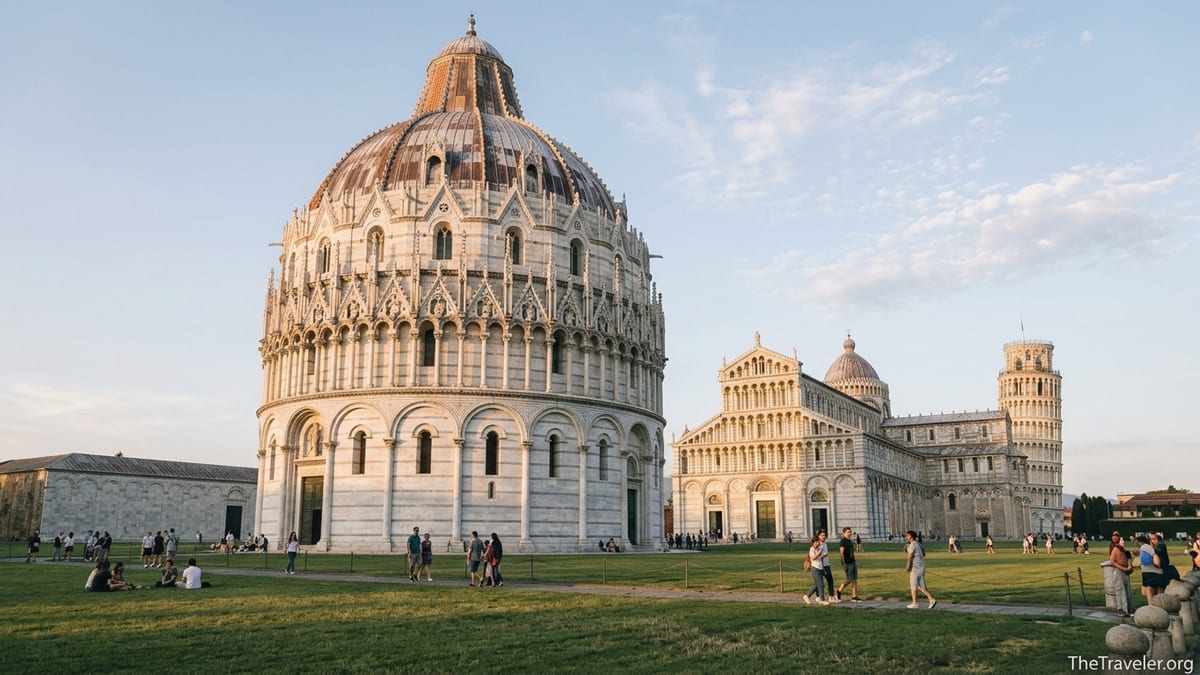
Understanding the Baptistery’s Place on the Piazza dei Miracoli
The Baptistery of St John stands directly in front of Pisa Cathedral, with the Leaning Tower rising just behind the church. Together with the Camposanto cemetery, these four monuments form the UNESCO‑listed Piazza dei Miracoli, one of the most important ensembles of medieval architecture in Europe. Many first‑time visitors arrive focused on taking a quick photo with the tower and only then realize the scale and quality of the other buildings around them.
The Baptistery itself is the largest in Italy, begun in the mid‑12th century and completed in the 14th century. Its lower level shows solid Romanesque arches and simple forms, while the upper tiers add Gothic pinnacles and tracery. Walking across the lawn or paved paths toward its striped marble walls, you can see how its gentle tilt echoes that of the more famous campanile nearby, a visible reminder that this whole area is built on soft, unstable ground.
Because the square is a public space, you do not pay to enter Piazza dei Miracoli or walk around the Baptistery’s exterior. You will, however, need a ticket to go inside. This is where some planning makes a real difference: buying a combined pass instead of a single‑monument ticket can save you money and time if you intend to visit more than one interior.
In practice, most travelers pair the Baptistery with at least the cathedral, and often the Leaning Tower. A common itinerary for a day trip from Florence or Lucca might be: arrive mid‑morning, walk the square, visit the Baptistery and cathedral after lunch, then climb the tower in the late afternoon once crowds have thinned. Understanding how the Baptistery fits into that flow helps you avoid backtracking and long queues.
Tickets, Prices and How to Time Your Visit
Tickets for the Baptistery are managed together with the other monuments of the cathedral complex. At the time of writing, a basic multi‑monument ticket that covers interiors on the Piazza dei Miracoli, including the Baptistery, typically costs a little over 10 euros when purchased directly from the official operator or at the on‑site ticket office. Prices vary depending on how many monuments you add and whether you include the Leaning Tower, but expect Baptistery access to be included in most “all monuments except Tower” or “full complex” passes.
For example, a traveler might book a combination ticket online for around the mid‑20 euro range that includes the Leaning Tower climb, cathedral entry and access to other monuments like the Baptistery and Camposanto. Another option is to skip the tower entirely and buy an on‑site pass just for the three or four non‑tower monuments, which usually runs a bit more than the cost of a sit‑down pizza and drink in the historic center. Third‑party platforms and guided tours often charge more but bundle in a licensed guide, headsets and occasionally transport from Florence or Cinque Terre.
Opening hours change seasonally, generally starting in the morning and running through late afternoon or early evening, with longer hours in summer. In high season, arriving before 10 am or after 4 pm makes it easier to appreciate the acoustics without the thickest crowds. On a typical August day, group tours tend to schedule Baptistery visits late morning, right after their tower‑climb slots, which is when the interior feels busiest.
If you prefer to improvise, you can buy same‑day tickets at the official ticket office near the square. However, Leaning Tower slots are limited and often sell out for peak times, so anyone set on climbing should reserve in advance. Even if you only plan to visit the Baptistery and cathedral, pre‑booking a combo ticket online can help you bypass a slow‑moving line at the counter on busy weekends and holidays.
What to Expect Inside: Acoustics, Architecture and Atmosphere
From the outside, the Baptistery can look like yet another elegant marble dome. Inside, the experience is very different. As you step in, you move from the bright Tuscan light to a dim, echoing space defined by a circular ambulatory, towering columns and a central baptismal font. The marble floor and the double‑shell dome above create a remarkable reverberation; even normal conversation carries in a way that surprises many visitors.
Several times an hour, a staff member may step to the side of the space and sing a few notes. Within seconds, the sound appears to multiply and hang in the air, overlapping with itself so that a single voice seems to become a small choir. The demonstration is brief, typically under a minute, but it is one of the main reasons many travelers say the Baptistery was the most memorable interior on the square. If hearing this is important to you, plan to linger for at least 15 to 20 minutes inside rather than just taking a quick lap and leaving.
Architecturally, you will notice the contrast between the plain, almost severe interior lower walls and the more decorative upper galleries. Look for the finely carved pulpit by Nicola Pisano, completed in the 13th century, whose panels and columns feature densely packed biblical scenes and classical‑influenced figures. If you visit after having seen the newer pulpit in the cathedral, you can trace how this sculptural style developed across a few decades and different commissions in Pisa.
There is usually access to an upper gallery reached by a narrow staircase. From there, you can look down on the font and across to the cathedral facade, framed by arched windows. Photographers in particular appreciate this vantage point, which allows you to capture the striped exterior of the Duomo and the tip of the Leaning Tower rising above it. The stairs can be slightly worn and uneven, so those with limited mobility may prefer to remain on the ground level and focus on the acoustics and central space instead.
Current Conditions, Restoration and Practical Comforts
Like most medieval monuments in Italy, the Baptistery undergoes periodic restoration. Work may involve cleaning the marble, stabilizing the structure or conserving sculptures. At various times this has meant scaffolding on portions of the exterior or inside near the dome, though efforts are usually made to keep most of the interior accessible to the public. Before your trip, it is worth checking recent traveler photos on major review sites or image‑sharing platforms to see whether large sections are covered, especially if photography is a priority.
Inside, lighting is relatively subdued, and on very hot summer days the building can offer welcome shade and slightly cooler air than the square outside. There is no seating apart from a few steps and low barriers, so if you plan to wait for more than one acoustic demonstration, be prepared to stand. The stone floor can feel hard after a while; many visitors appreciate comfortable walking shoes with some cushioning.
There are no restrooms inside the Baptistery itself. Public facilities are available elsewhere on the Piazza dei Miracoli, typically for a small fee payable by coins or contactless card. It is sensible to use these before you start visiting the interiors so you do not have to interrupt your circuit of Baptistery, cathedral and Camposanto. Food and drink are not allowed inside, and large backpacks may be restricted or asked to be left in a cloakroom or locker, especially if you also plan to climb the tower.
Photography is generally permitted for personal use, but flash and tripods are usually not allowed. Because the interior is dim, a smartphone or camera that performs well in low light will give you better results. Many visitors find that rather than trying to capture the acoustics on video, which rarely does them justice, it is more rewarding simply to stand quietly in the center and listen.
Etiquette, Dress Code and Accessibility Considerations
The Baptistery is part of a religious complex and still associated with Christian rites, even though it functions primarily as a historic monument today. Dress expectations are similar to those at the cathedral: shoulders and knees covered is a safe guideline. In practice, staff are generally more lenient with tourists than at some churches in Rome, but very short shorts, cropped tops or bare shoulders can attract unwanted attention or, in rare cases, entry refusal. Packing a lightweight scarf or shawl to cover up is a simple way to avoid issues.
Inside, visitors are expected to keep noise to a moderate level, both out of respect for the religious nature of the site and to allow everyone to appreciate the acoustics. Shouting just to test the echo is discouraged, and security staff may intervene if a group becomes too loud. During the singing demonstration, it is customary to remain quiet, pause photography and listen; applause at the end is common and welcome.
For travelers with mobility challenges, the ground floor can usually be accessed with only a small threshold step, but the upper gallery is reached by a narrow, winding staircase with no elevator. If you use a wheelchair or have difficulty with stairs, you can still enjoy most of the experience from the main level. The Piazza dei Miracoli paths are largely flat, but some sections are paved with old stone slabs that can be slightly uneven, so allow extra time to move between monuments.
Families with young children often find the Baptistery more manageable than the Leaning Tower. There is no age limit to enter, and you are free to step outside if a child becomes restless. However, strollers may not be allowed on the upper level and might need to be left parked at the side of the ground floor. If your child is sensitive to loud or echoing sounds, be aware that the acoustic demonstrations can feel intense; standing near the edge rather than directly under the dome can soften the effect.
Fitting the Baptistery into Your Wider Pisa Itinerary
Many visitors see Pisa on a half‑day trip from cities like Florence, La Spezia or Lucca, often as part of a cruise excursion or rail journey through Tuscany. In those cases, time on the ground may be limited to three or four hours. With such a schedule, it is tempting to focus only on the Leaning Tower, but carving out 30 to 45 minutes for the Baptistery can significantly deepen your understanding of the site without derailing your plans.
A practical flow for a short visit might be: arrive at Pisa San Rossore or Pisa Centrale station, walk or take a short bus or taxi to Piazza dei Miracoli, pick up your pre‑booked ticket or buy one on arrival, and then start inside the Baptistery. From there, move on to the cathedral, followed by the Camposanto, leaving the tower climb for last if you have it booked. Ending in the tower allows you to time your climb close to your train departure while avoiding re‑entering other interiors with tired legs.
If you are staying overnight in Pisa or have a full day, you can slow this pace considerably. Some travelers like to visit the square twice: once in the early morning, when the light is soft and tour buses have not yet arrived, and again in the late afternoon or early evening for a different atmosphere. In that case, you might choose to see the Baptistery in the morning and return later just to sit on the grass and watch the changing light on the marble facades.
Keep in mind that the area immediately around the Piazza dei Miracoli is heavily geared to tourism, with souvenir stands, gelato shops and simple cafés. For a more local feel before or after your visit, you can walk 10 to 15 minutes toward the Arno River and the historic center, where streets like Borgo Stretto and Piazza delle Vettovaglie offer a denser mix of bakeries, wine bars and small restaurants frequented by residents and students from the nearby university.
The Takeaway
The Baptistery of St John is far more than a photogenic backdrop to Pisa’s famous tower. It is a place where architecture, sound and light come together in a way that feels surprisingly intimate, especially for a building of its size. Taking the time to step inside, listen to the acoustic demonstration and notice details like the carved pulpit and patterned marble floors will leave you with a deeper memory of Pisa than a quick snapshot on the lawn.
With a little advance planning around tickets, timings and dress, the practical side of visiting is straightforward. The main question is not whether the Baptistery is “worth it,” but how you want to experience it: as a quick stop between the tower and cathedral, or as a quiet, resonant space where you pause for longer than your itinerary strictly requires. Either way, it is likely to be one of the moments from Pisa that stays with you after you return home.
FAQ
Q1. Do I need a separate ticket for the Baptistery, or is it included with Leaning Tower tickets?
The Baptistery is usually included in multi‑monument or full‑complex tickets, while basic Leaning Tower tickets may or may not cover it. When buying online or at the official ticket office, check whether your chosen option lists the Baptistery by name. If not, you can often upgrade to a pass that includes it for a modest additional fee.
Q2. How much time should I plan inside the Baptistery?
Most visitors spend about 20 to 30 minutes inside. That allows time to walk the perimeter, examine the pulpit and font, climb to the upper gallery if you wish, and wait for at least one acoustic demonstration. If you are particularly interested in architecture or sound, you might want closer to 40 minutes.
Q3. When do the acoustic singing demonstrations take place?
The demonstrations are typically performed by staff at intervals throughout the day rather than at strictly published times, and they may pause during very crowded moments or special events. The safest approach is to plan to stay inside for at least 15 to 20 minutes; in high season, it is common to hear a demonstration during that window, especially in the late morning and mid‑afternoon.
Q4. Is the Baptistery open all year, and what are the typical opening hours?
The Baptistery is generally open year‑round, with reduced hours on some holidays and occasional closures for maintenance or religious ceremonies. Opening times are usually from morning to late afternoon or early evening, with longer hours in peak summer months. It is wise to confirm the current timetable on the official Pisa cathedral complex channels shortly before your visit.
Q5. Is there a dress code for entering the Baptistery?
There is no rigidly enforced dress code signposted at the entrance, but visitors are expected to dress respectfully as in other churches in Italy. Covered shoulders and knees are recommended. In practice, neat shorts and short‑sleeved tops are usually accepted, while very revealing clothing may cause problems. Carrying a light scarf or wrap is an easy way to adapt if needed.
Q6. Can children visit the Baptistery, and is it suitable for families?
Children are welcome, and many families find the echo and singing demonstration especially engaging for younger travelers. There is no age limit to enter, and you can carry infants in your arms or a baby carrier. Strollers may need to stay on the ground floor and cannot be taken up to the gallery. Because sound carries strongly, it is considerate to step outside if a child becomes very noisy or distressed.
Q7. Is the Baptistery accessible for wheelchair users or visitors with limited mobility?
The ground floor is usually accessible with only a small threshold, though conditions vary and assistance may be needed for the entrance step. The upper level is reached by narrow stairs and is not wheelchair‑accessible. The wider Piazza dei Miracoli has mostly flat, paved paths, but some surfaces are uneven. If accessibility is a concern, consider contacting the cathedral complex in advance to ask about the latest arrangements.
Q8. Are photos and videos allowed inside the Baptistery?
Personal photography without flash is generally allowed. Tripods, large camera rigs and flash are usually prohibited to protect the interior and avoid disturbing other visitors. Short, discreet video recordings are often tolerated, but staff may ask you to stop if filming obstructs movement or coincides with the acoustic demonstration. Always follow any instructions given by on‑site personnel.
Q9. Can I visit the Baptistery without visiting the Leaning Tower?
Yes. You can buy a ticket that covers only the Baptistery and other monuments such as the cathedral and Camposanto, without including a tower climb. This is a good option if you dislike heights, are traveling with young children who cannot climb the tower, or simply want to focus on the art and architecture without the extra cost of the tower ticket.
Q10. What is the best time of day to visit the Baptistery to avoid crowds?
Early morning shortly after opening and late afternoon toward closing tend to be the quietest times, especially on weekdays outside of major holidays. Mid‑morning to early afternoon, particularly between roughly 10 am and 2 pm, is when most tour groups arrive and the interior feels busiest. If you can choose, aim for the first or last hour of public opening for a calmer experience.