


If you only have a day or two in Florence, it is natural to focus on marquee sights like the Duomo, the Uffizi and the Ponte Vecchio. Somewhere between guidebook must-sees and local favorites sits Ponte alle Grazie, a less discussed bridge over the Arno that many visitors cross without really noticing. The question is simple: is it worth deliberately adding this bridge to your Florence itinerary, or should you save your limited time for other stops?
Get the latest updates straight to your inbox!
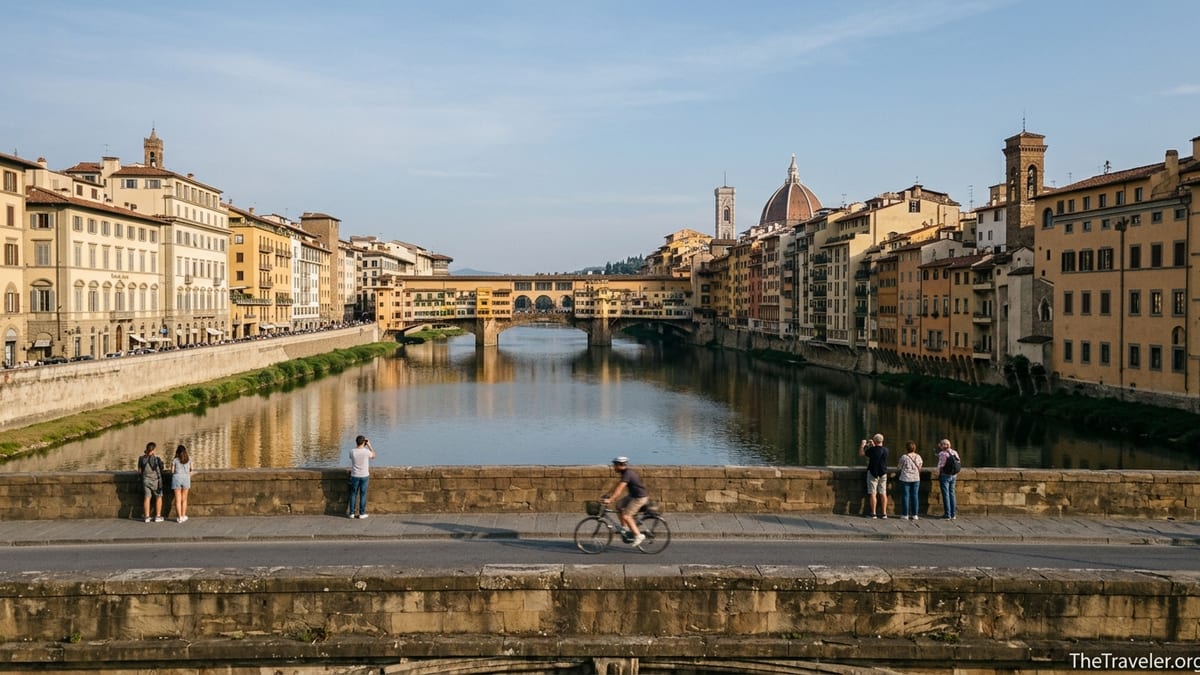
Where Ponte alle Grazie Fits in the Florence Picture
Ponte alle Grazie spans the Arno just upstream from the Ponte Vecchio, connecting the Santa Croce area on the north bank with the San Niccolò and Oltrarno neighborhoods on the south. In practical terms, that means it often becomes the crossing point for anyone walking between the Basilica of Santa Croce and the climb up to Piazzale Michelangelo or the green slopes around San Miniato al Monte. It is also one of the bridges that mark the eastern edge of the dense historic center, which helps if you are trying to get your bearings in a city that can feel like a maze of stone streets.
Historically, this was one of Florence’s oldest river crossings, originally built in the 13th century and once longer and older than the Ponte Vecchio itself. The current structure is a postwar reconstruction with five arches, more understated than its medieval ancestor and without the houses and chapels that once crowded its deck. For today’s traveler, that lack of built-up edges translates into something very practical: wide, open sidewalks and unobstructed views up and down the river.
The area around the bridge is firmly within the UNESCO-listed historic center, so you are never far from major landmarks. From the middle of Ponte alle Grazie you can look west toward the Ponte Vecchio and the dome of Santa Maria del Fiore, then turn east to see the low weir of the Arno and the hills that cradle Florence. If your mental picture of the city comes mainly from famous postcard angles, this different perspective can be surprisingly refreshing.
In terms of atmosphere, Ponte alle Grazie is noticeably quieter than the Ponte Vecchio or the busier Ponte Santa Trinita closer to the shopping streets. You are more likely to share space with local joggers, dog walkers and commuters on bicycles than with large tour groups. That alone can make it feel like a small discovery in a city that receives millions of visitors each year.
Views and Photo Opportunities from the Bridge
The most obvious reason to make time for Ponte alle Grazie is the view. From its center, looking west, you get a clean line of sight to the Ponte Vecchio with its jumble of jewelry shops clinging to the sides, framed by the towers and roofs of the historic center. Early in the morning, when the sun rises behind the hills, the light often falls softly on the façades along the north bank, lending them a pale gold tone that works well for wide-angle shots.
Because Ponte alle Grazie sits slightly higher and closer to the bend of the river than some other crossings, it offers one of the best vantage points for capturing the green slopes above the San Niccolò neighborhood. If you look south, you can often pick out the white façade of San Miniato al Monte on the hill and the terrace of Piazzale Michelangelo just below it. Travelers who have already taken the classic panoramic photo of Florence from that piazza often appreciate being able to flip the perspective and photograph the hills themselves from down on the river.
In practical photography terms, the bridge’s simple design gives you more freedom to work. There are solid stone parapets that you can safely rest a camera or smartphone on, and the sidewalks are broad enough that you can back up a step or two without feeling as though you are blocking traffic. At sunset in spring and autumn, you can capture reflections of the sky on the Arno’s surface, especially if there has been little wind and the water is relatively still that evening.
If you enjoy long exposures, the relative lack of crowds on Ponte alle Grazie compared to the Ponte Vecchio makes it easier to set up a small travel tripod without drawing too much attention. Photographers often appreciate standing near the middle of the span and facing northwest to catch the evening lights coming on along the Lungarno while the last natural light lingers behind the dome and bell towers. Even with a phone, simple night-mode shots can turn out well here because passing headlights and streetlamps create gentle streaks along the quaysides.
Using Ponte alle Grazie as a Smart Route Through the City
From an itinerary-planning standpoint, Ponte alle Grazie is often less about being a stand-alone attraction and more about being a very useful connector. If you have mapped out a morning in Santa Croce and an afternoon climbing to Piazzale Michelangelo or visiting the Bardini Gardens, a straight walk across this bridge is usually the most logical way to string those experiences together. The crossing itself takes only a few minutes, but it allows you to move between major neighborhoods without doubling back toward the more congested Ponte Vecchio corridor.
Many self-guided walking itineraries for Florence’s Oltrarno district effectively position Ponte alle Grazie as a corner or gateway. One common route has you start near the Duomo, wander through Piazza della Signoria and the Uffizi courtyard, then follow the riverside Lungarno east past the National Library until you reach the bridge. Crossing here drops you into the quieter San Niccolò area, from which you can climb via tree-lined streets or stone stairways to Piazzale Michelangelo and further up to San Miniato al Monte. That entire walk, from the Duomo to San Miniato using Ponte alle Grazie, typically takes around 35 to 45 minutes at a moderate pace, not counting stops for coffee or photos.
The bridge also works well as a link in a loop walk if you like to structure your days around circuits rather than out-and-back legs. For example, you might start your morning near Santa Maria Novella station, head toward the river, cross toward Oltrarno via Ponte alla Carraia for a coffee in Santo Spirito, then wander east along the south bank through the artisan streets until you reach the base of Piazzale Michelangelo. After enjoying the panorama, you could descend via the steps into San Niccolò and recross the river on Ponte alle Grazie, finishing your loop near Santa Croce in time for a visit to the basilica or an early dinner.
Runners and walkers who like to log gentle kilometers also make good use of this bridge as one end of a riverside circuit. A common route follows the Arno on one bank from near the Cascine Park or the Ponte alla Vittoria area, loops upstream past the Ponte Vecchio, reaches Ponte alle Grazie, then returns on the opposite bank. The flat terrain and frequent streetlights make it appealing for early morning or early evening outings, giving you a feel for how residents use the river as their daily promenade.
Pros and Cons: Is It Worth Prioritizing?
Whether Ponte alle Grazie justifies a deliberate detour depends heavily on your time in Florence and your travel style. On the plus side, it is free, open at all hours, and rarely crowded to the point of discomfort. The views towards the Ponte Vecchio and the hills, the sense of space and the calmer pace all add up to a pleasant pause between visits to better-known sights. If you appreciate quieter moments and like to discover a city through its everyday vantage points, the bridge can become one of those places you remember long after you have ticked off the major museums.
Another advantage is that Ponte alle Grazie drops you directly into areas that feel more residential and creative than the heavily touristed shopping streets north of the river. Once you step off the south end into Piazza de’ Mozzi, you are only a short walk from the Bardini Gardens, from stretches of the Oltrarno known for artisan workshops, and from streets that locals still use for their daily errands. In that sense, building the bridge into your movements nudges you toward corners of Florence that many first-time visitors overlook.
On the downside, the bridge itself does not have the ornate design or historical atmosphere that some travelers expect from Florence’s landmarks. The medieval chapels and built-in dwellings that once lined its span are long gone, and what stands today is a fairly understated 20th-century structure. If your schedule is extremely tight and you are weighing a dedicated detour to Ponte alle Grazie against, say, an extra half hour in the Uffizi or time inside a church like Santa Croce, most visitors would probably choose the latter.
The balance therefore comes down to whether you see the value in scenic, unscripted stops between headline attractions. If your itinerary is already mapped almost hour by hour, you may find that you cross Ponte alle Grazie organically on the way to something else and that is enough. If, on the other hand, you have an afternoon with flexible time for wandering and photography, marking the bridge on your mental map and aiming to cross it at sunrise, sunset, or after dark can be a modest but satisfying investment.
What You Can Combine Near Ponte alle Grazie
One of the strongest arguments in favor of including Ponte alle Grazie is what lies on either side of it. On the north bank you have the Santa Croce district, with its namesake basilica known for tombs of figures like Michelangelo and Galileo, as well as a warren of side streets lined with small restaurants, wine bars and leather workshops. Within a ten-minute walk of the bridge you can move from a solemn interior filled with Renaissance art to lively squares where locals gather for an evening drink.
Cross to the south and you immediately encounter the edge of the Oltrarno, particularly the San Niccolò area. This pocket of the city feels more village-like, with lower buildings, narrow lanes and a mix of small art galleries, cafes and casual trattorias. From Piazza Poggi, near the base of the hill, winding steps and ramps climb up toward Piazzale Michelangelo. Many visitors choose to do the ascent in the late afternoon so that they arrive at the terrace in time for the sunset over the city and the Arno. Walking back down after dark and recrossing Ponte alle Grazie then gives you the experience of Florence’s riverfront at night, with reflections of streetlamps and occasional live music drifting up from the squares.
If you prefer gardens and quieter corners, the Bardini Gardens sit on the Oltrarno side within easy reach of the bridge. Reached by a short uphill walk from the south end of Ponte alle Grazie, these gardens offer terraced views of the skyline that are often less busy than the famous piazza above. You can spend an hour wandering their paths, then drop back down to the river and stroll across the bridge toward Santa Croce or the historic center.
Food-wise, the areas around both ends of Ponte alle Grazie give you a more local dining feel than the heavily trafficked streets immediately around the Duomo. On the north side you can find small enoteche serving glasses of Tuscan wine with simple crostini or panini priced in line with what locals pay, rather than the premium sometimes charged in the busiest tourist zones. On the south side, heading a few blocks into San Niccolò or up toward the Oltrarno’s deeper streets, you can sit down for a plate of fresh pasta or grilled vegetables in places that cater as much to neighborhood residents as to visitors.
When and How Long to Spend on the Bridge
The nice thing about Ponte alle Grazie is that visiting it does not require a fixed time slot. You can experience its main appeal in as little as ten or fifteen minutes: stroll out to the middle, take in the views upstream and downstream, perhaps photograph the Ponte Vecchio from this angle, and continue on your way. If you are walking between set appointments, such as timed museum entries, the bridge works well as an unscheduled pause that does not threaten to derail your day.
That said, certain times of day give the bridge more character. Early morning is ideal if you enjoy the feeling of having a place almost to yourself. Commuters may be crossing on bikes, but the general tourist flow is still concentrated near hotels and breakfast rooms. The light can be soft and cool, which suits both photos and quiet reflection. Late afternoon into sunset, by contrast, offers warmer colors and a more sociable feel. Couples and small groups tend to linger on the parapets, and the façades of the buildings along the Arno catch the low sun in pleasing tones.
At night, Ponte alle Grazie can be part of a relaxed after-dinner walk. Many visitors staying near the Duomo or in the Santa Croce area find themselves strolling along the Lungarno and crossing one of the central bridges almost without planning it. Choosing Ponte alle Grazie for this purpose gives you a slightly darker, calmer environment than the Ponte Vecchio, which remains lively well after dark. Streetlighting keeps the sidewalks navigable, and the reflections of Santa Croce and the adjacent quaysides in the water can be particularly attractive in the evening.
Seasonally, your experience can vary but the bridge remains accessible year-round. In the peak summer months, crossing at midday can feel hot, as shade is minimal, so it is wiser to schedule your time there in the earlier or later parts of the day. In spring and autumn, when temperatures are milder and skies often clear, Ponte alle Grazie can become one of the most pleasant segments of a half-day walking route, especially if you include garden visits or hill climbs on the Oltrarno side.
The Takeaway
Ponte alle Grazie is not the most famous bridge in Florence, nor the most architecturally striking, but it quietly adds value to many itineraries. Its real strengths are location and atmosphere: it sits at a natural hinge point between the Santa Croce district and the Oltrarno hills, and it offers broad views and calm sidewalks that invite you to slow down for a few moments. If you like to build your travels around small vantage points as much as headline sights, the bridge is very likely worth a planned crossing.
If your time in Florence is limited to a rushed single day, you do not need to carve out a special time slot solely for Ponte alle Grazie. You can simply note its position on the map and choose it as your crossing if your route between two major sights naturally passes nearby. For travelers spending several days in the city, or for repeat visitors who have already seen the main museums, treating the bridge as a deliberate stop at sunrise, sunset, or after dark can give you a different feel for the Arno and the city’s quieter rhythms.
Ultimately, the question is less whether Ponte alle Grazie is an attraction in itself and more whether you value the experiences that come with it: an uncluttered view of the river, a convenient gateway into the artisan streets of the Oltrarno, and a few minutes of perspective between busier stops. Framed that way, adding it to your Florence itinerary is a small adjustment that can pay off in memorable moments at very little cost.
FAQ
Q1. Is Ponte alle Grazie worth visiting on a first trip to Florence?
For a first visit, Ponte alle Grazie is worth including if you enjoy walking and photography. It offers excellent views and a calm crossing, but it should be combined with nearby highlights like Santa Croce or the climb to Piazzale Michelangelo rather than treated as a major attraction on its own.
Q2. How long should I plan to spend on Ponte alle Grazie?
Most visitors spend about 10 to 20 minutes on the bridge, enough time to walk across, pause in the middle for photos of the Ponte Vecchio and the hills, and continue toward their next stop.
Q3. What is the best time of day to see Ponte alle Grazie?
Early morning and late afternoon into sunset are the most rewarding times. Morning offers quieter conditions and soft light, while late afternoon and evening create warm colors and reflections on the Arno that are ideal for photos.
Q4. Is Ponte alle Grazie close to other major attractions?
Yes. On the north side you are within a short walk of the Basilica of Santa Croce and the historic center, while on the south side you are close to the San Niccolò neighborhood, the path up to Piazzale Michelangelo and the Bardini Gardens.
Q5. Is Ponte alle Grazie suitable for families with children?
It is generally suitable for families, as the sidewalks are wide and separated from vehicle lanes by solid parapets. Parents should still keep young children close, but the bridge feels less crowded and hectic than the Ponte Vecchio.
Q6. Can I visit Ponte alle Grazie at night?
Yes, the bridge is open at all hours and is commonly used by pedestrians after dark. Streetlighting makes it reasonably easy to navigate, and many visitors enjoy an evening stroll across it after dinner in the Santa Croce or Oltrarno areas.
Q7. Is Ponte alle Grazie accessible for people with limited mobility?
The bridge deck is level and paved, with no steps, so it is generally accessible for wheelchairs and strollers. Approaches on both sides are standard city sidewalks, though surface smoothness can vary slightly on the older stone sections nearby.
Q8. How does Ponte alle Grazie compare to the Ponte Vecchio?
Ponte alle Grazie is quieter and more functional, without shops or heavy crowds, making it better for open views and relaxed walking. The Ponte Vecchio, by contrast, is more historic and atmospheric but often far more crowded, especially in peak seasons.
Q9. Is there an entry fee to visit Ponte alle Grazie?
No, there is no charge to walk across Ponte alle Grazie. It is a public bridge and can be visited freely at any time of day or night.
Q10. Should I prioritize Ponte alle Grazie if I only have one day in Florence?
If you have just one day, you can treat Ponte alle Grazie as a bonus rather than a priority. If your walking route between key sights naturally brings you near the bridge, it is worth crossing for the views, but core attractions like the Duomo, the Uffizi, the Accademia and the Ponte Vecchio should come first.