


Ask a dozen visitors which Florence bridge offers the best views and most will answer Ponte Vecchio without hesitation. Yet photographers, locals and repeat travelers quietly swear by another crossing just upstream: Ponte alle Grazie. If you have limited time in the city or you are planning that once-in-a-lifetime Arno sunset walk, choosing where to stand can mean the difference between a postcard-perfect panorama and a jostling, overcrowded experience. This guide compares the two bridges in detail so you can decide which one delivers the better views for your style of travel.
Get the latest updates straight to your inbox!
Getting Oriented: Two Bridges, Two Very Different Experiences
Ponte Vecchio is Florence’s medieval showpiece, a stone arch bridge lined with goldsmiths’ shops and watched over by the elevated Vasari Corridor. It stands roughly at the heart of the historic center, connecting the Uffizi side with the Oltrarno quarter and drawing a near-constant stream of tour groups, street performers and shoppers. Walking onto it feels more like entering a narrow market street than stepping onto a bridge, which is a big part of its charm but also shapes what you can actually see from it.
Ponte alle Grazie, a few minutes’ stroll upstream, has a completely different character. Rebuilt in the 1950s after wartime destruction, it is a modern, open-arched bridge with clean lines and wide pavements. Here there are no shops, no buskers and almost no tour groups. Instead, you get space, long sightlines and a calm, residential atmosphere anchored by the nearby Santa Croce district on one side and the quieter Oltrarno embankments on the other.
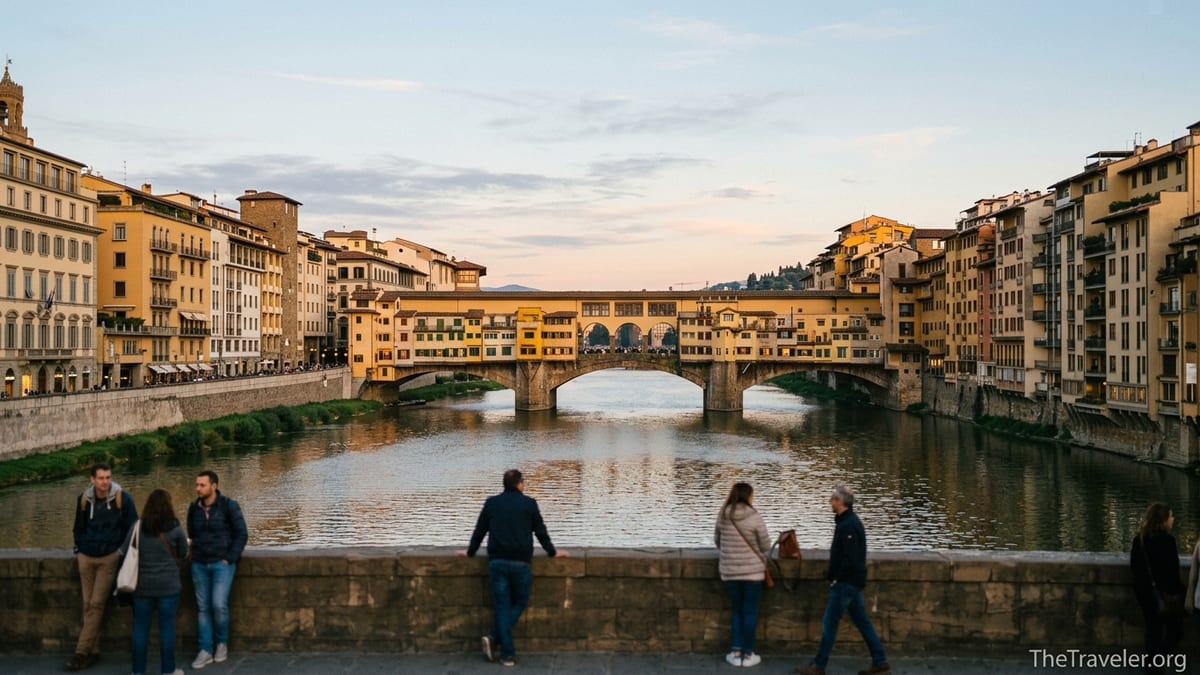
For visitors comparing views, the key distinction is this: Ponte Vecchio is often the view, while Ponte alle Grazie is one of the best places to view it. When you picture Florence in your mind, you are likely seeing the honey-colored boxes of Ponte Vecchio over the Arno at sunset. That image is taken from elsewhere, very often a bridge like Ponte alle Grazie or Ponte Santa Trinita, rather than from the Ponte Vecchio itself.
This does not mean Ponte Vecchio is a disappointment from the inside. Looking out through its central terraces, you get intimate glimpses of river life, with the flat green of the Arno framed by worn stone and shuttered wooden shopfronts. But if your priority is a wide, cinematic sweep of the city, the less glamorous Ponte alle Grazie has the edge.
The Classic Postcard View: Why Photographers Favor Ponte alle Grazie
Stand at the center of Ponte alle Grazie and turn to face west in the late afternoon. In front of you the river narrows into a gentle S-curve, leading your eye straight to the stacked houses of Ponte Vecchio, then onward to the warm stone of the Uffizi, the pale facade of the Vasari Corridor and the distant outline of Palazzo Vecchio’s tower. Travel photographers often highlight this position as one of the best free viewpoints in Florence because it gives a clean, unobstructed composition with minimal clutter from heavy traffic.
In practical terms, this matters more than you might think. If you are carrying a camera with a 35 mm or 50 mm lens, you can frame Ponte Vecchio comfortably in the center of your shot, letting the river and embankments act as natural leading lines. Because Ponte alle Grazie is less crowded, you can take your time, adjust your tripod if you are shooting long exposures around blue hour, or simply lean on the stone balustrade without anyone pushing in front of you at the crucial moment.
This bridge also rewards different times of day. At sunrise, when most of the city is still quiet, the light often falls from behind you, washing the facades of Ponte Vecchio and the north bank in a soft gold that reflects in the water. Around sunset, especially in late spring and early autumn, the sky behind the bridge can color to pink and orange while the river darkens, giving classic mirror-like reflections. Plan to be there about 30 to 40 minutes before official sunset if you want to experiment with multiple angles.
Travelers who have a full day in Florence sometimes pair this spot with other view-heavy stops in the same area, such as the rose garden below Piazzale Michelangelo or the terraces around San Miniato al Monte. Because Ponte alle Grazie sits toward the eastern end of the historic center, it can be a natural part of a riverside walk that starts near the Basilica of Santa Croce, continues across the bridge for views back toward the district, then winds uphill toward the famous panoramic terrace above the city.
Inside the Icon: What You Really See from Ponte Vecchio
From a pure viewing perspective, Ponte Vecchio is less about wide vistas and more about atmosphere and detail. The stone arches and dense line of gold and jewelry shops restrict how far you can see along the river, and crowds often block the railings on both sides. Even so, there are reasons many travelers still consider it an essential vantage point at least once, especially at night.
The bridge includes a few central openings, sometimes referred to as small terraces, where the Vasari Corridor steps out from above the shops and creates viewpoints over both sides of the Arno. From the south-facing opening, you can look toward Ponte Santa Trinita, with its elegant arches and the facades of Lungarno degli Acciaiuoli framing the water. From the north-facing side, you see toward Ponte alle Grazie and the long line of buildings that includes the Uffizi and other palazzi along the north bank. These views are narrower and more vertical than what you get from Ponte alle Grazie, but they offer a sense of depth as the bridges and embankments recede into the distance.
At street level, what many visitors actually remember most is not the river but the sensory overload of the bridge’s interior. Shop windows glow with gold chains and rings in the evening, wooden shutters creak open in the morning as jewelers set out displays, and buskers play violins or guitars while tourists pause beneath the corridor’s arches. If you visit around midday in peak season, the crowd can be shoulder to shoulder, which makes thoughtful photography difficult but can be fascinating for people-watching. Coming back later in the evening, when day-trippers have left and some shopfronts are closed, often gives a calmer atmosphere and easier access to the railings.
For travelers trying to balance time and energy, one strategy is to treat Ponte Vecchio as a cultural and shopping stop rather than the main viewpoint. Walk across slowly, browse the jewelers, peek through the openings on each side, then move to a quieter neighboring bridge for your big-picture photographs. This approach is particularly useful if you are traveling with kids or older relatives who find heavy crowds tiring.
Crowds, Safety and Comfort: When Each Bridge Shines
The question of which bridge offers better views is closely tied to who is standing around you when you are trying to enjoy them. Ponte Vecchio is rarely empty. In high season, queues can even form at the most popular central openings as people wait to take photos of the river without strangers in their frame. Pickpocketing is not rampant but is possible anywhere crowds are dense, so most guidebooks quietly advise keeping bags zipped and phones secure when you stop. For travelers who dislike jostling or who are nervous about theft, this can blunt the pleasure of the view.
Ponte alle Grazie, in contrast, tends to attract a mix of locals walking home, joggers using the pavements for exercise and a smaller number of independent travelers. Because there is more room to spread out and no reason for people to linger in large clusters, you can usually find a peaceful corner even around sunset. Solo travelers often report feeling more relaxed here, able to set a small tripod or rest a camera on the parapet without drawing much attention.
Season and time of day also change the experience. In August afternoons when temperatures can climb well above 30 degrees Celsius, the stone canyon of shops on Ponte Vecchio traps heat, and shade is intermittent. In the cooler shoulder seasons of April, May, September and October, it is more pleasant, and late evenings after 9 p.m. can feel almost romantic as the crowds thin and warm light from the shops reflects on the water. Ponte alle Grazie, being more exposed, can feel windy and chilly in winter, but in spring and early autumn the open sky and long light make it a comfortable place to linger.
For families with strollers or travelers with mobility concerns, both bridges are broadly accessible, but movement across Ponte Vecchio can be slowed significantly by congestion. If you are heading to a timed museum entry, such as the Uffizi or Palazzo Pitti, it is often smarter to cross by Ponte alle Grazie or another nearby bridge and save Ponte Vecchio for a time when you are not on a schedule.
Photographing Florence: How Each Bridge Frames the City
When planning photographs, it helps to think like a local photographer who has to deliver specific shots for a magazine spread or travel brochure. If the assignment is “classic image of Ponte Vecchio over the Arno at sunset,” they will not stand on the bridge itself. Instead, they are likely to work from Ponte alle Grazie, Ponte Santa Trinita or the southern embankment near Lungarno Torrigiani, all of which offer a clear, frontal or three-quarter angle of the bridge and its reflection.
Ponte alle Grazie earns particular praise among photography guides because it combines openness with relative quiet. From the upstream side, you can capture Ponte Vecchio framed between the riverbanks with the skyline layering behind, including the tower of Palazzo Vecchio and, in some conditions, a hint of the Duomo’s dome further back. Switch to the opposite side of the bridge and look east, and you have a different but equally appealing scene: the lower weir of the Arno near San Niccolò, the leafy hill rising toward Piazzale Michelangelo and, in the right light, rowers or paddleboarders cutting across the glinting water.
Ponte Vecchio offers a more constrained but still useful set of angles. Street photographers often use its crowds as a subject, framing musicians or couples leaning over the parapet with soft-focus arches and water behind them. If you have a fast prime lens such as a 50 mm at f/1.8 on a full-frame camera, you can blur the background of the Arno into an impressionistic strip of color while keeping your subject tack sharp. Night shots from the bridge can be evocative, with reflections of street lamps stretching across the river; a compact travel tripod set at chest height lets you shoot at lower ISO without excessive camera shake, provided you pick a quiet corner and stay out of the main flow of pedestrians.
For travelers relying on a smartphone, the reality is simple: you will get more varied and less obstructed cityscapes from Ponte alle Grazie. Wide-angle smartphone lenses can distort edges when you are close to buildings, which is hard to avoid inside Ponte Vecchio’s narrow corridor. On Ponte alle Grazie, you have space to step back, straighten your horizons and capture the full arch of the bridge with minimal distortion. Using your phone’s “night mode” from here around blue hour can produce surprisingly detailed images of the illuminated old town without the blown highlights that often plague shots taken directly under the bright shop lights of Ponte Vecchio.
Itinerary Ideas: Building Your Walk Around the Best Views
Most first-time visitors only cross the Arno a couple of times in a short stay, so structuring those crossings thoughtfully can maximize the views you experience. One popular route starts at the Duomo in late afternoon, winds down via Piazza della Signoria and the Uffizi courtyard, then reaches the river near the loggia that overlooks Ponte Vecchio. From there, instead of walking straight across the famous bridge, you can first stroll upstream along the north bank to Ponte alle Grazie. Spend 20 to 30 minutes taking in the panorama and photographing Ponte Vecchio from a distance, then cross into the Oltrarno and work your way back along the south bank, arriving on Ponte Vecchio as twilight deepens and the shopfronts light up.
Another option is to design an early-morning circuit for photography and a late-evening one for atmosphere. Set an alarm for just before sunrise, walk to Ponte alle Grazie while the city is quiet and capture the first light on the buildings flanking the river. Then, after a coffee near Santa Croce or in the back streets of the Oltrarno, head toward other viewpoints such as Piazzale Michelangelo or the terrace of a public garden for a higher vantage. In the evening, after dinner in Santo Spirito or San Niccolò, cross Ponte Vecchio slowly on your way back toward the central hotels, enjoying street musicians and reflections of the illuminated bridge in the water below.
Travelers with only a single night in Florence can still experience both sides without rushing. For example, if you arrive by train mid-afternoon, drop your bags near Santa Maria Novella, walk down to the river and cross at Ponte Santa Trinita or Ponte alle Grazie first to get that iconic long view. After a gelato along the Lungarno, time a slow crossing of Ponte Vecchio for roughly 30 to 45 minutes after sunset, when the sky is deep blue, the crowds have thinned slightly, and the bridge’s lights feel most magical.
If you are keen on avoiding the busiest hours, try to visit Ponte Vecchio before 9 a.m. or after 9 p.m. in peak summer, and lean on Ponte alle Grazie as your main viewpoint during mid-afternoon and at classic sunset times. This simple adjustment can turn a potentially stressful shuffle across a famous bridge into a sequence of calm, well-timed river moments.
The Takeaway
So which bridge truly offers better views, Ponte alle Grazie or Ponte Vecchio? If you define “better” as broad, cinematic cityscapes and uncluttered angles for photography, Ponte alle Grazie wins. Its open design, quieter atmosphere and direct sightline toward Ponte Vecchio and the historic north bank make it one of Florence’s strongest river viewpoints, especially at sunrise or around sunset when the light softens and reflections sharpen.
Ponte Vecchio, however, delivers something that no other bridge can: immersion inside one of Florence’s most historic and atmospheric spaces. The views from it are more limited, framed by shops and crowds, but the emotional experience of standing where merchants have traded for centuries, under the shadow of the Vasari Corridor, is difficult to replicate elsewhere. Many travelers ultimately choose to savor both perspectives, treating Ponte alle Grazie as their photography base and Ponte Vecchio as their cultural and sensory highlight.
For most visitors, the smart approach is not to choose one bridge over the other but to use each according to its strengths. Start at Ponte alle Grazie when you want to see Florence stretched out along the Arno in all its layered beauty, then cross Ponte Vecchio when you are ready to step into the city’s living history, with jewelry glinting in the windows and music echoing against ancient stone. Used together, the two bridges provide a complete picture of Florence by the river: one looking at the postcard, the other stepping inside it.
FAQ
Q1. Which bridge offers the best overall view of Ponte Vecchio?
Ponte alle Grazie generally offers the best overall view of Ponte Vecchio, with an open, frontal angle that includes the bridge, the river and much of the historic skyline.
Q2. Is Ponte Vecchio worth visiting if I mainly care about views?
Yes, but manage expectations. Ponte Vecchio’s views are narrower and often crowded; its real value is the historic atmosphere, shops and experience of walking through a medieval bridge-street.
Q3. When is the best time of day to visit Ponte alle Grazie for photos?
Early morning and the hour before sunset usually provide the most flattering light, softer colors and fewer crowds, especially in spring and autumn.
Q4. Can I see the Duomo from either Ponte alle Grazie or Ponte Vecchio?
You can often glimpse the Duomo’s dome or the Palazzo Vecchio tower from both bridges, but they appear as part of a distant skyline rather than the main subject of the view.
Q5. Which bridge is better if I want to avoid crowds?
Ponte alle Grazie is usually much quieter, with space to stop and take photos in peace, while Ponte Vecchio can be very crowded from mid-morning into the evening.
Q6. Are there good night views from these bridges?
Yes. At night, both bridges offer reflections of city lights on the Arno, but Ponte alle Grazie gives a broader panorama, while Ponte Vecchio provides more intimate, close-up scenes of lit shopfronts and arches.
Q7. Is it safe to carry a camera or tripod on either bridge?
Both bridges are generally safe, but on Ponte Vecchio you should keep an eye on your gear due to crowds. On Ponte alle Grazie it is easier to set up a small tripod without being jostled.
Q8. How long does it take to walk between Ponte alle Grazie and Ponte Vecchio?
Walking between the two bridges along the river usually takes about 5 to 10 minutes at a relaxed pace, so it is easy to include both in a single stroll.
Q9. Which bridge should I prioritize if I only have one evening in Florence?
If views and photos are the priority, start on Ponte alle Grazie around sunset, then cross Ponte Vecchio later that evening for the atmosphere and historic feel.
Q10. Are there nearby spots that combine with these bridges for even better views?
Yes. Piazzale Michelangelo and the hillside around San Miniato al Monte offer elevated panoramas and pair well with river-level views from Ponte alle Grazie and a walkthrough of Ponte Vecchio.