


Ponte alle Grazie is not as instantly famous as Ponte Vecchio, but anyone who spends time in Florence’s historic center will almost certainly cross or photograph it. The bridge frames one of the city’s best views of the Arno and Ponte Vecchio, and it sits at a crossroads between Santa Croce, the Oltrarno and the riverfront lungarni. Precisely because it feels like an ordinary neighborhood bridge rather than a major landmark, visitors often underestimate it and repeat the same avoidable mistakes. From ZTL camera fines to risky riverbank selfies, here are the pitfalls to watch out for when exploring around Ponte alle Grazie.
Get the latest updates straight to your inbox!
Underestimating the ZTL and Driving Too Close to the Bridge
One of the most expensive mistakes visitors make around Ponte alle Grazie is trying to drive “just a bit closer” to the bridge or their hotel. Florence’s historic center is wrapped in a ZTL, the Zona a Traffico Limitato, controlled by plate-reading cameras. Via de’ Benci, the street that runs directly off the bridge into Santa Croce, has an electronic gate and cameras that many visitors miss while following their GPS. Travelers regularly discover weeks later that every pass under a red ZTL light has generated a separate fine, often in the range that can quickly add hundreds of euros to a trip.
The problem is compounded by navigation apps that do not always show the ZTL accurately. A common scenario: a driver coming from the ring road along Viale della Giovine Italia follows instructions to cross the Arno at Ponte alle Grazie to reach a hotel near Piazza Santa Croce. The app suggests Via de’ Benci; the visitor drives straight ahead, unaware that the camera at the start of the street is active that evening. The hotel might later be able to register the car for one permitted transit, but not for multiple passes or for the wrong entry, leaving the driver with several fines for a single wrong turn.
If you absolutely must approach the area by car, a safer approach is to leave the vehicle in a structured garage or paid lot outside the ZTL, such as those near Piazzale Michelangelo, Porta Romana or the main station area, and then walk or take a taxi the rest of the way. Many garages inside the ZTL can register your plate to the “white list” for a specific entry and exit, but you need to book in advance and follow the exact route they provide. For most visitors, the simplest strategy is to treat everything immediately around Ponte alle Grazie and central Florence as a car-free zone and plan accordingly.
Motorbikes and scooters have slightly more flexibility, but they are not exempt from all restrictions, particularly bus lanes and pedestrian areas. Renting a scooter and casually following locals through every narrow street is a reliable way to receive fines later. Unless you are familiar with Italian traffic signs and Florence’s regulations, it is wiser to park your two wheels before entering the densest part of the centro storico and walk the final stretch to the Arno.
Ignoring the River’s Power and Getting Too Close to the Water
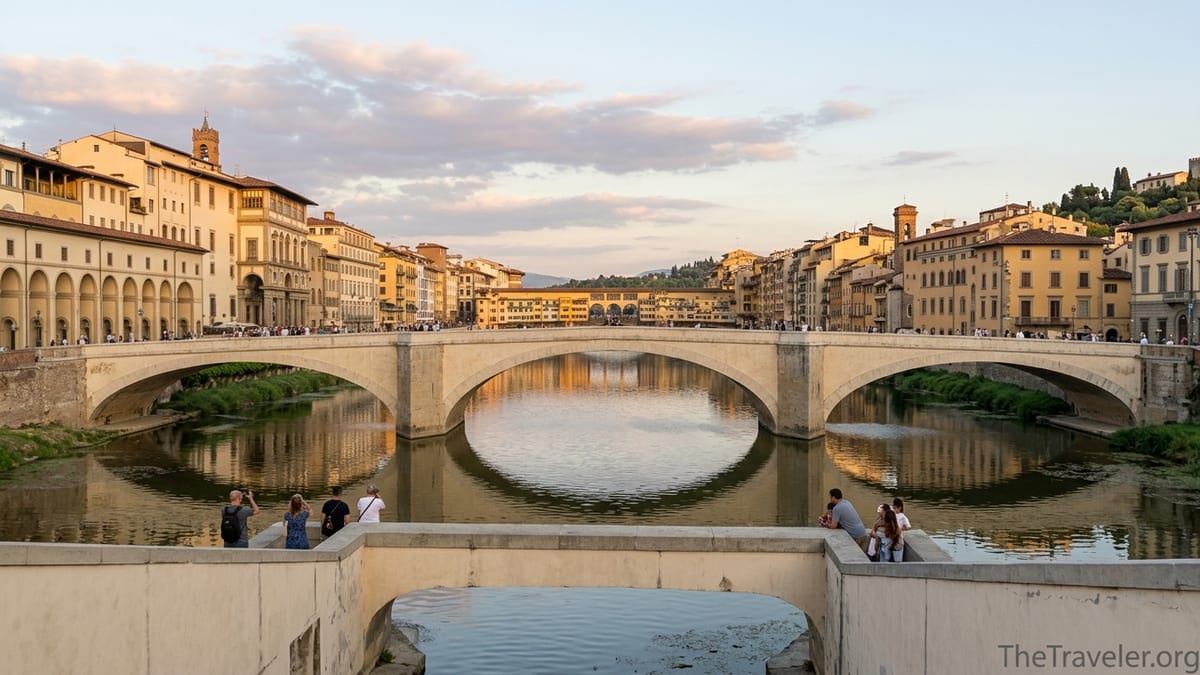
The Arno looks calm from Ponte alle Grazie, especially on warm evenings when the river mirrors the pastel sky and Ponte Vecchio glows in the distance. That tranquility encourages visitors to clamber down informal paths to the water’s edge or climb over low barriers for a better photo. What many do not realize is that the river’s depth and current can change quickly, and submerged debris or slick algae-covered stones can turn a casual step into a dangerous slip. Local kayak guides warn that the stretch near the bridge can drop to around a meter and a half in summer, exposing rocks and metal debris that are invisible from the bank.
In recent years Florence has invested heavily in removable flood barriers and updated protocols along the riverfront, particularly around Lungarno delle Grazie, a reminder that the Arno is not just a picturesque backdrop but a serious flood risk. During heavy rain upstream in the Apennines, water levels can rise rapidly, and the city’s civil protection service occasionally tests temporary barriers along nearby embankments. Visitors who venture beyond marked areas, especially at night or after rain, put themselves in the path of unexpected surges and unstable ground.
Another recurring mistake is attempting “romantic” photos from makeshift river level spots near the weirs, such as the pescaia upstream toward San Niccolò. Social media is full of images of couples sitting on low ledges with their feet almost touching the water. These ledges can be wet and extremely slippery, and a fall into the Arno, even close to shore, is difficult to recover from without help because of the current and the steep stone banks. Local emergency services every year respond to incidents involving people who underestimated the difficulty of climbing back up once they had scrambled down.
The safest way to enjoy the river up close is through organized activities with local clubs, such as guided kayak outings that depart from regulated launch points and provide life jackets and clear safety briefings. Otherwise, enjoy the Arno from above: from the balustrade of Ponte alle Grazie looking toward Ponte Vecchio, from Lungarno Torrigiani on the Oltrarno side, or from the terraces near Piazzale Michelangelo. The view is just as beautiful, and you are not putting yourself or rescuers at risk.
Missing the Best Views by Stopping in the Wrong Spots
Many visitors treat Ponte alle Grazie as nothing more than a shortcut between Santa Croce and the Oltrarno. They cross quickly in the middle of the roadway or stop at the first opening in the balustrade to snap a quick photo before moving on. In doing so, they often miss the angles that make this one of Florence’s most rewarding viewpoints, especially at sunrise and sunset. The classic view is from the upstream side of the bridge, looking west: the Arno narrows and draws the eye straight to Ponte Vecchio, which seems to float along with its golden shops reflected in the water.
The bridge’s design, rebuilt in the 1950s after the wartime destruction of the medieval Rubaconte bridge, leaves several slightly recessed viewing spots along the pedestrian walkways. Rather than stopping where the crowd naturally bunches up at mid-span, it is worth walking all the way toward the Oltrarno side and looking back. From that angle you get a wider slice of sky, more of the Uffizi’s facade and the Vasari Corridor to the right, and, on clear days, a hint of the Tuscan hills beyond. Photographers often set up tripods here for blue-hour cityscapes, leaving plenty of room for others to simply lean on the railing and absorb the scene.
Another overlooked perspective is from Lungarno Torrigiani, the south-bank riverfront that runs from Via de’ Bardi to Ponte alle Grazie. Standing near the corner where the street curves toward the bridge, you can look back at the north bank with the Uffizi, the stone arches of the Corridoio Vasariano and the cream-colored buildings of central Florence stacked above the Arno. Visitors frequently arrive at Ponte Vecchio, find the bridge itself crowded and the views partially blocked by shops, and give up. A five-minute walk east to Ponte alle Grazie rewards them with a far more open panorama and fewer selfie sticks.
Timing also matters. Many visitors arrive mid-afternoon in summer when the light is harsh, the reflections are flat and the river can look muddy. If your schedule allows, return either shortly after dawn, when joggers and locals walking dogs far outnumber tour groups, or about 30 minutes before sunset. On clear evenings, the pastel band of color above the horizon aligns with the Arno and Ponte Vecchio, and lights begin to flicker on along the lungarni. Spending even ten extra minutes to wait for this transition can transform an ordinary snapshot into one of your favorite memories of Florence.
Overlooking the History Hidden in a “Modern” Bridge
Because the current structure dates from the late 1950s, many travelers write off Ponte alle Grazie as a modern concrete crossing and hurry back toward the more obviously historic Ponte Vecchio. What they overlook is that this site has been a crucial crossing point since the thirteenth century and once hosted one of Florence’s most unusual communities. The original Rubaconte bridge, completed in the 1200s, was lined with houses, towers, oratories and even a small convent whose nuns became known as “le Romite del Ponte” because they had literally walled themselves into cells built on the piers above the Arno.
Over time, parts of that medieval bridge were closed in to enlarge nearby piazzas and adapt to changing needs. Eventually the structure was integrated into the growing fabric of the city, with the modest church of Madonna delle Grazie at one end giving the bridge its new name. All of that was swept away in August 1944, when retreating German troops blew up every bridge across the Arno except Ponte Vecchio in an attempt to slow the Allied advance. Ponte alle Grazie collapsed into the river, along with the houses and chapels that had clung to it for centuries.
The bridge you see today reflects the debates that took place in Florence in the 1950s about how to rebuild. Rather than a stark slab of reinforced concrete, architects opted for a stone-faced structure with five arches and relatively low supports, intended to harmonize with the historic setting without imitating the past. Those decisions, at first controversial, now feel almost invisible, which is a sign of how successfully the bridge has blended back into the city. Pausing halfway across and imagining the vanished houses and chapels can bring a depth of appreciation that many visitors miss when they only see Ponte alle Grazie as a photography platform.
On the north side of the bridge, Via de’ Benci leads into streets once dominated by powerful merchant families such as the Alberti and Peruzzi. A short detour to nearby museums and palaces reveals layers of Medieval and Renaissance history that rival anything around the Duomo. Visitors who only follow crowd flows between the cathedral and Ponte Vecchio often overlook this quieter quarter, yet it offers a more balanced picture of Florence as a living city that has been repeatedly reshaped by floods, wars and modern planning decisions.
Rushing Past the Neighborhoods on Either Side
Another common mistake is treating the area around Ponte alle Grazie merely as a corridor between headline sights, especially for those who march from the Uffizi to Piazzale Michelangelo without exploring the streets that fan out from the bridge. On the north bank, a few minutes’ walk inland brings you to Piazza Santa Croce, the basilica that contains tombs or monuments to figures like Michelangelo and Galileo. Yet many visitors only step into the square for a hurried photograph before rejoining their tour group, unaware that the surrounding streets are full of small artisan workshops, libraries and cafes where Florentines actually spend time.
On the Oltrarno side, walking a block back from Lungarno Serristori takes you into a tight weave of residential lanes that feel far removed from the crowds of Piazza della Signoria. Around Piazza dei Mozzi, you will find local bars serving espresso at prices closer to what residents pay, small grocery shops, and the lower reaches of the hillside that leads up to San Niccolò and eventually Piazzale Michelangelo. Travelers who only climb the formal staircase from the west miss the gentler, more atmospheric approach through these neighborhoods, where laundry hangs from balconies and conversations drift out of open windows on summer evenings.
Even simple choices, like where to take a break, can change how you experience the bridge area. Instead of stopping at the first riverfront bar with a rooftop terrace and premium cocktail prices, consider ducking into a side street cafe near Via de’ Benci or Via dei Renai, where a cappuccino at the bar often costs roughly a couple of euros and comes with the chance to watch daily life unfold. Spending an extra half hour this way can ground your memory of Ponte alle Grazie in lived atmosphere rather than only in a staged sunset photo.
Staying present in these neighborhoods also helps with orientation. Many visitors find themselves disoriented when coming down from Piazzale Michelangelo after dark and end up using Ponte Vecchio as their primary reference point, sometimes adding a long detour through crowded streets. Knowing that Ponte alle Grazie sits roughly in line with Santa Croce and the eastern part of the historic center gives you an alternative mental map and often a quieter route home.
Misjudging Safety, Crowds and After-Dark Atmosphere
Compared with the dense throngs on Ponte Vecchio, Ponte alle Grazie can feel almost empty at certain times of day. That relative quiet is one of its charms, but it can also lead visitors to misjudge the atmosphere, either by assuming it is unsafe or, conversely, by ignoring basic street smarts because it “feels local.” In reality, the area around the bridge is a mix of residential buildings, embassies, student housing and tourist flows, and it is generally as safe as the rest of central Florence, provided you take the usual urban precautions.
Petty theft in Florence tends to concentrate where there are crowds and distractions, such as buses, supermarket queues and major squares. Around Ponte alle Grazie, an occasional risk comes when visitors place cameras or bags on the low wall while framing a shot with both hands. A quick grab-and-run from a passing bike or scooter is rare but possible. Keeping bags secured and never leaving valuables unattended on the balustrade or pavement is a simple way to remove opportunity from would-be thieves.
At night, especially in mild weather, the north side of the bridge can be lively thanks to bars and clubs along Via de’ Benci and nearby streets. Noise and groups of young people are more likely issues than serious crime. Some travelers, particularly families with young children, are surprised by how boisterous it can become around midnight and choose to reroute back to their accommodation via quieter streets one or two blocks away. Planning your return route in advance and being aware that the most direct streets might also be the busiest after dark will prevent unpleasant surprises.
Finally, visitors sometimes underestimate how tiring Florence’s days can be, especially in summer when heat on stone pavements reflects upward. Sitting directly on the stone parapets of Ponte alle Grazie for long periods, legs dangling above the river, might look relaxing but can put you in the path of bikes, scooters and occasional service vehicles that share parts of the bridge. Whenever possible, step aside to wider sections of pavement or to benches on the nearby lungarni to rest, rather than creating pinch points on the narrowest sections of the bridge sidewalk.
The Takeaway
Ponte alle Grazie may not appear on every postcard stand, yet it offers some of the most memorable perspectives and authentic experiences in Florence. The key is to approach it with the same respect you would give to more famous sights. Respect the ZTL boundaries and leave the car or scooter outside the historic core. Respect the Arno by keeping a safe distance from the water and staying behind barriers. Respect your own time by pausing for the best viewpoints and lingering in the surrounding neighborhoods rather than rushing through them.
By avoiding the most common mistakes visitors make around Ponte alle Grazie, you not only protect your wallet and safety, you also open space for richer encounters: a quiet early-morning stroll with hardly another person in sight, an evening espresso among locals in the back streets of San Niccolò, or a deep breath on the bridge’s stone balustrade as the lights of Ponte Vecchio shimmer into being downstream. Treated this way, Ponte alle Grazie becomes more than a thoroughfare. It becomes a lens through which to see Florence as both historic and continuously evolving.
FAQ
Q1. Is it safe to walk around Ponte alle Grazie at night?
It is generally as safe as other central areas of Florence, with a mix of residents, students and visitors. Use normal city precautions, stay on lit streets and avoid getting too close to the riverbank after dark.
Q2. Can I drive across Ponte alle Grazie without getting a ZTL fine?
The bridge itself connects to streets inside the ZTL on the north side, monitored by cameras. Unless your hotel or a garage has registered your plate and given you a precise route, it is safer to avoid driving here and park outside the restricted zone.
Q3. Where is the best viewpoint from Ponte alle Grazie?
The upstream (eastern) side of the bridge, looking west toward Ponte Vecchio at sunrise or sunset, offers the most iconic panorama, with the Arno leading your eye toward the historic shops and city skyline.
Q4. Are there good places to eat or drink near the bridge?
Yes. On the north side, small cafes and wine bars line the streets around Via de’ Benci and toward Piazza Santa Croce, while the Oltrarno side around Piazza dei Mozzi and Via dei Renai has more local-feeling bars and trattorias just a short walk from the river.
Q5. Is swimming in the Arno allowed near Ponte alle Grazie?
No. Swimming in the Arno is strongly discouraged for safety reasons. The current, submerged debris, changing water levels and steep stone banks make it hazardous, even if the surface looks calm.
Q6. How does Ponte alle Grazie compare to Ponte Vecchio for photos?
Ponte Vecchio is the subject, while Ponte alle Grazie is often the best vantage point. From here you can capture Ponte Vecchio, the Uffizi and the hills beyond without the crowds and visual clutter of the older bridge.
Q7. Are there public transport options close to Ponte alle Grazie?
Several city bus routes run along the lungarni on both sides of the bridge and connect to Santa Maria Novella station and other districts. Stops are usually within a few minutes’ walk, making it easy to reach the area without a car.
Q8. What is the history of Ponte alle Grazie?
The original bridge, built in the thirteenth century and later known as Ponte alle Grazie, once carried houses, chapels and even a small convent. It was destroyed in 1944 and replaced in the 1950s with the current five-arch structure designed to fit the historic setting.
Q9. Are there any guided tours that include Ponte alle Grazie?
Many walking tours that focus on the Oltrarno, Santa Croce or riverfront include a crossing or viewpoint from Ponte alle Grazie, even if it is not the headline stop. You can also find photography tours that specifically use the bridge as a sunset location.
Q10. What should I wear or bring when visiting the area?
Comfortable walking shoes are essential, as you will likely be moving between riverfront paths and cobbled streets. In summer, carry water, sun protection and a light layer for evening breezes over the river; in cooler months, bring a windproof jacket, since it can feel colder on the open bridge than in sheltered lanes.