


Ponte alle Grazie is one of Florence’s quieter bridges, a few minutes’ walk from the Uffizi yet often overlooked in favor of its famous neighbor, Ponte Vecchio. Precisely because it is less crowded, planning your visit here pays off. With a bit of preparation around timing, access, safety and nearby sights, Ponte alle Grazie can become the place where you catch your breath, frame your best photos of the Arno, and see a more local side of Florence.
Get the latest updates straight to your inbox!
Understanding Ponte alle Grazie and Its Setting
Ponte alle Grazie spans the Arno just upstream from Ponte Vecchio, linking Via de’ Benci on the north bank with Piazza de’ Mozzi and Lungarno Serristori on the south. Historically known as Ponte di Rubaconte, it was once Florence’s longest and oldest bridge, dating to the 13th century, and was rebuilt in a simple five-arch form after World War II. Today it serves both as a practical crossing and as one of the best places to admire Ponte Vecchio from a distance without the crowds that gather directly around the older bridge.
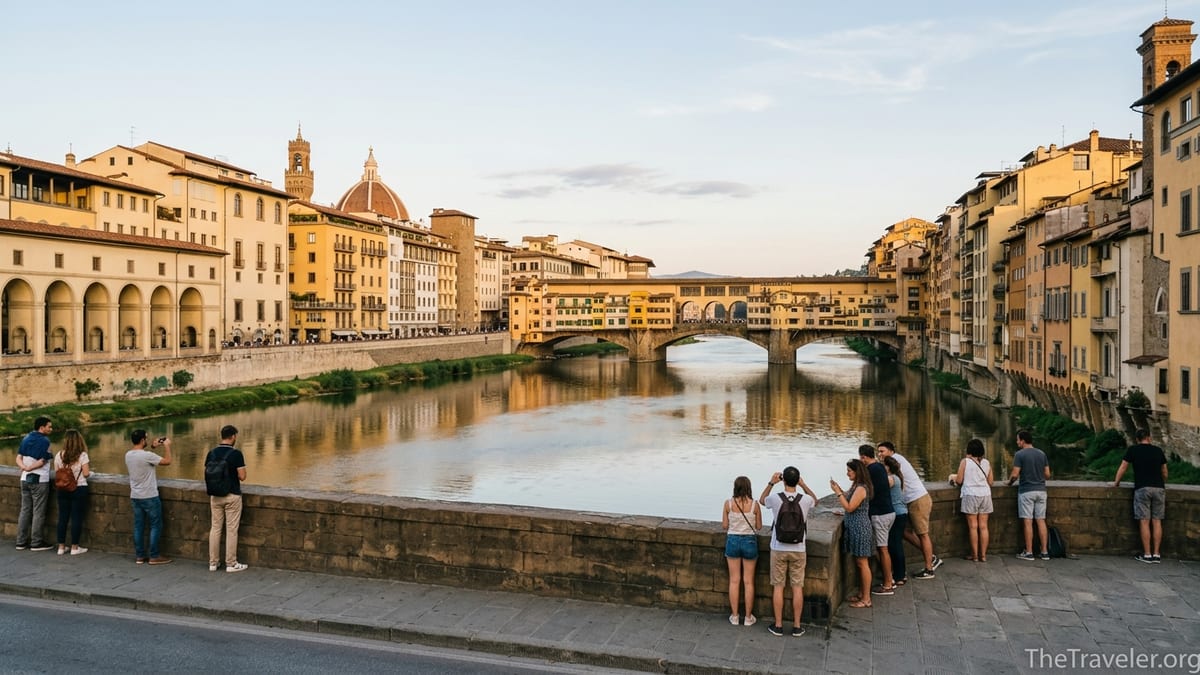
Standing on Ponte alle Grazie you have a classic westward view: Ponte Vecchio framed by the Uffizi, the Vasari Corridor and the line of ochre facades along the river. To the east, you see the weir at San Niccolò and the low curve of the Arno as it leaves the historic center. On the south side of the bridge runs Lungarno Torrigiani, a riverside street with benches and a small green area facing the Evangelical Lutheran church, a neo-Gothic landmark that gives this corner a neighborhood feel rather than a purely touristic one.
The bridge sits at the transition between the densest historic core and the quieter Oltrarno quarter. You can walk here in about 10 minutes from Piazza della Signoria via Via de’ Neri and Corso dei Tintori, or arrive from the Oltrarno side after visiting San Niccolò or climbing to Piazzale Michelangelo. That position makes Ponte alle Grazie an ideal stop in the middle of a day of sightseeing, provided you understand how the surrounding streets, traffic rules and walking routes work.
Choosing the Best Time of Day and Season
Light and crowd levels change the feel of Ponte alle Grazie dramatically, so timing is the first thing to plan. Early morning, roughly between 7:00 and 9:00, is when local runners and commuters use the bridge while most tour groups are still around Santa Maria Novella and the Duomo. In summer, this is the coolest part of the day, and you can often have an entire section of railing to yourself for photos of Ponte Vecchio and the dome catching the first warm light.
By late morning and early afternoon, coach tours and school groups usually fill the historical core, but Ponte alle Grazie still remains less congested than Ponte Vecchio or Ponte Santa Trinita. The trade-off is harsher overhead light, especially in July and August, which flattens photos and raises the temperature on the exposed stone sidewalks. If your schedule allows only midday, plan a short stop on the bridge itself and spend more time under nearby trees on Lungarno Serristori or in the small green area at the corner with Piazza de’ Mozzi where you can sit in the shade and watch the river.
For photographers, late afternoon to sunset is the prime slot. When the sun drops behind the city to the west, the facades along Lungarno degli Archibusieri and the arches of Ponte Vecchio glow in warm tones reflected in the water. From the eastern side of Ponte alle Grazie, you can face west and capture classic postcard images without the dense crush of tripods that forms along other bridges. In winter and early spring, the lower sun angle gives a softer light almost all day, but evenings can be chilly on the exposed span, so pack a scarf or light jacket even when the rest of the day feels mild.
Navigating Florence’s ZTL and Getting to the Bridge
For many visitors, the main logistical challenge is Florence’s ZTL, the Limited Traffic Zone that tightly restricts cars in the historic center. Cameras monitor dozens of entry points, and unauthorized access can trigger fines that often arrive weeks later to rental car addresses. Ponte alle Grazie sits right at the edge of this zone on the north side and just inside the Oltrarno ZTL on parts of the south bank. The simplest strategy is to avoid driving into central Florence at all and instead park at an outlying garage such as Villa Costanza on the A1 motorway or a pay lot near the Firenze Campo di Marte station, then rely on tram, bus, taxi or your own feet to reach the bridge.
If you must arrive by car, speak with your hotel well in advance. Many central hotels can register your number plate for limited access on arrival and departure, but the permission usually covers only specific routes and times. A common approach is to follow hotel instructions precisely, drive in to drop luggage, then move the car to a garage outside the ZTL boundary. From there, you can walk or take a short taxi ride to Ponte alle Grazie. Drivers who try to improvise or follow only navigation apps often find themselves unknowingly crossing ZTL cameras on streets like Corso dei Tintori or Via de’ Benci.
For most travelers staying centrally, walking is the best way to reach Ponte alle Grazie. From the Duomo, a straightforward route runs down Via del Proconsolo to the Bargello, then along Via Ghibellina and Corso dei Tintori to the bridge, taking around 12 to 15 minutes at an easy pace. If you are arriving by train at Santa Maria Novella, you can either walk 20 to 25 minutes through the historic center or take a taxi to the San Niccolò side, asking the driver to drop you near Piazza Giuseppe Poggi or Piazza de’ Mozzi to avoid unnecessary detours into restricted streets.
Planning Your Walks and Viewpoints Around the Arno
One of Ponte alle Grazie’s advantages is that it anchors some of the most pleasant riverside walks in Florence. A popular loop for visitors starts at the Uffizi, crosses Ponte Vecchio, walks east along Lungarno Torrigiani to Ponte alle Grazie, then crosses back to the north bank and returns via Corso dei Tintori. This circuit takes about 30 to 40 minutes without stops and offers alternating views of both famous bridges and the riverside palaces. If you enjoy longer strolls, you can continue east beyond Ponte alle Grazie towards Ponte San Niccolò where the Arno feels less urban and more like a town river with trees and benches.
Runners often use Ponte alle Grazie as a turning point on morning routes along the Arno. A realistic plan if you are staying near Piazza della Signoria is to set out just after sunrise, jog from Ponte Vecchio east to Ponte alle Grazie and then further on to Ponte San Niccolò and back, covering roughly 4 to 5 kilometers. The sidewalks are mostly wide along the lungarni, but you still need to watch out for uneven paving and occasional delivery vans before 9:00. Good running shoes and a reflective band for misty autumn mornings make these outings safer and more enjoyable.
For panoramic city views, many visitors pair Ponte alle Grazie with a climb to Piazzale Michelangelo or the church of San Miniato al Monte. A common itinerary is to cross the bridge to the south bank, walk a few minutes east to the stone ramps and stairs near Piazza Giuseppe Poggi, and then follow the signed path uphill for 15 to 20 minutes. From the terrace of Piazzale Michelangelo, you can look back and easily spot Ponte alle Grazie as the first large bridge upstream from Ponte Vecchio. Planning the climb late in the afternoon and returning via the bridge after dark gives you both a hilltop sunset and the sight of Florence’s riverside lights reflected in the Arno.
Safety, Comfort and River Conditions
Ponte alle Grazie itself is generally safe at all normal sightseeing hours, and you will rarely find it empty during daylight. Standard city awareness is enough: keep your bag zip closed, avoid leaving phones or cameras unattended on the parapet while you adjust settings, and be cautious if backing up for photos near the curb, as local buses and taxis use the bridge. In summer, strong sunshine reflecting off the water can be unexpectedly intense, so lightweight clothing, sunglasses and a refillable water bottle are not just nice-to-have but practical essentials.
The Arno can look deceptively calm from the bridge. Organized kayaking and river cruises occasionally pass under the central spans, but the current and depth change significantly with rainfall and upstream dam releases. In dry late summer, parts of the riverbed near the weir east of the bridge can become visible, while in heavy autumn rains the water rises quickly and speeds up. Do not attempt to climb down informal paths or walls from either end of Ponte alle Grazie to access the water’s edge. Instead, if you want a closer look at river life, use established paths in areas like the grassy banks near Parco dell’Anconella further east or join a guided activity operated by licensed local outfitters who monitor water safety notices.
Weather planning matters more than many first-time visitors assume. In July and August, midday pavement temperatures can make the walk to the bridge feel much longer. If you are visiting during this peak heat period, try to schedule riverside walks either before 10:30 in the morning or after 18:00, and factor in a stop at a café on either side of the bridge for water or a cold espresso. In late autumn and winter, the wind funneled along the Arno can be sharp even when the wider city feels mild, so gloves or a hat can make the difference between a quick rushed crossing and a leisurely twenty minutes enjoying the views.
Linking Ponte alle Grazie With Nearby Sights and Cafés
Ponte alle Grazie is rarely the only goal of a day out in Florence, so it helps to think of it as a hinge between several clusters of attractions. On the north side, within a five to ten minute walk, are the Basilica of Santa Croce with its frescoes and tombs, the Bargello Museum, and the lively stretch of Via de’ Neri with its mix of bakeries, sandwich shops and gelaterie. A realistic plan is to visit Santa Croce in the late morning, have a simple lunch such as a schiacciata sandwich or a plate of ribollita nearby, then walk down to the river and use Ponte alle Grazie as your crossing point into the Oltrarno for the afternoon.
On the south side, just across the bridge, you are at the gateway to the San Niccolò quarter. Small contemporary galleries, artisan workshops and casual wine bars line streets such as Via di San Niccolò and Via dei Renai. From here, you can either wander through back streets towards Porta San Miniato or follow Lungarno Serristori west to eventually reconnect with Ponte Vecchio. Coffee bars and small trattorie in this area often feel more local than those immediately surrounding the Duomo, and prices for a cappuccino at the counter or a glass of house wine by late afternoon are usually a little lower.
If your time in Florence is short, a useful half-day structure is to start at the Uffizi or Palazzo Vecchio in the morning, reach Ponte alle Grazie around midday for a pause and photos, cross into San Niccolò for lunch and a short wander, then climb to Piazzale Michelangelo for the late afternoon and descend via the same bridge after sunset. This approach lets you experience both banks of the river and one of the city’s classic viewpoints without doubling back too often or spending too long on any single stretch.
The Takeaway
A visit to Ponte alle Grazie rarely appears as a headline attraction in guidebooks, yet it encapsulates much of what makes Florence satisfying at street level: manageable crowds, layered history and a constant interplay between city and river. By planning your timing around light and heat, understanding Florence’s traffic restrictions so you are not worrying about fines, and linking the bridge with coherent walking routes and nearby neighborhoods, you turn a simple crossing into a memorable part of your day.
Think of Ponte alle Grazie less as a single point on your map and more as a quiet stage on which the rest of Florence passes. Commuters on bicycles, kayaks gliding below, students crossing to classes and evening strollers all share this span. With modest preparation and realistic expectations about weather, distances and river conditions, you can step onto the bridge already relaxed, ready to slow down and watch the city move around you.
FAQ
Q1. Is Ponte alle Grazie worth visiting if I already plan to see Ponte Vecchio?
Ponte alle Grazie offers a very different experience from Ponte Vecchio. It provides one of the best unobstructed views of Ponte Vecchio itself and is typically far less crowded, so even a 15-minute detour gives you quieter photo opportunities and a sense of the Arno without the crush of souvenir stalls.
Q2. How long should I plan to spend at Ponte alle Grazie?
If you are on a tight schedule, 15 to 20 minutes is enough for photos and a brief pause. If you include a short riverside walk on either side and perhaps a coffee in nearby San Niccolò or near Santa Croce, it is easy and pleasant to spend an hour in the immediate area.
Q3. What is the best time of day to photograph the view from the bridge?
Early morning and late afternoon are generally best. In the morning you avoid the heat and capture softer light on the dome and Ponte Vecchio, while late afternoon and sunset bring warm tones and reflections on the water looking west from the eastern side of the bridge.
Q4. Can I reach Ponte alle Grazie easily from the main train station?
Yes. From Santa Maria Novella station you can walk through the historic center in about 20 to 25 minutes, passing the Duomo and Piazza della Signoria, or take a short taxi ride and ask to be dropped near Piazza de’ Mozzi or Lungarno Serristori to arrive on the south side of the bridge.
Q5. Is the area around Ponte alle Grazie safe in the evening?
The bridge and surrounding streets are generally busy with locals and visitors until late evening, especially in warmer months. Standard city awareness is sensible, but most travelers feel comfortable crossing after dinner or returning from Piazzale Michelangelo via the bridge.
Q6. Are there any restaurants or cafés with a good view near the bridge?
Directly on the bridge there are no cafés, but within a few minutes’ walk you will find riverside bars and restaurants on Lungarno Serristori and casual eateries in the San Niccolò quarter and around Santa Croce. Many have partial river views or pleasant outdoor seating, especially in spring and early autumn.
Q7. Can I combine a visit to Ponte alle Grazie with a climb to Piazzale Michelangelo?
Yes, very easily. From the south end of the bridge you can walk a few minutes to the ramps and stairs that lead up to Piazzale Michelangelo, taking about 15 to 20 minutes to reach the terrace. Many visitors cross Ponte alle Grazie in the afternoon, climb for sunset, then return by the same route in the evening.
Q8. Is Ponte alle Grazie accessible for travelers with limited mobility?
The bridge itself is level with paved sidewalks and curb ramps at both ends, so crossing is straightforward for wheelchairs and strollers. Some surrounding streets, particularly in the older parts of San Niccolò, have uneven cobblestones, so planning gentler routes along the lungarni and main streets helps if you need smoother surfaces.
Q9. Can I take part in boat or kayak tours that pass under Ponte alle Grazie?
Several local operators offer seasonal river activities on the Arno, and some routes include sections near or under Ponte alle Grazie. Availability depends on water conditions and daylight hours, so it is best to check dates, times and safety requirements directly with providers once you are in Florence.
Q10. Do I need to worry about Florence’s ZTL when visiting the bridge?
If you arrive on foot, by taxi or public transport, you do not need to think about the ZTL at all. Problems arise mainly for visitors who drive rental cars into the historic center without understanding the restrictions. The simplest approach is to park outside the central zone or rely on your accommodation to arrange any necessary permissions and directions before you attempt to drive near the river.